
Professor Aimy Bazylak (MIE) has been elected to the 2020 cohort of the Royal Society of Canada’s College of New Scholars, Artists and Scientists. Established in 2014, the College is the country’s first national system of multidisciplinary recognition for the emerging generation of Canadian intellectual leadership.
As the Canada Research Chair (Tier II) in Thermofluidics for Clean Energy, Bazylak is working to advance fuel cells, electrolyzers and batteries for the production of clean power and energy storage without greenhouse gas emissions. Her research is focused on the use of modelling and real-time imaging to design new materials for high efficiency and performance.
Bazylak is an international leader in understanding the multiphase and microscale transport processes involved with polymer electrolyte membrane fuel cells and electrolyzers. Her research group is the first in North America to visualize operating polymer electrolyte membrane fuel cells using synchrotron X-ray radiography; this work has accelerated the advancement of water and carbon dioxide electrolysis at a pace that would not otherwise have been possible.
Based on the insights gained through her fundamental research, Bazylak has partnered with automotive and energy companies such as Nissan, Volkswagon and Hydrogenics Corp. to develop next-generation fuel cells and electrolyzers for higher efficiency, zero-greenhouse gas emission power and energy storage.
Bazylak served as the Director of the U of T Institute for Sustainable Energy from 2015 to 2018. She is Associate Chair, Research and Energy Systems Option Chair for the Division of Engineering Science and has served on the President’s Committee on the Environment, Climate Change, and Sustainability since 2017. She is a fellow of CSME and the American Society of Mechanical Engineers.
Bazylak’s contributions have earned her several prestigious awards, including the Canadian Society for Mechanical Engineering (CSME) I.W. Smith Award, the Alexander von Humboldt Fellowship, and the Helmholtz International Fellow Award. Most recently, she received U of T‘s McLean Award, which recognizes early-career researchers and supports outstanding research.
“Professor Bazylak has made incredibly innovative contributions to the field of sustainable energy, both in terms of fundamental knowledge and practical impact,” says Chris Yip, Dean of U of T Engineering. “Warmest congratulations to her on being recognized as one of the next generation of world-leading Canadian scholars and for being such an inspiration to our students.”
Yellow hard hats and purple paint — two colourful symbols that signal the longstanding traditions of U of T Engineering F!rosh Week. Although the class of 2T4 won’t be together in-person this fall, the organizing team is on a mission to make sure first years won’t miss a beat.
“It’s been incredibly tough, but easily the most rewarding thing I’ve done,” says Gabe Sher (Year 4 ElecE), Orientation Chair. “It’s an opportunity for us to really focus in on the core of F!rosh Week: helping students make friends and get excited for their undergrad journey. Moving to virtual forced us to rethink F!rosh Week at the micro and macro levels and build it back up from scratch with those goals in mind.”
Happening September 7 to 13, the Orientation team plans to welcome more than 800 incoming U of T Engineering students, logging into all-virtual events.
“A big challenge throughout the summer has been making sure that everyone can access F!rosh Week, regardless of where they are in the world,” says Sher. “Having accessibility be a central tenet of our planning has been a good way to centre ourselves in making this all happen.”
“Our team completely rebuilt the Orientation Week website with a robust infrastructure that can handle redirecting Zoom calls, video hosting, everything that’s happening, our site will be the hub for that week,” says Dana Kokoska (Year 4 ElecE), Orientation Vice Chair, Marketing.
Sher adds that a benefit of hosting F!rosh Week virtually this year is that students can participate at their own pace. “You’re in the comfort of your own home or residence, and you can engage exactly as much as you want to,” he says. “Of course, we want that to be more than less, but if you need a break, it’s easy to just close your webcam and go grab a snack.”
Events include virtual drop-in hours to meet student Leedurs [sic] and new classmates; matriculation and tours of the campus; a space-themed design challenge, an online scavenger hunt; and even the instantly recognizable purple paint.
Purple face paint, along with a yellow Skule™ hard hat, t-shirt, backpack, stickers and other F!rosh Kit items were mailed to students across the globe, from Vancouver, B.C. , to Yangon, Myanmar, to Lagos, Nigeria.

The team have blocked a time — dubbed the Dye Station — for students to all get together on Zoom and paint their faces with natural dye included in the Orientation kits. “It’ll be different than previous years, but it’ll still be fun. It’s amazing we found a solution to keep this tradition going,” adds Kokoska.
For students like Caitlin Chee-Kirkpatrick (Year 1 EngSci) who live in the Toronto and GTA, some kits were personally delivered by team members wearing masks and practicing physical distancing.
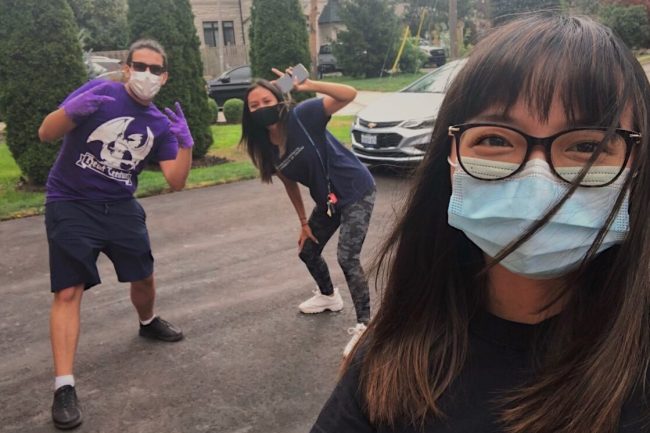
“My Leedurs [sic] were so kind, and chatted with me about academics and social life at U of T. I really appreciated the warm welcome extended to me,” says Chee-Kirkpatrick. “Even though this is a highly unusual year, everyone at U of T Engineering has really gone out of their way to welcome us to the engineering community — receiving this package in person is like the icing on the cake.”
With F!rosh Week just days away, Sher and the team are putting the finishing touches on their site and event plans. His advice to students participating: “Everyone else is feeling the same excitement and nervousness for school as you are, so take time to see what you’ve got in common with the people you meet in F!rosh Week. You’ll be surprised just how many great people you meet.”
A U of T Engineering team is developing a new way to coat minute particles of copper onto the inside of fabrics, such as those used in face masks. The technology could provide an additional layer of safety to help slow the spread of COVID-19.
The goal is to deposit very fine copper particles onto both woven and non-woven fabrics using twin-wire arc (TWA) spray technology. This fabric will then be used in one of the layers of a reusable fabric face mask. It’s anticipated this copper-embedded fabric will not affect filter or flow rate parameters and will be able to irreversibly kill most viral and other pathogens within a few minutes.
By embedding the copper into the fabric, the masks will provide a continuous and proactive fight against the transmission of current and evolving harmful pathogens without altering the physical barrier properties of the masks.
The anti-microbial properties of copper have been observed since ancient times — Egyptian and Babylonian soldiers would place bronze shavings in their wounds to reduce infection and speed up healing. Today, Professor Javad Mostaghimi (MIE) and his team — including co-investigators Professor Mohini Sain (MIE), Dr. Larry Pershin (MIE), Professor James A. Scott (Public Health) and Professor Maurice Ringuette (Cell & Systems Biology) — are exploiting these same anti-microbial properties to develop coatings that safeguard everything from office furniture to personal protective equipment, such as masks.
“If we can harness the anti-microbial properties of copper to improve the effectiveness of reusable face masks we can significantly reduce the spread of COVID-19 and do a better job at protecting both our frontline workers and our community at large,” says Mostaghimi.
Mostaghimi directs the Centre for Advanced Coating Technologies (CACT), and has studied the impact of copper coatings on healthcare-associated infections for years. He has seen first-hand how copper coatings can be used on high-touch surfaces to help kill bacteria.
In one study, a copper coating was applied to the handles of half the chairs in a Toronto General Hospital waiting room. Over the course of five months they saw that the chairs with copper coatings had a 68 percent reduction of viable bacteria cells per centimetre square.
Current research from other groups shows COVID-19 surviving two to three days on stainless steel and even longer on other surfaces, however it has been demonstrated that the coronavirus particles were inactivated within four hours when exposed to a copper-coated surface at room temperature.
“Traditionally, implementing copper coatings would be very expensive,” Mostaghimi explains. “But our research has developed a method that makes applying copper coatings more economically viable.”
The CACT method is known as twin-wire arc spray. The “wire” part refers to the fact that the raw copper is supplied in the form of copper wire, which is more affordable than copper powders. The spray rates allow for large surfaces to be coated efficiently.
Another advantage is that the TWA method allows for the spray parameters to be controlled so that even heat-sensitive surfaces — such as wood, fabrics and even cardboard — can be coated.
Mostaghimi and his team were awarded an Alliance Grant from the Natural Sciences and Engineering Research Council (NSERC) to explore the possibility applying the TWA method to create copper-embedded fabrics for manufacturing reusable face masks.
For their project titled Copper Embedded Fabrics and Face masks for Rapid, Irreversible Destruction of COVID-19, Mostaghimi and his team are collaborating with Green Nano Technologies Inc. who will produce a pilot set of the copper embedded face masks.
“Using our TWA spray technology, we will be able to produce copper embedded masks at a marginally more expensive cost than N95 surgical face masks,” says Pershin, the Centre Manager at the CACT.
“Additionally, as copper degrades both DNA and RNA genetic material, the masks will have the added benefit of irreversibly inactivating all microbial pathogens, regardless of their mutation rates even after masks were disposed.”
Various copper concentrations will be tested on the fabrics to help determine the optimal parameters for destroying the virus. The copper-embedded fabrics will be tested by Professor Maurice Ringuette of U of T’s Department of Cell & Systems Biology. Ringuette and his team will use the fluid released from virus-infected bacteria when ruptured, called bacteriophage lysates, to simulate the COVID virus on the masks.
The research has potential health and safety benefits that could extend beyond the end of the current pandemic. To have affordable, reusable anti-viral PPE available for healthcare workers could mean a decrease in disease transmission in healthcare facilities and a reduction in healthcare-associated infections.
Professor Michael Guerzhoy recently joined U of T’s Division of Engineering Science (EngSci) and the Department of Mechanical & Industrial Engineering (MIE).
Guerzhoy is an expert in machine learning and statistics whose research focuses on applications in healthcare, computer vision, and data science. He has taught computer science, data science, and machine learning in U of T’s Departments of Computer Science and Statistical Sciences. Most recently, he was an instructor at Princeton University’s Center for Statistics and Machine Learning.
Guerzhoy is an Affiliate Scientist at the Li Ka Shing Knowledge Institute at St. Michael’s Hospital in Toronto. He previously worked on computer vision and machine learning at Epson Canada and the French National Institute for Research in Digital Science and Technology (Inria) in Grenoble, France.
Writer Christina Heidorn sat down with Professor Guerzhoy to learn more about his research, goals, and why he’s excited about teaching undergraduate students.
Why did you choose to come to U of T Engineering to teach in the EngSci program?
Simply put, a classroom full of EngSci students is my favourite place to be. Nowhere else have I seen so much enthusiasm for learning, so much willingness to work hard, but also such a strong sense of community and, yes, a sense of fun.
What do you see as key ingredients for effective engineering education?
When I’m thinking about teaching a course — a new one or an old favourite — I first of all consider the kinds of things that students will learn to do in the course. I design my lectures around the course assignments; I strongly believe that most learning happens when students are actually doing something rather than just listening to a lecture.
One of my favourite things about teaching is designing assignments and sharing them with others — assignments I designed for EngSci classes are used in universities around the world. I also try hard to use lectures to give students a sense of what’s important in the discipline I’m teaching intellectually. Students in the first-year programming course will hear about how people like Ada Lovelace, Charles Babbage, Alan Turing, Kurt Goedel, and John von Neumann invented modern computing, and see how new ideas create new technology.
An engineer is not simply someone who can hack together a solution to a problem, though that’s definitely part of being an engineer! An engineer thinks about design systematically and thinks about how the technology they create will be used. I try to model those processes in my teaching.
What are your goals in the next few years?
I have one modest goal: make ESC180 and ESC190 (EngSci’s Year 1 programming courses) the best introductory programming sequence in the world. I think I have the right audience for that. I also hope to incorporate more data science and data analysis into the first and second year of the EngSci curriculum, and to develop an advanced data science elective.
In terms of research, I have a couple of projects I’m particularly excited about and am working on with some of my students. One is using Generative Adversarial Networks to check the quality of statistical models. Another is better understanding Double Descent, an exciting and somewhat mysterious empirical observation about how models such as neural networks are trained. I’m also exploring ways to run “virtual” clinical trials using Recurrent Neural Networks, and am working on using analysis of large bodies of text to better understand how mental illnesses influence writing style.
Any advice you’d like to share with the incoming class of 2T4?
Think big and stay curious. Figure out what you want to do and learn and go for it. It’s easy to get bogged down in problem sets and midterms and lose sight of the big picture — you are here to learn, to harness the mysteries of the universe in order to make people’s lives better, and to expand your mind.
At the same time, any skill only comes with practice. This is especially important in courses like computer programming. Learning to program is like learning an instrument or learning to ride a bike —you can’t do it without practice.
What is one “fun fact” about you?
I like making music. Sometimes I sing about grading . Catch me at the next EngSci Nocture talent show!
During a typical academic year, Professor Chirag Variawa’s (ISTEP) pre-lecture ritual involved taking a walk and listening to music before making his way into the Lee & Margaret Lau Auditorium, a large collaborative space in the Myhal Centre that seats nearly 500 people. Inside, the room would be filled to near-capacity with first-year engineering students.
“I’d fire up the laptop, the screen turns on, and the room goes quiet,” says Variawa. “Students are looking ahead at me, at the screen, and it’s time to teach.”

This fall, as the U of T Engineering community gets set to begin classes remotely, Variawa’s prep — and his peers’ — is looking much different. Professors have used the summer to reimagine their course delivery and reassess their teaching approaches.
Variawa is teaching APS 100: Orientation to Engineering this fall, a course taken by more than 1,000 first-year engineering students in a variety of different disciplines.
“It’s difficult to lecture off into the ether to 1,000 students,” says Variawa. “We’re so used to looking around the classroom to gauge their interest in these concepts.”
To keep students immersed in topics such as engineering ethics, academic integrity, as well as equity, diversity and inclusion, he’s taking advantage of some high-tech equipment to give his lectures some polish and reflect his creativity.
At home, Variawa has set up a green-screen background, a professional microphone and camera, as well as three monitors. The background allows for him to appear alongside his slides as he lectures, and even to make cameos in videos he’ll be showing the class.

The course’s Teaching Assistants (TA) will also facilitate virtual breakout sessions, an opportunity for active learning, discussions, “and to build rapport, a sense of community, between students and their instructors,” says Variawa.
While Variawa has found digital solutions to present his lectures, Professor Marianne Touchie (CivMin) is redefining what it means to “chalk and talk” for her course, CIV 375/575: Building Science.
Touchie’s classes will be delivered using light boards in place of chalk boards, as well as a mix of tablet screen capture, green-screen lectures, motion graphics and interactive activities. She is also hoping to create a virtual three-dimensional house for students to explore as part of their labs.
“It would be so neat to teach students how components of a building fit together by enabling them to see into the walls to closely study the materials,” she explains.
Touchie acknowledges she’s had a head start: she and Professor Kim Pressnail (CivMin) began creating filmed lectures in 2018 to eventually support a flipped-classroom experience. As a result, Building Science already has more than 100 lecture videos ready to go.
“Our current situation gives us a chance to iterate how we’re using with these video resources,” says Touchie. Over the summer, she and Pressnail have redesigned the course framework with new modes of engagement and assessment. Touchie says the emphasis will be on fostering discussions and collaborative group projects, allowing students to build relationships with their peers.
Undergraduate and graduate students are usually huddled together in groups or sitting face-to-face in APS 500: Negotiation in an Engineering Context, taught by Professor Elham Marzi (ISTEP). The course explores small and big negotiation scenarios in industry. The grand finale is a United Nations-style, multi-party, multi-stakeholder roundtable negotiation meeting.

“Students get really into it — they debate each other, caucus in the hallway, build coalitions, and they pound their fists on the table,” says Marzi. “For this term, I had to think, how do we get students to be as engaged and be able to express themselves in the same way?”
Marzi says she isn’t necessarily rewriting the script this fall term — negotiations lectures will be done using the software package BB Collaborate instead of in-person — however her classes will still have many opportunities for students to practice their newly honed negotiation skills.
When students are given role-playing scenarios to practice, they will be paired and grouped differently each time. The virtual spaces will also allow students to record their negotiations to better assess themselves and give feedback to partners.

“That feedback is going to be immensely valuable and unique,” adds Marzi. “Up until now, we’d rarely been able capture a play-by-play of a negotiation.”
For Professor Natalie Enright Jerger (ECE), the focus this summer wasn’t on how she’d adapt her course online — she’ll use a combination of pre-recorded lectures and live demonstrations — but rather a reassessment of her teaching philosophy.
“The adjustment to working and learning from home was tough for everybody. I felt a lot of anxiety about how to balance work and taking care of my daughter,” says Enright Jerger. “I’m looking at this course through the lens of compassion and empathy — I’m trying to put myself in my students’ shoes. If I’m feeling this unsure, what must they be feeling? How can I be there to support them?”

Enright Jerger has filmed a welcome video for ECE 253: Digital and Computer Systems, where she not only introduces the course, but shares details about herself and the challenges she has faced since the COVID-19 pandemic.
“I also address what I perceive as challenges my students could be facing, whether they’re feeling isolated, or are struggling with sharing their space, or are providing care for loved ones,” says Enright Jerger, whose TAs will also be making similar videos. “Getting to know each other is going to be such a challenge this term. I want them to know I’m open to hearing about their challenges.”
In MIE 303/311: Mechanical and Thermal Energy Conversion, a major component in students’ learning experience is getting to observe the internationally unique, real-life heat engines in the Energy Lab, located in the Mechanical Engineering Building.
“The switch to remote delivery gives us an opportunity to improve access for all students.” — Professor Aimy Bazylak
To replicate this online, Professor Aimy Bazylak (MIE) worked with Tomas Bernreiter, laboratory engineer and manager, and TA Raymond Guan (MIE MASc candidate) to film high-resolution videos to showcase up-close details of the Energy Lab’s engines and turbines. The videos feature Jason Chan (MIE MASc candidate) and other TAs leading students through experiments and a detailed look of the various working pieces of the engines.
“The switch to remote delivery gives us an opportunity to improve access for all students. In a normal setting, we have groups of five to 15 with each engine, and there will inevitably be some who get a better view and enhanced engagement with the lab,” explains Bazylak. “These videos will help facilitate smaller-group interactions between students and TAs and improve access for all students, as we strive to deliver the best possible lab experience.”

Bazylak says that pivot from an in-person experience to an online experience has allowed her to reflect on her role as an educator, as well as the tools and approach she’ll use to effectively teach, even after the pandemic is over.
“This pandemic has forced me to re-examine how I can best add value to the learning experience — it’s not just about delivering the information and giving students the opportunity to learn,” says Bazylak.
“Key measures of success for me will be the engagement I can achieve with my students and how much they value their time in my lectures, tutorials and labs. By teaching remotely, I can engage with students in new ways that will bring value to my virtual class now, and my literal classroom down the line.”
The upcoming fall semester will be unlike any other in the University of Toronto’s history due to the shift to virtual learning necessitated by the COVID-19 pandemic. But for incoming student Michael Acquaviva (Year 1 EngSci), the unusual start to his post-secondary journey represents more of an opportunity than a hinderance.
“My generation will be viewed as the one that lived through a pandemic and that had to adapt to certain changes in the world,” says Acquaviva, who graduated from William Lyon Mackenzie Collegiate Institute and will pursue a degree in engineering science at U of T Engineering.
“I think that ultimately is a strength when it comes to adaptability. It builds resilience.”
Acquaviva is one of six students named top scholars this year by the Toronto District School Board (TDSB) – students who achieved an average of 99 per cent or higher in Grade 12 – and one of three who will be attending U of T this fall.
Not surprisingly, Acquaviva had his pick of universities. But he says there was only ever one choice for him.
“U of T has always felt like the right place for me,” he says. “When I went for a campus tour, it just felt like I belong there.”
His peers in the engineering science program will include fellow TDSB top scholar Qingyuan Wu (Year 1 EngSci), who graduated from Forest Hill Collegiate Institute.
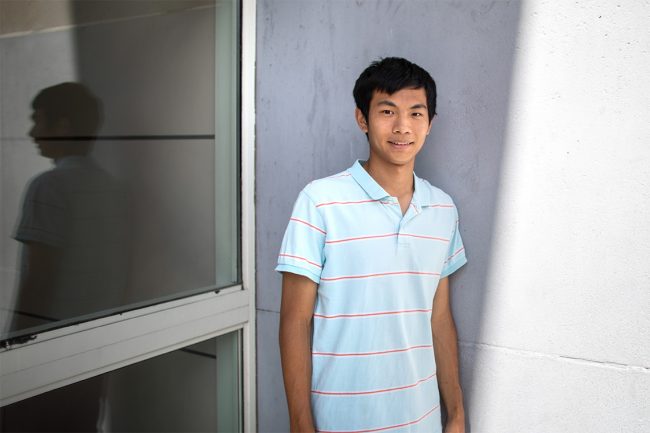
“I chose U of T because it’s the best university in Canada and the engineering program is also the best in Canada,” says Wu. “The engineering science program appeals to me because it brings both the practical aspect of engineering and the science aspect which is more theoretical, and I think that’s a perfect mix.”
Wu says the shift to online classes and assessments towards the end of Grade 12 emphasized the importance of self-discipline, which will be key for succeeding in university.
“If you go to school, you have to physically sit there for each class and listen. But for online courses, nobody’s pushing you,” Wu says. “So, what I tried to do to keep myself engaged was to make sure I did [work] every day so I didn’t get into that bad habit.”
Wu is also looking to tap into the energy and enthusiasm of his engineering science peers. That includes proactively looking to forge connections and make friends with classmates by adding them on Instagram.
“Apart from me pushing myself, I’ll also try to meet other people in my program and try to study with them online,” Wu says. “For me, making friends is a huge thing.”
Acquaviva, too, says that interpersonal connections will still be a feature of his fall plans, even if he’ll miss the in-person social interactions of a typical university semester.
“With all the technology today, it’s still possible to build interpersonal connections, whether it’s through Zoom, Facetime or social media,” he says. “Of course, I’d rather have that in-person interaction, so that’s something I’m really looking forward to when we eventually go back [to class]. But, for the time being with the pandemic, we have to manage with what we have.”
Acquaviva says he was drawn to the engineering science program because it’s designed to gradually take students from general engineering to a specialization by the third year. “I’m really looking forward to all the resources U of T has to offer for engineering students,” he says. “That was a big selling point for me when I was making my decision on which university to go to.”
Acquaviva adds that he’s also open to exploring opportunities in entrepreneurship and business – which further enhanced the appeal of going to U of T.
“The business aspect of how you can implement engineering into business is something that appeals to me,” he says. “I know U of T has all kinds of resources for that – there’s the engineering business major, the Myhal Centre [for Engineering Innovation and Entrepreneurship] … there’s also the program in partnership with Rotman where, directly after your engineering degree, you can go for an MBA. So that’s also something I’m considering.”
Acquaviva says that a love of learning will also likely help him and other incoming U of T students navigate the unusual fall semester.
“I enjoy learning,” he says. “It actually motivates me every day to get out of bed. If you have a passion for learning, I think that’s the most important thing.”
This story is adapted from a version published on U of T News. Read the full article.