
The economic impact of COVID-19 has rippled through industries across the world. Businesses everywhere have dealt with sudden closures, new health and safety rules and disruptions to the supply chain.
For alumnus Dan Chan (IndE 9T0), vice president of supply chain strategy at Canadian Tire Corporation (CTC), the pandemic has presented the greatest challenge of his career, testing his expertise in industrial engineering as he worked to rapidly solve problems and ensure the company continues to offer the highest level of customer service.
As COVID-19 cases in Canada rapidly spiked in March, schools closed, and home essentials such as bathroom tissue began flying off the shelves. Meanwhile, Canadian Tire’s supply-chain team had begun planning for the pandemic as early as December.
“We first started hearing about the novel coronavirus in China before Christmas. We immediately started to consider how our supply chain would be impacted. A good percentage of goods on our shelves come from China,” recalls Chan. “Would we need to source goods from elsewhere? How quickly can we get our stock in case China shuts down?”
To ensure shoppers were not faced with empty shelves and low stock, industrial engineers were able to assist in supplier management by analyzing data to determine what products were forecasted to be low in stock, where it could be sourced, and how quickly it could be received.
“Our team has always used industrial engineering to solve these types of problems,” says Chan. “In this case, there was just a greater sense of urgency.”
Since graduating from U of T Engineering, Chan has worked in supply chain management for 27 years. Over his 24 years at CTC, he says he’s had the pleasure of working alongside many industrial engineers whose expertise has been integral to the operational success of the supply chain.
“Industrial engineers maximize service levels while balancing inventory, warehouse and transportation needs within the supply chain,” explains Chan. “They play a prominent, crucial role.”

Network modelling, for example, is used to help deploy inventory, while human factors design is integral to improving ergonomics and optimizing distribution centre layouts. And with Canadian Tire having one of the largest fleets of automatic guided vehicles in North America, automation is regularly used within the distribution centres. What’s more, with huge amounts of raw data to analyze and interpret, industrial engineers regularly make recommendations to increase efficiencies and manage bottlenecks in order to provide customers with what they need.
Along with the question of how the virus in China would affect the supply chain, there was the question of how Canadian Tire stores would be impacted as COVID-19 began to appear in North America. As cases rose in Ontario, non-essential businesses were asked to close to help contain the virus and lighten the burden on the Canadian health-care system.
On March 19, SportChek and Mark’s — stores under the CTC umbrella — were closed to the public as a step to help curb the spread of the virus. On April 4, Canadian Tire stores in Ontario, which make up 40 percent of the store network, temporarily shut their doors. But online sales were still available.
“We saw a huge surge — shopping levels higher than during our Black Friday sales,” says Chan.
The unprecedented jump in e-commerce wasn’t the only new challenge to deal with — certain items were in huge demand. With gyms closed, customers were looking to order exercise equipment and weights online to begin building their at-home workout routines. These items were five times more popular than before the pandemic and at first, it was difficult to meet the unpredictable levels of demand.
Industrial engineering tactics allowed CTC to optimize the processes in their distribution nodes to fulfill customer orders. By taking in and analyzing huge amounts of data resulting from online orders, Canadian Tire could identify potential bottlenecks in the process as well as identify the capacity of various distribution nodes to help determine where to send the work to get orders out on time and as quickly as possible.
As distribution nodes adapted to manage the huge amount of online sales, stores were slowly able to open again in Ontario.
On May 9, Canadian Tire stores in Ontario reopened to the public and by mid-May, SportChek and Mark’s across Canada would follow. This brough a new slew of challenges to ensure both employees and customers could be safe while shopping. Practicing physical distancing and personal protective equipment (PPE) would all be part of the new normal in warehouses, distribution centres and retail stores. Canadian Tire needed to source and distribute PPE to all of their employees and be sure all their operations met the rigorous safety protocols set out by health and safety experts — all changes that were informed through data analysis by CTC’s industrial engineering team.
CTC has implemented health and safety protocols in its 1,700 retail locations and distribution centres, as the company continues to adapt and explore new ways to meet the increased customer demand for storefront and e-commerce options.
“One of the key principles we embrace in supply chain management is resiliency,” says Chan. We have a plan, and a back-up plan and know how to make quick decisions, adjust and move forward.”
Building a car is hard. Building a propane/electric hybrid car from scratch using only volunteer labour in less than six months is, some would say, impossible.
Luckily, nobody mentioned that to Douglas Venn (MechE 6T9, MEng 7T1).
“We had no idea how impossible it was,” he says. “We just did it.”
Fifty years ago this summer, Venn led a team of students and professors in designing and building Miss Purity, a low-emission vehicle that competed in the Clean Air Car Race of 1970. The vehicle embodies the creativity, ingenuity, and determination that define the U of T Engineering spirit.
Venn grew up in Toronto and admits to being “car crazy,” as a youth. He built or rebuilt a number of hot rods, vintage and sports cars, entering them in local competitions and even on occasion taking the top prize.
But during his undergraduate engineering program, he started thinking more about alternative vehicles.
“I was following the work of William Lear, founder of Learjet,” he says. “He was experimenting with steam-powered cars, which I thought was just fantastic because a steam engine gives peak torque at stall, and you can use almost any fuel you want.”
Cars running on anything other than gasoline or diesel were a pretty far out idea at a time when public attitudes toward automobiles were very different than they are today.
“If you look at cars of that time, which are vintage cars now, they were really huge,” says Juri Otsason (MechE 7T0, MASc 7T2), another member of the team. “Fuel was cheap. All that mattered was performance.”
That was beginning to change in the late 1960s, as cities such as Los Angeles started to get serious about dealing with smog. Formed primarily from vehicle emissions — including carbon monoxide, nitrogen oxides and unburned hydrocarbons — smog has been linked to respiratory conditions and other health issues.
“In Los Angeles at that time, you often couldn’t see the tops of the buildings through the smog,” says Otsason.
It was in this atmosphere that Venn headed to Detroit for the January 1970 Congress of the Society of Automotive Engineers (SAE). There, he heard Professor Richard Thornton recount the story of the Great Electric Car Race of 1968, which pitted a team of his students at MIT against one from Caltech.
Then Thornton mentioned that he, along with staff and students from Caltech, was planning to organize another such race that summer, one that would be open to any university.
“My ears perked up,” says Venn. “I spoke to Thornton after the talk, and he was very keen to get a team from Canada, because it would open up their national event into an international one.”
Venn headed back to U of T with a mission: to convince his fellow students, along with faculty supervisors, to enter the competition by building a low-emission vehicle from scratch in less than six months.
“A lot of people thought we were crazy,” says Otsason, one of the first students Venn was able to bring on board. Another early convert and enthusiastic supporter was mechanical engineering professor Phil Hughes.
“He was one of the loveliest people I ever met, just like a kindly grandfather,” says Venn. “I remember him saying ‘By Jove, I think this is a smashing idea!’”
Rounding out the team were Steve Baker (MechE 7T2), Simon Ng (ElecE 7T1), and nearly a dozen other students. Faculty advisors included Hughes, as well as mechanical engineering professors I.W. Smith, and F. Hooper, and electrical engineering professor R.S. Segworth.
It quickly became clear that the steam power concept would be too complicated and expensive given the time constraints. Instead, the team opted for a hybrid design: a combustion engine running on propane — a cleaner-burning fuel than gasoline — coupled with an electric drive system that would be more efficient at lower speeds.
Another key decision was to bring on board Venn’s cousin Ken Bell, then a student at the Ontario College of Art and Design, to create the car’s exterior. The result was striking: Bell designed a sleek, futuristic-looking vehicle, complete with gullwing doors.
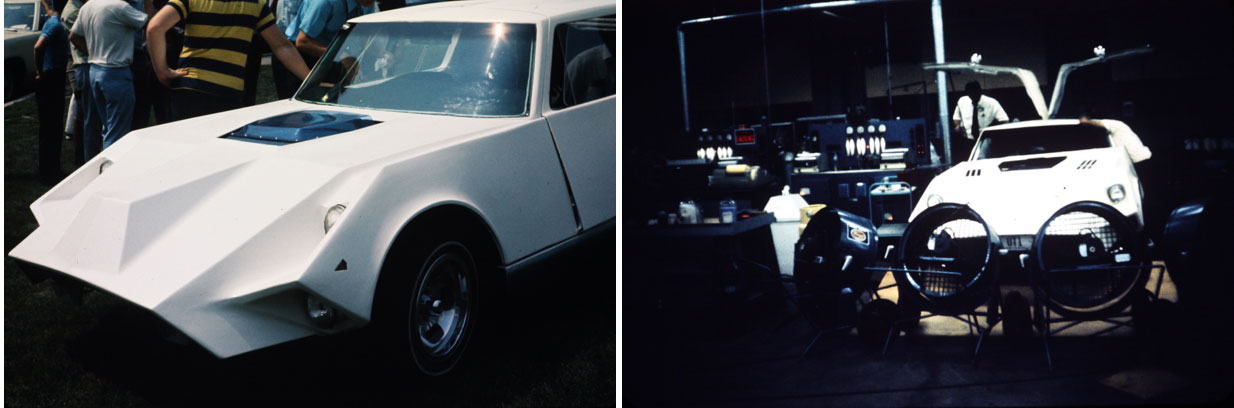
“They looked cool, but there was a practical consideration as well in that they left more room for the batteries,” says Otsason. The design eerily anticipated the DeLorean, the vehicle made famous in the Back to the Future films, which was then still years away from production.
Miss Purity began to attract attention almost immediately. Over the next six months, there were what Venn describes as “an increasing number of television appearances, as well as newspaper and magazine articles.”
Read more about Miss Purity and the Clean Air Car Race in archived articles from the New York Times, Popular Mechanics, Hemmings Motor News, and Automotive Fleet Magazine.
One of the highlights was a visit from officials from the National Air Pollution Control Administration (NAPCA), the forerunner of the Environmental Protection Agency (EPA).
“To say that they were excited by the U of T project would be an understatement,” says Venn. “They were thrilled, I think because not many of the teams were building cars from scratch the way we were.”
NAPCA even commissioned a short movie to document the Clean Air Race of 1970, narrated by Hollywood actor Orson Welles. Copies are hard to find these days, but Miss Purity features prominently in the film.
The press coverage increased further as the actual race started in August of 1970. Miss Purity turned heads everywhere she went.
“The race organizers had arranged events in every city,” says Otsason. “In Toronto, all the cars went down to city hall, and mayor Dennison came out to meet us. It was really something.”
This archival video from the Associated Press covers the Clean Air Car Race. The Toronto stop is featured from 2:40 to 4:00.
Venn remembers being asked by the race organizers to deliver banquet invitations using Miss Purity to then-governor of Massachusetts Francis Sargent and the mayor of Boston. The deliveries went well, but afterward, the car wouldn’t start.
“The front page of the Boston Globe was taken up by a photograph of Miss Purity being pushed by us,” he says. “The headline read ‘This car doesn’t pollute — not when muscle-powered!’”
The technical glitch wasn’t the only one. Early one morning, about halfway through the race, just outside of East St. Louis, a major breakdown nearly took Miss Purity out completely.
“The engine and most of the electric drive had to be completely torn out,” says Venn. “Luckily, we were close to a very supportive Chevrolet dealership that gave us a bay and provided the necessary parts.”
With their help, the car was repaired the same day. “We put the car back together and drove through the night to catch up with the race in Odessa, Texas,” says Venn. “Nobody could believe it!”
After more than 5,500 km of driving, the race came to an end in Pasadena, California. Miss Purity tied for first place among the hybrid cars, sharing the prize with a team from Worcester Polytechnical Institute, who were driving a modified AMC Gremlin.
Counting the return trip, which went through Vancouver and across Canada back to Toronto, Miss Purity was driven more than 16,000 km. She was sold for one dollar to the National Research Council in Ottawa for a further two years of research work, overseen by another U of T mechanical engineering graduate, Don Buchan.
In the years after the race, Venn partnered with some of the U of T Engineering professors involved to create a spinoff company, Vehicle Research, Ltd., that aimed to build electric vehicles for the consumer market.
“We had the very first three-phase induction, AC-driven electric car in the world, the same kind of drive now used by Tesla,” he says. “Unfortunately, the idea was way too far ahead of its time, and we didn’t have the deep pockets of Elon Musk.”
Venn eventually took a job designing household appliances, but he remained strongly involved in the automotive world through his continued membership in SAE.
In 2015, Venn was speaking to his friend Ron Passer about the project. After watching the movie of the race together, they decided to track down the car and see if it could be restored.
“The vehicle was found in Don Buchan’s front yard in Ottawa, where it had ‘lived’ for a number of years,” says Venn. Passer trailered the car back to his shop in Schomberg, Ont. and separated the body from the chassis.
Both are now being restored in partnership with Plastiglas Industries Ltd. in Ajax, Ont., which was founded by Miss Purity team member and driver, Steve Baker along with his brother Rick Baker just after the race.
For Venn, the legacy of Miss Purity has a lot to do with the community that it brought together.
“If we had thought too much about some of the challenges we would face, it’s possible some of us may have been overwhelmed, but that’s not the attitude we brought,” says Venn. “There’s a lot of capability within the human spirit. Impossible or not, there are times when you just have to do it.”
Fifty years after the Clean Air Car Race, practically all cars are now much ‘cleaner ’than in 1970, with the happy consequence that smog has been greatly reduced in many urban areas.
But pollution is still very much with us, and rising atmospheric concentrations of CO2 remain a challenge, one which Otsason believes still resonates with the story of Miss Purity.
“It drove home the point that there are ways of dealing with the problems we face in terms of pollution or emissions,” says Otsason. “I think she inspired people to look for alternatives, and we’re still doing that today.”
https://www.youtube.com/watch?v=1_lfOKNgKoU
Video slideshow, part 1: Miss Purity 1970 — The Build
https://www.youtube.com/watch?v=d5UgJO_gdH4
Video slideshow, part 2: Miss Purity 1970 – Clean Air Car Race Plus Pre and Post Activities
https://www.youtube.com/watch?v=YLns2Unyptc
Video slideshow, part 3: Miss Purity 2020 – The Restoration
A team of researchers from U of T Engineering and the University of Michigan has redesigned and enhanced a natural enzyme that shows promise in promoting the regrowth of nerve tissue following injury.
Their new version is more stable than the protein that occurs in nature, and could lead to new treatments for reversing nerve damage caused by traumatic injury or stroke.
“Stroke is the leading cause of disability in Canada and the third leading cause of death,” says University Professor Molly Shoichet (ChemE, BME, Donnelly), senior author on a new study published in the journal Science Advances.
“One of the major challenges to healing after this kind of nerve injury is the formation of a glial scar.”
A glial scar is formed by cells and biochemicals that knit together tightly around the damaged nerve. In the short term, this protective environment shields the nerve cells from further injury, but in the long term it can inhibit nerve repair.
About two decades ago, scientists discovered that a natural enzyme known as chondroitinase ABC — produced by a bacterium called Proteus vulgaris — can selectively degrade some of the biomolecules that make up the glial scar.
By changing the environment around the damaged nerve, chondroitinase ABC has been shown to promote regrowth of nerve cells. In animal models, it can even lead to regaining some lost function.
But progress has been limited by the fact that chondroitinase ABC is not very stable in the places where researchers want to use it.
“It’s stable enough for the environment that the bacteria live in, but inside the body it is very fragile,” says Shoichet. “It aggregates, or clumps together, which causes it to lose activity. This happens faster at body temperature than at room temperature. It is also difficult to deliver chondroitinase ABC because it is susceptible to chemical degradation and shear forces typically used in formulations.”
Various teams, including Shoichet’s, have experimented with techniques to overcome this instability. Some have tried wrapping the enzyme in biocompatible polymers or attaching it to nanoparticles to prevent it from aggregating. Others have tried infusing it into damaged tissue slowly and gradually, in order to ensure a consistent concentration at the injury site.
But all of these approaches are mere Band Aids — they don’t address the fundamental problem of instability.
In their latest paper, Shoichet and her collaborators tried a new approach: they altered the biochemical structure of the enzyme in order to create a more stable version.
“Like any protein, chondroitinase ABC is made up of building blocks called amino acids,” says Shoichet. “We used computational chemistry to predict the effect of swapping out some building blocks for others, with a goal of increasing the overall stability while maintaining or improving the enzyme’s activity.”
“The idea was probably a little crazy, because just like in nature, a single bad mutation can wreck the structure,” says Mathew O’Meara, a professor of computational medicine and bioinformatics at the University of Michigan, and co-lead author of the new paper.
“There are more than 1,000 links in the chain that forms this enzyme, and for each link you have 20 amino acids to choose from,” he says. “There are too many choices to simulate them all.”
To narrow down the search space, the team applied computer algorithms that mimicked the types of amino acid substitutions found in real organisms. This approach — known as consensus design — produces mutant forms of the enzyme that don’t exist in nature, but are plausibly like those that do.
In the end, the team ended up with three new candidate forms of the enzyme that were then produced and tested in the lab. All three were more stable than the wild type, but only one, which had 37 amino acid substitutions out of more than 1,000 links in the chain, was both more stable and more active.
“The wild type chondroitinase ABC loses most of its activity within 24 hours, whereas our re-engineered enzyme is active for seven days,” says Marian Hettiaratchi, the other co-lead author of the paper. A former postdoctoral fellow in Shoichet’s lab, Hettiaratchi is now a professor of bioengineering at the University of Oregon’s Phil and Penny Knight Campus for Accelerating Scientific Impact.
“This is a huge difference. Our improved enzyme is expected to even more effectively degrade the glial scar than the version commonly used by other research groups,” says Hettiaratchi.
The next step will be to deploy the enzyme in the same kinds of experiments where the wild type was previously used.
“When we started this project, we were advised not to try as it would be like looking for a needle in a haystack,” says Shoichet. “Having found that needle, we are investigating this form of the enzyme in our models of stroke and spinal cord injury to better understand its potential as a therapeutic, either alone or in combination with other strategies.”
Shoichet points to the multidisciplinary nature of the project as a key to its success.
“We were able to take advantage of the complementary expertise of the authors to bring this project to fruition, and we were shocked and overjoyed to be so successful,” she says. “It went well beyond our expectations.”
This research was funded by Medicine by Design, and the Natural Sciences and Engineering Research Council.
Zero-emission sources of power harvested from solar and wind are less costly and more widely available than ever before. But what happens when the sun doesn’t shine or the wind doesn’t blow? Professor Aimy Bazylak (MIE) may have an answer.
Bazylak holds the Canada Research Chair in Thermofluidics for Clean Energy. Her research program focuses on two complementary technologies: electrolyzers and fuel cells.
Electrolyzers use electricity to drive a chemical reaction, such as splitting water into hydrogen and oxygen. Fuel cells reverse this process, turning stored chemical energy back into electricity.
“When fed hydrogen, fuel cells can produce zero-emission power on demand,” says Bazylak. “I’m excited and driven by the vital role that clean energy technology must play for a sustainable future.”
Another application of electrolyzers is the electro-reduction of carbon dioxide. This chemical reaction is the first step in a complex process that can upgrade waste carbon into valuable products, such as plastics or fuels. This process increases the economic incentives for carbon capture and storage.
Whether they are upgrading captured carbon or producing hydrogen to store renewable electricity, electrolyzers rely on the efficient transport of flows through porous materials. Bazylak and her team study ways to optimize these components.
Leveraging their expertise in microfluidics, they are designing better fuel cell and electrolyzer materials and architectures to increase overall efficiency or reduce undesirable side effects, such as water buildup that degrades performance.
For her contributions to fuel cell and electrolyzer technology, Bazylak was named this year’s winner of the McLean Award. The $125,000 award, jointly funded by the Connaught Fund and the McLean endowment, recognizes early career researchers and supports outstanding basic research in the fields of computer science, mathematics, physics, chemistry, engineering sciences and the theory and methods of statistics.
“I feel deep gratitude for receiving the McLean Award,” says Bazylak. “I’m tremendously excited about the privilege this provides to both advance clean energy with my team as well as support the growth and development of junior researchers.”
Bazylak says that the funding will also support efforts to further increase diversity in scholarship and research.
“The scientific community lacks diversity, and barriers and discrimination are systemic issues,” she says. “The McLean Award will help me and my team to grow allyship for equity, diversity, and inclusivity in clean energy, and thereby embrace a certainly tremendous untapped potential of up and coming leaders of tomorrow.”
“On behalf of the Faculty, my warmest congratulations to Professor Bazylak on this well-deserved award,” says Ramin Farnood, Vice-Dean, Research at U of T Engineering. “Her dynamic team is at the forefront of innovation in sustainable energy, and she has demonstrated a strong commitment to building a more inclusive community.”
Last January, U of T Engineering launched a new program focused on using online collaboration tools to build effective, multidisciplinary design teams with members all over the world. Its creators could not have known how timely their efforts were.
“Prior to the pandemic, utilizing virtual-international teams was seen as a time and cost- saving approach to harness talent and maximize efficiency,” says Professor Elham Marzi (ISTEP). “In the present state, we are seeing organizations left with little choice but to embrace virtual-international teams as the best way forward.”
There are signs that the shift online caused by COVID-19 may continue even after the virus subsides. Already, major technology companies such as Twitter, Shopify and Facebook have told their employees that they can keep telecommuting indefinitely.
“This is the new global reality our graduates need to prepare for,” says Marzi.
The International Virtual Engineering Student Teams (InVEST) initiative facilitates virtual and cross-cultural collaboration by connecting U of T Engineering students with their peers at partner universities abroad.
Student teams undertake technical projects under the supervision of faculty members at partner universities. They also participate in value-added learning activities on technology use, effective teamwork and intercultural communication and understanding.
Together, these international, multidisciplinary teams complete design projects, sometimes for an external client, using a suite of software tools to communicate and track their progress.
InVEST is delivered by a team that includes:
- Professor Elham Marzi (ISTEP), InVEST Director & Principal Investigator
- Rahim Rezaie, InVEST Assistant Director
- Debbie A. Mohammed, University & Industry Liaison
- Anuli Ndubuisi (OISE), Research and Program Manager
- Oluwatobi (Tobi) Edun, Operations & Research Manager
- Patrick Ishimwe, Website & Social Media Developer
“Some of our students already travel abroad at some point in their degree programs,” says Rezaie. “But travel is expensive, and the students usually can’t stay away for more than a few weeks. Virtual collaboration offers a more scalable way for the university to enhance international experience for graduates.”
InVEST, which is supported by the Dean’s Strategic Fund, was designed to be compatible with existing experiential learning activities, such as fourth-year capstones courses, MEng research projects, or independent project courses.
However, at the request of U of T’s Centre for International Experience, the team has added a number of summer research exchanges that were moved online due to travel restrictions.
“What this program provides is the ability to have eyes and ears in more than one country,” says Edun. “This leads to a bigger and more diverse set of ideas around the table, and a richer experience for everyone involved.”
Jeff Mukuka (Year 4 CivE) is one of the participants. His project is a design exchange internship with Solar Ship, Inc., a company that designs tethered and mobile airships, known as aerostats, for applications ranging from tourism to freight transportation.
“Through InVEST, I’ve had the privilege of working with people from many countries, including the U.S., U.A.E., Nepal and Zambia,” says Mukuka. “The experience working with such a diverse team was transformational and I have made many lifelong friends.”
In addition to their design work, students in InVEST engage with educational modules that help them address some of the issues that come up during extended online collaboration.
“These days, we’re all learning that Zoom etiquette is important, that we need to be respectful when having a meeting that essentially lets your co-workers inside your home,” says Marzi. “That’s true whether you’re in Ecuador, Canada or Africa, but how it is perceived may vary from place to place, so we’re getting the students to think through that.”
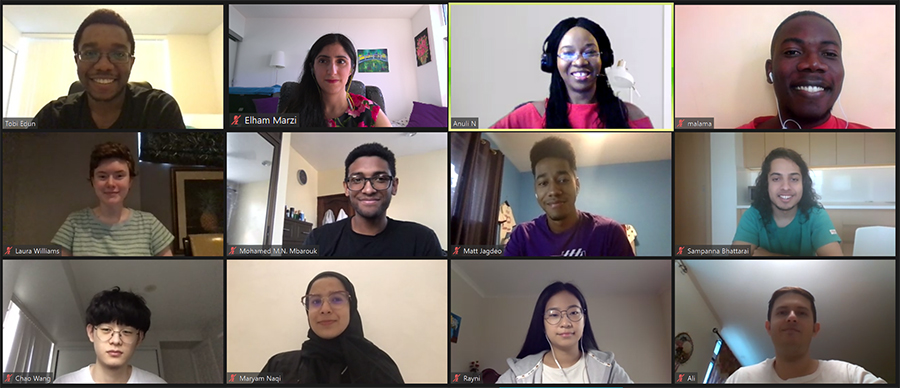
“I learned a lot from the modules: intercultural communication skills, group conflict resolution, and how to use software tools for virtual collaboration,” says Mukuka. “The skills I have acquired are invaluable, especially now that the future is projected to have more remote work even after COVID-19 ends.”
Mukuka’s project is one of four completed over the last several months, with others ongoing, involving a total of 24 students. These include 13 students from partner universities such as University of Johannesburg in South Africa, and the University of the West Indies in Trinidad.
Heading into the fall semester, the team will expand the program with more projects.
“We are in contact with more than fifteen universities around the world at the moment,” says Edun. “Some of the projects I’m excited about for the fall include one about biogas production, in partnership with Covenant University in Nigeria, as well as one about making power grids more resilient to lightning strikes, with Brazil’s Federal University of Minas Gerais.”
All members of the InVEST team agree that while online collaboration across cultures was already emerging as a critical skill for engineering graduates, the current situation has accelerated the trend.
“When we started out, we heard from partners that online collaboration would be complicated and cumbersome,” says Rezaie. “Our goal was to de-risk this approach, to show people that there was value in this kind of engagement. That value proposition has become a lot clearer over the past few months, which has led to much more interest.”
Visit the InVEST website to learn more about the program.
U of T Engineering professor Steven Waslander (UTIAS) is developing the next generation of unmanned aerial vehicles (UAVs), better known as drones, that are capable of high-speed maneuvers, automated landing and stable flight near obstacles.
“This work could greatly expand the applications quadrotor drones are useful for,” explains Waslander. “The more advanced they become, the better they’ll be at inspecting infrastructure, search and rescue in remote environments, tracking moving objects for security, and delivering light-weight packages.”
But to succeed, his team needs the necessary state-of-the-art equipment to make it happen. Waslander is among five U of T Engineering researchers to receive funding through the Canada Foundation for Innovation’s (CFI) John R. Evans Leaders Fund (JELF), announced today.
The fund provides researchers with foundational tools and infrastructure, enabling research discovery and innovation. Funding was awarded to 33 projects across the University of Toronto, totalling more than $9.5 million.
For Waslander, the CFI JELF will go towards acquiring the latest in motion-capture cameras for real-time, high-accuracy motion tracking of drones, as well as a dedicated GPU server, for rapid graphics processing, to improve vehicle modelling through reinforcement learning.
The team is partnering with tech company NVIDIA, which will provide the GPU cluster, and Vicon Industries Inc for the cameras. This equipment will be deployed within an innovative indoor flight arena, located at the U of T Robotics Institute in the Myhal Centre for Engineering Innovation & Entrepreneurship
With the setup, Waslander and his team will test automated drones as they track a moving ground rover within the flight arena. “We want to execute repeated landings on the moving vehicle, maintaining the relative position accuracy to within 10 centimeters, even as the speed of the target vehicle increases,” says Waslander, who is working with Ford Motor Company and Drone Delivery Canada as a first application of this method.
“Foundational research infrastructure, coupled with world-class researchers, leads to groundbreaking discoveries,” says Ramin Farnood, U of T Engineering’s Vice-Dean of Research. “With the support of CFI, our U of T Engineering researchers can continue to be leaders in their field and make positive, vital contributions to our society and the economy.”
The U of T Engineering CFI JELF recipients in this round are:
- Leo Chou (BME) —DNA Nanotechnology for spatially programmed immune receptor activation
- Jane Howe (MSE, ChemE) — Advanced scanning electron microscope for in situ and liquid-phase electron microscopy study
- Goldie Nejat (MIE) — Robotics infrastructure for smart manufacturing (RISM)
- Nicolas Papernot (ECE) — Trustworthy machine learning
- Steven Waslander (UTIAS) — Autonomous docking and active perception for unmanned aerial vehicles