
A team of researchers from U of T Engineering and the University of Michigan has redesigned and enhanced a natural enzyme that shows promise in promoting the regrowth of nerve tissue following injury.
Their new version is more stable than the protein that occurs in nature, and could lead to new treatments for reversing nerve damage caused by traumatic injury or stroke.
“Stroke is the leading cause of disability in Canada and the third leading cause of death,” says University Professor Molly Shoichet (ChemE, BME, Donnelly), senior author on a new study published in the journal Science Advances.
“One of the major challenges to healing after this kind of nerve injury is the formation of a glial scar.”
A glial scar is formed by cells and biochemicals that knit together tightly around the damaged nerve. In the short term, this protective environment shields the nerve cells from further injury, but in the long term it can inhibit nerve repair.
About two decades ago, scientists discovered that a natural enzyme known as chondroitinase ABC — produced by a bacterium called Proteus vulgaris — can selectively degrade some of the biomolecules that make up the glial scar.
By changing the environment around the damaged nerve, chondroitinase ABC has been shown to promote regrowth of nerve cells. In animal models, it can even lead to regaining some lost function.
But progress has been limited by the fact that chondroitinase ABC is not very stable in the places where researchers want to use it.
“It’s stable enough for the environment that the bacteria live in, but inside the body it is very fragile,” says Shoichet. “It aggregates, or clumps together, which causes it to lose activity. This happens faster at body temperature than at room temperature. It is also difficult to deliver chondroitinase ABC because it is susceptible to chemical degradation and shear forces typically used in formulations.”
Various teams, including Shoichet’s, have experimented with techniques to overcome this instability. Some have tried wrapping the enzyme in biocompatible polymers or attaching it to nanoparticles to prevent it from aggregating. Others have tried infusing it into damaged tissue slowly and gradually, in order to ensure a consistent concentration at the injury site.
But all of these approaches are mere Band Aids — they don’t address the fundamental problem of instability.
In their latest paper, Shoichet and her collaborators tried a new approach: they altered the biochemical structure of the enzyme in order to create a more stable version.
“Like any protein, chondroitinase ABC is made up of building blocks called amino acids,” says Shoichet. “We used computational chemistry to predict the effect of swapping out some building blocks for others, with a goal of increasing the overall stability while maintaining or improving the enzyme’s activity.”
“The idea was probably a little crazy, because just like in nature, a single bad mutation can wreck the structure,” says Mathew O’Meara, a professor of computational medicine and bioinformatics at the University of Michigan, and co-lead author of the new paper.
“There are more than 1,000 links in the chain that forms this enzyme, and for each link you have 20 amino acids to choose from,” he says. “There are too many choices to simulate them all.”
To narrow down the search space, the team applied computer algorithms that mimicked the types of amino acid substitutions found in real organisms. This approach — known as consensus design — produces mutant forms of the enzyme that don’t exist in nature, but are plausibly like those that do.
In the end, the team ended up with three new candidate forms of the enzyme that were then produced and tested in the lab. All three were more stable than the wild type, but only one, which had 37 amino acid substitutions out of more than 1,000 links in the chain, was both more stable and more active.
“The wild type chondroitinase ABC loses most of its activity within 24 hours, whereas our re-engineered enzyme is active for seven days,” says Marian Hettiaratchi, the other co-lead author of the paper. A former postdoctoral fellow in Shoichet’s lab, Hettiaratchi is now a professor of bioengineering at the University of Oregon’s Phil and Penny Knight Campus for Accelerating Scientific Impact.
“This is a huge difference. Our improved enzyme is expected to even more effectively degrade the glial scar than the version commonly used by other research groups,” says Hettiaratchi.
The next step will be to deploy the enzyme in the same kinds of experiments where the wild type was previously used.
“When we started this project, we were advised not to try as it would be like looking for a needle in a haystack,” says Shoichet. “Having found that needle, we are investigating this form of the enzyme in our models of stroke and spinal cord injury to better understand its potential as a therapeutic, either alone or in combination with other strategies.”
Shoichet points to the multidisciplinary nature of the project as a key to its success.
“We were able to take advantage of the complementary expertise of the authors to bring this project to fruition, and we were shocked and overjoyed to be so successful,” she says. “It went well beyond our expectations.”
This research was funded by Medicine by Design, and the Natural Sciences and Engineering Research Council.
Zero-emission sources of power harvested from solar and wind are less costly and more widely available than ever before. But what happens when the sun doesn’t shine or the wind doesn’t blow? Professor Aimy Bazylak (MIE) may have an answer.
Bazylak holds the Canada Research Chair in Thermofluidics for Clean Energy. Her research program focuses on two complementary technologies: electrolyzers and fuel cells.
Electrolyzers use electricity to drive a chemical reaction, such as splitting water into hydrogen and oxygen. Fuel cells reverse this process, turning stored chemical energy back into electricity.
“When fed hydrogen, fuel cells can produce zero-emission power on demand,” says Bazylak. “I’m excited and driven by the vital role that clean energy technology must play for a sustainable future.”
Another application of electrolyzers is the electro-reduction of carbon dioxide. This chemical reaction is the first step in a complex process that can upgrade waste carbon into valuable products, such as plastics or fuels. This process increases the economic incentives for carbon capture and storage.
Whether they are upgrading captured carbon or producing hydrogen to store renewable electricity, electrolyzers rely on the efficient transport of flows through porous materials. Bazylak and her team study ways to optimize these components.
Leveraging their expertise in microfluidics, they are designing better fuel cell and electrolyzer materials and architectures to increase overall efficiency or reduce undesirable side effects, such as water buildup that degrades performance.
For her contributions to fuel cell and electrolyzer technology, Bazylak was named this year’s winner of the McLean Award. The $125,000 award, jointly funded by the Connaught Fund and the McLean endowment, recognizes early career researchers and supports outstanding basic research in the fields of computer science, mathematics, physics, chemistry, engineering sciences and the theory and methods of statistics.
“I feel deep gratitude for receiving the McLean Award,” says Bazylak. “I’m tremendously excited about the privilege this provides to both advance clean energy with my team as well as support the growth and development of junior researchers.”
Bazylak says that the funding will also support efforts to further increase diversity in scholarship and research.
“The scientific community lacks diversity, and barriers and discrimination are systemic issues,” she says. “The McLean Award will help me and my team to grow allyship for equity, diversity, and inclusivity in clean energy, and thereby embrace a certainly tremendous untapped potential of up and coming leaders of tomorrow.”
“On behalf of the Faculty, my warmest congratulations to Professor Bazylak on this well-deserved award,” says Ramin Farnood, Vice-Dean, Research at U of T Engineering. “Her dynamic team is at the forefront of innovation in sustainable energy, and she has demonstrated a strong commitment to building a more inclusive community.”
Last January, U of T Engineering launched a new program focused on using online collaboration tools to build effective, multidisciplinary design teams with members all over the world. Its creators could not have known how timely their efforts were.
“Prior to the pandemic, utilizing virtual-international teams was seen as a time and cost- saving approach to harness talent and maximize efficiency,” says Professor Elham Marzi (ISTEP). “In the present state, we are seeing organizations left with little choice but to embrace virtual-international teams as the best way forward.”
There are signs that the shift online caused by COVID-19 may continue even after the virus subsides. Already, major technology companies such as Twitter, Shopify and Facebook have told their employees that they can keep telecommuting indefinitely.
“This is the new global reality our graduates need to prepare for,” says Marzi.
The International Virtual Engineering Student Teams (InVEST) initiative facilitates virtual and cross-cultural collaboration by connecting U of T Engineering students with their peers at partner universities abroad.
Student teams undertake technical projects under the supervision of faculty members at partner universities. They also participate in value-added learning activities on technology use, effective teamwork and intercultural communication and understanding.
Together, these international, multidisciplinary teams complete design projects, sometimes for an external client, using a suite of software tools to communicate and track their progress.
InVEST is delivered by a team that includes:
- Professor Elham Marzi (ISTEP), InVEST Director & Principal Investigator
- Rahim Rezaie, InVEST Assistant Director
- Debbie A. Mohammed, University & Industry Liaison
- Anuli Ndubuisi (OISE), Research and Program Manager
- Oluwatobi (Tobi) Edun, Operations & Research Manager
- Patrick Ishimwe, Website & Social Media Developer
“Some of our students already travel abroad at some point in their degree programs,” says Rezaie. “But travel is expensive, and the students usually can’t stay away for more than a few weeks. Virtual collaboration offers a more scalable way for the university to enhance international experience for graduates.”
InVEST, which is supported by the Dean’s Strategic Fund, was designed to be compatible with existing experiential learning activities, such as fourth-year capstones courses, MEng research projects, or independent project courses.
However, at the request of U of T’s Centre for International Experience, the team has added a number of summer research exchanges that were moved online due to travel restrictions.
“What this program provides is the ability to have eyes and ears in more than one country,” says Edun. “This leads to a bigger and more diverse set of ideas around the table, and a richer experience for everyone involved.”
Jeff Mukuka (Year 4 CivE) is one of the participants. His project is a design exchange internship with Solar Ship, Inc., a company that designs tethered and mobile airships, known as aerostats, for applications ranging from tourism to freight transportation.
“Through InVEST, I’ve had the privilege of working with people from many countries, including the U.S., U.A.E., Nepal and Zambia,” says Mukuka. “The experience working with such a diverse team was transformational and I have made many lifelong friends.”
In addition to their design work, students in InVEST engage with educational modules that help them address some of the issues that come up during extended online collaboration.
“These days, we’re all learning that Zoom etiquette is important, that we need to be respectful when having a meeting that essentially lets your co-workers inside your home,” says Marzi. “That’s true whether you’re in Ecuador, Canada or Africa, but how it is perceived may vary from place to place, so we’re getting the students to think through that.”
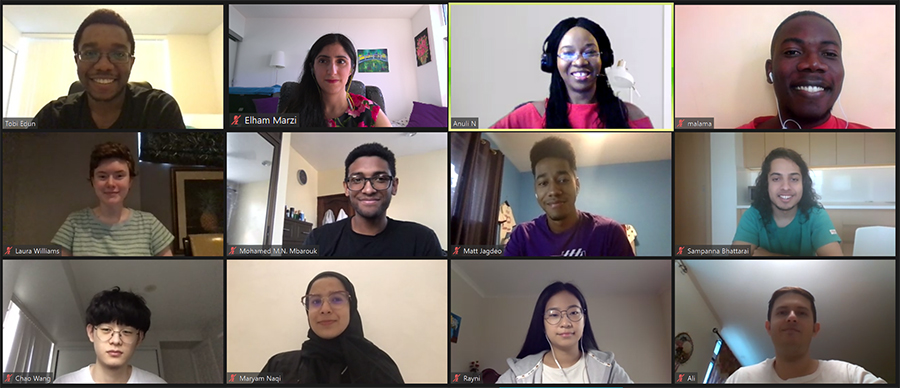
“I learned a lot from the modules: intercultural communication skills, group conflict resolution, and how to use software tools for virtual collaboration,” says Mukuka. “The skills I have acquired are invaluable, especially now that the future is projected to have more remote work even after COVID-19 ends.”
Mukuka’s project is one of four completed over the last several months, with others ongoing, involving a total of 24 students. These include 13 students from partner universities such as University of Johannesburg in South Africa, and the University of the West Indies in Trinidad.
Heading into the fall semester, the team will expand the program with more projects.
“We are in contact with more than fifteen universities around the world at the moment,” says Edun. “Some of the projects I’m excited about for the fall include one about biogas production, in partnership with Covenant University in Nigeria, as well as one about making power grids more resilient to lightning strikes, with Brazil’s Federal University of Minas Gerais.”
All members of the InVEST team agree that while online collaboration across cultures was already emerging as a critical skill for engineering graduates, the current situation has accelerated the trend.
“When we started out, we heard from partners that online collaboration would be complicated and cumbersome,” says Rezaie. “Our goal was to de-risk this approach, to show people that there was value in this kind of engagement. That value proposition has become a lot clearer over the past few months, which has led to much more interest.”
Visit the InVEST website to learn more about the program.
U of T Engineering professor Steven Waslander (UTIAS) is developing the next generation of unmanned aerial vehicles (UAVs), better known as drones, that are capable of high-speed maneuvers, automated landing and stable flight near obstacles.
“This work could greatly expand the applications quadrotor drones are useful for,” explains Waslander. “The more advanced they become, the better they’ll be at inspecting infrastructure, search and rescue in remote environments, tracking moving objects for security, and delivering light-weight packages.”
But to succeed, his team needs the necessary state-of-the-art equipment to make it happen. Waslander is among five U of T Engineering researchers to receive funding through the Canada Foundation for Innovation’s (CFI) John R. Evans Leaders Fund (JELF), announced today.
The fund provides researchers with foundational tools and infrastructure, enabling research discovery and innovation. Funding was awarded to 33 projects across the University of Toronto, totalling more than $9.5 million.
For Waslander, the CFI JELF will go towards acquiring the latest in motion-capture cameras for real-time, high-accuracy motion tracking of drones, as well as a dedicated GPU server, for rapid graphics processing, to improve vehicle modelling through reinforcement learning.
The team is partnering with tech company NVIDIA, which will provide the GPU cluster, and Vicon Industries Inc for the cameras. This equipment will be deployed within an innovative indoor flight arena, located at the U of T Robotics Institute in the Myhal Centre for Engineering Innovation & Entrepreneurship
With the setup, Waslander and his team will test automated drones as they track a moving ground rover within the flight arena. “We want to execute repeated landings on the moving vehicle, maintaining the relative position accuracy to within 10 centimeters, even as the speed of the target vehicle increases,” says Waslander, who is working with Ford Motor Company and Drone Delivery Canada as a first application of this method.
“Foundational research infrastructure, coupled with world-class researchers, leads to groundbreaking discoveries,” says Ramin Farnood, U of T Engineering’s Vice-Dean of Research. “With the support of CFI, our U of T Engineering researchers can continue to be leaders in their field and make positive, vital contributions to our society and the economy.”
The U of T Engineering CFI JELF recipients in this round are:
- Leo Chou (BME) —DNA Nanotechnology for spatially programmed immune receptor activation
- Jane Howe (MSE, ChemE) — Advanced scanning electron microscope for in situ and liquid-phase electron microscopy study
- Goldie Nejat (MIE) — Robotics infrastructure for smart manufacturing (RISM)
- Nicolas Papernot (ECE) — Trustworthy machine learning
- Steven Waslander (UTIAS) — Autonomous docking and active perception for unmanned aerial vehicles
A team of U of T Engineering researchers is leveraging machine learning to enhance the manufacturing of common everyday items. They have created an algorithm that efficiently sifts through thousands of possible geometric configurations to design better industrial catalysts.
“Catalysts speed up chemical reactions, making manufacturing more efficient and less costly,” says Professor Chandra Veer Singh (MSE). “They are used to produce everything from plastics to industrial fertilizers, and researchers around the world are constantly trying to improve their performance. Alloying is a key strategy in this field.”
An alloy is a combination of two or more metal elements, such as platinum or iridium. Many catalysts are binary alloys that contain two metals, or tertiary alloys that contain three. But in 2018, a team of American researchers developed a new synthesis technique that allows an alloy of five different metals to be used as a catalyst.
“These alloys are referred to as high-entropy alloys (HEA) because the large number of elements creates a high level of entropy, which is a measure of amount of disorder in the material,” says Zhuole Lu (MSE MASc candidate). “Some HEAs may turn out to be excellent catalysts, but the challenge is that there are just too many possible combinations.”
For example, if a researcher has 30 metals to choose from, there are about 400 ways to create a binary alloy, and about 4,000 ways to create a tertiary alloy. But there are more than 140,000 ways to create a five-element HEA.
Those numbers become even larger when geometric effects are taken into account. Even for a single five-element combination, there are millions of different ways those same elements could be arranged on an alloy surface.
Creating and testing all the potential combinations and arrangements would be a very costly and time-consuming way to find new catalysts. Singh, Lu and postdoctoral fellow Zhi Wen Chen recently published a paper in the journal Matter that outlines a new approach.
The team designed and implemented a machine learning algorithm — known as a neural network — that can realistically simulate the properties of a given HEA, without having to actually produce it in a lab.
“What makes this work special is its inclusion of structural effects,” says Chen. “You can imagine the metal atoms in the HEA as plastic balls in a children’s ball pit. Current machine learning models treat the alloy as though it had a flat surface. But we know that the top of the ball pit is bumpy, and that bumpiness can have a big impact on the catalyst’s properties. Our model takes that into account.”
The team validated the model by predicting the catalytic performance of a five-element HEA that contained the metals iridium, palladium, platinum, rhodium and ruthenium. They then compared the predictions of the machine learning model with experimental measurements from five different research groups. The results matched surprisingly well.
In the future, the team hopes to expand the approach, creating a model that can simulate different combinations of elements as well as different geometries. Such an algorithm could quickly point researchers toward the most promising catalyst candidates.
“By simultaneously accounting for different metals and different structures, we believe our tool will help materials scientists rapidly screen for the best new catalysts, while also enabling a deeper understanding of HEAs and alloy catalysts in general,” says Singh.
U of T Engineering researchers have developed a new method of injecting healthy cells into damaged eyes. The technique could point the way toward new treatments with the potential to reverse forms of vision loss that are currently incurable.
Around the world, millions of people live with vision loss due to conditions such as age-related macular degeneration (AMD) or retinitis pigmentosa. Both are caused by the death of cells in the retina, at the back of the eye.
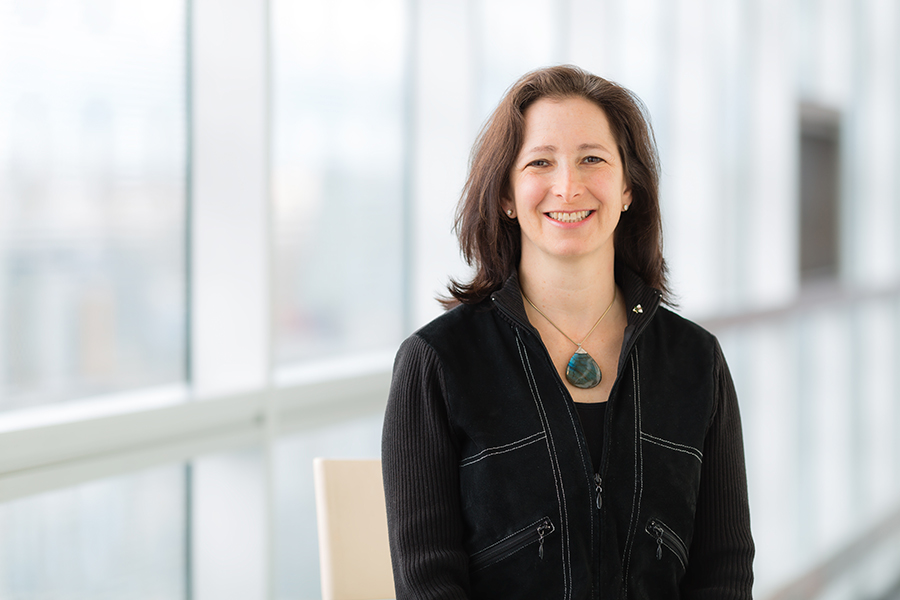
“The cells that are responsible for vision are the photoreceptors, which have an intimate relationship with another type of cell known as retinal pigmented epithelium (RPE) cells,” says University Professor Molly Shoichet (ChemE, BME), whose lab is located in the Donnelly Centre for Cellular and Biomolecular Research.
“In AMD, the RPE die first, and this then causes the photoreceptors to die.”
Many researchers have experimented with treatments based on injecting healthy photoreceptors or RPE cells into the eye to replace the dead cells. But integrating the new cells into the existing tissue is a major challenge, and most injected cells end up dying as well.
Shoichet and her team are experts in using engineered biomaterials known as hydrogels to promote the survival of newly injected cells after transplantation. The hydrogels ensure an even distribution of cells, reduce inflammation and promote tissue healing in the critical early days post-injection. Eventually, they degrade naturally, leaving the healthy cells behind.
In 2015, the team used hydrogels to inject healthy photoreceptor cells into damaged retinas in a mouse model. While the team observed some vision repair, the benefits were limited, so they began to think more carefully about the relationships between RPE cells and photoreceptors.
“RPE and photoreceptors are considered as one functional unit — if one cell type dies, then the other one will too,” says Shoichet. “We wondered if co-delivery of both cell types would have a bigger impact on vision restoration.”
As with photoreceptors, many groups had tried implanting RPE cells on their own, but nobody had ever integrated both cell types into a single treatment. Once again, the hydrogels pointed to a solution.
“What other groups have typically done is either inject photoreceptors in a saline solution, which often results in cells clustering together, or surgically implant a layer of RPE cells usually grown on a polymer film,” says Shoichet.
“Our hydrogel is viscous enough to ensure a good distribution of both cell types in the syringe, yet it also has important shear-thinning properties to facilitate injection through the very fine needle required for this operation,” adds Shoichet. “The combination of these properties opened up a new strategy for successful delivery of multiple cells.”
The team tested co-injection in a degenerative mouse model resembling AMD. In a paper recently published in the journal Biomaterials, they report that mice who received the co-injection regained about 10 percent of their normal visual acuity. Those who received either cell type on its own showed little to no improvement.
Co-injected mice were also more active in dark chambers than light ones, showing that these nocturnal animals could once again distinguish light and shadow.
“I still remember the long days of behavioural testing,” says Nick Mitrousis, Shoichet’s former PhD student and lead author of the paper, now a postdoctoral fellow at the University of Chicago.
“We designed the experiment so that I wouldn’t know which mice had received the treatment and which received a placebo. When some of the mice started responding, I kept vacillating between optimism that the experiment might have actually worked, and worry that the recovering mice might just be split between the different treatment groups.”
The worries were unfounded: it turned out that the co-injection treatment really had an effect. But both Mitrousis and Shoichet caution that there is a very long road between these preliminary results and a trial that could eventually find its way into the clinic.
“First, we need to demonstrate the benefit of this strategy in multiple animal models,” says Shoichet. “We’ll also need a source of human photoreceptor cells and a way to further improve cell survival, both of which we’re working on. Still, we are very excited by these data and always open to collaboration to take the research further.”
This research was funded by Medicine by Design, the Natural Sciences and Engineering Research Council, the University Health Network, and the Ontario Institute for Regenerative Medicine.