Samantha Chan (Year 1 MechE) was just eight years old when she decided to become an engineer.
Her parents had taken her to see Big Hero 6 — an animated superhero film starring a young robotics prodigy — and the story cemented her early passion for building machines using electrical components.
“The movie got me super excited and inspired, and I begged my mom to enrol me in a robotics class,” she says. “When I learned about the bigger world of mechatronics, that’s when I knew I wanted to be an engineer.”
In high school, Chan joined the STEM Club and was mentored by a teacher who shared her passion for STEM subjects. She also dedicated time to exploring her creative and entrepreneurial interests, which include 2D animation, singing and developing a video game together with friends who brought a wide range of technical and artistic skills to the project.
Today, Chan — now 17 — is well on her way to realizing her dream of combining her love of engineering with her interests in business and creativity.
In September, she left Vancouver to begin her first year of a mechanical engineering degree at the University of Toronto as one of 10 Schulich Leaders — recipients of Canada’s most prestigious scholarships for students pursuing careers at the intersection of STEM and entrepreneurship.
“I applied for the Schulich Leader Scholarship because I liked how it prioritized leadership and entrepreneurship rather than just academic excellence,” she says. “I am incredibly grateful to have been chosen and to be part of this community; everyone is here because they want to achieve something.”
Although she’s just weeks into her degree, Chan already knows that she wants to combine her interests in engineering, creativity and business to make a big difference for the world.
“I want to go into sustainability because it’s necessary for the future,” she says. “Right now, a lot of progress being made scientifically is not accessible to the public. I want to start a business focused on creating solutions that the public can use to contribute to a more sustainable world.”
Every scholarship opens doors to a powerful community of networking and support
Established in 2012 by Canadian businessman Seymour Schulich, the Schulich Leader Scholarships are awarded to 100 exceptional students each year from across Canada — including 10 for incoming undergraduate students to U of T, five of whom are studying at U of T Engineering.
The scholarships are valued at $100,000 each for science, technology and mathematics students and $120,000 each for engineering students, covering the entire cost of an undergraduate education.
“The University of Toronto is deeply impressed by the achievements and aspirations of our Schulich Leaders,” says Meric Gertler, president of U of T. “We are immensely grateful to Seymour Schulich and the Schulich Foundation for investing in the success of our next generation of game-changing innovators across the STEM disciplines.”
Sandy Welsh, vice provost of students at U of T, says that beyond their monetary value, the Schulich Leader Scholarships open doors to unmatched opportunities for networking and support.
“The monetary value of every Schulich Leader Scholarship is unmatched in Canada, but what makes these awards extra special is the community that comes with them,” she says.
“Every incoming Schulich Leader automatically becomes part of a network of scholars — those still at U of T and those who have graduated — who encourage one another, share ideas, create access to invaluable contacts and so much more. The result is generations of STEM leaders fully supported to achieve their most ambitious goals.”
Chan agrees. “Being part of the Schulich Leader community constantly reminds me of the Latin saying ‘Aut inveniam viam aut faciam’ — ‘I shall either find a way or make one.’ It has shown me that if I really put my mind to something, I can achieve it.”
Meet U of T’s 2024 Schulich Leaders:
Ammar Ahmad, Computer Engineering
Hailing from southwestern Ontario, Ahmad has a strong interest in software engineering and hopes to specialize in artificial intelligence and machine learning. While still in high school, he undertook an internship at the University of Waterloo where he developed a health informatics app to collect and analyze public opinions on health topics from social media. He also organized and led a 100-attendee hackathon hosted at the Accelerator Centre.
Connor Jantzi, Electrical Engineering
While attending high school in Elmira, Ontario, Jantzi was actively involved with a robotics team and won both the Canada Wide Science Fair and the Waterloo Wellington Science and Engineering Fair. Passionate about business and problem solving, he also started his own business helping to bring farm fresh eggs to his local community. In his spare time, Jantzi enjoys playing sports and mountain biking.
Phalguni Nandakumar, Computer Engineering
While growing up in Guelph, Ontario, Nandakumar extensively pursued her interests in computer coding and other STEM subjects — including serving as a teen ambassador with Canada Learning Code, working as a STEM Leader and inclusion worker with the Guelph Neighbourhood Support Coalition, founding the start-up Creative Coding and more. In her spare time she enjoys hiking and making pottery.
Samantha Chan, Mechanical Engineering
Hailing from Hong Kong and Vancouver, Chan has been passionate about mechatronics since childhood. While attending Little Flower Academy in Vancouver, she led the STEAM and Physics Olympics team and explored her passion for leadership as a member of the Model UN Leader Secretariat team and One World One Heart leadership team. She is also interested in science, history, singing, fencing and 2D animation.
Srijit Iyer, Engineering Science
While attending high school in London, Ontario, Iyer launched a consulting business helping start-ups navigate the world of cryptocurrency and NFT. He also founded an influencer management agency, working with global brands such as TikTok Canada and Sony Music, and helping influencers maximize their potential across different platforms. He is now excited to pursue his dual interests in engineering and entrepreneurism as an engineering science student at U of T.
A career in engineering wasn’t always an ambition for Professor Justin Beland (MIE).
“For a good part of high school, I planned to become a firefighter, move to Thunder Bay to train, and return to Toronto, but I didn’t explore much outside of that,” says Beland, who joins the Department of Mechanical & Industrial Engineering as a new assistant professor, teaching stream.
“As I got closer to graduating, the principal at my high school suggested that I take physics, chemistry, calculus, biology and philosophy, instead of focusing solely on gym. I ended up developing a real interest in physics and calculus, and my motivation shifted toward academics with an interest in engineering.”
Following some sage advice from his mother, Beland began his engineering studies, which has followed a diverse path since his undergraduate days.
Graduating from Western University with a BESc in civil engineering and BSc in physics, he then made a pivot when entering his graduate studies at the University of Toronto to focus on optimization algorithms, probabilistic modelling and machine learning.
“After my undergraduate education, I wanted to leverage my background in structural engineering within aerospace by joining the advanced aerospace structures group at the University of Toronto Institute for Aerospace Studies (UTIAS),” says Beland.
He adds that his interest in aerospace was sparked after he attended air shows with his grandfather as a child, and later connected with the movie Apollo 13.
“But it turns out I couldn’t get into that program. Instead of seeing this as a setback, I ended up working with Professor Prasanth B. Nair (UTIAS), who focuses on algorithm development and creating new types of data-driven models, which turned out to align well with my career goals.”
During his graduate studies, Beland had the opportunity to work on research projects with far-reaching applications. These projects involved the development of novel function approximation algorithms and the extension of Bayesian optimization algorithms to high-dimensional problems and optimization under uncertainty. Applications of this work may involve the design of aircraft engines, biomedical systems, robot design, chemical/drug design, optimization of physics simulations and much more.
From this, Beland gained valuable insights from peers and collaborators. He was also involved in teaching curriculum and had the chance to instruct several machine learning courses for both undergraduate and graduate students.
Beland is now the newest instructor for MIE250: Fundamentals of Object-Oriented Programming and APS1070: Foundations of Data Analytics and Machine Learning. He also plans to introduce new courses based on his research as well as more in-depth courses related to deep learning methods.
“During my undergraduate and graduate studies, I learned programming, all sorts of mathematics, machine learning, engineering design and how to think like an engineer, all while meeting lifelong friends who I’m still in touch with, both professionally and personally,” he says.
“I want to apply those principles in my courses and make sure students are making the same kinds of connections to benefit them outside of the classroom. I’m excited to create a classroom environment that motivates and engages students, making the courses both fun and relatable.”
Along with a commitment to making complex topics understandable and accessible to students, Beland is also involved in work inside and outside of U of T Engineering. He continues to work on research projects stemming from his PhD research, including modelling techniques that link deep neural networks to Bayesian networks, Bayesian optimization methods for high-dimensional problems, and optimization under uncertainty.
“Where I am now is far different from where I imagined I would be when I was in high school,” he says.
“I’m looking forward to working with students to help them uncover their own goals and potential.”
Fifteen members of the U of T Engineering community are among the recipients of the 2024 Arbor Awards — the University of Toronto’s highest honour in recognition of exceptional and longstanding volunteer service.
“Volunteers are the foundation of our community, driving its success with their generosity and dedication. Their time and energy spark growth, build meaningful connections and open doors to new opportunities,” says Sonia De Buglio (ChemE 9T4, MASc 9T8), Director of Alumni Relations at U of T Engineering.
“These incredible alumni have dedicated their time to mentor students, assess university applications, host events to create community, sit on advisory boards and so much more.”
Established by U of T in 1989, the Arbor Awards are presented annually to alumni and friends whose loyalty, dedication and generosity have added substantially to the quality of the U of T experience.
Among the U of T Engineering recipients are Henry N. Cheung (EngSci 8T5) and Sarah W. Mak (IndE 8T6), who are founding members of the Engineering Alumni Association Hong Kong Chapter, and support alumni in the Hong Kong region through events, lectures and other outreach activities. Also recognized are alumni volunteers from the Iron Dragon team who coach students and promote personal growth through training and consultation.
“Simply put, our achievements wouldn’t be possible without them. They make a huge impact on the entire faculty, and it is an honour to celebrate them,” says De Buglio.
The 2024 U of T Engineering Arbor Award recipients are:
Marion E. Breukelman (GeoE 8T6)
Breukelman has played a key role in developing the Engineering Alumni Applicant Assessor program. Over the past eight years, she has continued to be a dedicated supporter, devoting countless hours to this alumni volunteer experience. Breukelman has also been instrumental in shaping the faculty’s admissions assessment process, providing her valuable insights on how this volunteer opportunity can be improved.
David N. Bowden (IndE 7T9)
Bowden is a long-standing champion of U of T who has served three terms on Governing Council as an Alumni Governor. His service on Council included membership on several boards and committees, including the Audit, Elections, Pension, and Planning and Budget committees. Bowden’s commitment to the wider community includes lending his expertise to the MaRS Discovery District.
Henry N. Cheung (EngSci 8T5)
Cheung is a steadfast champion of the Faculty of Applied Science & Engineering, and the U of T Hong Kong alumni community. He is a founding member of the Engineering Alumni Association Hong Kong Chapter, and served as its president for four years, beginning in 2018. Specific contributions include delivering an online talk during the pandemic and serving as moderator for the Fireside Chat Career Series, hosted by the engineering alumni chapter.
Jacqueline V. Csonka-Peeren (EngSci 8T8, MASc MIE 9T2)
Csonka-Peeren is a champion of Engineering Science who has volunteered many times to judge student competitions. She also led a fundraising campaign to establish the 8T8 Engineering Science Scholarship, in recognition of the 35th reunion of her graduating class. To date, more than $75,000 has been raised for the endowed award, which supports summer research opportunities for one or more students each year.
Ernesto Díaz Lozano Patiño (CivMin 1T5 + PEY, MASc 1T8)
A deeply engaged student who became Engineering Society President, Díaz Lozano Patiño continues to be heavily involved as an alum. He currently completed a four-year term on the College of Electors. His ongoing contributions to U of T Engineering include returning to speak to civil engineering students and rallying his fellow graduates from the class of 1T5 to fund a new scholarship.
Mehran Hydary (ElecE 1T5)
Hydary believes in actively giving back to the engineering community and to the Faculty of Applied Science & Engineering. He shared his leadership perspectives at the Skule Lunch & Learn, and BizSkule Speaker series where he discussed cryptocurrency. Most recently, he sat on the Engineering Alumni Network board, and chaired the Alumni Engagement subcommittee, which is building out a global ambassador program.
Iron Dragon Alumni Volunteers: Desmond H. Chan (CivMin 1T4), Hannah L. Fletcher (IndE 2T1), Michael Lucky (MechE 1T6), Yca T. Meriel (MSE 1T9), Courtney Siu (BA ‘19)
The Iron Dragon team is one of the top university dragon boat programs in the country, providing access to high-performance athletics for the U of T community. The team’s experienced coaches accommodate people new to the sport as well as those with years of experience, promoting personal growth through individual training and consultation.
Sarah W. Mak (IndE 8T6)
Mak is one of the founding members of the Engineering Alumni Association Hong Kong Chapter, which launched in 2014. She continues to take an active leadership role with the association by helping with the planning, promotion and execution of all chapter events, as well as with administration. Mak is also co-leading the planning and rollout of a quarterly Fireside Chat series.
Salvatore (Sam) Mantenuto (ElecE 8T0)
Mantenuto is a passionate supporter of the Faculty of Applied Science & Engineering. As a member of Faculty Council, he generously offers his time and advice, fostering strong connections within the community and industry. Meanwhile, as Chair of the Electrical & Computer Engineering Industry Advisory Board, Mantenuto provides strategic advice and actively makes introductions to new donors and industry partners.
Herman M. H. Ng (EngSci 0T5)
Ng is an enthusiastic, longtime supporter of the Faculty of Applied Science & Engineering. As an executive in data analytics, he has generously shared his expertise with students since 2007 as a mentor and guest speaker. His other roles include co-chair of a bootcamp on machine intelligence for fellow alumni, and serving as a career and recruitment ambassador for U of T Engineering and the Rotman School of Management.
Maithili Mavinkurve Thambinayagam (CompE 0T3)
Thambinayagam has inspired the next generation of engineering leaders as a committed volunteer at U of T Engineering. She has participated in various panels related to entrepreneurship, artificial intelligence and data, and has provided mentorship, advice and inspiration to female students in The Edward S. Rogers Sr. Department of Electrical & Computer Engineering. She also generously shared her thoughts as a Convocation Speaker in 2022.
See the full listing of the 2024 Arbor Award recipients.
The University of Toronto has signed a multi-year agreement with Siemens Canada that seeks to transform the energy grid and boost Canada’s ability to provide clean energy to communities.
The partnership will bring together U of T’s cutting-edge research, commercialization and policy expertise with Siemens’s industry-leading experience in sustainable energy management and intelligent infrastructure — all with a view to advancing Ontario’s energy transition goals and contributing to Canada’s target of achieving net-zero emissions by 2050.
“The University of Toronto is delighted to strengthen our relationship with Siemens by entering into this institutional partnership agreement,” says Leah Cowen, U of T’s vice-president, research and innovation, and strategic initiatives, at a signing ceremony held Nov. 21 at Hart House.
“This framework agreement will generate broad and deep mutual value enabling both Siemens and U of T to build a green future together as global organizations with global ambitions.”
The partnership expands on U of T’s existing ties with Siemens: the company is partner in U of T’s Grid Modernization Centre, which brings together companies and U of T researchers to advance decarbonization of the electric grid while supporting innovation in clean energy technologies, policy advocacy and financing. The centre is led by Climate Positive Energy, a U of T institutional strategic initiative that leverages research expertise across the university to support efforts to curb carbon emissions, reimagine energy systems and facilitate an equitable transition to a clean energy future in Canada and globally.
“We are thrilled to strengthen our partnership with the University of Toronto through signing this framework agreement,” says Faisal Kazi, president and CEO of Siemens Canada.
“Today marks not just another step but the continuation of a collaborative journey we’ve nurtured over many years. I look forward to seeing continued leadership and innovation as a result of this agreement.”
The partnership with Siemens Canada is part of ongoing efforts across the university to address grid modernization and accelerate the transition to a more sustainable future powered by clean energy.
For example, researchers on all three campuses are currently contributing to efforts to transform Canada’s energy grid — and the infrastructure that powers homes, buildings and electric vehicles — into an intelligent and secure grid. The resulting “smart grid” will leverage the latest advances in AI to appropriately direct energy to the points of highest need at critical times to avoid power outages.
The undertaking combines two areas where U of T is among the world leaders — sustainability and AI. U of T was named the most sustainable university in the world in the 2024 QS World University Rankings, and is a longstanding leader in AI research, thanks in part to the efforts of luminaries like University Professor Emeritus Geoffrey Hinton, whose foundational discoveries and inventions were recently recognized with a Nobel Prize.
At the same time, U of T researchers are also at the forefront of addressing emerging challenges associated with the transition to a smart grid. That includes security considerations — which will be among the key areas of focus for U of T’s partnership with Siemens, a leading supplier of electrical components to utilities.
For example, Professor Deepa Kundur, chair of the Edward S. Rogers Sr. department of electrical and computer engineering in the Faculty of Applied Science & Engineering, leads a research group that’s exploring exploring how to defend power utilities from cyberattacks.
Working with industrial partners across different sectors, these and other U of T researchers are helping companies make better use of resources and enabling safe access to emerging green technologies.
Going forward, U of T’s collaboration with Siemens will expand beyond energy systems to encompass other crucial sectors such as AI, automation and advanced manufacturing.
New funding from the Ontario Research Fund (ORF) will advance twelve projects from across U of T Engineering, with applications ranging from sustainable aviation to next-generation electric vehicle battery systems.
Two of the projects are based at U of T Engineering’s Thermal Management Systems (TMS) Laboratory and focus on improving the way battery systems handle heat, as well as developing lightweight structural battery pack components.
“Whether they are being used for electric vehicles or for stationary energy storage systems that reduce strain on the grid, lithium-ion batteries are transforming the way we use electricity,” says Carlos Da Silva, Senior Research Associate at the TMS Lab and Executive Director of U of T’s Electrification Hub.
“Unfortunately, today’s batteries are still sensitive to temperature: if they get too cold or too hot, it can degrade their performance and even present safety risks. We are working on new technologies that make batteries more resilient to thermal fluctuations.”
Led by Professor Cristina Amon (MIE), researchers from the TMS lab are building advanced computational modelling and digital twin methodologies that predict and optimize how heat flows through battery packs. The methodologies are carefully calibrated and validated through industry-relevant experiments in the lab.
These methodologies will help battery designers anticipate and prevent thermal management challenges before they arise. It can also enable them to optimize the design and deployment of fire mitigation measures, such as ultra-thin heat barriers, within their battery systems.
The team is also collaborating with Ford Canada and several other companies in the energy storage space. For example, they have worked with Jule (powered by eCAMION) on the development of direct current electric vehicle fast chargers with integrated battery energy storage systems, one of which was recently unveiled on the U of T campus.
“We are grateful for this ORF-RE funding, which will accelerate our research and help us further expand our partnerships, ensuring that battery thermal innovations have a seamless transition from the lab to the marketplace,” says Amon.
“As a result of this work, the next generation of batteries will be safer and more resilient than ever before, which is especially important in colder climates like ours here in Ontario.”
The full list of U of T Engineering principal investigators and their associated projects funded by ORF-Research Excellence and ORF-Small Infrastructure Fund in the latest announcement is:
- Cristina Amon (MIE) — Next-Gen Electric Vehicle Battery Systems: Lightweight, Thermally Performant and Fire Safe for all Climates
- Cristina Amon (MIE) — Powering Ontario’s Grid Transformation and Electric Vehicle Fast Charging with Thermally Resilient Battery Energy Storage
- Aimy Bazylak (MIE) — RECYCLEAN: Critical Minerals Recycling & Re-manufacturing for the Energy Transition
- Ali Dolatabai (MIE) — Advanced cold spray facility
- Clinton Groth (UTIAS) — Hydrogen as a Sustainable Aviation Fuel – Combustion Research to Remove Impediments to Adoption in Gas Turbine Engines
- Xilin Liu (ECE) — Integrated circuits for wireless brain implants with multi-modal neural interfaces
- Caitlin Maikawa (BME) — Biointerfacing materials for drug delivery lab
- Emma Master (ChemE) — Accelerating biomanufacturing innovation through enhanced capacity for scale-up and downstream bioprocess engineering
- Seyed Mohamad Moosavi (ChemE) — Machine learning for nanoporous materials design
- Enid Montague (MIE) — Automation and equity in healthcare laboratory
- Javad Mostaghimi (MIE) — A New Generation of Compact, Transportable Mass Spectrometers for Rapid, In-Field Sample Analysis
- Shurui Zhou (ECE) — Improving collaboration efficiency for fork-based software development
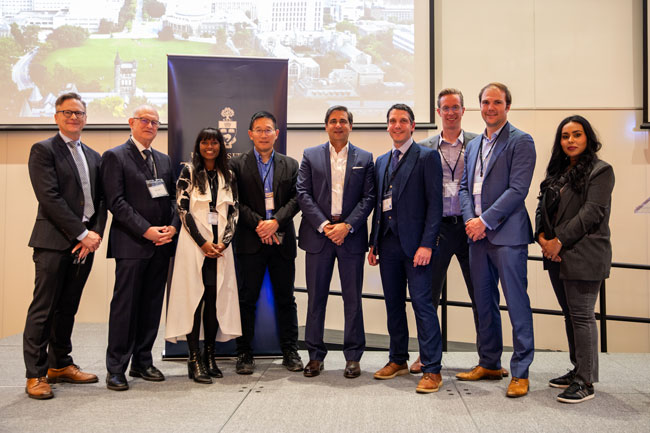
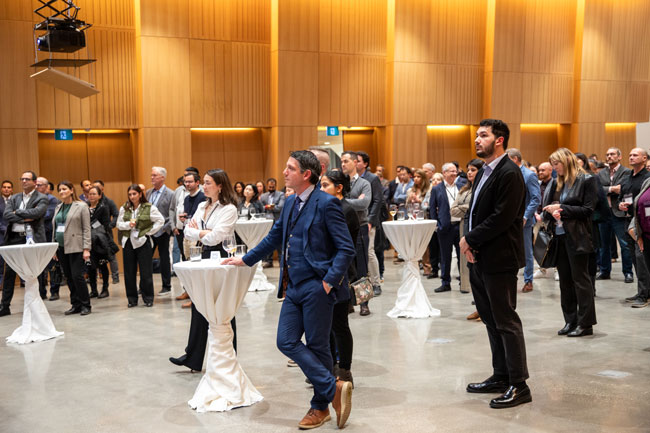
On November 21, more than 200 guests gathered at U of T’s Schwartz Reisman Innovation Campus to celebrate and explore mutually beneficial partnerships between academia, industry and community organizations.
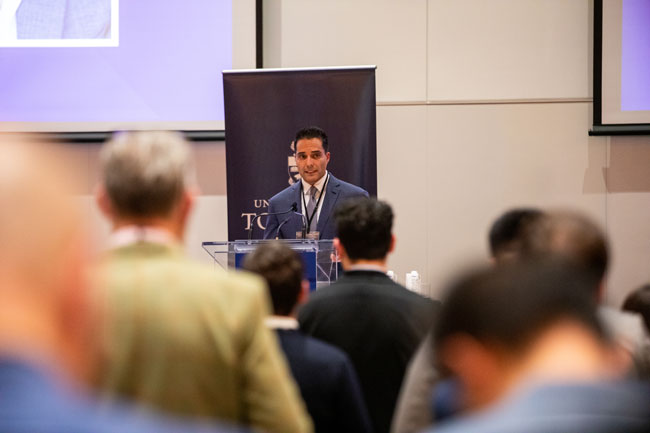
The event, held for the first time since 2019, was co-hosted by the U of T Engineering partnerships office and the University-wide Blue Door partnerships office, as well as by Toronto Global. Presenters included Arzhang Seddighi of Marvell Technology Inc., and Faisal Kazi, CEO of Siemens Canada, who gave the keynote address.
“I hardly need to point out how much the world has changed over the past five years,” said Christopher Yip, Dean of U of T Engineering at the event.
“What hasn’t changed is the need for the kinds of solutions that come from research, innovation and collaboration. Tonight, for the first time, we can proudly say we are welcoming all of our industry partners together at one time to celebrate the partnerships we’ve formed and imagine the partnerships yet to come.”