
Dr. Riccardo Comin, a post-doctoral fellow in The Edward S. Rogers Sr. Department of Electrical & Computer Engineering, has won the 2015 John Charles Polanyi Prize for Physics for his research into a rapidly emerging new class of materials, called perovskites, that could lead to more efficient solar cells and lighting.
The Polanyi Prizes are given annually to outstanding researchers in the early stages of their careers. The prizes, worth $20,000 each, are awarded in five areas: physics, chemistry, physiology or medicine, literature and economic science. Comin is the only recipient from the University of Toronto.
“By scientific upbringing, I’m a solid state physicist,” said Comin. “I take new compounds, films or crystals, crafted by chemists, and I analyse them to figure out what’s special about those materials.”
Comin’s work, under the direction of Professor Ted Sargent (ECE), is to investigate the mysterious properties of a very special family of hybrid organic-inorganic materials called perovskites. Perovskites show great promise for a range of applications, from more efficient LED technologies to high-efficiency flexible and lightweight solar cells.
Learn more about Comin’s recent work, published in the journals Science and Nature:
“My work in the Sargent Group has been to explore various key characteristics of perovskites, including their chemical composition, crystalline structure, and electronic structure,” said Comin. “Thanks to the Polanyi Prize, I plan to expand my work into using x-ray methods to look at the collective phenomena involving the reorientation of the organic molecules embedded in the inorganic crystalline structure of these hybrid materials.”
Comin earned his bachelor’s and master’s degrees at the Universita degli Studi di Trieste in Italy, both in physics. He completed his PhD at the University of British Columbia under the supervision of Andrea Damascelli, where he worked on characterizing quantum materials. When he joined the Sargent Group for his post-doctoral fellowship, he was ready to take a more applied approach to his research.
“I’d done a lot of fundamental materials science, and I was thinking, ‘What are the strategies and processes involved in harnessing and functionalizing the material properties that are key for devices that realize solar, imaging or lighting applications?’” he said “Here, we’re trying not just to develop high-quality materials, but also to combine them into device architectures that use the best properties of these materials. Ultimately, the metric for the quality of the work is the efficiency and performance of our devices.”
The John Charles Polanyi prize was created in honour of the achievement of John Charles Polanyi, recipient of the 1986 Nobel Prize in Chemistry and a professor in the University of Toronto’s Department of Chemistry.
“My congratulations to Riccardo, who is doing exceptional research,” said Professor Ted Sargent, vice-dean, research for the Faculty of Applied Science & Engineering, and Comin’s supervisor. “It’s particularly wonderful to see him honoured with this award, named after one of the greatest investigators in the University of Toronto’s long history.”
Learn more about this year’s five John Charles Polanyi winners.
University of Toronto engineering professor Molly Shoichet (ChemE, IBBME) has received the 2015 Fleming Medal and Citation from the Royal Canadian Institute in recognition of her outstanding contributions to the public understanding of science.
Shoichet joins the prestigious ranks of other distinguished recipients, including environmental activist David Suzuki, U of T chemistry professor and Nobel Prize winner John C. Polanyi and astronaut Chris Hadfield.
Among her many science outreach activities, in May Shoichet founded the groundbreaking initiative Research2Reality (R2R), which uses digital media to communicate cutting-edge research performed in Canada and spark nationwide awareness. R2R hosts more than 70 short videos featuring some of the country’s top research scientists and engineers describing their work in accessible terms. The initiative has garnered more than 1,000 social media followers in five months.
A world-renowned expert in tissue engineering and regenerative medicine, Shoichet holds a Canada Research Chair in Tissue Engineering and is a University Professor, the highest academic rank at the University of Toronto. She also serves as the senior advisor on science and engineering engagement to U of T President Meric Gertler.
“Research is the heart of invention, invention leads to innovation, and innovation is the core of our future,” said Shoichet, who was also named one of five 2015 L’Oréal-UNESCO for Women in Science Award Laureates from around the world earlier this year. “This is an opportunity to use modern communications tools to ignite a national discussion and inspire the next generation of researchers to invent the future.”
“On behalf of our Faculty, I want to congratulate Professor Molly Shoichet on this tremendous honour,” said Dean Cristina Amon. “As a world-leading researcher and educator with a remarkable record of innovation and discovery, she is an exemplary ambassador for the vital importance and impact of scientific research on our society, our well-being and our future prosperity.”
Research2Reality is supported by six research-intensive universities to date, along with the Ontario government and Discovery Science Channel, where some of the videos are televised.
This story originally appeared on U of T News.
The new federal Liberal government is bringing back the long-form census for 2016 and no one is more grateful than University of Toronto researchers.
The 61-page census was killed by the former Conservative government in 2011 prompting outrage from urban planners, health care advocates, scientists and demographers.
On Nov. 5, one day after being sworn in as minister of innovation, science and economic development, Navdeep Bains announced the return of the mandatory census, saying “we need good, reliable data.” Most Canadians receive the short census of about six pages but 2.9 million households will get the longer one in May.
There is a financial penalty for not filling it out, but Bains did not specify what it would be. In 2006, 93.5 per cent of the population filled out the forms.
U of T engineering professor Michael Carter (MIE) explained that “we are very grateful, so pleased to know it is back. We were very upset about [not having it].”
The long census had substantial practical benefits, he said. Carter is an industrial engineering professor and founder of the Centre for Research and Healthcare Engineering (now the Centre for Healthcare Engineering). He has worked on projects with hospitals, on home care, long-term care, medical labs and mental health institutions.
One area where the long-form census provided value was in the department’s work with Local Health Integration Networks (LHINs) in Ontario, particularly with a project that took in Scarborough and parts of eastern Ontario.
His department used data from the census to produce maps showing where the demand for services was the greatest, allowing the LHINs to work with their respective suppliers to meet those demands.
“One of the major concerns with health care is that it is relatively easy to measure utilization but how do we measure the true demand for it?” said Carter. “The long-form census is a valuable asset for that.”
Carter said “people are panicking about the baby boomers” reaching old age and the data from the long-form census will be invaluable in assessing their needs.
Timothy Chan (MIE), director of the Centre for Healthcare Engineering, said he used the long-form census in a study to determine where defibrillators should be used in public places, examining population densities and high risk areas for cardiac arrest.
The long-form census, Chan said, is “extremely critical” in determining demographic trends. “The more granular the data, the better.”
This story originally appeared on U of T News.
There’s a story behind the Buzzclip — a clip-on device that detects obstacles in the path of blind and partially sighted people and uses vibration to alert them to obstructions ahead.
And the story begins in India.
That’s where Arjun Mali spent years volunteering with his family at a blind school and orphanage. His late grandmother was one of the school’s largest supporters and he spent a lot of time helping prepare and serve food to the children.
“I used to spend a lot of time with kids that were the same age as me. We would play games and I would teach them bits of English and read them English books,” said Mali. “They especially loved Harry Potter.”
The orphanage provides a safe and secure environment for the children to live and learn, Mali said, but the stigma associated with blindness and the everyday chaos of Indian city streets means that many of the children grow up without ever leaving the compound. When they reach the age where the opportunity of college and further education is available, many students do not participate because they fear travelling outside.
Mali and longtime friend Bin Liu (CivE 1T4) — who pursued a minor in business while studying at U of T Engineering – channelled these experiences into a startup designed to make an important improvement in the lives of blind and partially sighted people.
“What really inspired this venture was meeting a 19-year-old student called Sunita who wanted to continue her education,” Mali said. “She would commute to a girl’s college about 35 minutes away from the orphanage and would constantly talk about her love of running.
“Everyday on her way back from school, she would try and find a place where she could safely run as fast as she could. It took her seven months to carefully find a route to a field that was big enough for her to run free. That’s when I decided that I had to do something, anything, even if it could make life a little bit better for her and many other incredible people like her.“
Through iMerciv, a company the two friends founded, they developed the BuzzClip: a small and discreet wearable device.
“The BuzzClip detects obstacles within the wearer’s immediate surroundings and provides intuitive vibrations at different frequencies depending on the distance to the object,” said Liu. “This allows the wearer to safely navigate around obstacles that might be missed by traditional aids.”
(Below, a six-foot-five user of the BuzzClip offers a video testimonial about how the device offers the kind of help a white cane cannot provide for someone who is tall.)
[youtube https://www.youtube.com/watch?v=0JxMPE-SGsg]
Mali and Liu developed their company at Techno2014, an entrepreneurship training program hosted by the Impact Centre, one of the University of Toronto’s nine campus-linked accelerators and part of U of T’s Banting & Best Centre for Innovation & Entrepreneurship (BBCIE).
“Every day, U of T entrepreneurs demonstrate the positive impact technology like the BuzzClip can have on people’s lives,” said Karen Sievewright, director of the BBCIE. “This social innovation addresses an important market need and I’m looking forward to seeing them exhibit their product at the university’s accessibility showcase at the end of this month.”
Since graduating from the Techno program, Liu and Mali have continued to build their company and experiment with different product models.
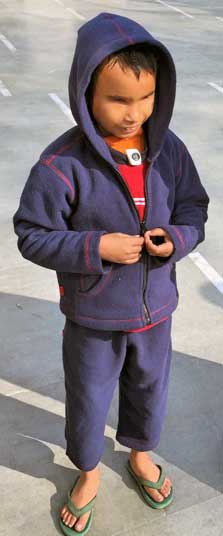 “Due to the social stigma attached with visual impairment, for those who are partially sighted, there are no solutions at all,” said Liu. “Many of these individuals tend to opt out of using a cane or guide dog as they do not want to stand out in public or be perceived as someone that needs help.”
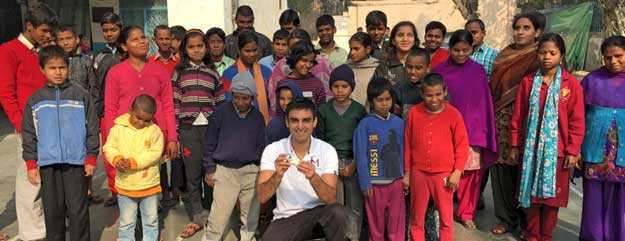
Last December, Mali returned to the school, Janta Adarsh Andh Vidyala in New Delhi, to test the BuzzClip prototype.
“It was extremely rewarding to go back to the orphanage and see the reactions when we tested our early prototypes. The kids and older students were amazed that they could so easily find people, walls, tables, chairs and navigate around the building like they have never done before.
“There was a lot of emotion and excitement as well as many questions, the main one being: why didn’t you bring this to us before?”
In addition to their work in India, Mali and Liu have been heavily involved in the local blind community. They regularly attend conferences as well as volunteer with organizations such as the Toronto Ice Owls, a hockey team for the visually impaired.
To raise funds for the first production batch of the BuzzClip, iMerciv launched its first crowdfunding campaign this month. The company raised almost 25 per cent of its $50,000 goal after only one day and has continued on to raise more half the goal of their campaign, which ends on November 21.
Some of the perks available for supporters include obtaining a BuzzClip for themselves or providing one for a blind person in India.
“Our goal is to create a long-lasting impact for communities living with blindness or partial sight, empowering them to lead a confident and independent life,” said Mali. “With the support we receive through this campaign, we can make this goal a reality and change the lives of millions of people living with vision loss across the world.”
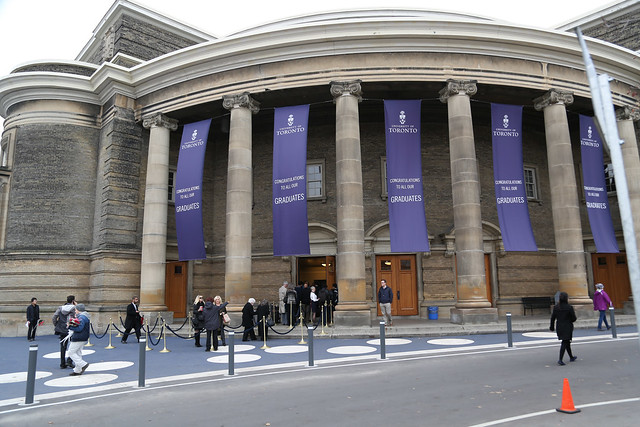
On November 10, amidst their professors, friends and family members, more than 400 graduate and undergraduate engineering students received their degrees at Fall Convocation.
Experience the celebration:
Engineers from the University of Toronto have discovered that human sperm can adapt their swimming style to their environment. While they usually gyrate in a three-dimensional, corkscrew-like motion, the team was the first to observe sperm slithering along a surface using a two-dimensional, snake-like motion. The discovery could offer a new way to select the fittest, highest-quality sperm to be used in infertility treatments.
Professor David Sinton (MIE) began studying the movement of sperm about six years ago, while he and his wife were seeking help conceiving. “We benefited from fertility treatments, and our story has a happy ending. The experience of infertility, however, was a real eye-opener.” he said. “I also wondered how a mechanical engineer could contribute to the treatment of infertility.”
Sperm selection is one of the aspects of infertility treatment where mechanical engineering can offer insight. Up to 90 per cent of human sperm in males with infertility have defects, e.g., poor motility, DNA damage or abnormal morphology such as malformed tails that cause them to swim in circles. In previous work, Sinton and his team used their expertise in microfluidics — understanding and manipulating the flow of fluids in very small spaces — to design tiny, fluid-filled channels through which they could ‘race’ sperm. They showed that the winners of this ‘sperm Olympic marathon’ tended to have higher DNA integrity, which in turn makes them more likely to produce a viable embryo.
But the marathon won’t be the only event in the sperm Olympics. Since then, the team has spent a lot of time observing sperm under the microscope to find other ways of selecting the fittest competitors. “You tend to see a lot of them near the walls of the channel,” said Sinton. “So the question has been, why are they there?”
To find out, graduate student Reza Nosrati (MechE PhD Candidate) collaborated with Professor Christopher Yip (IBBME, ChemE) and Amine Driouchi (Biochemistry PhD Candidate) on a technique called total internal reflection fluorescence (TIRF) microscopy. TIRF shows only what is happening within 100 nanometres of a flat surface. It was this method that allowed Nosrati to observe the sperm slithering in 2D for the first time.
“When you look at the TIRF microscopy images, you see that the head is actually aligned very closely with the surface,” said Nosrati, adding that they typically slithered for about one body length before returning to traditional 3D corkscrew motion. Nosrati measured the speed of both swimming modes and did calculations to compare their efficiency. “When human sperm swim in 2D, they are able to swim about 50 per cent faster,” he said.
Comparison of human sperm in 3D “corkscrew” mode versus 2D “slither” mode. (From “Two-dimensional slither swimming of sperm within a micrometre of a surface” by Sinton et al., published in Nature Communications)
Nosrati’s calculations showed that slithering is a more efficient motion when the fluid that the sperm are swimming through is thicker and more viscous. This fits with the environment in certain parts of the female reproductive tract. “It’s a favorable way to get through thick stuff,” said Sinton. “It seems to be a competitive advantage.” The work is published today in Nature Communications.
The team has more work to do before the finding can be applied. First, they have to figure out whether all sperm can do the slither motion, or just some of them. If slithering is indeed limited to a subset of sperm, they need to establish whether the ability to slither is correlated with desirable qualities, in the way that faster swimming is. But if it does work out, it’s not hard to imagine the team creating microchannels small enough that sperm could only get through by slithering. “We’re thinking of this like a field event,” says Sinton, returning to the Olympic analogy. “We could set up all types of different obstacles and see what gets through.”
The team is conducting such trials now. Increasingly common techniques for in-vitro fertilization — such as intracytoplasmic sperm injection, or ICSI — are designed for used with a single sperm cell. This makes finding that one-in-two-hundred-million winner all the more important.