
The Lassonde Mineral Engineering Program team triumphed at the fourth annual World Mining Competition, held from Oct. 29 to Nov. 1, 2015 at the University of Saskatchewan in Saskatoon. Students Seung Young Baek (Year 4 MinE), Matthew Hart (Year 3 MinE), Daryl Li (Year 4 MinE), and Peter Miszkiel (Year 4 MinE) placed first among 13 teams and 11 schools from Canada, Germany, India and the United Kingdom.
“Achieving the top spot at the World Mining Competition is a testament to the quality of the Lassonde Mineral Engineering Program and the excellent students it attracts,” said Professor Brent Sleep, chair of the department of civil engineering and acting director of the Lassonde Institute of Mining. “Competition was keen, and we congratulate our students on their hard work and being stellar ambassadors for the program.”
The multidisciplinary competition challenges teams — usually composed of business, engineering and geology students — to solve a mining strategy case centring on issues facing the international mining industry. Established in 2012, the World Mining Competition is Canada’s first undergraduate mining case competition, held each year at the University of Saskatchewan. Previously called the National Mining Competition, the name change reflects the global representation of its participants.
“Our win really showcases that U of T is a top mineral engineering school and a force to be reckoned with,” said Miszkiel. “The fact that we came to an interdisciplinary case competition with only mineral engineering students demonstrates how diversified and well-rounded our knowledge and skill sets are.”
The team attributes their success to the quality education of the Lassonde Mineral Engineering Program and effective teamwork.
“Our classes, work experience, up-to-date knowledge of industry trends and understanding of the case gave us the tools we needed to compete with some of the brightest minds in Canada and internationally,” said Hart. “We came together so well because we are all strong in different areas: finance, risk management, corporate social responsibility and technical issues.”
This year’s case focused on sustainability. Teams acted as consultants for a fictitious major mining company looking to acquire a junior exploration company with a lithium mine. Students had 36 hours to create a 25-minute presentation on a holistic proposal that considered social, environmental, economic and political factors. Teams faced two rounds of judges from accounting, human resources and government representatives, as well as mining executives.
“We learned that what really makes or breaks mining projects is the ability to gain social licence,” said Li. “Ultimately, the country’s government and people allow a company to operate in it, so it’s vital to engage them, hear their concerns and take their opinions seriously. With is in mind, our responses were much stronger than the other teams’.”
The students hope to bring this momentum to their next competition, the Canadian Mining Games, which will take place in February 2016. All four students are also on the U of T Mining Games team.
“We want to continue to participate and outperform in mining competitions and represent the Lassonde Mineral Engineering Program,” said Baek.
How does a second-year engineering undergraduate student nab a coveted internship with a global lighting startup like Nanoleaf? It helps to offer critical thinking, creativity and boundless energy — but having the boss share your intellectually impressive hobby doesn’t hurt.
When Nanoleaf CEO Gimmy Chu (ElecE 0T6) met electrical engineering student Frank Gu (Year 2 ElecE), he discovered that the young applicant was a member of U of T’s Blue Sky Solar Racing Club. Chu had worked on the acclaimed Blue Sky car almost a decade earlier.
“Gimmy gave me an assignment to prove my capability for the intern position,” Gu says. “Then, Gimmy and I proceeded to talk about Blue Sky Solar Racing at U of T.”
Nanoleaf, an LED startup from U of T Engineering alumni, recently announced a new product launch in partnership with Apple.
“The U of T presence is still very strong at Nanoleaf, and I believe it always will be,” says Nanoleaf spokesperson Leslie Chen. “When we were looking for interns to join our team, the first place we looked was at U of T.”
U of T News writer Brianna Goldberg spoke with Gu about his experiences at Nanoleaf, which he joined in early 2015.
How did Nanoleaf recruit you?
I met the Nanoleaf team during the You’re Next startup career fair 2015. They had a booth in the lower level of the MaRS building, and a very bright light bulb for demonstration. I remember the first thought that flashed past my mind when I saw what they were doing: “MY EYES!” So that blinding experience was how the Nanoleaf people made their impression on me.
I did the standard routine of shaking some hands, taking a card, and dropping off a resume. After one day, no reply, not even a confirmation. One week, still nothing. Finally, I emailed Gimmy Chu, Nanoleaf’s CEO, and he got back to me pretty quickly wanting to schedule a meeting to chat. We spoke briefly about some current technological trends. Gimmy gave me an assignment to prove my capability for the intern position. Then, Gimmy and I proceeded to talk about Blue Sky Solar Racing at U of T. Gimmy also worked on the Blue Sky car almost a decade ago, and I am an active team member of the Blue Sky team. I guess that’s how Nanoleaf recruited me!
Why did you want to work with them?
At first I just wanted a job for some additional learning experience and a challenge. But after meeting with Gimmy, I was immediately attracted to Nanoleaf. Of all the CEOs/managers/bosses that I have dealt with in the past, I can confidently say that Gimmy is the most “chill” (excuse my slang). At the time, I was merely a frosh in school for only half a year. Gimmy did not seem to mind.
He was interested in two things: what I can offer, and what I want to obtain from working with Nanoleaf. It is almost a feeling of urgency, a liveliness that shouts, “We are going to do great things, so if you are ready, hop aboard!” I think it’s this energy that drew me to them, and it’s because of this energy that I am staying with them. The first day at work, I stayed till 8 p.m. because I felt like I was finally in a place I belonged.
Does your work at Nanoleaf connect with or supplement what you’ve learned at U of T?The projects I work on at Nanoleaf give me an opportunity to convert theoretical knowledge obtained in the classrooms into real applications that serve real purposes. Specifically, the project management and strategies I learned in my Engineering Strategies and Practice course were used heavily during the discussion and design of a solution at Nanoleaf. Computer Fundamentals taught the basics of the C/C++ programming language, and writing kernel drivers at Nanoleaf allowed me to apply this abstract knowledge. These are some aspects that connect directly with my courses.
I believe university is also a place to learn how to socialize and form new connections and friendships. Beyond the scope of courses at U of T, working at Nanoleaf has exposed me to an exciting cross section of different social groups in our society: programmers, PhDs, electrical engineers, artists, writers, marketing and strategists. As a surprise, during my stay in the Shenzhen office, I was also offered the opportunity to visit Nanoleaf’s production facility, providing me with a rich first-hand experience of the modern electronics manufacturing industry.
So yes, I would say working at Nanoleaf complements my academic and social pursuit at U of T greatly!
What have you learned in working with Nanoleaf that surprised you?
Your “limit” is where you define it to be. When I first started working at Nanoleaf, I had only a preliminary knowledge of the programming languages used: C, Javascript and Swift. However, Gimmy let me begin with a highly experimental project that involved networking, servers, databases, cloud architectures, and whatever other jargon that’s out there in the industry. I took it up as a challenge. A month into the project, and I was already comfortable with the technologies involved. Two months in, I began cooperating with the rest of the team in the main program development. By May, I was patching up kernel drivers (advanced development) with guidance from Tom.
At Nanoleaf, I was surprised by my “limit.” I have no limit. We all have no limits. If I take something as a challenge, I can always push myself ever harder and further to accomplish it no matter how daunting the task. The key is to always believe in yourself and acknowledge that you can be your own greatest enemy.
This story originally appeared on U of T News.
If you or someone you know has benefited from a bone marrow transplant, then you may be more knowledgeable about stem cells and regenerative medicine (RM) than you think.
Bone marrow transplants, a procedure used in treating cancer that has been around for the last 40 years, is just one of the applications of stem cell science. RM includes stem cells, biomaterials and molecules and it is used to repair, regenerate or replace diseased cells, tissues and organs.
“Regenerative medicine is exciting because it offers opportunities to learn about the fundamentals of tissue and organ development, form and (normal and diseased) function, as well as provide new strategies to treat and perhaps one day cure devastating degenerative diseases,” explains Peter Zandstra, an engineering professor at U of T’s Institute of Biomaterials & Biomedical Engineering (IBBME) and a leading member of the University of Toronto’s Medicine By Design initiative.
The Canadian RM community met in Toronto this week for its annual scientific conference: the Till & McCulloch Meetings, named for the University of Toronto researchers James Till and Ernest McCulloch who discovered transplantable stem cells in 1961.
The conference was a who’s who of world-renowned researchers affiliated with U of T, including engineering professors Molly Shoichet (ChemE, IBBME) and Milica Radisic (ChemE, IBBME), as well as Janet Rossant (Ontario Institute for Regenerative Medicine and SickKids), Gordon Keller (McEwen Centre for Regenerative Medicine), Andras Nagy (Mount Sinai Hospital) and Armand Keating (University Health Network). A quarter of the attendees at the conference had a direct affiliation with the university.
“It was really gratifying to host the Till and McCulloch Meetings in Toronto and have Jim Till preside over the lectureship and meeting. U of T researchers were represented very well at the conference,” says Zandstra, who also heads up the Centre for Commercialization of Regenerative Medicine . “Molly and Milica showcased exciting work combining stem cell derived cells into biomaterials for transplantation and organ modeling, while Sid Goyal (Physics) presented new work on clonal dynamics during blood stem cell transplantation.”
With its tremendous concentration of stem cell scientists and bioengineers, Toronto boasts one of the largest combined biomedical and biotechnology clusters in North America. More than 11,000 principal investigators and technicians operate from nine teaching hospitals and 37 research institutions.
Toronto’s prominence in this field is expected to grow even stronger when the Centre for Commercialization of Regenerative Medicine, a translation centre working closely with U of T, brings together Medicine by Design, OIRM and cell manufacturing capabilities under one roof at MaRS Discovery District. The “RM village” being envisioned for downtown Toronto will solidify the city’s reputation as a RM leader and place to watch.
This year’s Till & McCulloch Award Lecture was presented by Timothy Kieffer from the University of British Columbia. He was being recognized for his work in diabetes, including breakthrough research published in Nature Biotechnology last year.
Zandstra, the chief scientific officer for CCRM, and a member of the award selection committee, called the paper “a fantastic example of Canadian leadership in an important and competitive area of regenerative medicine.”
It was a celebration of collaboration at Victoria College’s Alumni Hall last Wednesday as students, professors and industrial partners gathered to recognize the latest achievements of the University of Toronto Institute for Multidisciplinary Design and Innovation (UT-IMDI).
Founded in 2012 by Professor Kamran Behdinan (MIE), UT-IMDI catalyzes multidisciplinary collaborations between engineering students and industry partners. Undergraduate and MEng students apply for paid internships lasting several months, providing engineering solutions for companies in a variety of sectors. The students get a vibrant experiential learning environment, while partner companies benefit by leveraging innovative new ideas and identifying potential future talent.
Dean Cristina Amon congratulated the latest cohort of 24 UT-IMDI graduates. “You have had a unique opportunity to address industry challenges and develop key communications, professional and leadership competencies by collaborating with our partners to create innovative technical solutions,” she said. “You have worked intensely on these projects and you have more than risen to the challenge.”
Todd Young, chair of UT-IMDI’s Advisory Board and vice-president and general manager of customer services at Bombardier Commercial Aircraft, received the Recognition Award for his work in helping the program grow over the last three years. In his remarks, he noted that some of the graduates have already been hired by the industry partners. “That is a true testament to the value this program brings,” he said.
The completed projects ranged from intelligence analysis to advanced manufacturing and aircraft design. Below are three examples of student success:
Speeding up repairs
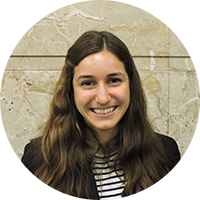 Gabrielle Sebaldt (MechE 1T5+PEY) worked at Bombardier, helping to standardize and speed up the repetitive process of making repair methodologies for composite aircraft components. She created a software script that asks the user questions about the repair they are making through a series of forms, then creates a document based on their inputs. “The form sequence responds to your previous answers, so you’re not asked for information that is not relevant to your repair,” she said.
Sebaldt really enjoyed the experience of working at a company. “The camaraderie was very strong,” she said. “People help each other out, and I really felt like I was part of the team, even though I was the intern.” She hopes to continue doing engineering design in her future career.
Anticipating future demand
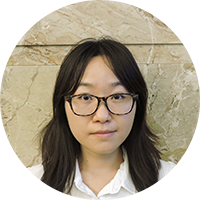 Lu Liu (MechE MEng candidate) took on a project for SPP Canada Aircraft Inc. that looked at a classic problem in manufacturing: customers often need a shipment of parts more quickly than they can be created from scratch. Liu created a mathematical model that would accurately forecast the number of spare parts that are likely to be required at a given time. This allowed the company to optimize their process and avoid having too much or too little stock on hand at any time.
Liu said that working for a company was a great way to translate what she learned in the classroom into industrial solutions. “They told me about their pressures, and I applied my knowledge,” she said. “It gave me confidence.”
Predicting and extending product life span
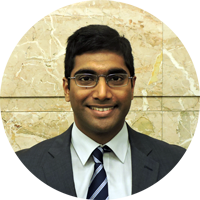 Jayant Yerrapragada (AeroE MEng 1T5) worked for Honeywell Aerospace on flexible air heaters that are commonly used to maintain cabin temperature in a range of aircraft. He statistically analyzed a number of failure cases to get a sense of what faults or common causes of damage can cause them to stop working. He then developed a mathematical model to predict the average life span of the heaters and identify ways in which this could be improved.
“If there had been no UT-IMDI, I would have had to apply for projects with ten different companies,” said Yerrapragada. “With this program, students only send their resume to one person.” Yerrapragada’s internship was so successful that it was extended from four months to a year; he is now working full-time for Honeywell. “I met wonderful people, and I had a blast,” he said.
Nanoleaf, the fast-growing startup from U of T Engineering alumni, launched a new product Oct. 27 tied to Apple’s HomeKit line.
“We’ve received Apple’s approval to join the HomeKit ecosystem,” said Nanoleaf spokesperson Leslie Chen.
The Nanoleaf Smarter Kit combines “the world’s most energy efficient smart bulb” and a stylish, connected hub with Apple’s Siri-enabled HomeKit, Chen said. This will allow users to wirelessly control the startup’s award-winning LED bulb designs by simply using their voice.
“With the emergence of smart home products, lighting is entering a whole new territory,” said Chen, one of a growing number of recent U of T grads recruited to Nanoleaf.
 “Imagine sitting in the living room and being able to control all of the lights in your home with just a few words,” she said. “Pretty revolutionary to say the least!”
Chen said the Ivy is an app-controlled bulb that users can turn on, off and dim using their Apple phone, tablet or smart watch. The Nanoleaf Smarter Kit is set for release in selected Best Buy locations in early November, she added, with more details still to come.
“Integrating technology like this, especially through a company as famed as Apple, is a great way to reach a wider audience and get access to a new market,” said Karen Sievewright, managing director of U of T’s Banting & Best Centre for Innovation & Entrepreneurship. “It’s a smart move by Nanoleaf.”
The green tech startup founded by Engineering alumni Gimmy Chu (ElecE 0T6), Tom Rodinger (IBBME PhD 0T7) and Christian Yan (ElecE 0T6) has grown from a massively successful Kickstarter project in early 2013, based on the strength of their stylish “world’s most energy efficient” bulb, to a bustling company with approximately 40 employees spread between its Toronto and Shenzhen, China, offices.
The venture recently scored funding from ‘Asia’s richest philanthropist,’ debuted products at fairs in New York, Shanghai and Tokyo and won a reddot design award for 2015.
- Read about Nanoleaf’s Kickstarter surpassing its goal by 500 per cent
- Read about ‘Asia’s richest philanthropist’ investing in Nanoleaf
- Read about Nanoleaf creating green jobs in Canada and China
- Read about Nanoleaf’s revolutionary dimming bulb
Chen says the next big step for Nanoleaf will be releasing a product they believe will change the way people think about lighting.
“Light is not merely illumination. Light is atmosphere, it wakes you up after a night of sleep, it keeps us safe and content, just as much today as two million years ago,” said Chu, CEO of Nanoleaf. “We want to make products that will transform simple lighting solutions into meaningful experiences.”
Nanoleaf made the announcement as U of T’s Impact Centre prepared to host a symposium celebrating the International Year of Light.
Chen says the gains of Nanoleaf rely on the team members they continue to recruit from U of T.
“The U of T presence is still very strong at Nanoleaf, and I believe it always will be,” said Chen. “When we were looking for interns to join our team, the first place we looked was at U of T.”
Watch for U of T News and Engineering News stories profiling Nanoleaf’s three undergrad interns, Jeanny Yao, Frank Gu and Josh Hwang in the coming week.
“Nanoleaf will always be very closely connected with U of T: our three founders are all alumni and without the school, they would have never met in the first place,” said Chen.
“It will always be part of our identity and I think that’s why U of T grads are a good fit for us.”
This story originally appeared on U of T News.
Originally published in the 2015 issue of Interfaces Magazine.
Not so long, lessons on bioethics and the history of medicine might have seemed out of place in an engineering program, but today, they blend easily into the diverse menu of courses in U of T’s Bioengineering Minor. The program was launched in 2006 in the recognition that biological applications were increasingly taking center stage in technological advancement.
“We also recognized that students were quite curious to learn more,” says Professor Emma Master (ChemE), director of the Bioengineering Minor. “They were hearing more about it in the news and were curious what bioengineering means — and what it can do.”
Although bioengineering only congealed into a recognized field in recent decades, Master notes that technological processes and designs rooted in biology have a long history. The use of microbes to ferment yogurt, cheese, beer and wine, for example, are all ancient applications of biology. Microbial processes have also been used in sewage treatment for over a century. Today’s bioengineering has leapt beyond yogurt and beer to span everything from developing brain-computer interfaces to synthesizing plant-based polymers that could replace plastic.
“The common thread is the application of biology in many areas,” says Master.
Bioengineering students like Jandi Kim (ChemE 1T5), who graduated in the spring, have the opportunity to conduct research that gives them practical and theoretical know-how, and helps lay the groundwork for new technologies. For her undergraduate thesis, Kim assessed the toxicity of air samples across Canada — specifically, the oxidative capacity of particulate pollution in the air.
Oxidative damage to the skin, for example, contributes to skin aging. Particulate matter in the air, especially the tiny, 2.5 micrometer variety that Kim studied, has been linked to respiratory diseases, including lung cancer, possibly by inducing oxidative stress. Under the supervision of Professor Greg Evans (ChemE) and former postdoctoral fellow Krystal Godri Pollitt (ChemE 0T5, MASc 0T8), Kim worked to determine just how much oxidative damage these particulates could inflict on our lungs. She tested 392 samples from British Columbia, Alberta, Ontario and Quebec by mingling the particulates with synthetic lung lining fluid. The fluids contained the same anti-oxidants found in the natural equivalent, and after incubating the samples with the “lung lining” for several hours, she measured how much these anti-oxidants had been depleted.
After nearly a year of extractions, pipetting, measurements and data analysis, Kim appeared to have her preliminary results revealing variation in particulate toxicity across the provinces, as well as differences between rural and urban air. Kim also learned how research is an iterative process and rarely runs smoothly on the first go. Curious patterns in Kim’s control data revealed there’d been a systemic error somewhere along the way, possibly in mixing or pipetting. Until the error is found and corrected, her results remain tentative, but despite the complications, the process has left Kim satisfied.
“I was very glad that I did something from the beginning, and I found the result from my research,” she said. Though she graduated in June, she’s still working to pinpoint the cause of the error and is keen to see the project through.
Katarina Neskovic (ChemE 1T5) can relate.
“Things don’t always go as planned — that’s what research is all about — but when it does, it’s a wonderful feeling,” says Neskovic, who completed her undergraduate thesis with University Professor Michael Sefton (IBBME) focusing on the role of a novel biomaterial and the complement protein system on blood vessel growth.
Endothelial cells are a critical component of blood vessel growth, or angiogenesis, which line the interior vessel walls and migrate to the site of a wound or developing tissue.
“On the global scale, we want materials that can promote blood vessel growth for tissue engineering applications,” says Neskovic. “One of the cornerstones of tissue engineering is bringing a blood supply to the tissue engineered organ.” Without blood, the introduced organ could not survive.
For Neskovic, a chemical engineering graduate, work with tissue cultures was an entirely new experience, but she says she quickly learned what she needed to and got her experiments underway.
Neskovic’s experiments focused on a polymer called MMA, short for Poly(methyl methacrylate-co-methacrylic acid), that previous studies had shown promoted blood vessel growth.
Researchers aren’t sure exactly how this occurs, so to start answering that question, Neskovic conducted what are called “scratch assays”: simulating wounds in thin layers of lab-grown endothelial cells. As wounds heal — even in lab-grown tissue — endothelial cells migrate toward the gap. When Neskovic threw MMA into the mix, she found it altered that rate of cell migration.
This finding alone doesn’t solve the puzzle of MMA’s growth-promoting powers, and further research will be needed to confirm Neskovic’s results, but her research contributes incrementally to finding the answer.
Since graduating, Neskovic has participated in the Next 36 program, an incubator program that accepts just 36 young entrepreneurs across Canada each year. She’s not sure where she’ll head next, but says she’s loving the entrepreneurial world.
Kim plans to pursue work in the environmental or pharmaceutical industry and she hopes to eventually go on to graduate studies.
Meanwhile, the Bioengineering Minor continues to attract new students, sprouting a second minor last year, which focuses exclusively on medical applications of bioengineering.
“Advances in life sciences are escalating with the advent of genomics and automated platforms for studying biological systems,” says Master. “All this means that understanding fundamental aspects of biology is becoming increasingly an important part of being technically savvy.”
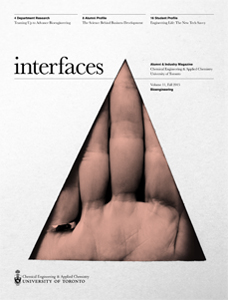 Interfaces Magazine is an annual publication from University of Toronto Department of Chemical Engineering & Applied Chemistry.