
With a week left before Hult Prize finals at the Clinton Global Initiative’s annual meeting, U of T’s Team Attollo is gaining momentum, finding partners in India and Africa and picking up interest from educational organizations.
The innovation driving all the excitement? That’s “talking stickers”, the system created by the team of engineers and neuroscientists to improve literacy for impoverished children around the world.
One of only six teams left from more than 20,000 entrants in the world’s largest student competition on global challenges, the social entrepreneurs developed a handheld scanner called ollo which uses stickers with QR codes to bring words to life through songs, nursery rhymes and short stories. It’s been attracting media attention locally and in developing countries around the world where they’ve been testing the product.
If they win the finals on Sept. 26, at an event hosted by former President Bill Clinton in New York City, the team gets $1 million in seed capital funds that will go toward building the social startup and putting affordable Attollo devices into the market.
For team members Aisha Bukhari (ElecE 0T8), Peter Cinat (CompE 0T2) and Rotman MBA graduates Lak Chinta and Jamie Austin, it’s been a long road since winning the U of T competition back in December. Between them, the group has three engineering degrees, two PhDs in neuroscience and four MBAs, but they’ve had to learn new skills like how to make a pithy business pitch and how to capture investor and media interest.
[vimeo 139652753 w=500 h=281]
Talking Stickers by Atollo from Janelle & Steve Miller on Vimeo.
In March, they won the Hult regional rounds in Dubai. They’ve all left their full time jobs to focus on the startup, going through several incarnations of their initial idea, absorbing advice from profs and other social entrepreneurs and tweaking their product.
But it’s been worth it for the group. With this year’s competition focused on early childhood development in the urban slum, team members say they feel their Attollo device has a real shot at reducing illiteracy in the developing world.
“Studies show that underprivileged children are exposed to 30 million fewer words by the age of 3 compared to their more privileged counterparts – this has a big impact on their vocabulary,” said Attollo team member Austin.
“By the time these children reach school, this gap widens to the point where they struggle to succeed in school and then later in life. We traveled to India and Kenya, and we found that the concept of the word gap was also prevalent. These children struggle with language and vocabulary development. The good news is that parents can solve the word gap by talking, reading and singing more to their children every day.”
But parents sometimes struggle with illiteracy, too. That’s where the Attollo device comes in.
Easily scalable due to its low cost, the device uses stickers to prompt playback of pre-recorded educational audio, helping to overcome parents’ own challenges with literacy. Parents can record new vocabulary, short sentences or pages from a book in their own voice. They can use the device to complete interactive activities with their child. Or, when a parent is busy working, it can be left in the hands of children to scan stickers and learn from the playback.
As part of the Hult competition, the team has been testing Talking Stickers this summer at schools in disadvantaged neighbourhoods of Hyderabad, India and Mombasa, Kenya. They’ve worked with such NGOs as the Aga Khan Foundation and Pratham, the largest early childhood development NGO in India.
Thanks to those trial runs, Pratham, Aga Khan and Right to Play have signed letters of intent, expressing interest in obtaining several hundred devices and stickers. UNICEF has also expressed interest.

U of T Faculty of Information Associate Professor Matt Ratto helped with product development. And along the way, staff and faculty from U of T’s Rotman School of Management and across U of T rallied to help Team Attollo, with everything from feedback on pitches and presentations to financial support.
“Students and faculty at U of T know that the challenges we confront as a global community are more intertwined, complex, and social than ever before,” said Vivek Goel, U of T’s vice-president of research and innovation. “Team Attollo represents the kind of critical thinking, problem-solving, teamwork and ethical and social reasoning that the university encourages and supports in its social entrepreneurs.”
Thanks to Rotman School of Management Professor Dilip Soman, the group got a face-to-face meeting with government officials in the state of Telengana. Those officials also want to partner with the group to purchase the devices and stickers for government-run early childhood development initiatives.
“My role was simply to talk about the team’s product and potential to the Canadian Trade Office in Delhi and to request their help,” Soman said. “The Canadian Trade Commissioner in New Delhi, Ivy Lerner Frank, has been a great supporter of our work at the India Innovation Institute, and she saw this as a classic example of the kind of innovative social enterprise ideas that need to be supported. Ivy and her office facilitated meetings between the team, and the Telangana government, resulting in the memorandum.”
Team members also participated in an incubator at the Hult International Business School in Boston, receiving mentoring and strategic planning advice.
For this next week, the group is focused on last-minute preparations ahead of the finals on Sept. 26.
After that, they’re working with Autodesk Research, who crafted the device, and Professor David Johns (ECE), who is helping the group make the device more compact and affordable. They’re also considering secondary markets for Talking Stickers such as collaborations with consumer packaged goods and medical/pharmaceutical companies to help people around the world who can’t read to comprehend instructions on drugs and other goods.
Attollo members say they’re excited to work with U of T’s Dr. Stanley Zlotkin and the Centre for Global Child Health at SickKids Hospital in Toronto to use the Talking Stickers concept to help families understand how to use Sprinkles – a UNICEF child nutrition product. Stickers can be placed on Sprinkles sachets to provide audio instructions on proper product usage when scanned – in any dialect or language around the world.
It’s the work with Pratham that has them the most excited. They see the potential of putting reading devices into the hands of children who can’t afford to go to school.
“The way we’re going to distribute this into our target area is by finding a like-minded partner who shares our mission of impacting underprivileged children in communities we need to serve,” Cinat said. “We think we’ve found such a partner in Pratham. Their mission is to teach and support children who have been left behind. Pratham serves 1 million children under the age of 6 today in India, operating in 21 out of 29 states.”
“Still, there’s over 20 million people not served with any form of early childhood development. That’s the market that together with Pratham we are going to target.”

This story originally appeared on U of T News.
A team of U of T Engineering alumni and students has created the fastest human-powered vehicle on earth — a bicycle that reached a top speed of 139.45 kilometres per hour (86.65 miles per hour) at the World Human Powered Speed Challenge in Battle Mountain, Nevada, last week.
The 25-kilogram speed-bike, named Eta after the Greek letter used to denote efficiency in engineering equations, broke the previous 200-metre world record of 133.8 km/h (83.13 m.p.h.) on Sept 17. It then broke its own record twice over the next two days, clocking its final record-holding speed on Saturday, Sept 19. The bike was piloted by U of T Engineering alumnus Todd Reichert (EngSci 0T5, UTIAS PhD 1T1), who, along with fellow alumnus Cameron Robertson (EngSci 0T8, UTIAS MASc 0T9), founded Aerovelo, a company that designs and builds human-powered vehicles.
“We knew going in Eta was the fastest bike we’ve ever built, but the course at Battle Mountain is so unique, that this was the first time we really saw the bike perform to its full potential,” said Reichert. “I’m really proud of the work we’ve done.”
About a dozen teams competed in the World Human Powered Speed Challenge, which has been held annually for 16 years. While a few of the teams represented engineering faculties at other universities, most were simply dedicated enthusiasts of pedal power.
Reichert and Robertson are no strangers to world records. The duo are also well known for winning the Igor I. Sikorsky Human-Powered Helicopter Prize for the first-ever sustained flight of a human-powered helicopter in 2013 and for building the world’s first human-powered ornithopter in 2010, a machine that flies by flapping its wings like a bird.
Eta was created at the University of Toronto and is the result of a long-standing partnership between Aerovelo and U of T Engineering’s Human Powered Vehicle Design Team (HPVDT).
“Both teams benefit from [the partnership],” said Calvin Moes (EngSci 1T5, MSE MASc Candidate), current captain of the HPVDT. “They get experienced people to help them, and a workshop here at U of T, while we get the benefit of the research they do.”
Other HPVDT members who worked on Eta included Alex Selwa (EngSci 1T5), Trefor Evans (EngSci 1T4), Victor Ragusila (EngSci 0T8, AeroE PhD candidate), Peter Wen (Year 3 MechE) and Tomek Bartczak (EngSci 0T2). HPVDT also fielded its own bike in this year’s competition. Called Bluenose, the vehicle was built for the 2012 World Human Powered Speed Challenge, and raced by Aerovelo in 2013.

Making high-speed bicycles is all about minimizing the loss of energy to road friction and air resistance. “On a regular road bike, you hit that kind of break-even point where you’re losing as much as you’re putting in at about 30 or 40 kilometres per hour, mostly because of the air resistance, “ said Moes. “We get rid of that almost entirely.”
This is done by surrounding the bike in a carbon fibre shell, known as a fairing, which helps it slice through the air. Making a windshield is a pain — transparent materials are more expensive and harder to work with than carbon fibre, and anything with that much curvature would distort the light so much that it would be hard to see out of anyway. For that reason, riders in both Eta and Bluenose navigate by watching a small screen connected to a tiny camera in the tail fin.
Other innovations involve super-hard tires that don’t stick to the road and a gearshift designed to minimize any energy loss to friction, heat or even sound. That doesn’t mean the ride is quiet though. “Because the shell is so thick, it resonates with the road,” said Moes. “At full speed, it sounds like a jet engine in there.”
Profesor Jun Nogami (MSE) is the faculty advisor for HPVDT; he posted live updates from Battle Mountain in real time on his blog. “It’s always a great experience for our students to be involved in building and racing these bikes,” he said. “They also get the opportunity to work with and to be inspired by graduates such as Todd and Cam. Competing at Battle Mountain is the icing on the cake, where we meet and learn from like minded people from all over the world.”
Aerovelo and the HPVDT have much to be proud of. ““This has been a dream of ours for years, but we took a different approach this year to breaking the record and spent more time preparing and testing,” said Robertson. “It feels incredible to have all that preparation pay off.”
Footage of Aerovelo’s first record-breaking run on September 17, 2015. The team followed this up by breaking their own record — twice — and recording a final speed of 139.45 kilometres per hour (86.65 miles per hour).
A more reliable way to remember birth control pills, a single tool that fixes most bike problems, and a satellite communications network that can help ensure tragedies like the missing Malaysian Airlines flight MH370 never happen again.
Students from across U of T Engineering pitched these and 10 other startup ideas at this year’s Hatchery Demo Day last Thursday, vying for $42,500 in seed funding and the chance to see their ideas boosted toward commercialization.
“You have made us proud, you have delivered and you have raised the bar once again,” said Joseph Orozco, executive director of The Entrepreneurship Hatchery at U of T Engineering. “Today is the culmination of a rigorous journey, but what you’ve started is just the beginning.”
Prior to the Demo Day competition, students developed their ideas through the Hatchery’s intensive summer program that involved building prototypes, assessing business viability and receiving valuable mentorship from professors and industry experts. Teams will continue to access the Hatchery’s resources to build their ventures in the time ahead.
The seed funding at Demo Day was provided through three prizes donated and presented by alumnus Anthony Lacavera (CompE 9T7), chairman and CEO of the Globalive Group and Wind Mobile, as well as a fourth — the Orozco prize — which was provided through funds raised by the students themselves.
See the winning teams in action in this video from Hatchery Demo Day 2015
Here are this year’s four winners:
Kepler Communications ($20,000 Lacavera Prize)
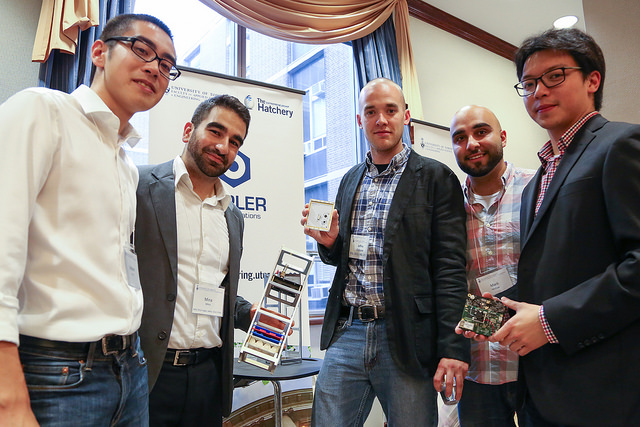
Kepler Communications aims to do nothing less than revolutionize communications infrastructure in space. Despite a rapidly increasing number of satellites — including small, standardized devices known as CubeSats — most can only relay their information to Earth when they are near a ground station. This leads to long periods of data blackout, which in turn limits the usefulness of satellites for many applications, such as real-time aircraft tracking.
Mina Mitry (EngSci 1T2, AeroE MASc 1T4) and Jeffrey Osborne (AeroE PhD Candidate) met on the University of Toronto Aeronautics Team (UTAT). “Jeff approached me with the problem that small satellites are facing this big communications bottleneck,” said Mitry. “I thought it was an amazing idea.” They brought on board Wen Cheng Chong (EngSci 1T3) and Mark Michael (ECE PhD Candidate) who were also part of UTAT. Together, the team began work on what they call a “cell phone tower network in space.”
Their idea is that existing satellites will convey their data to Kepler’s network of 50 low-cost, easily replaceable CubeSats specifically designed for data transmission. These in turn will pass data via a secure protocol to a network of five ground stations at various geographical locations. Mitry says that as few as 10 Kepler CubeSats and one ground station would be enough to provide a useful system. At the Demo Day event, they unveiled their first CubeSat prototype, and they hope to have their first launch by the end of 2016.
Winning top prize “feels fantastic” according to Mitry: “we believe that we have the best possible people we could, and it’s reaffirming to get validation that we really are the right team to do this.”
TeleHex ($10,000 Lacavera Prize)

Peter Wen (Year 3 MechE) has been a serious cyclist for many years, and honed his craft working on the University of Toronto Human Powered Vehicle Team. His company, TeleHex, aims to make bike repair easier, not just for pros like himself, but for newbies as well. “Biking should be a simple pleasure, but a lot of people don’t fix their bikes,” he said. “One of the barriers is that they don’t want to mess around with the tools.”
For example, on many bikes, the hexagonal-shaped socket that adjusts the handlebars might be a completely different size from that which controls the brake line. This forces riders to carry and fumble around with many different-sized keys.
Wen has designed a unique telescoping tool that automatically adjusts to fit the metric bolt sockets on most bikes. He partnered with U of T Rotman MBA student Rishi Persad to form the company.
The device is half the weight and volume of products currently on the market, and it generated major buzz when the team posted about it on the online forum Reddit. In addition to the Hatchery prize money, Wen and Persad are well on their way to raising a further $15,000 in a Kickstarter campaign.
“I’m very humbled that there are so many people enthusiastic about being early adopters of this technology,” said Wen. “It’s an engineer’s dream come true.”
MedChart ($10,000 Lacavera Prize)
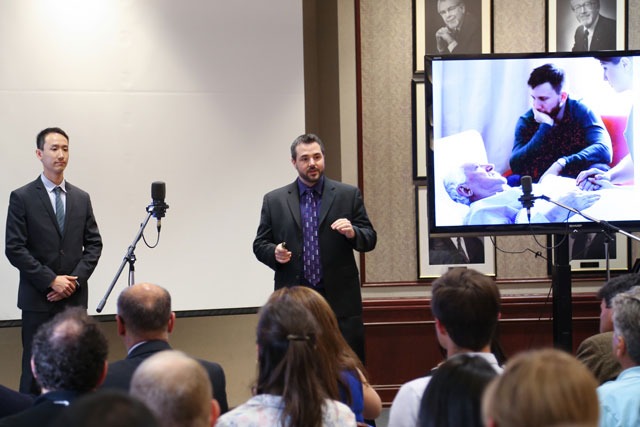
Today, most of our personal information — from university transcripts to credit ratings — is stored online. Yet more than 60 per cent of our medical information exists only in paper format, and is not easily shared between hospitals, doctors and specialists.
James Bateman (EngSci 1T3, ECE PhD candidate) experienced this limitation first hand while watching his family care for his grandmother after she broke her hip, as well as his father-in-law, who had been diagnosed with cancer. “My mother-in-law ended up carrying around this massive 300-page binder,” he said. “There is no reason why in 2015 our medical records should not be as accessible and secure as our banking information.”
Together with his business partner Derrick Chow (EngSci 1T3, AeroE MASc candidate) Bateman aims to simplify the process of obtaining and maintaining medical records. For a fee, their company, MedChart, will do all the legwork of obtaining records from any care provider and uploading them to its secure, online platform. Scans of the records can be accessed from anywhere with an Internet connection, and MedChart will conduct all the follow-up to make sure that they stay up to date. Users can easily interact with the records, for example, to correct errors. They can also print medical ID cards that connect to the database using QR codes.
The team plans to use their prize money to subsidize the cost of obtaining their first set of records. Their goal is to have upwards of 1,000 subscribers by the end of 2016. Bateman attributes MedChart’s success to the mentors they had at the Hatchery. “Even when Derrick and I thought that we had something that was good, they’d tell us: ‘No, you have to make it better,’” he said. “They kept pushing, and I think that’s what brought us to the next level.”
Pillsy ($2,500 Orozco Prize)
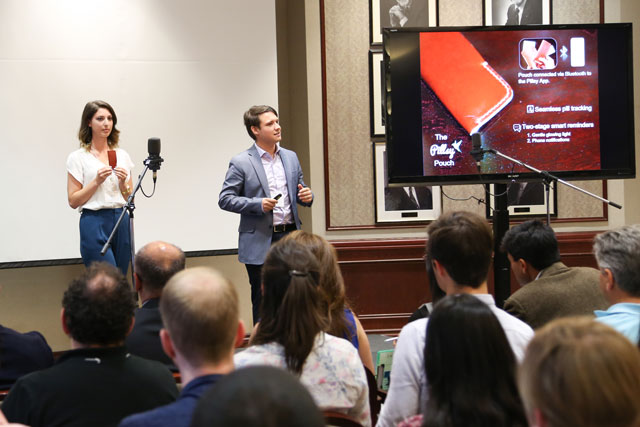
Late last year, Valentin Peretroukhin (EngSci 1T3, AeroE PhD Candidate), Eric Ma (EngSci 1T3, BioMedE MASc Candidate) and Tony Zhang (EngSci 1T3, AeroE MASc Candidate) all came together around a major health-care problem: people who forget to take their pills when they are supposed to.
This is an issue with many medications, but particularly with birth control pills, which are used by 80 per cent of women in Canada at some point in their lifetime. The team soon expanded to include Simon Bromberg (EngSci 1T3, BioMedE MASc candidate), Sandra Fiset (MHSc Candidate) and MPH Epidemiology Candidate Courtney Smith.
While there are dozens of apps designed to help women remember to take their pill on time, they all suffer from the same drawback. “They’re all passive and therefore ineffective,” said Fiset. In other words, they rely on people to enter information manually, a task that can be forgotten almost as easily as the pill itself.
The team’s solution was simple: Ma, a hobbyist leatherworker, designed a small pouch to hold the pills. This pouch was then modified with off-the-shelf Bluetooth sensors that connect to a user’s mobile phone. Unlike other apps, Pillsy can use the sensors to tell if a user did indeed take her pill, and can provide her with gentle reminders until she does. It also provides helpful information on what to do if a pill is missed.
The team hopes to create an initial run of 150 pouches by the end of this year. They will be used in a research trial designed by Smith to confirm that the product really does improve compliance. Feedback from the trial will also be used to further improve the product. “We wanted to find a niche where we could sink our teeth into the problem,” said Peretroukhin. “This is a user group that we feel could really use the technology.” If successful, the long-term plan is to expand the product into other types of medications.
For more information on The Entrepreneurship Hatchery and the other teams who competed, please visit the Hatchery website.
Undergraduate students can expect to attend approximately 1,440 lectures during their time at U of T Engineering. Although most will be informative, not all lectures will feature an inspiring talk by one of the Faculty’s most esteemed alumnae.
On Sept. 10, Catherine Lacavera (CompE 9T7), director of intellectual property and litigation at Google, flew in from Silicon Valley to welcome this year’s incoming class with an encouraging plenary address at Convocation Hall.
“You’re going to conquer engineering and you’re going to use it to innovate and optimize in any field of endeavour,” Lacavera said to the capacity crowd of future 1T9 graduates. “You’re going to make your work easier, and your life and the lives of others better.”
Lacavera told the students her plan was always to end up in patent law, but she chose to study engineering because it provides a strong foundation for any career. People know engineering is a challenging degree that provides a baseline education in math and science, as well as problem solving and design thinking.
Dean Cristina Amon, who also spoke to the students, emphasized that although the journey may not always be easy, there is an entire community of faculty, staff, alumni and fellow students who offer continual support and encouragement. She also told students there is a multitude of fun and dynamic extracurricular opportunities that complement their engineering courses.
“You will be able to pursue your interests and passions through more than 80 U of T Engineering clubs and teams and hundreds of University-wide activities, from the Blue Sky Solar Racing Team and the Skule™ Orchestra to student government and intramural sports,” Dean Amon said.
“Throughout your studies here, you will also experience the special camaraderie of engineering and make lifelong friends — something our global network of more than 45,000 alumni can attest to.”
Lacavera echoed Dean Amon’s sentiment, adding that many students may found startups together based on the relationships they form at U of T Engineering.
“Don’t forget to meet your co-founders,” she said. “They are sitting next to you. You’ll spend the next four years with these folks and you’ll have the opportunity to form friendships with them that will last a lifetime. Meet your classmates. Hear their stories. Learn from each other and help each other. It’s a small world and it’s getting smaller.”
Lacavera also encouraged the incoming class to embrace change and extend themselves beyond their comfort zones. She used her own professional experience as an example. In 2005, after spending nearly four years at New York-based global law firm White & Case LLP, she packed it in and moved across the country to Mountainview, California to take a position at Google.
She has now been at Google for more than 10 years, where she and her team handle one per cent of all patent litigation in the United States. In 2013, Fortune magazine named her one of its “40 Under 40” and called her “Google’s secret weapon in the smartphone wars.”
Success runs in the Lacavera family. Her brother, Anthony Lacavera (CompE 9T7), founder of WIND Mobile, also gave a plenary lecture to the first-year cohort in 2012.
“If my brother were here today he’d tell you that you have 80 years, give or take, on this planet,” Lacavera said. “He’d tell you that once you factor in sleeping, eating, raising children and the 1,440 or so lectures you’ll attend, you have about 20 years on this planet — or 175,000 hours — to do something truly innovative.”
But Lacavera ended her speech with a twist on her brother’s advice.
“I think your time for innovation is right now,” she said. “You’re already innovators. And you’re going to be innovating every day over the next four years here at U of T Engineering.”
Watch Catherine Lacavera’s Plenary Lecture:
https://www.youtube.com/watch?v=W0Oc3gdpsAE
Watch the Plenary Lecture Q&A:
https://www.youtube.com/watch?v=o6XPaFSnG_4
On behalf of the Faculty of Applied Science & Engineering, I want to extend my warmest welcome to all of our students. Whether you are just beginning your studies here at U of T Engineering or are a returning student, I am delighted you are part of our vibrant and diverse community of learners, researchers, innovators and entrepreneurs at the premier engineering school in Canada and one of the best in the world. I hope you have enjoyed your introduction to the new academic year and are looking forward to the challenges and excitement that lie ahead.
At U of T Engineering, you have the opportunity to learn from world-leading professors, collaborate across disciplines to solve complex challenges, and develop the technical, leadership and entrepreneurial competencies to become global engineering leaders. You can tailor your degree with a minor or certificate; start your own company through The Entrepreneurship Hatchery; gain invaluable experiential learning through our Professional Experience Year and the Institute for Leadership Education in Engineering (ILead); and join one of the more than 80 U of T Engineering clubs and teams or hundreds of University-wide activities, from the Blue Sky Solar racing team and the SkuleTM Orchestra, to student government and intramural sports.
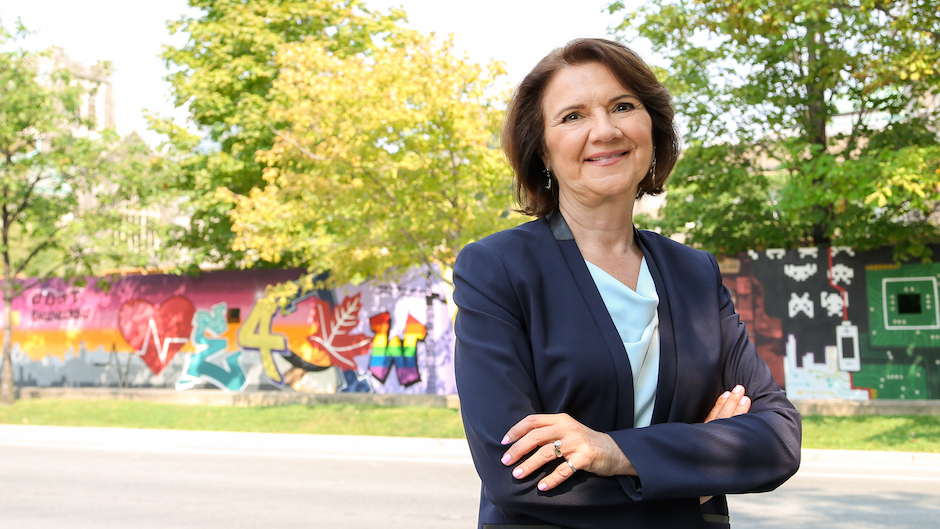
Many of you will also be among the first students to benefit from the Centre for Engineering Innovation & Entrepreneurship (CEIE). When it opens in 2017, this leading-edge new building will offer one of the finest learning and research environments of any engineering school in the world. I invite you to visit 55 St. George St. to see the 276-foot graffiti installation that surrounds the construction site. This mural captures the rich history and tremendous impact U of T engineers have around the world, and the pioneering research, transformative education and inspiring entrepreneurship that will take place within the CEIE.
U of T Engineering opens opportunities to you that are unrivalled anywhere else. And we are here to guide you every step of the way, from our First Year Office and full range of student resources, such as academic advising and financial aid, to our inspiring professors and dedicated staff and the University’s Centre for International Experience. Your classmates, too, will provide camaraderie, friendship and support that you can find only in a tightly knit Faculty like ours.
Welcome — or welcome back — to SkuleTM. A world of boundless possibilities lies ahead of you. Warmest wishes for a rewarding journey.
Cristina Amon
Dean
Read more about the start of the new school year:
- Back to #Skule: social media highlights
- U of T Engineering welcomes two new professors
- ‘Your time for innovation is now’ says 2015 Plenary Lecturer Catherine Lacavera
Students are not the only ones returning to class this week. U of T Engineering welcomes two new faculty members : professors Marianne Hatzopoulou (CivE) and Michael Jong Kim (MIE). They’re joining a talented and diverse group of professors who are leading pioneering research and inspiring the next generation of global engineering leaders.
Professor Hatzopoulou holds degrees in environmental technology and physics from the American University of Beirut. She completed her PhD in Urban Transportation Planning at the University of Toronto in 2008 and did postdoctoral work at the Massachusetts Institute of Technology. She specializes in the modelling of road transport emissions and urban air quality as well as evaluating population exposure to air pollution.
Professor Jong Kim completed his PhD at U of T in 2012 and pursued post-graduate research at the University of California Berkeley and the National University of Singapore Business School. He specializes in statistical learning and the development of decision-making algorithms for industrial and corporate systems.
U of T Engineering spoke with the new professors to find out more about their research and what they’re looking forward to at U of T:
Could you explain the focus of your research?
MH: I study traffic-related air pollution. My research involves investigating how emissions are generated by on-road vehicles, how they disperse in urban environments and ultimately who is exposed. I try to understand how traffic patterns, road design and the characteristics of the built environment can be modified to improve air quality in urban areas. I collaborate with epidemiologists and health scientists in the development of tools that can help vulnerable individuals reduce their exposure.
MJK: My area of research is known as Operations Research (OR), which utilizes mathematical and statistical models to come up with optimal decisions and policies to help companies with their operational activities. One of the main application areas I am working in is data-driven physical asset management. That is, how can we use data to help companies manage their physical assets by prescribing recommendations such as which assets to purchase, when to maintain them, and how to estimate the end of their useful lives.
Why did you choose U of T?
MH: U of T is a vibrant, diverse and inspiring place to do research. I can collaborate with a wide range of researchers in transportation, the environment and health. The city of Toronto itself is also an ideal test bed for my research and provides a great environment for knowledge transfer.
MJK: U of T is one of the very best research universities in the world, with great students and research faculty. Also, it doesn’t hurt that I was born and raised in Toronto, so I’m excited to return after post-graduate work in the United States and Singapore.
What are you most looking forward to in your new position?
MH: I’m looking forward to collaborating with other faculty members, learning from world-class researchers and contributing to all aspects of academic life. But if I had to choose one aspect of my new position that I am looking forward to the most, it would be to meet the students. I am eager to teach my first lecture and to have students knocking at my door asking me about what I do and whether they can be part of it. I find it most rewarding when students become interested in my research and my courses and I am ready to challenge myself if they aren’t!
MJK: Interacting with my colleagues and students to discuss new and interesting ideas. I have also been appointed as the new director of the Centre for Maintenance Optimization and Reliability Engineering (C-MORE), which I am very excited about leading. C-MORE’s research is driven by close interactions with industry, in particular with industry consortium members and with researchers at universities world-wide.
As a new professor, what one piece of advice would you give to new students?
MH: Enjoy your time learning and accept your failures — they are also part of learning. Engage in research, even if it is for a course project; make it a point to explore a novel aspect of a subject. It helps you learn about how knowledge is created, it allows you see the limits of what we know and the realm of what we don’t know.
MJK: Take care. It’s very easy — especially for talented students — to simply “get by” during your time as a student. Caring about even the small things you do takes practice, and is the most effective way I know to find meaning in what you do.
What do you hope to accomplish during your time at U of T Engineering?
MH: I hope to continue pushing the envelope in my research area, to develop an interesting research program that attracts graduate students and provides new knowledge relevant to today’s challenges. I also hope to be a better teacher, to learn about how students learn and how they can get excited about learning, and to constantly adapt to a rapidly changing learning environment.
MJK: My primary goals are to set up a world-class research program that makes fundamental discoveries into the interplay between statistical learning (i.e. learning from data) and dynamic optimization (i.e. making adaptive decisions), and also to grow C-MORE to become the leading industry-academic institute for physical asset management.