
U of T Engineering welcomed more than 1,200 new undergraduates and more than 800 new graduate students to campus this week with a number of exciting events including parades, clubs fairs, campus tours and a Plenary Lecture from alumna Catherine Lacavera (CompE 9T7). In addition to preparing for their classes and learning more about the many extracurricular opportunities available to them, students found plenty of time to experience the school spirit and traditions for which U of T Engineering is well known.
Here’s a sample of social media posts that capture the energetic mood of an eventful first week back to Skule:
Mobile developers around the world have been scrambling to master Apple’s newest mobile operating system (iOS9) and the company’s latest app programming language since they were announced earlier this year.
The new app language, called Swift, was designed to help novice developers start building their own applications for mobile devices — and Parham Aarabi (ECE) aims to help get more than 100,000 new programmers up to speed. On Sept. 15, he launches a new MOOC (short for massive open online course) to teach anyone with an internet connection how to develop applications for the new operating system.
“This Specialization is going to teach thousands of people how to build apps that meet their own needs,” says Aarabi, a professor in The Edward S. Rogers Sr. Department of Electrical & Computer Engineering at the University of Toronto, as well as the founder and CEO of ModiFace Inc.
Aarabi is teaming up with one of ModiFace’s iOS development experts, Jack Wu, as well as University of Toronto’s Michael Spears, to deliver the Specialization through Coursera, the world’s largest open online education provider. Together, Aarabi and Wu have overseen the development of over 100 iOS apps at ModiFace that have been downloaded more than 60 million times. Spears manages U of T’s Mobile App Development Lab, and Aarabi is well known as an expert on optimizing user experience and user interfaces.
“Teaching at U of T, I can impact about 200 students a year,” says Aarabi. “The thing that initially interested me about teaching this Specialization was the chance to reach up to 100,000 people through the courses — there’s potential for so much creativity and productivity here, and I find that opportunity incredibly exciting.”
Learners who complete the three courses, as well as the final capstone project of building their own unique photo-related app for iOS, will receive a Specialization in iOS App Development in Swift. Throughout the course, students will take online quizzes and conduct peer assessments, including providing feedback to classmates on the apps each they will develop as their capstone project.
“We are thrilled to offer a Specialization in iOS App Development in Swift from the University of Toronto, a very current subject, and one in very high demand among our learners,” said Daphne Koller, president and co-founder of Coursera. “We are especially excited to see the hundreds of thousands of apps that people all over the world will learn to create as a result of this Specialization’s Capstone Project.”
Registration is now open on Coursera, with classes beginning Sept. 15. Students interested in the course can download a new app called SHIFT, built in Swift as a preview of what students can expect to learn, after iOS9 is released on Sept. 16.

Marissa Wu (EngSci 1T3) continues to grow her smart-watch sports coaching startup, Onyx Motion, as she shuttles between New York basketball courts, Rocky Mountain startup retreats, and her office in the heart of Toronto’s thriving wearable tech scene.
But the beginnings of her company? They sparked with an undergraduate friendship at U of T.
Wu says many of the skills and connections that helped her take Onyx Motion from a casual interest in entrepreneurship to a startup featured in the Globe and Mail, Canada AM and countless tech blogs came out of her undergrad experience at the University of Toronto.
U of T News: NBA’s Ben Gordon signs on to U of T wearable tech sports coaching startup, Onyx Motion
The diverse student clubs, internships, alumni and peer networks — not to mention, actual learning in classes — that new students tap into by choosing U of T helped Wu grow into a headline-making tech leader.
As a new crop of students join the U of T community this September, Wu shares her advice on how first-year students and other budding entrepreneurs can best use their experience at the University of Toronto.
Talk about what interests you with other students. It might help you find your future co-founder.
“I was nervous about making friends when I first came to U of T — I think everyone worries about that,” said Wu.
But she says her path to Onyx Motion began when Wu started chatting with a friend in her engineering program about startups and wearables. They stayed in touch and eventually joined The Next 36 undergraduate entrepreneurship accelerator as a team, launching the first iteration of Onyx Motion. The startup later joined the UTEST accelerator, run by U of T and MaRS Innovation.
Join entrepreneurship programs to gain support and experience.
“I don’t think I would have had the guts to start a company without them guiding me through it,” Wu said, describing The Next 36. The program was co-founded by U of T entrepreneurship professor Ajay Agrawal. It helps students develop as entrepreneurs by learning from mentors and the Next 36 community as teams work together to build a startup.
Wu also suggests looking into The Entrepreneurship Hatchery, which welcomes students from all academic disciplines. U of T is home to many accelerator programs tailored to diverse types of startups and entrepreneurs.
Join clubs and apply for leadership roles in them — even if you don’t think you have enough experience.
“A lot of times if you’re in first or second year you think, ‘Oh, I can’t do that role, it’s for older students who know what they’re doing.’ But if you just throw yourself into it and apply, there’s so much to learn.
“I was a leader in several clubs and can tell you, there aren’t as many people to pick from as you would think.” Wu says often students will hold executive roles in several clubs. “It’s because there aren’t enough people applying! If more people applied, it would be better for everyone.”
But how can you land a leadership role if you don’t yet have any experience?
“It’s the same as any other job. You do your best in preparing your resume, try to make your cover letter appeal to that specific club and explain why you think you’d be good even though you might not have much experience.
“If you make it, great. If you don’t, ask why and come back next year with the right experience.”
Reach out to U of T alumni working in your field. They might even become your mentors.
“Karl has been super helpful,” Wu says of her mentor, Karl Martin (EngSci 0T1, ElecE MASc 0T3, PhD 1T0), CEO of Nymi — another U of T-developed wearable startup, featured in The Wall Street Journal and other international outlets. “He meets with me all the time to offer advice, and just to talk things through. I try to run every major decision by him first.”
Martin also introduced Wu and her team to the NBA’s Ben Gordon, who’s now an official part of the Onyx Motion roster.
“The partnership between Onyx Motion and Ben Gordon, as facilitated by Nymi, speaks to the power and reach of the entrepreneurial ecosystem here on campus,” said Karen Sievewright, director of the Banting & Best Centre for Innovation & Entrepreneurship at the University of Toronto. “I’m confident that as our network keeps growing, connections like this one will continue to build success within our community, city and beyond.”
Explore the city and try new things — try not to let studying become your whole life.
“I didn’t do a very good job of getting out because I was so busy all the time,” says Wu. She says that’s a regret from her time as an undergraduate.
“The city has all kinds of great events, like Winterlicious, and all sorts of music and food festivals. I would say, make time for that. It’s the best way to explore.”
This story originally appeared on U of T News.
Engineering professors Levente Diosady (ChemE) and Brendan Frey (ECE) have been elected fellows of the Royal Society of Canada (RSC) on the basis of their exceptional contributions to Canadian intellectual life.
The Society’s mission is to recognize scholarly, research and artistic excellence, to advise governments and organizations, and to promote a culture of knowledge and innovation in Canada. Fellowship in the RSC is one of the highest honours that Canadian researchers can achieve.
“Professors Levente Diosady and Brendan Frey are trailblazing researchers who are expanding our understanding of what is possible and improving lives,” said Dean Cristina Amon. “They exemplify the very best of engineering innovation and the outstanding calibre of research conducted at our Faculty; we are extremely proud that they are being recognized for their extraordinary achievements.”
Diosady and Frey were among 13 new fellows elected from the University of Toronto. Across Canada, 87 new fellows were named in 2015.
About Levente Diosady
Levente Diosady is a renowned food engineer who has spent much of his career developing techniques for fortifying food with micronutrients in order to prevent micronutrient deficiency. He is best known for developing the technology for double fortification of salt with iron and iodine to combat iodine and iron deficiency. This salt has already cured over one million children in India of anemia at a cost of lest than ten cents per person. India is now phasing in use of this salt in all school lunch programs, which should result in the reduction of iron deficiency in more than 100 million children.
Diosady is now developing technology for iron fortification of tea. This has the potential to significantly reduce the death toll due to low iron status in mothers and infants at childbirth, which currently kills around 100,000 people annually.
Diosady’s work has been recognized with the Engineering Institute of Canada’s K.Y. Lo Medal, the International Association of Engineering and Food’s Lifetime Achievement Award, and the Queen’s Jubilee Medal. Diosady is a fellow of the Canadian Institute of Food Science and Technology, the International Academy of Food Science and Technology, the Chemical Institute of Canada, the Hungarian Academy of Engineering and the Canadian Academy of Engineering. He has been inducted into the Order of Ontario and was recently awarded the Officer’s Cross of the Order of Merit of the Republic of Hungary.
About Brendan Frey
Over the past twenty years, Brendan Frey has played a key role in the emergence of new areas of research and application in machine learning and genome biology. He was one of the first researchers to successfully train a deep neural network, and he was a pioneer in inventing message-passing algorithms, which are now widely used. He is a co-inventor of the affinity propagation algorithm and of the factor graph notation for graphical models.
Frey also co-developed the long-sought-after ‘splicing code’ for determining how genes are expressed and introduced a new approach to understanding the genetics of disease. His technique has successfully identified previously unknown genetic determinants of major human disorders, including autism, certain cancers and spinal muscular atrophy. Frey recently cofounded the start-up Deep Genomics, developing deep learning technologies to predict the consequences of genomic changes.
Read more about how Frey is applying machine learning principles to decode the human genome.
He has served on the technical advisory board of Microsoft Research, holds seven patents and has served as an expert witness in patent litigation. Professor Frey is a fellow of the American Association for the Advancement of Science, the Canadian Institute for Advanced Research (CIFAR) and the Institute of Electrical and Electronics Engineers. His many research awards include the NSERC E.W.R. Steacie Fellowship and the NSERC John C. Polanyi Award. He holds the Canada Research Chair in Biological Computation.
The new RSC Fellows will be formally inducted at a ceremony in Victoria, B.C. on November 27, 2015.
This story is Part 1 of a seven-part series, U of T Engineering in the City, running throughout fall 2015.
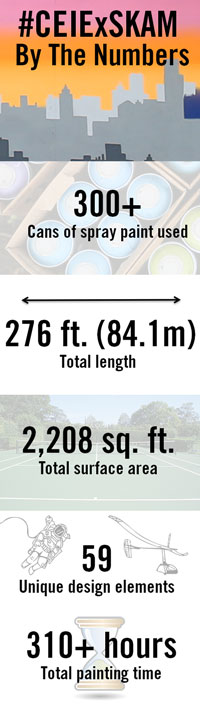
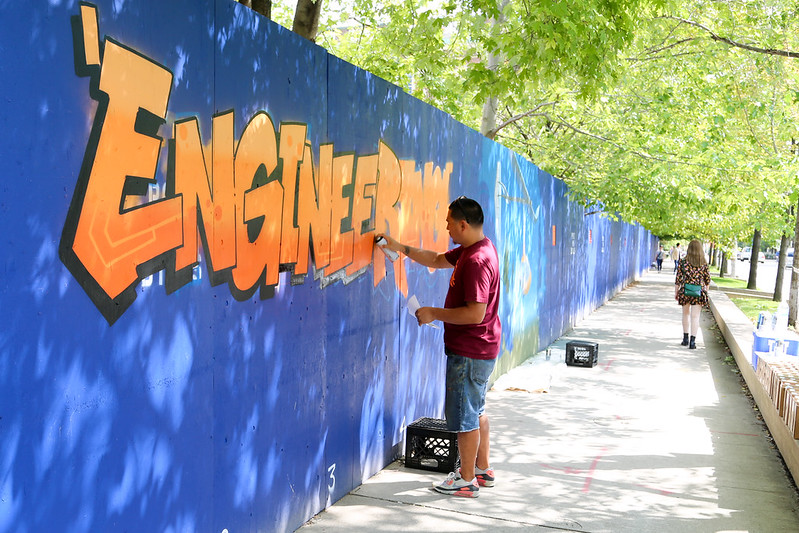
A bold, colourful and unconventional collaboration has taken shape at the University of Toronto’s Faculty of Applied Science & Engineering. Street artist Jason Wing, also known as SKAM, has painted a massive 276-foot (84-metre) installation that spans the outer wall around the construction site of the Centre for Engineering Innovation & Entrepreneurship (CEIE). It is the longest single graffiti installation in Toronto.
“The vibrant imagery in this mural installation represents the rich history and tremendous impact that U of T engineers have around the world,” said U of T Engineering Dean Cristina Amon. “At the same time, it looks toward the future, highlighting the pioneering research, transformative education and inspiring entrepreneurship that will take place within the CEIE.”
Located at the heart of U of T’s St. George campus, the CEIE will set a new standard for engineering education and research. The building will be a catalyst, enabling students, researchers, alumni and industry partners to work together across disciplines to solve some of the world’s greatest challenges.
Illustrating engineering’s impact
With a surface area that rivals that of a standard tennis court, the work contains more than 50 unique design elements. They depict innovations such as Horizon, the solar vehicle created by the Blue Sky Solar Racing team, and Nanoleaf, the world’s most energy-efficient light bulb, invented by U of T Engineering alumni Gimmy Chu (ElecE 0T6), Tom Rodinger (IBBME PhD 0T7) and Christian Yan (ElecE 0T6).
Other images such as wind turbines, a streetcar, a satellite and a human heart illustrate the multidisciplinary and collaborative research and industry partnerships for which U of T Engineering is known around the world. The artwork also includes the Lady Godiva Memorial Bnad [sic], Skule Cannon and other examples of the Faculty’s energetic student community and traditions.
A unique collaboration
Stretching along the east side of St. George Street north of College Street, the installation also highlights the connections between the University and the city. “Street art and other forms of popular culture are accessible to a wide audience,” said David Roberts, a professor in the Urban Studies Program at U of T’s Innis College who teaches a course on popular culture and the role of graffiti.
“I think this sort of project helps to break down barriers by making engineering more legible,” he explained. “You can start to have a conversation about all of the different things that engineering is.”
As one of the most established graffiti artists in the country, Jason Wing was the natural choice to create the installation. Wing’s signature style of graffiti has covered streetscapes across North America for more than 25 years. He is one of the key figures responsible for Toronto’s iconic Graffiti Alley and his clients have included Louis Vuitton, MuchMusic, Nike, Google, Adidas among many other global brands.
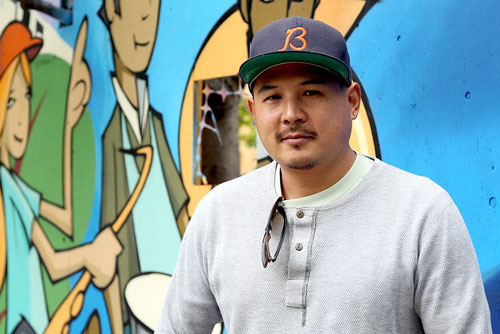
“I love painting, and to get a commission like this is awesome,” said Wing, who is working with fellow artists Alex Lazich and Aleksandrs Popelavskis on the CEIE installation. “It’s the biggest thing I’ve ever done in terms of scale.”
Wing hopes that the piece, which will be on display until the CEIE’s official opening in 2017, resonates with the public for its artistry. “I just hope it brightens people’s days,” he says. So far it seems to be working: as he paints, passersby often stop to compliment the project or to give a thumbs-up. “We hear all kinds of things: great job, amazing colours, I love what you guys are doing,” says Wing. “I’m sure there are going to be people who visit the campus just to photograph our work. It’s a public mural. It’s for everyone.”
Learn more about the stories behind the 30+ scenes on display.
Join the conversation on social media using #CEIExSKAM and #UofTEngineering.
Engineers at the University of Toronto just made assembling functional heart tissue as easy as fastening your shoes. The team has created a biocompatible scaffold that allows sheets of beating heart cells to snap together just like Velcro™.
“One of the main advantages is the ease of use,” says Professor Milica Radisic (ChemE, IBBME), who led the project. “We can build larger tissue structures immediately before they are needed, and disassemble them just as easily. I don’t know of any other technique that gives this ability.”
Growing heart muscle cells in the lab is nothing new. The problem is that too often, these cells don’t resemble those found in the body. Real heart cells grow in an environment replete with protein scaffolds and support cells that help shape them into long, lean beating machines. In contrast, lab-grown cells often lack these supports, and tend to be amorphous and weak. Radisic and her team focus on engineering artificial environments that more closely imitate what cells see in the body, resulting in tougher, more robust cells.
Two years ago, Radisic and her team invented the Biowire, in which heart cells grew around a silk suture, imitating the way real muscle fibres grow in the heart. “If you think of single fibre as a 1D structure, then the next step is to create a 2D structure and then assemble those into a 3D structure,” says Boyang Zhang a PhD candidate in Radisic’s lab. Zhang and Miles Montgomery, another PhD student in the lab, were co-lead authors on the current work, published today in Science Advances.
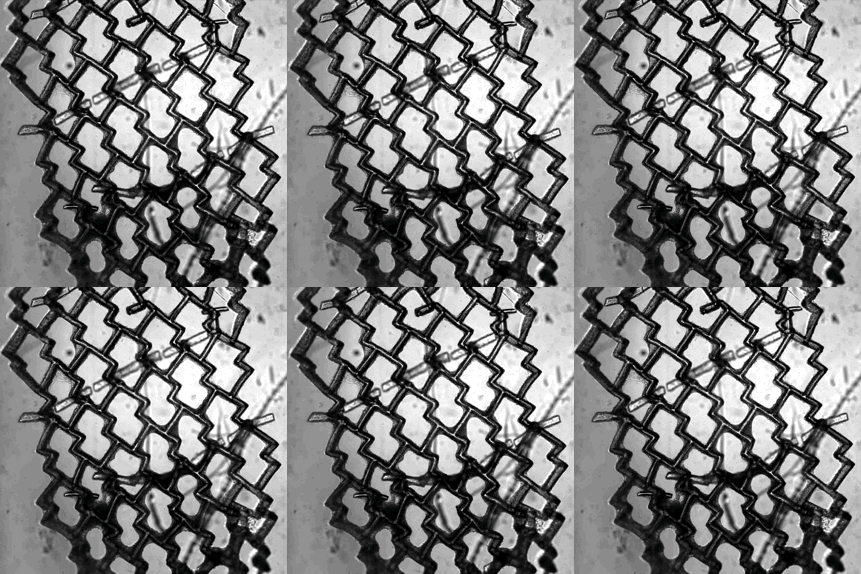
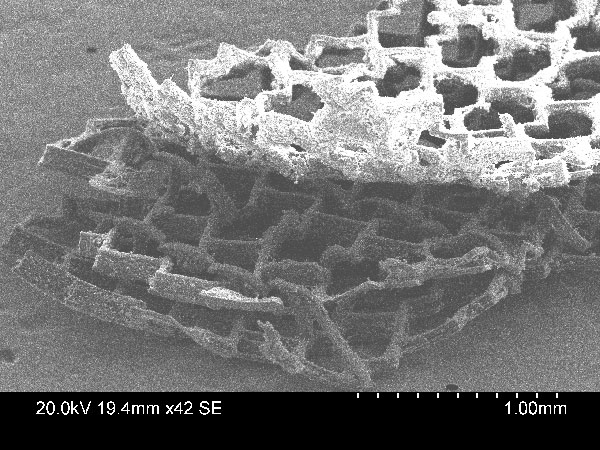
Zhang and his colleagues used a special polymer called POMaC to create a 2D mesh for the cells to grow around. It somewhat resembles a honeycomb in shape, except that the holes are not symmetrical, but rather wider in one direction than in another. Critically, this provides a template that causes the cells to line up together. When stimulated with an electrical current, the heart muscle cells contract together, causing the flexible polymer to bend.
Next the team bonded T-shaped posts on top of the honeycomb. When a second sheet is placed above, these posts act like tiny hooks, poking through the holes of honeycomb and clicking into place. The concept the same as the plastic hooks and loops of Velcro™, which itself is based on the burrs that plants use to hitch their seeds to passing animals.
Amazingly, the assembled sheets start to function almost immediately. “As soon as you click them together, they start beating, and when we apply electrical field stimulation, we see that they beat in synchrony,” says Radisic. The team has created layered tissues up to three sheets thick in a variety of configurations, including tiny checkerboards.
The ultimate goal of the project is to create artificial tissue that could be used to repair damaged hearts. The modular nature of the technology should make it easier to customize the graft to each patient. “If you had these little building blocks, you could build the tissue right at the surgery time to be whatever size that you require,” says Radisic. The polymer scaffold itself is biodegradable; within a few months it will gradually break down and be absorbed by the body.

Best of all, the technique is not limited to heart cells. “We use three different cell types in this paper; cardiomyocytes, fibroblasts and endothelial cells, but conceptually there is really no limitation,” says Radisic. That means that other researchers could use the scaffold to build layered structures that imitate a variety of tissues, from livers to lungs. These artificial tissues could be used to test out new drugs in a realistic environment.
Moreover, the ability to assemble and disassemble them at will could enable scientists to get much more detailed information on cell response than is currently possible. “You could take middle layer out, to see what the cells look like,” says Radisic. “Then you could apply a molecule that will cause differentiation or proliferation or whatever you want, to just that layer. Then you could put it back into the tissue, to see how it interacts with the remaining layers.”
The next step is to test how well the system functions in vivo. Radisic and her team are collaborating with medical researchers in order to design implantation experiments that will take the project one step closer to the clinic.