
It’s snack time: you have a plain oatmeal cookie, and a pile of chocolate chips. Both are delicious on their own, but if you can find a way to combine them smoothly, you get the best of both worlds.
Researchers in The Edward S. Rogers Sr. Department of Electrical & Computer Engineering used this insight to invent something totally new: they’ve combined two promising solar cell materials together for the first time, creating a new platform for LED technology.
The team designed a way to embed strongly luminescent nanoparticles called colloidal quantum dots (the chocolate chips) into perovskite (the oatmeal cookie). Perovskites are a family of materials that can be easily manufactured from solution, and that allow electrons to move swiftly through them with minimal loss or capture by defects.
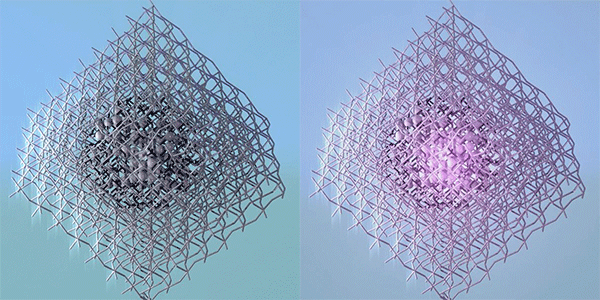
The work is published today in the international journal Nature.
“It’s a pretty novel idea to blend together these two optoelectronic materials, both of which are gaining a lot of traction,” says Xiwen Gong (ECE), one of the study’s lead authors and a PhD candidate working with Professor Ted Sargent (ECE). “We wanted to take advantage of the benefits of both by combining them seamlessly in a solid-state matrix.”
The result is a black crystal that relies on the perovskite matrix to ‘funnel’ electrons into the quantum dots, which are extremely efficient at converting electricity to light. Hyper-efficient LED technologies could enable applications from the visible-light LED bulbs in every home, to new displays, to gesture recognition using near-infrared wavelengths.
“When you try to jam two different crystals together, they often form separate phases without blending smoothly into each other,” says Dr. Riccardo Comin, a post-doctoral fellow in the Sargent Group. “We had to design a new strategy to convince these two components to forget about their differences and to rather intermix into forming a unique crystalline entity.”
The main challenge was making the orientation of the two crystal structures line up, called heteroexpitaxy. To achieve heteroepitaxy, Gong, Comin and their team engineered a way to connect the atomic ‘ends’ of the two crystalline structures so that they aligned smoothly, without defects forming at the seams. “We started by building a nano-scale scaffolding ‘shell’ around the quantum dots in solution, then grew the perovskite crystal around that shell so the two faces aligned,” explained coauthor Dr. Zhijun Ning, who contributed to the work while a post-doctoral fellow at UofT and is now a faculty member at ShanghaiTech.
The resulting heterogeneous material is the basis for a new family of highly energy-efficient near-infrared LEDs. Infrared LEDs can be harnessed for improved night-vision technology, to better biomedical imaging, to high-speed telecommunications.
Combining the two materials in this way also solves the problem of self-absorption, which occurs when a substance partly re-absorbs the same spectrum of energy that it emits, with a net efficiency loss. “These dots in perovskite don’t suffer reabsorption, because the emission of the dots doesn’t overlap with the absorption spectrum of the perovskite,” explains Comin.
Gong, Comin and the team deliberately designed their material to be compatible with solution-processing, so it could be readily integrated with the most inexpensive and commercially practical ways of manufacturing solar film and devices. Their next step is to build and test the hardware to capitalize on the concept they have proven with this work.
“We’re going to build the LED device and try to beat the record power efficiency reported in the literature,” says Gong.
This work was supported by the Ontario Research Fund Research Excellence Program, the Natural Sciences and Engineering Research Council of Canada (NSERC), and the King Abdullah University of Science & Technology (KAUST).
If you live in Toronto, you may have noticed that your commute is worse since the HOV lanes opened ahead of Toronto’s Pan Am Games. Or is it all in your head?
The smart traffic monitoring platform Connected Vehicles and Smart Transportation (CVST) has the answer to that question, and many more that haven’t been asked yet.
Connected ‘smart’ cities are the future — robust real-time data delivered by a host of distributed sensors will help ease congestion, improve personal safety, increase energy efficiency and reduce waste across our utilities, transportation infrastructure and more.
CVST currently includes data from highway cameras, road incident alerts, road closures, transit systems, bike-sharing networks, border crossings — and experimentation with live feeds from a drone stationed at Downsview in Toronto. In this next year, Leon-Garcia has plans to integrate air-quality sensors that measure CO2 and humidity, data from weather stations, and data streams on pollution emissions.
“I think it’s clear that smart cities pose a very interesting area in terms of opportunities and challenges,” said Professor Alberto Leon-Garcia (ECE), scientific director of the SAVI research team. “The aim is to improve livability and sustainability, but when you look at those there are multiple dimensions — we need to take a layered view of smart cities.”
CVST is one of the applications built on the Smart Applications on Virtual Infrastructures (SAVI) Network testbed, a next-generation internet platform that investigates the convergence of cloud computing and software defined networking. SAVI’s chief architect, Hadi Bannazadeh (ECE) led the development of a national application platform testbed, and for the past two years researchers across the country have been building and testing applications to run on it.
SAVI, a national NSERC Strategic Network, includes researchers from 10 universities and over 100 graduate students. The group held its annual general meeting at the University of Toronto on Tuesday, July 7, preceded by a testbed workshop to share developments and areas of exploration and experimentation.
The topics of smart cities and big data analytics were top of mind at the meeting. Dragan Narandzic, chief technology officer at Ericsson Canada, delivered a keynote address about Ericsson’s approach to integrating ICT into infrastructure, and the investments necessary to do so.
“We believe that there are three categories that need to be addressed: city attractiveness, city competitiveness, and city sustainability,” said Narandzic. “We, as part of the ICT industry, have an obligation to find a way to make cities run more efficiently.”
Industry partners from TELUS, Ciena, Fortinet Inc., BTI Systems Inc. and many others were on hand. Between sessions, attendees heard poster presentations and demonstrations by more than two dozen graduate students from across Canada.
With the SAVI Network slated to wrap in August 2016, Leon-Garcia has both immediate goals and a broader vision for the future of the platform. “What I didn’t build into SAVI was a third tier, and those are the sensors,” he said. “That was not even part of the original plan, but it’s within reach so we’re doing it.”
In the SAVI-enabled future, you get answers before you even ask questions. And yes, your commute really is worse post-HOV lanes. The data proves it.
A group of researchers from the University of Toronto and the Allergy, Genes and Environment (AllerGen) Network have launched an interactive map that tracks air pollution across Toronto for the Pan Am Games.
The tool uses data from new AirSENCE devices, which are a type of inexpensive air quality monitoring system that the U of T team developed. Placed around Pan Am sites, they measure the Air Quality Health Index (AQHI) and estimated concentrations of a number of air pollutants.
The technology was created by U of T chemical engineering professor Greg Evans (ChemE) and Jeffrey Brook, a senior research scientist with Environment Canada and an adjunct professor in the U of T Dalla Lana School of Public Health. The project is led by U of T PhD student Natalia Mykhaylova (ChemE).
“Click on a location to see the air quality health index and the estimated concentrations of key air pollutants over the previous three days,” says Evans. “Clicking on multiple sites allows you to compare them.”
The tool also allows users to compare AirSENCE data with air quality readings from both the Southern Ontario Centre for Atmospheric Aerosol Research (SOCAAR), an interdisciplinary centre for studying air quality that Evans directs, and the Ontario Ministry of Environment and Climate Change.
Evans’ recent research shows that traffic emissions may pollute one in three Canadian homes. Read more.
While Toronto’s air quality is better than many global cities that have hosted major sporting events, poor air quality days do occur. The AirSensors website will help residents and visitors — especially those with allergies, asthma or other respiratory conditions — to plan the timing and location of their activities. Athletes can use the tool to be alerted to poor air quality during their event or they may choose to adjust their pre-event training based on air quality.
“Each AirSENCE device uses an array of 14 sensors to estimate concentrations of five air pollutants: nitrogen oxides, ozone, particulate matter, carbon monoxide and carbon dioxide,” explains Evans. “This allows people to monitor air pollution in their local environment in real time.”
This new technology will help Canadians long after the Pan Am and Parapan Am Games have concluded, according to Evans.
“Following the Games, we will recalibrate and upgrade the AirSENCE devices, and deploy them at a variety of locations,” he says. “In 2016, we will launch the devices in Beijing. Ultimately, AirSENCE will enable users worldwide to make better-informed choices to manage their exposures to outdoor or indoor pollutants, reducing both the risk of exacerbations of pre-existing health conditions, like asthma, and of development of chronic disease through long-term exposure.”
When ECE Professor Natalie Enright Jerger received the Borg Early Career Award a few weeks ago, there was a certain sense of passing the torch. “I remember when my co-supervisor, Li-Shiuan Peh received this same award in 2007 when I was still a graduate student,” she said. “To have her turn around and nominate me meant a great deal.”
The award — conferred by the Committee on the Status of Women in Computing Research (CRA-W), part of the Computing Research Association — was presented June 16 at the International Symposium on Computer Architecture in Portland, Oregon. Named in honour of the computer science pioneer Anita Borg, the award recognizes Enright Jerger’s commitment to outreach, helping young women discover computer engineering and providing them with support to help them be successful in their studies.
“Outreach is really important to me because I wouldn’t have chosen or stayed in this career path if it wasn’t for the mentoring and outreach that I received,” said Enright Jerger. “I think it’s critically important to have someone you can relate to that has succeeded in your chosen field. You can look at them as say, ‘if they can do it, so can I!’”
Enright Jerger’s research in computer architecture focuses on designing new ways of arranging the components of computer processors in order to optimize performance. Her projects help manufacturers like Intel, AMD and Qualcomm build faster devices while keeping power usage, device weight and cost low. The result is smarter smartphones and more powerful computers for use in medicine, banking and many other fields.
During graduate school Enright Jerger became involved in a group known as wicarch (women in computer architecture). The group began as a way to solve a practical problem: helping female graduate students find other women to share hotel rooms with while attending conferences on computer architecture. Today, wicarch has expanded to offer pre-conference networking meetings, connecting women in computer science from around the world.
“We find that getting students plugged in to mentoring and networking early will help them be more successful,” said Enright Jerger, who remains one of wicarch’s key organizers. “If they’re struggling with their research topic, their supervisor, or just feeling isolated, they have people that they can email or call to connect with.”
In addition to her work with wicarch, Enright Jerger also gives talks to groups of high school students, especially women, to explain the value of engineering and the rewarding experiences she has had. She has also organized discipline-specific mentoring programs for CRA-W.
“Congratulations to Natalie — I am gratified to see her passion for outreach, as well as her leadership within her research community, recognized with the Borg Early Career Award,” said Professor Farid Najm, chair of The Edward S. Rogers Sr. Department of Electrical & Computer Engineering. “She sets an example to both established and aspiring engineers.”
Enright Jerger plans to continue her work engineering outreach. “I participate in these outreach activities because I know it’s important and because it feels good to help people, but it’s also nice when someone externally acknowledges that the work is important and meaningful,” she said.
With files from Marit Mitchell.
With the Pan Am/ Parapan Am Games beginning in Toronto today, the U of T Engineering community is cheering on two of its own.
Donna Vakalis (CivE PhD Candidate) competes for Team Canada in the modern pentathlon and Sasha Gollish (CivE MEng 1T0, EngEd PhD Candidate) runs for Canada in the 1500m.
When they’re not training, Vakalis studies the impact of indoor building environments on public health and productivity under the supervision of professors Heather MacLean and Jeffrey Siegel (both CivE) and Gollish is one of the first students enrolled in the Faculty’s new Engineering Education (EngEd) program, supervised by Professor Bryan Karney (CivE).
U of T Engineering spoke to both athletes in the days leading up to the games to find out how they balance engineering and sport.
What has it been like since you found out you made Team Canada?
Gollish: It’s been a total rush for sure! But it only happened recently so I’m not even sure it has totally sunk in. My goal was to qualify for the Pan Ams, but my other goal was to run fast. So I’ve been travelling a lot and continuing to compete.
Vakalis: I’ve been focused on world championships, which just happened last weekend, in Germany. It may sound like a lot all at once, but it’s actually useful because it’s a little tricky to peak twice in a year. You don’t want them too far apart, or right on top of each other, but two weeks is actually perfect.
Let’s talk about what it took to get here. When did you decide that you were going to go for it?
Gollish: Last summer I was competing in Leuven, Belgium, in a series that is basically like the Belgian Cup. I ran a 4:13 and I thought, hey, if I can run that now, I wonder what I can run next summer.
Vakalis: The fall after I competed [at the Olympics] in London, I started school. At that point I thought it might be time to retire, because it just requires a lot of energy in addition to being a full-time student. However, I surprised myself and learned how to be even more efficient with my time. At the beginning of this school year I found myself being really fit and eager to compete. I had to make a choice, am I going to go for it or not? I made that choice, and my supervisors fortunately were supportive. The goal of this whole season has been to qualify for Pan Ams.
When did you realize you actually had a shot?
Gollish: It wasn’t until I ran at Harry Jerome, part of the national series which was June 9 in Vancouver. The rankings were really tight and I was sitting in third position. There just weren’t that many fast races in North America, and I was trying to really push my boundaries. Plus there are a lot of awesome middle-distance runners right now in Canada: Kate Van Buskirk, Hilary Stellingwerff, Sheila Reid, Nicole Siffuentes. It could have been any two of us that were named to that team.
Vakalis: I was at a world cup in Rome in April. Because of how our qualification system works, they take our top two scores from last year’s world championships and the four world cups. At the moment I crossed the finish line in Rome, I knew I had done what it takes to qualify.
Why did you choose to do graduate studies at U of T?
Gollish: U of T is a pretty awesome engineering school to get into. It’s also got a phenomenal running program, and my coaches are the varsity coaches, so it’s a natural fit.
Another reason was my supervisor, Bryan Karney. We met a few years ago, and we share a passion for the science, the math. I call it the ‘Enginerd’ passion. My other background is coaching, so the Engineering Education (called EngEd) program is a really unique way to blend the skills of coaching and engineering.
Vakalis: There were multiple reasons. I knew I wanted to live in Toronto, and from doing my masters here, I knew U of T has a really strong school with a rigorous academic program. But I also care a lot about the people and atmosphere in the department. For me the single most important factor was meeting the professors and their students. Now, finishing up my third year I feel like I am part of a really smart, ambitious, supportive family.
Have you learned anything as an engineer that has affected your athletics, or vice versa?
Gollish: I take a very scientific approach to things, which I think is probably rooted in studying engineering. With running, there are a lot of fads that come and go, but I always look to see what the science says.
There’s also the whole efficiency game. I’m always trying to be efficient with my time, and maximize it, to use a calculus term. It’s not necessarily about doing more with less effort, but asking how can I get the most out of each day
Vakalis: There are so many connections if you are willing to think analogically. For example, as an athlete you can start to see connections between the structural properties of materials and the way your body works. I was recovering from an injury earlier this year, and it was helpful to understand the mechanics of my body, in order to heal smarter and faster.
In the other direction, being a pentathlete who has to execute moves perfectly when an Olympic berth will be on the line, it helps to be able to think clearly under tremendous pressure. That’s helpful for standing up and teaching a class, or being able to answer a challenging question in front of your thesis defence committee.
What is it like to be competing on home turf in Toronto?
Gollish: Obviously it’s pretty cool. Most athletes don’t get that opportunity, but it also comes with a host of pressures. You’ve got all your friends and family who are super-stoked to come out and watch you, and there’s the feeling that you have to perform.
But you don’t. At the end of the day, they know how hard you worked, they know how dedicated you are. If it doesn’t go that well they still love you.
Vakalis: In modern pentathlon, we’ve never had a world cup in Canada, so this is a first in terms of the caliber of competition at home. Honestly, I don’t think I will even know how much it means until the day I compete. There are members of my family and really close friends who have never been able to watch me compete, who will be there in the stands next weekend.
When I think of them it’s a very acute and intense feeling, but I also feel a little bit of that same feeling about the whole community. Having U of T students and Torontonians around, and being able to share with them something that is a big part of my life, and is really important to me. It feels really special, because it is.
These interviews have been edited and condensed.
U of T Engineering startup Onyx Motion is partnering with NBA shooting guard Ben Gordon in a bid to raise the calibre of digital basketball coaching offered by the company’s first-of-its-kind technology, a smartwatch app that offers on-court skills guidance.
“We’re hoping to build a motion marketplace — a library of data, moves and audio tips from pro players,” said Onyx Motion co-founder and CEO Marissa Wu (EngSci 1T3).
The U of T Engineering-developed startup announced Gordon’s role in helping to further development of the app, called Swish, on July 8.
Swish uses smartwatch motion sensors to analyze athlete techniques and offer straightforward tips on how a player can improve.
“The Swish technology is bringing users closer to their favourite basketball player by giving them the opportunity to learn from them,” said Gordon. “I’m excited to work with the team on the further development of this one-of-a-kind experience and help players at any level improve their game.”
The company founded by Wu has developed quickly. From the seeds of an idea as part of the Next 36 entrepreneurship development program it progressed to a startup, receiving support through the University of Toronto Early Stage Technology accelerator (offered jointly by MaRS Innovation) and winning a spot on CBC’s Next Gen Den.
Now, with its partnership with an award-winning NBA player and an IndieGoGo campaign, the company’s concept of a basketball coaching app has grown into much more, said Wu.
Next Generation of AI for Sport Coaching
“Here at Onyx Motion, we are building the next generation of AI for sports coaching,” said Wu. “Swish allows mobile devices to break into physical interaction to a point where it can tell you what to do to get better. Our goal was to create a health and fitness device that would give personal recommendations, not just churn out numbers.”
She said the Swish app is only the first part of Onyx Motion’s plan to move into other sports and industries where kinaesthetic learning is key. Basketball is only the first shot.
“I grew up playing basketball,” Wu recently told U of T Engineering News. “My dad got me into it, it was how we bonded, so I’m sure that was important.”
The introduction between Gordon and Onyx Motion was made by alumnus Karl Martin (EngSci 0T1, ElecE MASc 0T3, PhD 1T0), CEO of Nymi (formerly Bionym), another U of T Engineering startup whose debut product is a wearable biometric wristband that unlocks passwords, key codes and more by authenticating the wearer’s unique heartbeat rhythm. The technology recently attracted millions in investment and the attention of major media, including the Wall Street Journal and Wired magazine.
Martin said Bill Burgos, the Orlando Magic’s head strength and conditioning coach, had been in touch with Nymi to explore potential applications for athlete training. The fellow engineering science alumnus and UTEST mentor then introduced Burgos to Wu and Onyx Motion, which led to their connection to Gordon.
“The Onyx Motion team is onto something huge with their approach to digital sports coaching,” said Martin. “The Swish app represents the next generation of wearable tech applications, analyzing motion data and providing truly useful and actionable insights, rather than just letting you know what your activity levels are. It speaks volumes that they got Ben Gordon on board as their director of innovation and I’m really looking forward to seeing this take off.”
Nymi launches a pilot program with Mastercard, RBC and TD Bank this month, in which a special version of their Nymi band will be used for “tap and pay” payments at retailers supporting the Mastercard PayPass system.The startup grew from Martin’s U of T research and developed through a variety of the university’s entrepreneurship supports, including the Creative Destruction Lab accelerator. Martin continues to offer mentorship to founders such as Wu, who are new to taking their academic work into the market.
Wu recently told U of T Engineering News that she drew on her undergraduate-developed knowledge of biomechanical modelling of the human body in translating accelerometer data into actual movements.
She also said her leadership role in the University of Toronto Engineering Competition helped prime her to become her own CEO.
“I discovered that I loved running a team and creating my own path,” she said. “I liked the fact that there’s no right answer.”
Wu says that while Onyx Motion has big plans for future applications, her team is ready to take it one step at a time.
“We built it pretty much from scratch, so there isn’t a lot to compare it with,” she said. “We’re excited to learn from the experience of people using it, and to move forward with making it that much better.”
And to other aspiring entrepreneurs, she offers some already hard-won advice:
“Know why you’re doing it because you will have to persevere through lots of up and downs.”
Read more about Onyx Motion and other U of T Engineering startups to watch.