
Eight members of the U of T Engineering community have been inducted as fellows of the Canadian Academy of Engineering (CAE).
Professors Kamran Behdinan (MIE), Greg Evans (ChemE), Vladimiros Papangelakis (ChemE), Michael Sefton (ChemE, IBBME) and Jim Wallace (MIE), along with alumni Pu Chen (MIE MASc 9T3, PhD 9T8) and Anne Sado (IndE 7T7) are among the Academy’s 50 new fellows. Alumnus Norbert Morgenstern (CivE 5T6) was inducted as an honorary fellow.
The CAE comprises the country’s most accomplished engineers, who have demonstrated their dedication to the application of science and engineering principles in the interests of Canada. Fellows of the Academy are nominated and elected by their peers, in view of their distinguished achievements and career-long service to the engineering profession.
“I am delighted so many of our faculty and alumni have been recognized by the Canadian Academy of Engineering for their extraordinary contributions,” said Dean Cristina Amon. “I would like to extend heartfelt congratulations to our honourees. This recognition demonstrates the depth and breadth of their achievements and confirms that U of T engineers are leaders in their fields, both in Canada and around the world. ”
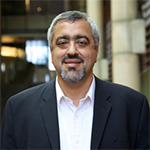 About Professor Kamran Behdinan
Professor Behdinan is a highly respected leader and innovator in engineering design and design education. He was the founding chair of the Ryerson Department of Aerospace Engineering and the founding director of both the Ryerson Institute for Aerospace Design and Innovation and the University of Toronto Institute for Multidisciplinary Design and Innovation. He has consecutively held the NSERC Engineering Design Chair at Ryerson University and the NSERC Chair in Multidisciplinary Engineering Design at U of T. Professor Behdinan is a fellow of the Canadian Society for Mechanical Engineering (CSME) and served as president of CSME from 2010-2012.
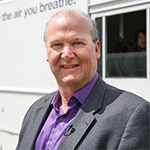 About Professor Greg Evans
Professor Evans is internationally recognized for his leadership and expertise in applying engineering principles to the study of air quality. He has founded two research networks, the Southern Ontario Centre for Atmospheric Aerosol Research and the Canadian Aerosol Research Network, and engineered instrumentation that has greatly advanced research in this field. Professor Evans has also made outstanding contributions to engineering education, recently leading the development of a graduate program in engineering education at U of T. He has received the President’s Teaching Award, national and international education awards, and a Professional Engineers Ontario Research and Development Medal.
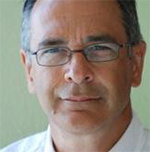 About Professor Vladimiros Papangelakis
Using novel experimental techniques coupled with mathematical modeling, Professor Papangelakis has made significant contributions to the development of hydrometallurgical
processes. He developed the first comprehensive model simulating the autothermal operation of reactors for the pressure oxidation of refractory gold ores and pioneered the concept of “chemistry at temperature” to probe and understand the behaviour of high temperature processes, particularly for nickel extraction from nickeliferous laterites. He has also made sustained contributions to the engineering profession, including service as president of the Metallurgy and Materials Society of the Canadian Institute of Mining, Metallurgy and Petroleum.
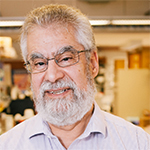 About Professor Michael Sefton
Professor Sefton is a pioneer in the field of tissue engineering and has made significant contributions to biomaterials, biomedical engineering and regenerative medicine. A leader in his professional community, he served as president of the U.S. Society for Biomaterials from 2005-2006 and has spearheaded several programs to advance the field. From 1999-2005, Professor Sefton was director of IBBME, leading its development into one of the best institutes of its kind in North America. His many honours include the Ontario Professional Engineers Gold Medal, the Engineers Canada Gold Medal and the Killam Prize in Engineering. He was recently inducted into the Institute of Medicine of the U.S. National Academies of Science.
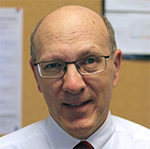 About Professor Jim Wallace
An internationally recognized researcher in the area of alternative fuel use in internal combustion engines, Professor Wallace has contributed significantly to the advancement of knowledge in this field. Professor Wallace’s innovative research on natural gas and hydrogen led to his election as a fellow of the Society of Automotive Engineers (SAE) for advancing the use of alternative fuels for emissions reductions. He is also a fellow of the Canadian Society for Mechanical Engineering and the Engineering Institute of Canada. An outstanding educator, Professor Wallace has won the President’s Teaching Award, U of T’s highest teaching honour, as well as the Ralph R. Teetor Educational Award from SAE.
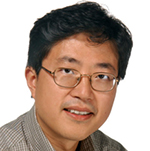 About Pu Chen
Recipient of the Premier’s Research Excellence Award and holder of a Canada Research Chair in Nano-Biomaterials, Pu Chen has greatly contributed to theoretical underpinnings and practical applications in low dimensional thermodynamics, interfacial and nanostructure
design and fabrication, peptide self/co-assembly, and energy storage and conversion. He has made contributions to peptide biopharmaceuticals, drug and gene delivery, protein-lipid membrane interactions, emulsification, thin films, and eco-friendly batteries. His work on peptide mediated short interfering RNA delivery and rechargeable hybrid aqueous batteries has resulted in large scale commercialization.
 About Anne Sado
Anne Sado is not just a prominent leader in business and academia; she is a dedicated leader in the community, whose ideas, energy and integrity extend her influence across the public and private sectors and make her an outstanding role model for young women in engineering. Ms. Sado had a successful 25-year career at Bell Canada before her appointment as president of George Brown College in 2004. In this role, she has presided over a significant expansion of the college and is spearheading initiatives that are transforming postsecondary education in Ontario. Ms. Sado received the Ontario Professional Engineers Gold Medal in 2007 and was inducted into the Order of Canada in 2013.
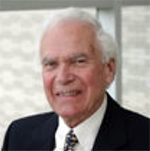 About Norbert Morgenstern
Norbert Morgenstern has consistently produced award-winning research that has shaped the civil engineering field, specifically in dam design, slope stability studies and major natural resource development. He has been invited to contribute his expertise by research institutions, multinational companies and governments in over 30 countries. He has given a significant number of keynote addresses at major international conferences and symposia, and has had 330 articles published in technical journals, conference proceedings and books. Dr. Morgenstern received an Honorary Doctorate from U of T in 1983 and won the Killam Prize in Engineering in 2001. He is a member of the Order of Canada.
The new CAE Fellows and Honorary Fellow were inducted on June 4 in Hamilton, ON, as part of the Academy’s Annual Meeting.
Originally published in the Spring 2015 issue of Edge Magazine.
In 1999, NASA issued a challenge to the scientific community: to develop a robotic arm with artificial muscles that could beat a human in an arm-wrestling match.
At a conference six years later, a high school girl faced off against three such arms. She won against each of them, but the scientific gauntlet was thrown down — and an idea was planted in Hani Naguib’s (MIE, MSE) mind. A professor of mechanical and materials engineering, Naguib’s attempt to make an artificial muscle is part of his interest in smart and adaptive materials.
“A smart material senses and responds to the environment,” he explains. “For example, if it senses heat, it could respond by cooling the environment. Or by sensing something in its environment, it might change its own shape.” Take the muscle. While previous generations of artificial muscles were made with motors, Naguib’s uses very fine, lightweight fibres that contain “memory material.” He can train his material to “remember” certain shapes. When he activates a small electrical charge, the material moves into a shape it has been programmed to remember — a hand making a fist, for example.
All of Naguib’s work is based on a deceptively simple principle — exploiting the existing properties of materials.
“Imagine if I put rubber in the freezer,” he says by way of analogy. “It would become really stiff. I could take rubber and make into any shape I want. If I put it in the freezer, it will retain that shape.”
Of course, Naguib’s lab isn’t full of rubber balls and freezers. He and his team work with nano- and micro-structures, eventually scaling up to build prototypes when they have a hit.
Some of the lab’s recent projects include:
- Smart wearables that have sensing and battery-like capabilities.
- Electronic skin that is self-healing (ultimately for going over those artificial muscles).
- Stents and surgical tools that are inserted in a patient as a thin wire and then open once they’re in place, making the surgical implantation less traumatic.
- Sponge-like materials for drug delivery that “squeeze” and release liquid drugs when they’ve reached the right spot in the body.
Where do these varied applications come from? Naguib says that while in the past labs like his would build something and then think about how it might be applied, today he has reversed the process. He actively seeks out problems to solve, talking to people at hospitals and in industry about how his lab could help them.
This problem-based method is also at the heart of the Toronto Institute for Advanced Manufacturing, which Naguib directs (see below).
“The idea is to bring research all the way to final products that have impact,” he says. “We’re looking to make long term benefits to society.”
About the Toronto Institute of Advanced Manufacturing (TIAM)
What?
Founded in 2014, this multidisciplinary institute at U of T Engineering is focused on:
- Manufacturing of advanced materials: making new and better materials
- Advanced processes and systems: improving manufacturing processes
- Knowledge-based manufacturing: handling data better and applying mathematical tools to manufacturing.
How?
By collaborating with industry to solve real problems. Researchers have collaborated with Magna International, Celestica, Blackberry, Pratt and Whitney, Bombardier and GE Digital Energy. TIAM also supports research and development for small- and medium-sized enterprises and startup companies.
Why?
To create long-term benefits to society. Advanced manufacturing creates jobs at the same time it produces value added, greener products that improve health and quality of life.
GLEE is part of the Faculty’s strategy to increase diversity, particularly gender diversity, which is a key goal of the Academic Plan. In 2014-15, women made up 30.6 per cent of the first-year class, the highest proportion of any entering engineering class in Canada.
9:55 a.m. – Registration
The lobby of the Galbraith Building is already buzzing with activity. A line of young women lugging suitcases and backpacks snakes toward a table covered with nametags, while others try on t-shirts or stand in twos and threes, chatting with other attendees.
All of these women — more than 80 in all — have earned admission to U of T Engineering this fall. And they have travelled here from across Canada for GLEE to learn more about the Faculty, meet their future classmates and get a taste of student life.
“U of T is awesome, and we’re going to spend the weekend showing you why,” exclaims one Engineering student volunteer as she leads a group of GLEE participants to the first session of the day.
10:30 a.m. – Welcome and Student Panel
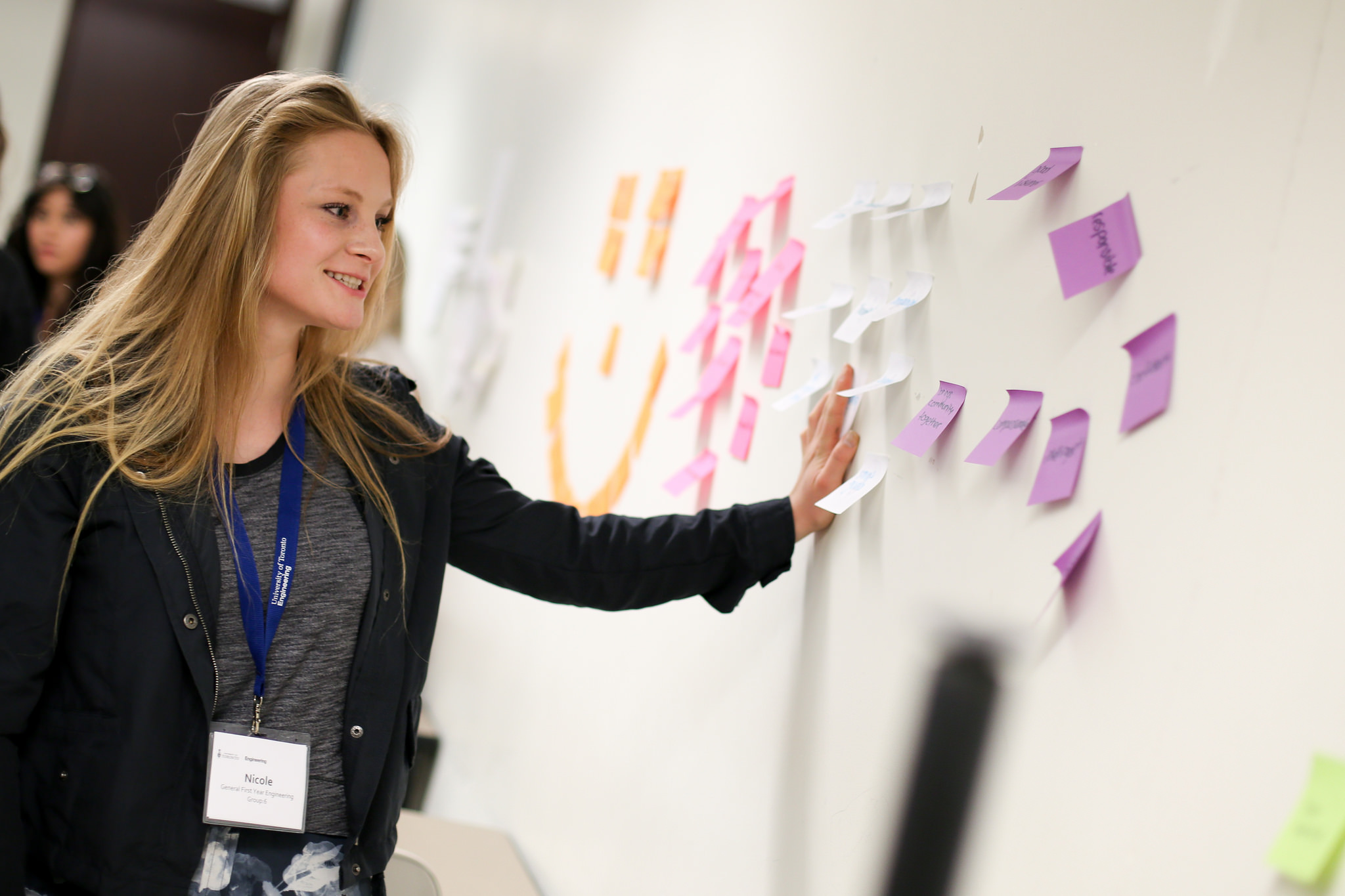
“This is definitely an inclusive environment — a close-knit community that is welcoming to all students,” Michelle Beaton, associate director of the Engineering Student Recruitment & Retention Office, tells GLEE participants before turning the microphone over to the weekend residence advisors, upper-year engineering students who have volunteered their time to make the program a success.
“Last year, we were in the exact same boat as you are now: deciding whether or not to come to U of T for engineering,” says Lauren Reid (Year 2 EngSci), who took part in GLEE last year and has just completed her first year of Engineering Science. “After the weekend at GLEE, I can tell you that the choice was pretty easy for us.”
The lively question-and-answer session that follows provides a candid and often humorous view of life at U of T Engineering. “Was the transition from high school as scary or even scarier than you expected it to be?” asks one GLEE participant. “Yes,” blurts out a residence advisor to gales of laughter, before clarifying that first year is a big learning curve and one of her biggest challenges was learning how to study effectively in a university environment. Others talked about the range of supports that are available to first-year students, including the First Year Office, Success 101 seminars, professors and teaching assistants, peer study groups and online resources.
Other questions include how to balance academics with extra-curricular activities and commuting, what minors students can take and whether the residence advisors knew for certain when they started first year that they wanted to be engineers. The upper-year students reassure the audience that while life as an engineering student can be demanding, they will be part of a tight-knit and supportive community that will help them succeed. They also dispense practical advice: make friends, take time away from your studies to relax and have fun, and don’t pull all-nighters.
1 p.m. – Workshops
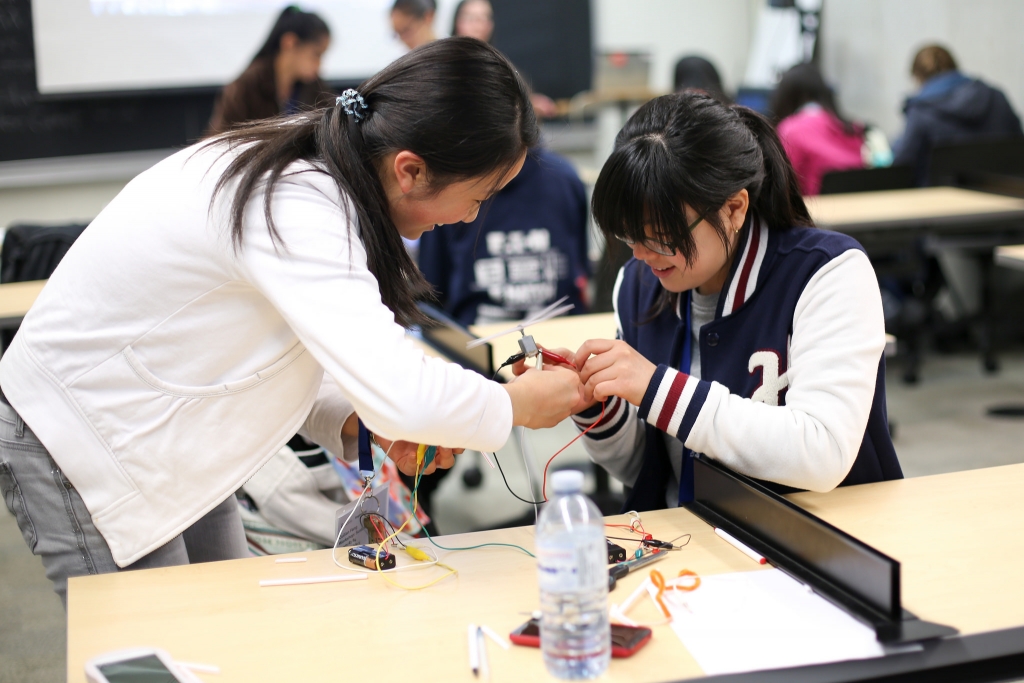
After lunch, the women begin to forge bonds with their future classmates during experiential workshops that range from sustainable energy to leadership.
With two other GLEE participants, Janice Zhou uses everyday items to fashion an arm that can pick up a cup from a distance, lift it in the air, invert it and set it back down.
“I’ve always heard the rumour that there aren’t a lot of girls in engineering programs and I got a little scared of that,” says Zhou, who is from Toronto and has already accepted her offer of admission to TrackOne. “But now I feel like I have a lot of peers and they all seem really nice and really smart. So I think GLEE really helped me gain some confidence.”
After attending a workshop on biomedical engineering, Sabahat Hussain, a Mississauga high school student who will be studying Engineering Science in the fall, says the most important thing she is learning at GLEE is that “school is not just about the marks. It’s all about the whole community and getting involved. That’s what I’m looking forward to.”
2:45 p.m. – Career Panel
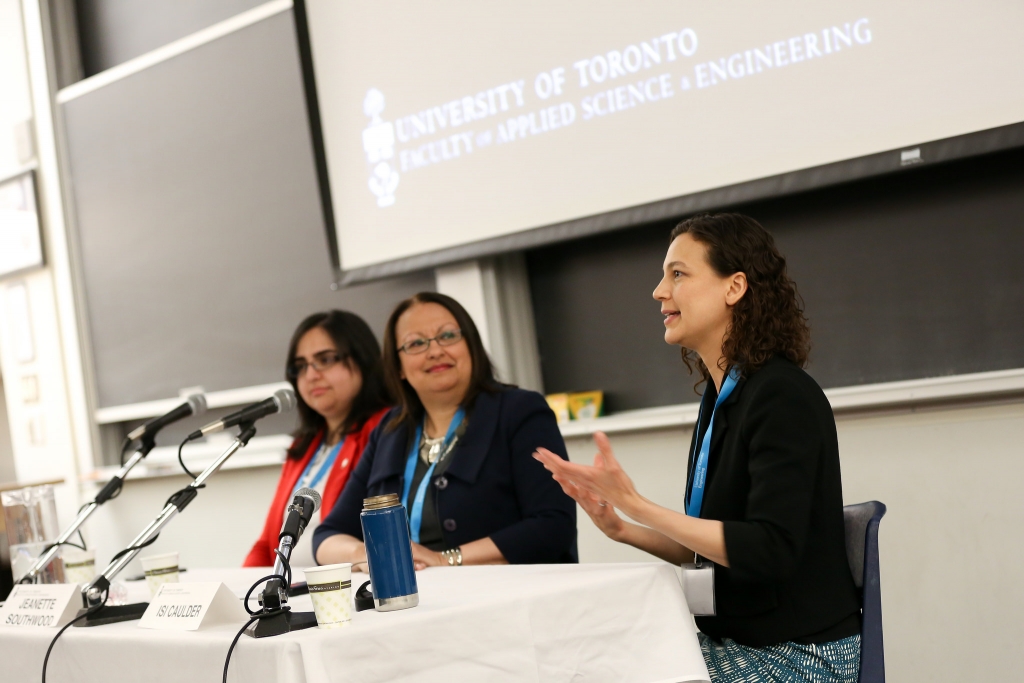 A career panel made up of U of T Engineering alumnae discusses topics including what it’s like being a woman in engineering, how to integrate a career and family, and pathways available to graduates beyond engineering, including law and medicine.
“If I can be some inspiration to other people and shed some light on certain things to encourage other people to take a really exciting path, then it feels like a really great thing to do,” panellist Isi Caulder (EngSci 8T9, ElecE MASc 9T1, LLB 9T5), a partner and patent lawyer at Bereskin & Parr LLP, says of volunteering for the panel.
Some of the students have already made up their minds. “There’s so many places you can go with engineering,” says GLEE participant Olivia Roscoe, who plans to combine computer engineering studies with Varsity volleyball. “You can go into any field and I’ve always liked the problem-solving piece of it. I’ve wanted to be an engineer since I was eight years old. It’s something I’ve always wanted to do.”
6:45 p.m. – Dinner
Dean Cristina Amon greets GLEE participants at a dinner at Strachan Hall at Trinity College. “You are among the best and the brightest, you are hard-working and you have high aspirations — and I believe you belong here,” she tells them. “I look forward to welcoming you this fall as part of our entering class.”
During dinner, Professor Angela Schoellig of the University of Toronto Institute for Aerospace Studies (UTIAS) encourages the students to follow their passions and shares her research on robotics, controls and machine learning. She also demonstrates one of her flying robots.
And Dr. Micah Stickel, chair of first year and emcee for the evening, jokes that the students likely recognize him from the instructional video for the new “personal profile” component of the U of T Engineering admission process.
8:30 p.m. – Evening Activities
 GLEE participants and residence advisors convene in the Trinity College quad for an evening of fun, friendship and snacks. “It’s like a giant slumber party,” says Tessa Pietropaolo (Year 4 IndE), the lead residence advisor.
After a night in residence, many of these young women stay on Sunday for the Faculty’s “Welcome to Engineering” events, where they learn more about the academic and co-curricular community they will become part of in the fall.
Professor Greg Evans (ChemE) has received a 2015 President’s Teaching Award, U of T’s highest honour for teaching. The President’s Teaching Award was established in 2006 to recognize sustained excellence in teaching, research on teaching and the integration of teaching and research. Recipients are also designated members of the University’s Teaching Academy for a five-year term.
Professor Evans has made extensive contributions as a researcher, educator and academic leader since joining the Faculty in 1990. He led the development of and serves as director for the Southern Ontario Centre for Atmospheric Aerosol Research (SOCAAR), an interdisciplinary centre for the study of air quality, with a focus on how aerosols impact human health and the environment. His ability to integrate his research and teaching have made him a sought-after supervisor and garnered him the University of Toronto Northrop Frye Award in 2013.
In addition to his outstanding classroom teaching, Professor Evans has developed innovative courses that go well beyond the delivery of technical content. Within these courses, he has created unique assignments that encourage ‘success skills’ such as teamwork, professionalism, communication and leadership. One such assignment is the “Environmental Consulting Engineer” project, in which students go through a term-long proposal and bidding process with a fictional client. The process involves collaborative learning and role-play, and it introduces students to engineering business practice while teaching technical skills.
Professor Evans has also made exceptional contributions as an educational leader. From 2003–05 he served as chair of first year for the Faculty. He then served as vice-dean, undergraduate from 2005–07. During this period he spearheaded significant curriculum development and added new curricular and extra-curricular learning opportunities.
Currently, Professor Evans is associate director of the Institute for Leadership Education in Engineering (ILead). The program is unique in Canada, and perhaps beyond, in that it integrates leadership development through curricular and extra-curricular facets of the engineering student experience. Most recently, Professor Evans has spearheaded the creation and implementation of the Graduate Collaborative Program in Engineering Education, the first engineering education graduate program in Canada. He serves as the inaugural director of this program.
Greg Evans has been recognized for his innovation in teaching and his educational leadership with a number of distinguished awards. These include the 2008 Joan E. Foley Quality of Student Experience Award from U of T, the 2010 Engineers Canada Medal for Distinction in Engineering Education, the 2014 Allan Blizzard Award for collaborative teaching and the 2014 Faculty Teaching Award, U of T Engineering’s highest recognition for teaching.
“Professor Greg Evans is an outstanding educator who inspires our students and colleagues to achieve their very best,” said Dean Cristina Amon. “He has been instrumental in transforming our Faculty’s culture of teaching innovation and excellence and I am thrilled that the university has recognized him with this prestigious honour.”
Since its inception, three other Engineering faculty have been honoured with the President’s Teaching Award: Professor Yu-Ling Cheng (ChemE), Professor Susan McCahan (MIE) and Professor Jim Wallace (MIE).
Ted Sargent, ECE professor and vice-dean, research for the Faculty, has been appointed to the rank of University Professor by U of T. University Professor is U of T’s highest academic rank, recognizing unusual scholarly achievement and pre-eminence in a particular field of knowledge. The number of such appointments is limited to two per cent of the University’s tenured faculty.
Professor Sargent is the Canada Research Chair in Nanotechology and a world-leading researcher in the area of nanotechnology-enabled solar cells. He was among the first to propose that a new nanomaterial known as colloidal quantum dots (CQD) could be deployed in solar cells to capture the half of the sun’s power that lies in the infrared wavelengths.
Professor Sargent then went on to develop the device theory and design, as well as the manufacturing and experimental characterization, of the colloidal quantum dot solar cell. Since then he has improved the efficiency of colloidal quantum dot solar cells by orders of magnitude; his solar cells are some of the highest-performing CQD solar cells in the world.
Ted Sargent has also built an international reputation for his work on detection of light using solution-processed materials. Image sensors — over a billion of which are in cellphone cameras, digital cameras, and x-ray systems — rely on silicon, which is blind to the infrared colors crucial to gesture recognition, environmental, and security applications. He has developed remarkably sensitive infrared light detectors that can readily be integrated with silicon electronics. He is the founder and CTO of InVisage Technologies, which commercializes this technology. The company has more than 50 patents issued in the US, Japan, Europe, Korea, Taiwan and China.
Ted Sargent’s teaching and training feature the integration of engaging teaching and leading-edge research in the classroom and the laboratory. He is known for his energetic, example-driven teaching style and the extent to which he brings the latest research advances into the classroom. His classes have explored Intel’s next-generation transistors, the exploitation of quantum physics in the most sophisticated lasers used to power the Internet and the transformation of the field of solar energy through innovations in nanomaterials. Recently, Professor Sargent successfully championed the founding of a Nanoengineering Minor within the Faculty.
“Professor Sargent is a passionate and inspirational researcher and a world-leading innovator in nanotechnology,” said Dean Cristina Amon. “On behalf of the entire U of T Engineering community, I am delighted to offer my congratulations on this richly-deserved recognition. We are all extremely proud of Ted’s remarkable accomplishments and his commitment to excellence in everything he does.”
Professor Sargent has received significant recognition for his research achievements. He is a Fellow of the Royal Society of Canada, the American Association for the Advancement of Science, the Canadian Academy of Engineering and the Institute of Electrical and Electronics Engineers (IEEE). He has been named one of Canada’s Top 40 Under 40, one of MIT Technology Review’s 100 top young innovators and one of Scientific American’s Top 50. Professor Sargent has received the IEEE Canada Outstanding Engineer Award and the Steacie Prize for Natural Sciences.
Two professors in The Edward S. Rogers Sr. Department of Electrical & Computer Engineering have received grants from the Canada Foundation for Innovation (CFI) worth a combined $3.4 million. The funding supports cutting-edge infrastructure upgrades and equipment needed to accelerate research on advanced electromagnetics and quantum security for smart grids.
Professor George Eleftheriades won $2.6 million for the Centre for Reconfigurable Electromagnetic Surfaces (CERES). The centre will be the Canadian focal point for research into high-frequency electromagnetic wave research, bringing together researchers from a variety of fields to solve problems in the communications, security and medical sectors. A core technology to be developed is a thin, lightweight surface that controls the generation, propagation and scattering of electromagnetic waves.
Professor Hoi-Kwong Lo received $762,660 for a project titled: ‘Smart Grid: Cyber-Physical Operation, Security and Quantum Technology.’ The project aims to make the sophisticated power generation and distribution systems we will reply on in the future smart and secure.
Funding awarded to these projects comes from CFI’s Innovation Fund, which supports promising and innovative directions in research or technology development in areas where Canada is, or has the potential to be, competitive on the global stage.
In addition, each project was awarded funding from the organization’s Infrastructure Operating Fund, which helps cover a portion of the operating and maintenance costs associated with the funded infrastructure.
“We are enormously grateful to CFI for these investments, said Professor Vivek Goel, U of T’s vice-president, research and innovation. “Ambitious, world-leading science requires powerful infrastructure, and we are fortunate that the Government of Canada recognizes that. It is through projects like these that our researchers will tackle society’s most pressing problems.”
See the complete list of University of Toronto CFI recipients.
With files from Jenny Hall