

A piece of string, a $1 spring and some 3D-printed plastic – it doesn’t sound like much. Yet, when brilliantly combined, these items can make a new tracheal intubation guide system for hard-to-intubate patients costing under $20.
It’s an innovative design that has netted its designers, then-fourth-year engineering students Qian (Linda) Liu (EngSci 1T3 + PEY) and Kaiyin (Cathy) Zhu (EngSci 1T3 + PEY) this year’s John W. Senders Award for Imaginative Design. From U of T Engineering, the award is “for the imaginative and successful application of the principles of human factors to the design of a medical device.”
Tracheal intubation is the placement of a flexible plastic tube into somebody’s windpipe (the trachea) to ensure that a patient can continue to breathe. They are often needed in high-risk situations in emergency wards or intensive care units.
But if the intubation is not done properly, or the patient is particularly vulnerable because of age or another circumstance, intubation can cause a great deal of internal damage.
Submitted by anesthesiologist Dr. Sherif Eskander, the project was intended to improve both the function and design over current tools, but also to keep costs low.
The students’ solution? Simplicity.
Leveraging the capabilities of 3D printing, the intubation tool (seen above) improves on current devices, and its novel design is intended to help tricky patients.
“He looking for a tool with the rigidity of a bronchial scope and the flexibility of a stylette,” explained Liu, who has just begun a Master’s Degree in Biomedical Design at John’s Hopkins University.
“There are some models out there that work,” she added, “but they cost $10,000.”
The project began as a final assignment for BME 489, a Capstone project-based course run through the Institute of Biomaterials and Biomedical Engineering (IBBME), part of the Division of Engineering Science’s Biomedical Systems Engineering Option. Students in the course worked in teams to tackle real-world biomedical engineering problems submitted by industry and health care professionals as well as professors looking to solve a particular problem.
Working with Dr. Eskander, the pair developed the tool to the point where it was ready for mannequin trials, already performing extremely well. Currently, Dr. Eskander and the inventors are working with other experts to perfect the design.
“The Senders award is an outstanding achievement for Cathy and Linda,” said course instructor Professor Rodrigo Fernandez-Gonzalez (IBBME). “Their project was selected over other capstone projects in the Faculty as the one with the greatest relevance for human health. With their tenacity, adaptability, and ingenious design, Cathy and Linda set an inspiring model for the incoming BME489 class.”
In a meeting with the young inventors, Professor Emeritus John W. Senders (MIE), namesake of the award, shared: “The history of mechanical engineering goes back to the Greeks. The Greeks might have invented something similar: straightforward, obvious – and that’s a good invention.”

Engineering professors Ted Sargent (ECE) and Peter Zandstra (IBBME) have been elected Fellows of the Royal Society of Canada.
Professor Sargent, of The Edward S. Rogers Sr. Department of Electrical & Computer Engineering (ECE), was elected to the Academy of Science in the Mathematical and Physical Sciences Division. His research has resulted in advances in nanotechnology and materials chemistry, which he has translated into new engineered devices for energy harvesting, light sensing and medical diagnosis. He pioneered solution-processed solar cells that absorb the sun’s full spectrum, including both its visible and infrared components. He has also created exceedingly sensitive light detectors to enable image acquisition in low light.
“It is a great privilege – particularly in light of the number of superb U of T scholars who have joined the ranks of FRSC, both from within and beyond the Faculty of Applied Science and Engineering,” said Sargent.
Professor Zandstra, of the Institute for Biomaterials and Biomedical Engineering (IBBME), was elected to the Academy of Science in the Applied Science and Engineering Division. Zandstra is a pioneer in the field of stem cell bioengineering, an area that applies engineering principles to stem cell biology. He has discovered new ways to grow stem cells in clinically-relevant bioreactors and used mathematical modeling to study stem cell behaviour. He has also employed micro-fabrication technologies to generate functional human stem cell-derived cardiac micro-tissues. Zandstra’s work has advanced our understanding of difficult-to-access developmental processes and catalyzed development of novel cell-based technologies.
“Professors Sargent and Zandstra’s groundbreaking research contributions have earned them reputations as leaders in their fields, not just in Canada but on a global level,” said Dean Cristina Amon. “Their remarkable achievements exemplify the calibre and impact of the research conducted by our faculty members. On behalf of the Faculty, I congratulate them on this richly deserved honour.”
Sargent and Zandstra were among 21 new Fellows from University of Toronto – more than the university has ever seen inducted in a single year. Ninety new Fellows were named in 2014 in total, including three Foreign Fellows, three Specially Elected Fellows and one Honorary Fellow. [Read the Citations for all 2014 Fellows here]
The Royal Society’s mission is to recognize scholarly, research and artistic excellence, to advise governments and organizations, and to promote a culture of knowledge and innovation in Canada. Membership in the RSC, which comprises the Academies of Arts, Humanities, and Sciences of Canada, is one of the highest honours a researcher can achieve, and the 21 U of T new Fellows join the nation’s most distinguished scholars, artists and scientists in an organization that dates back to 1882.
The Fellows will be formally inducted at a ceremony in Ottawa on November 22, 2014.

In Canada, the pharmaceutical drugs we find at the pharmacy are rarely cause for concern. We don’t worry about what has been added or if they’ve turned toxic because of improper storage.
But according to researchers at the Institute of Biomaterials & Biomedical Engineering (IBBME), other areas of the world aren’t so fortunate – and that needs to change.
Professor Peter Zandstra (IBBME) and PhD students Yonatan Lipsitz (IBBME PhD 1T6) and Nimalan Thavandiran (IBBME PhD) are one of two groups at IBBME that were recently awarded Grand Challenges Canada grants. The team is developing a new tool for drug sellers to test heart medication for additives or other problems.
The federal grant program encourages top researchers to use scientific or technical, social and business innovation to address some of the most pressing global health challenges.
This year’s recipients also include Lian Leng (MIE MASc 1T0, PhD 1T5) and Professor Axel Guenther (MIE, IBBME), who created a 3D skin printer to provide burn victims with skin grafts.
Counteracting counterfeit drugs
“In many parts of the developing world, counterfeit drugs are a huge problem,” said Lipsitz. “A very high number of drugs can have adverse health effects or have no effect.”
How serious is the problem? In a word: staggering.
“There are some classes of drugs, such as malaria drugs, where up to 50% of what you find in the market is counterfeit,” Lipsitz added.
For their project, the team is collaborating with the Center for Pharmaceutical Advancement and Training (CePAT) in Accra, Ghana, in conjunction with the U.S. Pharmacopeial Convention – the governing body for pharmaceutical standards in the States.
Simply put, the team is building testing plates. The researchers have found a method to derive large numbers of heart cells (cardiomyocytes) from human pluripotent stem cells (stem cells that can be used to generate any cell type), which are then seeded on plates in tiny wells. Each tiny well – 96 to a plate – can test for a different toxic material and its effects on the heart cells.
Why heart cells?
According to the researchers, cardiotoxic drugs, or drugs that adversely affect the heart, are among the most severe and highly publicized drug reactions involving substandard or counterfeit drugs – with high mortality rates.
If successful, the technology could provide unexpected benefits to the pharmaceutical industries in both developed and developing countries.
“If we can manufacture the heart cells on a large scale, and in a cost-efficient manner, this testing platform could definitely be useful here,” said Thavandiran.
But for the developing world, its implementation could be tricky.
“Ghana doesn’t have a huge infrastructure, and the regulatory landscape is not quite there,” shared Thavandiran. The next decade will be crucial to developing the conditions to make the testing platforms widely accessible, such as creating the means to manufacture the cells and the plates within the country.
Skin to order
A second U of T project funded through this grant this year is the “Skin Printer,” developed by Leng and Professor Guenther. The technology prints a steady stream of skin cells derived from the patient’s own cells, which can be used as a wound dressing on-site – and could revolutionize burn care in developing nations.
Developed in partnership with Dr. Marc Jeschke, the head of Sunnybrook Hospital’s Ross Tilley Burn Centre, the machine forms large, continuous layers of tissue that recreate natural skin. The printed product includes hair follicles, sweat glands and other essential complexities of human skin.
The funding will be used to allow the team to partner with researchers at the Children’s Surgical Centre in Phnom Penh, Cambodia.
“90 per cent of burns occur in low and middle income countries, with greater mortality and morbidity due to poorly-equipped health care systems and inadequate access to burn care facilities,” said Dr. Marc Jeschke. “Regenerating skin using a patient’s own stem cells can significantly decrease the risk of death in developing countries. This funding will enable us to transfer part of our skin regeneration technology to Cambodia.”
“Our team is determined,” said Guenther, “to move this exciting technology towards its clinical applicability.”
Read more about this year’s Grand Challenges Canada grants on their website.

Last week, U of T Engineering welcomed 1,254 new undergraduates and 740 graduate students to campus with a number of exciting events including parades, fairs, campus tours and a Plenary Lecture from entrepreneur and alumnus Mike Branch (ECE 0T3).
Dean Cristina Amon was proud to welcome the record-breaking group of students at the lecture, who join U of T Engineering from over 50 countries and nine provinces.
“I would like to extend my warmest welcome to all of you on behalf of the Faculty. We are delighted that you have decided to join our dynamic community here at the University of Toronto,” she told students in her opening remarks on September 4, 2014. “As a group, you have the highest admission average in the history of our Faculty at over 93%.”
She closed her welcome remarks by reminding students to make the most of their undergraduate degrees: “During your time here at the University of Toronto and throughout your career, immerse yourself and get involved wherever you can.”
With over 80 clubs to choose from, it is easier than ever to get involved with the Faculty.
“This year, students in the Faculty have so many choices for getting involved that appeal to many interests, from academics to extracurricular activities,” said Engineering Society president Teresa Nguyen (CivE 1T5).
And getting involved on campus is not only a great learning opportunity; it is also a great chance to meet other students.
For first year engineering student Sharpay Hanxing Yu (ChemE 1T8), choosing U of T meant leaving her family and friends in Shanghai, China, uprooting her life and moving to an unfamiliar city thousands of kilometers away.
It was a big risk, but she says she already feels at home because of the welcoming community and opportunities to get involved around campus.
“I’ve met so many people from so many different cultures,” Yu said. “Coming to Toronto is like travelling the world – everything is right here.”
In fact, over one third of new undergraduate students join from outside Canada, and 30.6 per cent are females. This diversity enriches the undergraduate experience both in and out of the classroom.
In addition to extracurricular activities, the Faculty is also thrilled to announce new and innovative learning opportunities for the 2014-2015 academic year.
“We are always looking for new and exciting ways to engage students,” said Susan McCahan, vice dean, undergraduate. “This year, for example, we’ve added online course options, which allow for more flexible scheduling and the option to get involved from anywhere.”
With new learning initiatives, clubs and activities, students like Yu have a wealth of opportunities to make the most of their time at U of T. And if the first week is any indicator, this undergraduate cohort will be an engaged and energetic group, eager to avail themselves of new possibilities.
“F!rosh Week has been amazing,” said Yu. “This was truly the first time I felt proud that I was on the path to becoming an engineer.”
Learn more about the many clubs and activities offered by U of T Engineering.

Were you a little chilly last winter? So were Alex Huang (ElecE 1T3+PEY) and Jason Yakimovich (CompE 1T3+PEY). Then fourth-year students slogging through bitter drifts to class, the two were so unimpressed by the “polar vortex” that they decided to take matters into their own hands by inventing the world’s first intelligent heated base layer.
In just six months, the pair founded their company, FuelWear, and created a light-weight, washable and cozy undershirt they call the Flame Base Layer. The garment can add 10 degrees Celsius to your body temperature in -20 C weather for three continuous hours, and has a smart monitor that turns off when you’re warm enough, and on again when you cool down.
Demand is already high. On August 26, FuelWear launched its first crowdsourcing campaign on Indiegogo with a target of $20,000. They reached it on September 2, just five days into their six-week window, and have been gaining momentum ever since.
The shirt is made of premium bamboo fabric, chosen for its antimicrobial properties and washability. The heating elements are made of carbon fibre and controlled by specially designed printed circuit boards. Rechargeable batteries last for up to 12 hours of continuous outdoor use, and LEDs indicate battery life. The whole package weighs just a few hundred grams, which is slightly heavier than a modern smartphone.
“It’s really soft—it feels great,” said Yakimovich.
“We’re really happy with the way it’s turning out, and we can’t wait to start processing orders,” added Huang.
But their journey hasn’t been all warm and fuzzy. From early struggles with designing and testing the product, to identifying their target demographics, FuelWear benefitted from the help and guidance from U of T Engineering’s Entrepreneurship Hatchery mentors Professor Vaughn Betz (ECE) and Rotman graduate student Candice Luck.
After being accepted into the Hatchery’s intensive summer program, Huang and Yakimovich met with Professor Betz to talk execution and marketing.
“We wanted to start with building the prototype, but he encouraged us to do more market research first and target our model to that niche market,” said Huang. “We found that the construction and outdoor-worker market was already very saturated, but we noticed major flaws in existing base layers for outdoor adventurers.”
Following market research, the duo began sourcing suppliers in June 2014.
“We had to do a lot of testing to find the right materials to make it washable, because there are electrical elements in there,” said Yakimovich. Their first two attempts at a prototype were hand-sewed on a second-hand sewing machine bought for the project; neither claims to be a tailor, and the results were a little misshapen. By their third iteration, they had forged a partnership with established garment manufacturer Gruven Athletics, and supplied Gruven with a pattern.
“Every time we made it, we made it simpler,” said Huang.
Huang moved to Edmonton from southern China at age 16, and met Yakimovich, who is also from Edmonton, during their first year of the Engineering Science program before both transferred into ECE. The two are now roommates in a condo at Bay and College, which makes planning business meetings simple.
Having exceeded their funding goal, things are heating up for FuelWear—they hope to ship the first base layers in time for Christmas. For those Indiegogo investors who got in with FuelWear on the ground floor, it’s going to be a toasty winter.
Find out more on their Indiegogo campaign.
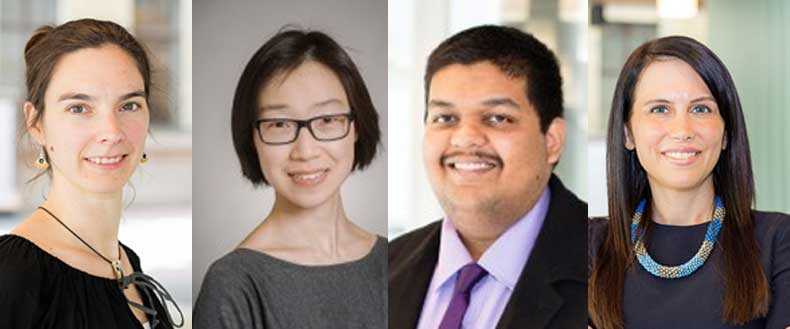
As new and returning engineering students attend their first classes of the year, the excitement on U of T campus is palpable.
But it’s not only the pupils who are looking forward to a fresh start; our newest educators are also excited to join the Faculty, to pursue research and to inspire the next generation of innovators and makers.
U of T Engineering is thrilled to welcome four new faculty members, each with diverse academic backgrounds that will enrich our culture of excellence. Just as we encourage multidisciplinary collaboration amongst our students, our newest faculty members also represent a broad cross section of experiences and interests.
Trained in a number of disciplines, Elodie Passeport (ChemE, CivE) received her PhD in Water Sciences in France before completing her postdoctoral fellowship at UC Berkeley. Prior to her position with Engineering, Passeport worked at U of T in the Earth Sciences department.
Margaret Hai-Ling Cheng (IBBME, ECE) is a U of T alumna herself and, prior to joining the Faculty, she pursued research at the Hospital for Sick Children where she combined her electrical and computer engineering expertise with her biomedical training to develop magnetic resonance imaging technologies.
Kinnor Chattopadhyay (MSE) specializes as a process metallurgist. Upon completing his PhD at McGill, he gained two years of experience in the metals industry working for Hatch Ltd., a global engineering and management consultancy firm.
Alumna Gisele Azimi (ChemE, MSE) received her PhD in chemical engineering at U of T before completing two postdoctoral positions at MIT, one in Materials Sciences and the other in Mechanical Engineering.
U of T Engineering spoke with these four new faculty members to learn more.
What are you most looking forward to in your new position?
EP: I am thrilled to begin building a research group while interacting with graduate students. Although we come to U of T with diverse backgrounds, we share a common interest: the advancement of environmental science and engineering. I also look forward to meeting our undergraduate students and helping to guide their discovery of engineering.
HLC: The university is the ideal place to pass our knowledge on to the next generation. The obligation we have as educators – to inspire students and open their eyes and minds to endless possibilities – is an opportunity and responsibility I truly look forward to. I am also excited about new collaborative research opportunities on campus, especially teaming up with groups who are interested in the fundamentals of science.
KC: One of my goals here at U of T is to collaborate with my colleagues to further develop in the area of process metallurgy. I am also sincerely excited to teach undergraduate and graduate courses in the process of metallurgy and extractive metallurgy.
GA: I look forward to performing leading-edge research with the goal of addressing some critical issues that exist in our society and environment. I also love teaching and am excited to inspire and educate the next generation of engineers who will someday make our world a better place.
What were your reasons for choosing the University of Toronto?
EP: For me, U of T’s main attraction was the strength of the colleagues and students. Another reason why this position was so attractive to me was the enhanced opportunities for multidisciplinary research enabled by the cross-appointment.
HLC: The University of Toronto is an amazing institution with strengths in so many research areas. It is also located in Toronto, which is a great city to live in and one of the best cities to engage in research. Above all, my family is here, and having a wonderful support system is very important to me.
KC: As the best school in Canada, U of T offers the unique opportunity to teach and supervise some of the brightest minds in the country and from around the world.
GA: The University of Toronto is my alma mater so I feel a deep attachment to it. U of T is also one of the best schools in the world, and it attracts talented students and the great faculty who will be my colleagues. I am looking forward to finding success in this tremendous university.
As a new professor, what one piece of advice would you give to new students?
EP: Make your learning experience as enjoyable as possible: search why it’s important, study with your friends, go talk to your professors; U of T has a lot of resources so make the most of them. And be sure to get a very, very warm coat.
HLC: My advice for graduate students is to have good research ideas, keep your head down, work hard, persevere, and get back up when you fail. Focus on your research, but keep your eyes and ears open to activities in the broader research community. Above all, don’t be afraid to tread unconventional research territories.
KC: This is your time to build your future. So love it and live it.
GA: Enjoy these beautiful years of your lives and try your best to learn about science, life and human communications as much as you can. Your time at U of T will build the foundation of a fruitful life.