

A 42-year-old investment banker arrived at the emergency room with complaints of nausea, vomiting, anxiety and tremors. He told doctors he drank alcohol every day—often at business lunches—and at home every evening. Worried about his health, he decided to quit drinking and had his last Scotch 24 hours before going to the hospital.
It’s a common scenario in emergency rooms across North America: a patient suddenly stops regular, excessive alcohol consumption and experiences withdrawal, a potentially fatal, easily treatable side-effect.
The most common clinical sign of withdrawal is tremor, especially in the hands and arms. Judging tremor severity is harder than it sounds—it requires considerable medical expertise, and even experienced doctors’ estimates can vary widely. Chronic alcohol abusers often come to the emergency department claiming to be in withdrawal in an effort to obtain benzodiazepines—a class of sedatives used to treat alcohol withdrawal, anxiety and more—and it can be difficult for inexperienced clinicians to determine if the patient is actually in withdrawal or “faking” a tremor to get access to these prescription medications. Front-line healthcare workers had no objective way to tell the sufferers from the fakers—until now.
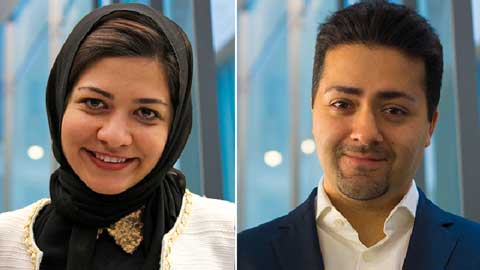
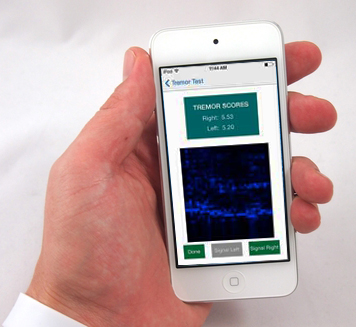
Professor Parham Aarabi (ECE) teamed up with PhD candidate Narges Norouzi (ECE MSc 1T4) and Professor Bjug Borgundvaag of the Faculty of Medicine to develop the world’s first mobile app to measure tremor strength, providing objective guidance that can help direct treatment decisions. The app also shows promise in making solid predictions about whether the tremor is real or fake. [Watch a video of the app in action].
To obtain data, users hold an iPod in both hands for 20 seconds while the device’s built-in accelerometer measures the frequency of the tremor. Researchers tested the app on 49 patients experiencing tremors in the emergency room, as well as 12 nurses trying to mimic the symptom. The app showed significant results, with only 17 per cent of nurses able to “fake it.”
While studies were promising, Norouzi found that her app’s ability to assess tremor strength matched that of junior physicians, while more senior doctors were able to judge symptoms with better accuracy. Norouzi’s next move is to continue honing the tool, comparing its performance to doctors’ subjective assessments, and to further study the effects of left- or right-handedness.
“There’s so much work to do in this field,” said Norouzi. “There is other work out there on Parkinson’s tremors, but much less on tremors from alcohol withdrawal.”
“The exciting thing about our app is that the implications are global,” said Professor Borgundvaag, who is also an emergency physician at the Schwartz/Reisman Emergency Centre at Mount Sinai Hospital. “Alcohol-related illness is commonly encountered, not only in the emergency room, but also elsewhere in the hospital, and this gives clinicians a much easier way to assess patients using real data.”
“Our app may also be useful in assisting withdrawal management staff, who typically have no clinical training in determining which patients should be transferred to the emergency department for medical treatment or assessment. We think our app has great potential to improve treatment for these patients overall.”
“We have just begun to scratch the surface of what is possible by applying signal processing and machine learning to body-connected sensors,” said Professor Aarabi. “As sensors improve and algorithms become smarter, there’s a good chance that we may be able to solve more medical problems and make medical diagnosis more efficient.”
Norouzi and the team presented this work on Aug. 29, 2014 at the International Conference of the IEEE Engineering in Medicine and Biology Society in Chicago.
Read more about this story in The Toronto Star.
The University of Toronto’s Da Vinci Engineering Enrichment Program (DEEP) is catered to curious, motivated high school students seeking advanced skills and knowledge in science and math. Over the summer months, students enjoy a variety of courses with subjects ranging from robotics to neuroscience. They gain insight into post-secondary education at U of T, while meeting like-minded students. The following photos take a look at a few of the courses offered by U of T Engineering Outreach this year, including ENGage and Girls’ Jr. DEEP (Photos: Roberta Baker).
They’re building up, shipping out and being celebrated as the future of innovation.
The University of Toronto is a hub for many biotech and health innovators looking to develop their research and business acumen through programs, courses, accelerators and more.
With consumers continually looking for the next new thing, it can take a lot for any startup to break through the noise – but two companies from U of T engineering alumni are doing just that.
U of T News’ Brianna Goldberg explores two startups that are recently making headlines from the MIT Technology Review to Wired magazine.
Wearable sensors get a boost
For Engineering alumnus David He (ECE 0T5), being named one of the MIT Technology Review’s ‘Innovators Under 35’ this week promises to be a big boost for the company he co-founded two years ago, Quanttus.
Quanttus has a simple goal: to change how people manage their own health. The company’s first prototypes are based on He’s PhD work with wearable sensors, specifically those that measure the mechanical functioning of the heart in previously unexplored ways.
MIT Technology Review’s editor-in-chief and publisher Jason Pontin highlights that He is in good company as one of the ‘Innovators Under 35.’
“Previous winners include Larry Page and Sergey Brin, the co-founders of Google; Mark Zuckerberg, the co-founder of Facebook; Jonathan Ive, the chief designer of Apple; and David Karp, the creator of Tumblr,” said Pontin. “We’re proud of our selections and the variety of achievements they celebrate, and we’re proud to add David He to this prestigious list.”
“This watch could finally get your blood pressure under control,” reads the headline of Technology Review’s feature on He. But from the $22 million in venture capital his company has already raised, it seems like it has the potential to do much more.
Read more about David He and Quanttus.
Bionym invites volunteer developers
The clock is counting down for the Nymi – a wristband that uses your heart rate to eliminate the need for passwords, PIN codes and more. Designed by U of T engineering alumni Foteini Agrafioti (ElecE MASc 0T9 PhD 1T1) and Karl Martin (ElecE BASc 0T1 MASc 0T3 PhD 1T0) through their startup Bionym, wearable tech’s much-anticipated fall 2014 release draws near.
Bionym has already received widespread attention from media outlets around the world, including The New York Times, Wired, The Economist and others.
In advance of their consumer launch, they have begun tapping into the tech community’s creativity for more ideas on additional uses for the Nymi. They recently put sample ‘software development kits’ in the hands of volunteer developers, helping them dream up new features to integrate into the Nymi’s offerings in addition to the applications it’s set to ship with, such as auto-unlock-and-lock
“The Nymi can grant you access to devices that are password-protected – be it a phone, tablet, computer or more – when they are nearby one another,” reads a recent post on their blog. “The device will lock again when the Nymi is no longer nearby.”
“From students working on hobby projects, to IT engineers at large companies,” the blog continues, “to those that build products and components for cars, buildings, airlines and stores, we’re looking for people around the world to realize the potential of the Nymi.”
Read more about Bionym’s invitation to developers on Tech Crunch.
Crowded around glossy posters, inquiring about dental resins and porous structural materials, U of T Engineering’s undergraduate students buzzed with excitement as they shared their summer research projects.
The event, known as UnERD (Undergraduate Engineering Research Day), was a one-day research symposium that gave students an opportunity to gain additional feedback and recognition for their hard work over the summer months. Presentations include posters and podiums from over 100 students covering topics from biomedical engineering and energy, to materials science and computer modelling.
After two keynote talks from Professor Paul Santerre (IBBME) and Professor Craig Simmons (MIE), a panel of judges also selected three grand prize winners who have the opportunity to publish their research in the Canadian Young Scientist Journal.
“Research is such an important component engineering, I wanted to be part of an event that celebrates that,” said engineering undergraduate Amy Zhao (MSE 1T6), who organized the event with fellow co-chair Marshell Ma (MIE 1T5).
Learn more about this year’s grand prize winners:
Ahmed Anwer (MechE 1T6): Functionally Graded Polymeric Structures and Their Superior Impact Properties
Closed-cell metallic foams – high-impact resistant structures that are lightweight because of tiny gas-filled pockets – are currently a widely-used material for most impact applications. However, these materials are expensive to manufacture. Anwer and the Smart and Adaptive Polymers Laboratory (SAPL) tested five different porous materials for their impact strength-to-weight ratio, and found that functionally graded porous structures – a certain method for manufacturing porous structures – are optimal.
Mitchell Nascimento (IBBME): Synthesis of Antimicrobial Monomers Using the Antibiotics Ciprofloxacin and Metronidazole
Dental resin composites are a promising material in dental restoration, but are subject to significant breakdown in the mouth. Nascimento, who studies fulltime at the University of Windsor and worked as a research assistant at U of T for the summer, developed an antimicrobial composite by coupling pharmaceutical drugs with dental resin which inhibits breakdown and can reduce the necessity of dental restoration implants.
Matthew Langley (EngSci 1T5): Modeling and characterization of donor cell memory in T cell progenitor-derived induced pluripotent stem cells
Adult cells can be programmed to become induced pluripotent stem cells (iPSCs) – stem cells that can be applied to any tissue in the body. However, these cells exhibit “donor cell memory,” meaning they display different gene expressions dependent on their cell type, which limits their use.
Langley has developed a novel method for characterizing donor cell memory such that it can be utilized to stabilize the cell. This serves to further enhance the utility of stem cells.
UnERD happens every summer at U of T Engineering, and is open to any undergraduate university student conducting research in the Faculty over summer. The initiative is supported in part through the Institute for Leadership Education in Engineering.
David He (ECE 0T5) found himself in good company today: MIT Technology Review just named him to its list of Innovators Under 35.
It’s a title the University of Toronto engineering alumnus shares with past honourees such as Larry Page and Sergey Brin (Google), Mark Zuckerberg (Facebook), Jack Dorsey (Twitter) and Jonathan Ive (designer of the iPod and iPad), to name a few.
So what market disrupting innovation has He produced to get added to this list of game-changers?
“We are still in stealth mode,” He told U of T News about the startup, Quanttus, launched out of his PhD research at MIT.
Curious users clicking through to the Quanttus website will find a welcoming interactive space. It invites users to ask such questions as: “How can I improve my focus?” and “How do I reduce my stress level?” They’ve been testing their product at Massachusetts General Hospital and raised $22 million in venture capital. And yet – what does it all mean?
The MIT Technology Review explains Quanttus’ core as a “watch-like gadget” that “gives a more direct view of the heart’s mechanical performance than an ECG can, capturing the strength and timing of a person’s heartbeats.”
“This could be the first time that we have gained access to an unprecedented amount of continuous vital signs data in real-life settings. These data may lead to new discoveries about our heart and how our lifestyles affect our body,” said He. “Our long-term vision is that unforeseen and preventable health events will be a thing of the past.”
“Over the years, we’ve had success in choosing young innovators whose work has been profoundly influential on the direction of human affairs,” said Jason Pontin, editor-in-chief and publisher of Technology Review. “We’re proud of our selections and the variety of achievements they celebrate, and we’re proud to add David He to this prestigious list.”
He shared a few details of Quanttus, and how his time at U of T helped him on his path to entrepreneurship.
What does your startup do?
Quanttus is combining next generation, wearable vital signs sensors with contextual data to extract patterns and insights, which allow us to improve our health by understanding how our lives impact our bodies at a physiological level.
How has your life changed since co-founding a Quanttus?
Since we started nearly two years ago, we have grown very rapidly and have attracted a lot of talent and attention despite the fact that we are still in stealth mode. We’ve been hard at work perfecting our product, performing clinical studies, and analyzing tons of human data. I’m particularly excited about our clinical study results and the accuracy we’ve achieved compared with clinical standards.
How will your startup change the lives of our readers?
Instead of one doctor’s visit per year, we are looking at half a million vital signs readings per person per day. This is the first time that we have had access to such an unprecedented amount of vital signs data in real-life settings. These data will lead to new discoveries about our heart and how our lifestyles affect our body. Our long-term vision is that one day, our devices will help make unforeseen and preventable health events a thing of the past.
What motivates you?
I look forward to going to work every day because of the amazing people who work at Quanttus. Here, people come from diverse backgrounds ranging from cardiology, engineering, data science, to user experience. It’s a wonderful feeling to work with like-minded people towards a common goal: improving people’s lives, and hopefully one day, saving lives.
How did U of T help you develop your concept?
The rigorous classes at U of T gave me a solid foundation of electrical engineering upon which my future work is based, whether it’s bioelectricity, circuit theory or signal processing. It’s a world-class learning environment where I met some of the best teachers and the brightest classmates that I know.
Tell me a bit about the people at U of T who’ve mentored or inspired you.
Professor Andreas Veneris (ECE) and Professor Khoman Phang (ECE), introduced me to the pursuit of academic research and the joy of creating something that has not been done before. This carries with me to this day. Professor Berj Bardakjian (IBBME, ECE) taught me the class “Cellular Bioelectricity”, which inspired me to explore the multidisciplinary field between human physiology and electrical engineering.
You’ve just been named one of MIT’s Innovators Under 35. When you started at U of T, was being a noted innovator always part of your plan?
To be honest, I’ve never imagined I’d be sharing a list with such talented individuals past and present. Looking back, I would say that thinking big, not being afraid to fail, and a good amount of luck got me to where I am now.
Before we announce our product to the world, we are making sure it is well tested for accuracy and quality. We can’t wait for it to be in people’s hands and for people to start benefiting from our product as soon as possible. Stay tuned!
Doing more with less is the future of lighting. As smart novel lighting technologies use less energy to shine brighter, it’s also a trend that flipping the switch in homes and businesses around the world.
It’s known as smart sustainable lighting, and researchers from the University of Toronto are leading the charge in design and production of this burgeoning field. This month, U of T’s Smart Sustainable Lighting Network (SSLNet) is bringing together key players in the field for a dynamic conference connecting researchers, industry, entrepreneurs and more.
“Smart sustainable lighting is important because energy-efficient products are the easiest and cheapest way to combat climate change, rising energy costs and increasing energy demand,” said Elyse Henderson, SSLNet’s special initiatives coordinator.
Taking place from August 18 to 20, Henderson says the conference is meant to catalyze Canada’s smart sustainable lighting interests around the future of LED devices, lead to even more innovation, and “take advantage of this growing industry to make Canada a key player.”
Writer Brianna Goldberg learned more about U of T’s role in the field from SSLNet founder, Venkat Venkataramanan. Venkataramanan is also founder of Lumentra, a U of T-nurtured startup that focuses on improving thermal management in LEDs, and he serves as director of scientific operations at U of T’s physical sciences entrepreneurship hub, The Impact Centre.
What’s the most exciting ‘smart sustainable lighting’ research going on at U of T?
U of T researchers are at the forefront of solid-state lighting technologies. Professor Zheng Hong Lu’s (MSE) group has set the world record in efficiency for lighting devices under laboratory conditions, and they are developing next-generation devices like flexible lighting. Professor Tim Bender (ChemE), and Professor Cynthia Goh with the Department of Chemistry are developing novel materials for enriched lighting. Professor Olivier Trescases (ECE) is leading efforts on smart power supplies for LED lighting. My own research focuses on improving the colour quality of LED lighting and efficient thermal management in lighting.
How does this research expertise end up affecting everyday life for consumers?
The Impact Centre’s lighting lab is the home of the Smart Sustainable Lighting Network. Through its collaborative research and development efforts, the lab has helped Canadian manufacturers create better lighting products for automotive, architectural, display, industrial automation, medical and mining lighting products. The Impact Centre’s SSLNet has helped establish Toronto as a major world-class hub at the forefront of energy efficient lighting.
What are some of the ways we might see this lighting research being championed by U of T entrepreneurs?
Professor Lu’s technologies for improving Organic Light Emitting Diodes are being commercialized by a U of T engineering alumni alumni Michael G. Helander (EngSci 0T7, MSE PhD 1T2) and Xiaofeng Terry Xu (MASc MSE 1T2), through the spin off company OTI Lumionics. Another spin off, Lumentra Inc, is developing efficient thermal management methods for LED lighting. A group of former U of T engineering students, Gimmy Chu (ElecE 0T6), Tom Rodinger (IBBME PhD 0T7) and Christian Yan (ElecE 0T6), now manufacture and sell the world’s most energy-efficient light bulbs under the label of Nanoleaf.