

Airlines Flight MH17 which crashed in the Ukraine on July 18, 2014
killing all 298 people on board (Photo: Roman Boed via Flickr).
Nearly a week after the Malaysian Airlines flight MH17 was destroyed over Ukraine, questions abound over what exactly happened.
Writer Jelena Damjanovic spoke to U of T engineering professor Doug Perovic (MSE) and anthropology professor Tracy Rogers about the procedures − and the challenges − of gathering scientific evidence and performing accurate analysis to determine the causes of such tragedies.
Perovic is a materials science & engineering professor and a renowned expert in forensic engineering. He currently teaches the only forensic engineering course in Canada, where he challenges students to apply engineering design concepts to real-world problems – learning the tools they need for high-level sleuthing.
Rogers is a forensic anthropologist and director of the forensic science program at the University of Toronto Mississauga. She’s helped identify remains found at the farm of serial killer Robert Picton.
What evidence might the bodies of the passengers provide about the tragedy?
TR: The information provided by the bodies of the victims would be most useful if the bodies were actually examined in place at the scene. The distribution of the remains, along with the patterns of injuries they sustained can help investigators sort out the sequence of events.
Knowing the seat number of each victim, and examining injuries in light of the person’s position on the plane, could provide some insight into which areas of the plane were most impacted.
The usefulness of this type of analysis will depend on the overall degree of destruction and degree of decomposition that has already taken place.
What evidence, if any, can be gleaned once bodies have been moved by non-professionals after decomposing for days?
TR: That is very difficult to say. It really depends on what they are trying to learn. Mainly they will be concerned with identification of the bodies, but some of the injury patterns might be informative – even information like whether or not the body was burned could be useful.
Now that the bodies have been moved from the scene, the investigators will have to ID the bodies to find out who they are, link that info to their seat placement and then examine the injuries to see if they can provide insight into where or how the plane was hit, etc. But the plane itself may prove more useful for this type of analysis.
What methodology and technology would be used to determine the cause of a plane crash?
DP: Let me outline some of the key steps to any investigation:
- Investigators employ the root cause failure analysis (RCFA) procedures.
- All available and relevant background information and data are collected.
- All physical evidence available is collected and reassembled as best as possible to reconstruct the aircraft structure.
- The origin of the failure event is then determined using a wide range of characterization tools, involving spectroscopy, microscopy, etc. as needed.
- The initial cause of the event is determined by analyzing the origin and using a cause-and-effect RCFA approach. This involves assessing all possible causes and the resultant effects, and then eliminating the possibilities to the most probable cause.
- Ultimately, the history of the event from beginning to end is determined in order to fully assess liability and damages.
Who is typically involved in investigating the causes of plane crashes – what bodies or institutions? What about instances when an aircraft crashes over a war zone?
DP: The federal authority of the country where the accident occurred takes the lead. Usually the National Transportation Safety Board (NTSB), Federal Aviation Administration (FAA), aircraft manufacturer and pilot associations are involved.
A crash over a war zone is clearly a problem for the normal course of events. The physical evidence has to be immediately secured and not disturbed until properly documented by experts to do the types of analyses outlined above. I understand that is not the case in Ukraine.
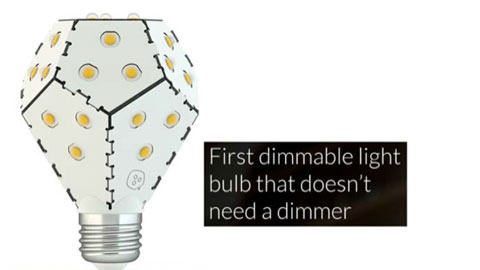
What if you could dim the lights across your entire house without having to buy dimming switches – and save the environment too?
Thanks to the latest invention from Nanoleaf, a startup from U of T Engineering alumni, you soon can.
Nanoleaf, creators of the world’s most efficient light bulb, has released a new dimmable LED bulb that can “transform” any on/off light switch into a dimmable switch. Called the Nanoleaf Bloom, the device is part of a Kickstarter campaign that recently blasted beyond its funding goal in less than two hours.
“In the past, with regular light switches, people had no choice but to use their lights either at full power or completely off,” said Nanoleaf co-founder Gimmy Chu (ElecE 0T6). “With our latest innovation, we not only give people the convenience of having the ability to adjust the brightness without the need for a dimmer … we enable them to save a significant amount of energy.”
The bulb screws into a typical light socket, and it can be dimmed by clicking the light switch on and off in certain combinations. The team estimates the new bulb will cost approximately $1.53 in energy per year.
“One of the coolest parts about our bulb is that at half brightness, it only uses a quarter of the full power,” he said. “At the lowest brightness, the Nanoleaf Bloom only uses half a watt of electricity… and it is still the world’s most energy efficient.”
Nanoleaf was first profiled by U of T in February of 2013. That’s when a Kickstarter campaign for the first bulb from Chu and his co-founders, fellow engineering alumni Christian Yan (ElecE 0T6) and Tom Rodinger (IBBME PhD 0T7), began to draw investments well beyond their original $20,000 goal.
Since then, the team scored influential global funding from the likes of Li Ka Shing (dubbed “Asia’s richest man” by Bloomberg news) while keeping the U of T connection alive, adding three new team members from the university and name-checking the support of President Meric Gertler when speaking with international media.
“I think people are drawn to the high energy efficiency design of our bulb as well as our story – a David vs. Goliath sort of thing – you know, just three entrepreneurs with no funding and just a bright idea,” Chu told U of T News in an article about the global funding.
“We used our passion for efficiency to build a light bulb that was well ahead of the competition. I’m actually surprised that the bigger companies haven’t hit our efficiency rates yet, but sadly I don’t think efficiency is their primary focus.”
Chu shared plans for the dimmable bulb in the U of T News story in March. Now that it’s launched, their latest product continues to rack up Kickstarter funding as they surpassed their original target of $30,000 in less than two hours.
“We want to inspire people to adopt more energy efficient technology into their everyday lives,” said co-founder Christian Yan. “The best way to do that is by making products that are simple and convenient to use.”
[youtube https://www.youtube.com/watch?v=eizpVPlS32E]
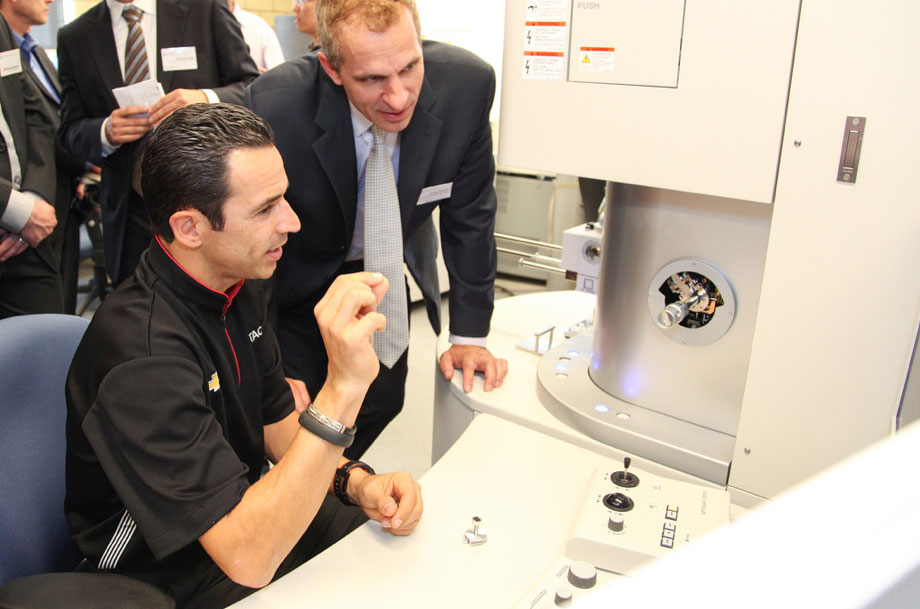
When three-time Indy 500 winner Hélio Castroneves speeds around the track at this month’s Indy races, he’ll be driving a racecar propelled by decades of materials research that makes him faster, safer and more efficient.
But with the opening of a new $20-million materials lab at the University of Toronto, the technology in Castroneves’ car could soon feel as old-fashioned as your grandma’s station wagon.
On July 17, Castroneves joined U of T Engineering to unveil the Ontario Centre for Characterization of Advanced Materials (OCCAM) – a high-tech facility that enables researchers to explore and develop novel materials that could be used in electronics, renewable fuels, construction, disease treatment and even futuristic racecar design.
Funded by the Canada Foundation for Innovation (CFI), the Ontario Ministry of Research and Innovation (MRI) and Hitachi High-Technologies Canada, OCCAM offers highly specialized tools to understand and manipulate matter at the atomic scale. The centre also emphasizes collaborative and multidisciplinary projects, anticipating over 350 different research programs annually involving academic researchers and private companies.
“This is expensive equipment to purchase and operate, but the new centre makes it available to everyone, from industry to academia,” said Professor Charles Mims (ChemE), a co-principal investigator for OCCAM alongside Professor Doug Perovic (MSE). The facility is a joint initiative between the Department of Materials Science & Engineering (MSE) and the Department of Chemical Engineering & Applied Chemistry (ChemE).

To celebrate OCCAM’s grand opening, Castroneves used one of the lab’s high-power electron microscopes to “cut” the centre’s name into a ribbon at nano-scale. The width of each letter was nearly 1,000 times smaller than a human hair.
The MSE logo will also be featured on the front of the racecar of Castroneves – part of the Hitachi-sponsored Penske Team – at this weekend’s Honda Indy Toronto races.
“OCCAM is a shining example of how U of T Engineering, in partnership with industry and government, is pursuing innovative solutions to some of world’s greatest challenges in health, city life and energy,” said Dean Cristina Amon. “We are profoundly grateful to CFI, MRI and Hitachi for their contribution to the creation of this unique world-class facility.”
Three big (and small) ideas enabled by OCCAM:
1. Car accidents that no longer kill people
“We have the technology today to make vehicles so safe that car accidents no longer kill people,” shared Professor Perovic. But if we have the means, why aren’t we using them? According to Perovic, the answer is cost – cost of materials and cost of manufacturing. That’s why, through OCCAM, he has partnered with Toronto-based Integran Technologies to develop newer, inexpensive methods of boosting vehicle safety and efficiency.
Integran is the only company in the world that can coat plastic and carbon fibre with nano-metals, allowing them to make virtually any material significantly stronger with one coating. While they are continuing to find ways of reducing cost, Integran’s technology has the potential for impact beyond the auto industry, from better spacecraft to lighter and more durable bicycles.
2. Stopping blood clots with non-stick nano-materials
Blood clots are essential in healing cuts, but they can be deadly for those requiring medical catheters (tubes that carry medicine or drain fluids in the body). Dangerous clots can form around the tubes in a process called thrombosis – an affiliction that leads to approximately 50,000 deaths in the United States each year.
To reduce the risk of blood clots, Professor Paul Santerre (IBBME), Jeannette Ho (ChemE/ IBBME MASc 9T7) and a group of other medical scientists and engineers have designed a method of producing catheters that include fluorinate oligomers, the same molecules that make frying pans non-stick. Already commercially available through licensing from Santerre’s spin-off company Interface Biologics, their invention has shown to reduce the rates of thrombosis by up to 75 per cent.
“OCCAM gives us access to tools and expertise that a small lab like us wouldn’t normally have,” said Roseita Esfand, director of research and development at Interface. “Collaborations such as this will help us to bring our technologies and products from bench to human.”
3. Solar fuels – If trees can do it, we can do it
Professor Ben Hatton (MSE) and group of multidisciplinary researchers are using OCCAM’s advanced equipment to design nano-materials that mimic the photosynthetic processes of plants. While plant photosynthesis uses the sun’s rays to produce sugars and carbohydrates, Hatton’s lab is hoping to make materials that produce methane and other gases.
This technology could be used to power vehicles, houses and more – and to store energy we aren’t using for later consumption. In doing so, they could reduce, and even reverse, the detrimental impacts of fossil fuels. “We’re still in early development stages,” explained Hatton. “But we’re excited by the advances and resources that OCCAM will provide, and we look forward to making our technology better and more efficient.”
“If trees can do it,” he said, “we can do it.”
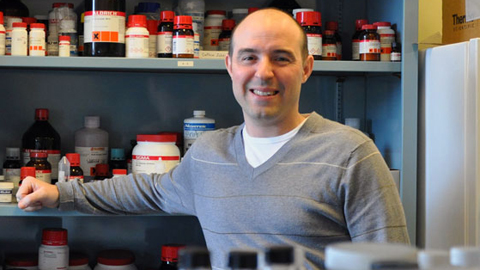
McLean Award (Photo: Diana Tyszko).
This year’s McLean Award winner Aaron Wheeler (IBBME) believes the solution to the colossal challenge of personalizing medicine for cancer patients may be a tiny one.
Funded jointly by U of T alumnus William McLean and U of T’s Connaught Fund, the $100,000 McLean Award is given annually to support outstanding basic scientific research at the University of Toronto.
Wheeler is an analytical chemist and professor at the University of Toronto whose research is primarily focused on digital microfluidics, a technology that allows scientists to work with minuscule volumes of fluids. Digital microfluidics takes a programming approach to microfluidics, allowing scientists to be precise in their work with tiny volumes of substances.
Among other advantages such as the ability to work with tiny, precious samples (tissue collected from a biopsy, for example), the ability to manipulate and study such tiny volumes of fluid makes it easier to work with three-dimensional clumps of cells, something Wheeler said could be beneficial particularly when developing treatment plans for people with cancer.
“Everyone agrees across the board that we should all be culturing cells in three dimensions because cells grown in 3D are much more similar to cells grown in in vivo systems like humans. If I wanted to evaluate, say, how a drug interacts with cells, I’d like those cells to copy us as much as possible.”
Unfortunately, growing and working with cells in three dimensions creates unique challenges.
“Coaxing the cells to grow is difficult. It often requires expensive reagents (external compounds or mixtures). You need some kind of gel scaffold for the cells to grow in, and some of those gels are expensive,” Wheeler explained. “Some of those gels are very soft, such that you put those cells in them and you coax them to grow and then it all falls apart.”
This expense and difficulty in growing these cells means that despite the advantages of working in 3D, most scientists are still working primarily with 2D cells grown on dishes.
Wheeler and his team are hoping to change that. “We’ve developed a microfluidic platform that allows us to grow cells in three dimensions and to do it in an automated fashion,” he said.
Using their digital microfluidics technology, Wheeler’s team is able to grow 3D cells in tiny gel pockets and digitally program the delivery of reagents to the cells.
“It turns out that that’s very gentle,” Wheeler explained. “So even if I’m working with a soft gel, I can deliver fresh reagents. I can pull reagents away and the gel doesn’t fall apart, and the cells are happy. We think this is going to make it a lot easier for folks to do 3D cell culture.”
Wheeler’s next challenge, with the help of the Connaught award funding, is to apply this approach to designing cancer treatments. He plans to take biopsies of tumour tissue and use that tissue to grow cells on the digital microfluidics device where he can then test various drugs on the cells before giving them to the patient the biopsy was taken from.
“We’re going to look to find a personalized approach to treating that patient to find the combination of drugs and concentrations that’s perfectly tailored for that person. We can build this little device, take it into the doctor’s office, collect the sample, press a few buttons and ideally get some answers back. It tells us how to treat the patient,” he said.
“It’s a radical idea. We’re not the first to have it by any means. Personalized medicine is something that everyone’s talking about, but how do you implement it? No one’s really making it happen yet, and we think this may be an interesting way to make it happen.”
“Professor Wheeler’s work perfectly embodies the spirit of the McLean Award,” said Judith Chadwick, U of T’s assistant vice-president (research services). “We are thrilled to recognize his achievements in a way that will help him continue his exciting research.”
Wheeler credits both the Connaught Fund and his team of researchers for the opportunity to move his unique approach to treating cancer patients forward.
“It’s a phenomenal opportunity to work on this. This is such a kind of crazy, out-there idea. We might find it difficult to get this idea funded without the McLean Award,” he said.
“If this award is a recognition of my work, it certainly is a recognition of my research group and I’m eager to share that honour with them because they are a really amazing group of scientists.”
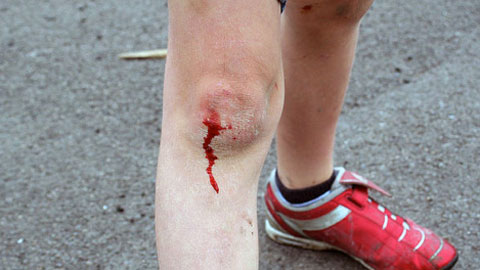
Whether you fall off your bike and scrape your knee, or knick your finger cutting onions, you know it’s only a matter of time before your injury has scabbed and healed.
But what really just happened – how did your wound actually mend?
Using a student-designed software program called MEDUSA, as well as a special type of microscope and a method called fluorescent tagging, a group of researchers from the Institute of Biomaterials & Biomedical Engineering (IBBME) at U of T have been studying just that.
Published recently in the journal Development, they speculate that they’ve uncovered how some of the fastest wound healers – the embryos of fruit flies – get the job done, in hopes of using their findings to develop medical therapies that aid healing in the future.
Watching wounds mend
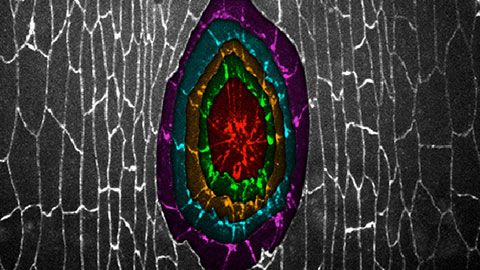
In a typical embryonic wound, a cable-like, cellular structure slowly draws in on itself, eventually closing off the wound in much the same way that a string bag closes. Second-year PhD candidate Teresa Zulueta-Coarasa (PhD IBBME 1T6) examined this behaviour in “normal’ and “mutant” fruit fly embryos.
The goal: to measure how quickly wounds heal over time and what mechanisms lie behind that healing.
It’s an incredibly laborious process. To determine the rate of healing in a single embryo, researchers measure the wound area on each and every frame of a film captured by confocal microscopy. Typically, this involves drawing a polygon shape on the borders of the wound onto hundreds of film images.
To speed the process of discovery, Zulueta-Coarasa developed the MEDUSA software program. The program employs algorithms to automatically find the borders of the wound in a single time frame of film. The resulting contour is then transferred onto the adjacent time frames and fitted to the individual images, making the analysis process for these large amounts of data far more efficient.
The team employed fluorescently-tagged proteins in order to sleuth out the mechanisms behind healing. Molecules that tended to gather around the wound edges increased in intensity, allowing the researchers to
identify specific molecules involved in the healing process.
“We found that for certain proteins, the intensity of the molecule in the wound margin increased rapidly, [suggesting that] those molecules are important to the wound healing process,” said Zulueta-Coarasa.
Helping with healing – from diabetes to cancer
The findings may one day play an important role for those suffering from diabetes or other circulation-related illnesses.
“Patients with chronic wounds heal really slowly or not at all,” explained Zulueta-Coarasa, “but if we could understand why wounds heal so fast in these [fly] embryos, we could develop a strategy to heal them.”
But what surprised the researchers most is that the study may have uncovered a parallel between wound healing and the metastasis of certain cancers.
One of the proteins the researchers saw double in intensity around the wound is called Abelson kinase, or Abl. According to Zulueta-Coarasa, “We have been able to discover that, in mutant embryos without that molecule, wounds still heal – but at a much slower rate.”
Abl, however, is a molecule more commonly associated with metastatic cancers.
“From a biomedical perspective,” explained Assistant Professor Rodrigo Fernandez-Gonzalez (IBBME), corresponding author on the paper, “the identification of a role for the protein Abl in coordinated cell migration [during wound healing] generates new hypotheses about its role in metastasis.”
“Abl activation is associated with invasive breast cancer, in which small groups of cells can coordinate their migratory behaviours to spread disease,” he added.
Though intriguing, the connection between the molecule’s role in speeding up the healing process and spreading cancer remains a mystery. “The actual mechanisms by which Abl promotes metastasis are unclear,” said Fernandez-Gonzalez.
For now, the team hopes to better understand the science behind the healing process, one tiny nick at a time.
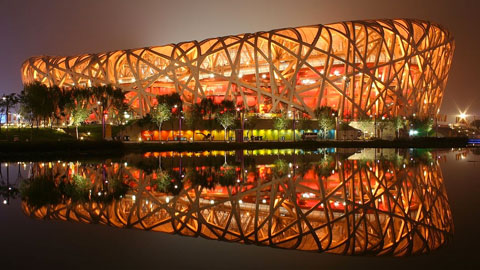
iconic “Bird’s Nest” Beijing National Stadium (Photo: Peter23 via
Wikimedia Commons).
For Jiaxin (Jansin) Cai (IndE 1T7), a summer exchange in Beijing, China is more than just extra credit: it’s a chance to experience his home in a whole new way.
Cai – an industrial engineering undergraduate at U of T– is one of six Engineering students to participate in this year’s Global Educational Exchange (Globex). With courses running from July 7 – 26 at China’s Peking University (PKU), the program encourages student exchanges and research collaboration between PKU and 21 engineering schools from around the world.
“I have never experienced higher education in China,” said Cai. “One of the reasons why I came to Canada for study was to learn more about a different culture. Similarly, even though China is my home country, I have never been to Beijing where the enriched Chinese culture originates.”
The University of Toronto, through the Department of Mechanical & Industrial Engineering (MIE), joined Globex last year as the program’s first Canadian partner.
Professor Kamran Behdinan (MIE), NSERC Chair in Multidisciplinary Engineering Design, is teaching a course in this year’s exchange, Applied Finite Element Technology, to 34 students from countries including Australia, China, Japan and the United States.
“Globex is a remarkable opportunity for students to collaborate in an international classroom, in a truly international setting,” said Behdinan. “It’s also a chance for us to share a part of our program curriculum with global learners.”
Another Globex student, Jiaxin Fan (MechE 1T7), is participating in a course called China’s Economy: Technology, Growth and Global Connections, taught by Professor Susan Mays of the Center for East Asian Studies at the University of Texas at Austin.
In addition to her courses, Fan is planning to soak up Chinese culture – especially the food – while in Beijing, including a visit to the iconic “Bird’s Nest” Beijing National Stadium.
“I applied to the Globex because I’m interested in traveling around the world,” Fan said. “Globex [is] an excellent opportunity for me to broaden my horizons.”
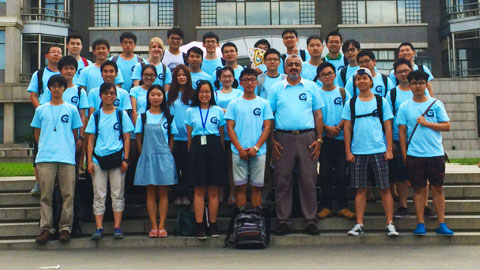
steps in Beijing, China (Photo: XueCheng Wang)
Occurring annually, Globex is designed to deepen partnerships between institutions by offering a framework for exceptional students and faculty to attain a global educational, research and professional experience. The 21 other partner universities this year include the University of Cambridge, Hong Kong University of Science & Technology, University of Melbourne and Yokohama National University.
The deadline for applications is typically in March each year. More information can be found on the MIE website.