
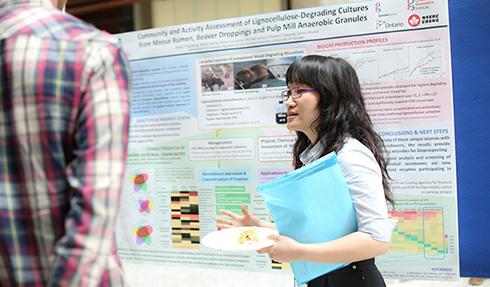
Genetically engineering algae to produce biofuel. Growing artificial spinal discs in a lab. Using nanotechnology to fight malnutrition. These are just some of the ideas presented at the 16th annual CSChE Ontario-Quebec Biotechnology Meeting on May 15 – 16, 2014, which brought together over 90 graduate students from across Ontario and Quebec to explore the fascinating science at the intersection of biology and chemical engineering.
“Right now is the real golden age of biotechnology,” said keynote speaker and alumnus Phil Dennis (CivE 0T0), who has worked in the biotechnology sector for over 25 years. “With the breakneck speed of technological developments, it’s starting to resemble the computer industry of a few decades ago.” Dennis is senior manager at SiREM, a company born out of research in Professor Elizabeth Edwards’ (ChemE) lab that is an industry leader in bioremediation – the use of bacteria and other microbes to clean up groundwater contaminated with chemicals.
Dennis has seen the development of high throughput genetic sequencing technology suddenly make it possible to look at whole biological systems at the molecular level, raising the possibility of manipulating living systems like never before.
Biotechnology and bioengineering encompass an enormous range of applications, from industrial enzymes and bioenergy to health and medical therapies. What unites students across these disciplines is a desire to improve our environment and our lives. “We need sustainable solutions and biotechnology can provide this, perhaps more than other industries,” said Dennis.
Here are just two of the big ideas presented at the student-run conference, hosted by graduate students from the University of Toronto’s Department of Chemical Engineering and Applied Chemistry.
How to turn trash into cash (hint: it’s the bacteria!)
Plastic, plastic everywhere! Thirty-two million tons of it ended up in garbage bins in the USA in 2012 alone, and of that mountain of plastic trash only nine per cent was recycled. PhD student Mahbod Hajighasemi (ChemE) is looking to the tiniest of life forms to help shrink this enormous environmental problem. “Wouldn’t it be great if we could make plastic from renewable materials instead of oil, and then completely recycle it instead of throwing it in the landfill? Bacteria can help us do that,” said Hajighasemi.
Some jurisdictions, like the state of California, have already started using compostable plastic that is made from renewable materials. Called polylactic acid (PLA), it is used to make coffee cups and shopping bags which, once used, are sent to composting facilities where they take several weeks to break down. “The problem is that PLA doesn’t actually decompose very quickly and when it does, it gives off carbon dioxide, an undesirable greenhouse gas,” said Hajighasemi.
Instead of composting the used PLA, Hajighasemi’s idea is to turn to nature’s recyclers – bacteria – to selectively break it down into its original chemical building blocks, which can then be used to make more plastic.
But how do you find bacteria that like to feast on a totally artificial plastic that doesn’t exist in nature?
It turns out that PLA is similar enough to natural polymers such as silk fibres or plant polyesters that there’s likely a bug out there that can break it down. By searching through genomics datasets from a wide range of micro-organisms, Hajighasemi has found some promising candidates among bacteria from cold marine environments and sewage treatment plants that could one day turn old plastic new again.
His hunt for plastic-degrading bacteria is part of a larger movement to look for industrially useful micro-organisms using data generated by the recent explosion in genomics studies. These include genetic information on a huge numbers of natural enzymes with unknown functions. It’s now up to researchers like Hajighasemi to figure out what they do and put their abilities to use.
How to go where you can’t go
How do you deliver a drug to the specific location in the body where it is needed? If you’re working with drugs that repair spinal cord injuries, the answer is “Not very easily.”
Drugs that can stimulate nerve growth and repair spinal cord damage already exist, yet therapeutic treatments remain elusive. “The main problem is how to get the drug to the damaged site,” said PhD student Irja Elliott Donaghue (ChemE/IBBME collaborative program). “The spinal cord is wrapped in a protective barrier that blood and drugs simply can’t cross.”
That means pills or even intravenous drugs won’t work. Injecting drugs with a needle directly to the spinal cord through that protective barrier – a method called catheter infusion – is risky to patients and would have to be repeated many times over weeks or months during the slow healing process.
What’s really needed is a slow-release drug delivery system that could be implanted in a patient once but would steadily release the needed drugs directly to the spinal cord, without the need for repeated injections.
That’s where a nifty bit of engineering by Elliott Donaghue and her colleagues comes in. Working with Professor Molly Shoichet (ChemE and IBBME) and other members of her research group, she has helped developed a gooey hydrogel that can be impregnated with drugs and injected into a patient’s spinal cord to give off a constant dose of medication for an extended time. “What’s neat about this hydrogel is that it’s very soft at cooler temperatures but gets stiffer as it warms up to body temperature,” said Elliott Donaghue.
This means that the fluid gel can easily be injected but firms up once it’s in the patient’s body to create a long-lasting drug source, while remaining flexible enough not to damage the spinal cord. As a bonus, the hydrogel is made of a natural polymer that slowly breaks down in the body and is eventually absorbed, eliminating the need to remove it once treatment is over.
Elliott Donaghue was first to test the method in rats in collaboration with Dr. Charles Tator at Toronto Western Hospital. The team is now working on adjusting drug doses and exploring the use of combinations of drugs to see greater effects.
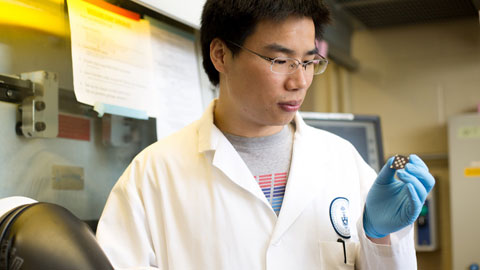
Think those flat, glassy solar panels on your neighbour’s roof are the pinnacle of solar technology? Think again.
Researchers in the University of Toronto’s Edward S. Rogers Sr. Department of Electrical & Computer Engineering have designed and tested a new class of solar-sensitive nanoparticle that outshines what we currently consider state of the art.
This new form of solid, stable light-sensitive nanoparticles, called colloidal quantum dots, could lead to cheaper and more flexible solar cells, as well as better gas sensors, infrared lasers, infrared light emitting diodes and more. The research, led by post-doctoral researcher Zhijun Ning (ECE) and Professor Ted Sargent (ECE), was published this week in Nature Materials
Collecting sunlight using these tiny colloidal quantum dots depends on two types of semiconductors: n-type, which are rich in electrons; and p-type, which are poor in electrons. The problem? When exposed to air, n-type materials bind to oxygen atoms, give up their electrons, and turn into p-type. Ning and colleagues modelled and demonstrated a new colloidal quantum dot n-type material that does not bind oxygen when exposed to air.
Maintaining stable n- and p-type layers simultaneously not only boosts the efficiency of light absorption, it opens up a world of new optoelectronic devices that capitalize on the best properties of both light and electricity. For you and me, this means more sophisticated weather satellites, remote controllers, satellite communication, or pollution detectors.
“This is a material innovation, that’s the first part, and with this new material we can build new device structures,” said Ning. “Iodide is almost a perfect atom for these quantum solar cells to bond with, having both high efficiency and air stability—no one has shown that before.”
Ning’s new hybrid n- and p-type material achieved solar power conversion efficiency up to eight per cent—among the best results reported to date.
But improved performance is just a start for this new quantum-dot-based solar cell architecture. The powerful little dots could be mixed into inks and painted or printed onto thin, flexible surfaces, such as roofing shingles, dramatically lowering the cost and accessibility of solar power for millions of people.
“The field of colloidal quantum dot photovoltaics requires continued improvement in absolute performance, or power conversion efficiency,” said Sargent. “The field has moved fast, and keeps moving fast, but we need to work toward bringing performance to commercially compelling levels.”
This research was conducted in collaboration with Dalhousie University, King Abdullah University of Science and Technology and Huazhong University of Science and Technology.
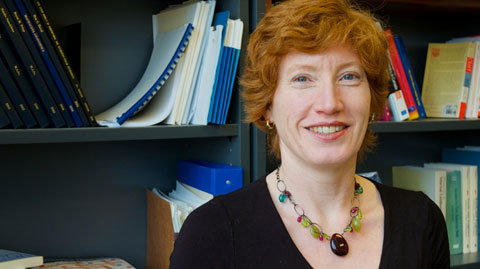
8:07 AM: the Gardiner Expressway rumbles with thousands of vehicles driving downtown to work, each with its own combustion engine releasing a barely-visible trail of exhaust into the atmosphere.
Is there a better way to move people around our city? If so, what is it? These are questions that Professor Heather MacLean (CivE) explores in several sustainability-focused courses she’s pioneered at U of T. This week, MacLean was recognized with an Excellence in Education Award for the Promotion of Sustainable Practices by the Canada Mortgage and Housing Corporation (CMHC).
CMHC established the Excellence in Education Award in 2003 to honour outstanding educational contributions to sustainable practices. Maclean was selected based on her efforts to integrate sustainable community development concepts into the academic curriculum.
MacLean’s research has focused on evaluating the sustainability of products, processes and engineering projects. She has made key contributions in developing novel methods to examine issues related to transportation, energy and urban systems.
“I teach students broadly about sustainability concepts, and focus on a life cycle approach as it is generally viewed as the foundation for sustainability assessment,” said MacLean. “By examining the life cycle of a product or project, from resource extraction, through manufacture/construction, use and end-of-life, students explore the overall impact of developments, taking into account complex environmental and socio-economic factors. I encourage students to think deeply about infrastructure challenges and to develop unique solutions that will benefit society.”
Maclean has created several innovative courses that promote sustainable practices, including the graduate course “Evaluating Sustainability of Engineering Activities”, the first course in Canada – and among the first worldwide – that focused on introducing and applying sustainability and life cycle evaluation methods.
In 2010, MacLean developed the first undergraduate civil engineering course in Canada – and one of only two in North America – on sustainable energy systems. She also completely revamped an existing undergraduate course, “Engineering Project Management and Finance” to include a module focused on sustainability implications of large-scale infrastructure projects. This is a core course for students within the Engineering Science Infrastructure option.
“Professor Heather MacLean’s initiatives in research, teaching and curriculum development are providing our students with the crucial competencies to meet future sustainability challenges” said Dean Cristina Amon. “I am grateful for her exceptional contributions and delighted that the CMHC has honoured her with this richly-deserved recognition.”

Nausea, vomiting, hair loss – these are just a few of the unpleasant side effects of chemotherapy. Although the drugs are designed to kill cancerous cells and save lives, the potent chemicals destroy tissues and can damage the human body.
Professor Molly Shoichet (ChemE, IBBME) is leading a multidisciplinary team of researchers who are developing new ways to administer drugs that target only cancerous tissues, leaving the healthy ones intact. This week, Shoichet received one of the University of Toronto’s most prestigious titles: University Professor. The distinguished rank is given to less than two per cent of tenured faculty, serving to highlight her outstanding contributions to research and teaching.
As a Canada Tier 1 Research Chair in Tissue Engineering, Shoichet’s research tackles a wide scope of medical-related challenges, from healing spinal cord injuries to blindness using stem cell therapy. The impact of her work extends beyond the laboratory, driven in part by her dedication to mentoring, teaching and motivating her students and colleagues.
“Professor Shoichet is an inspirational researcher and passionate innovator in biomedical engineering,” said Dean Cristina Amon. “On behalf of the Faculty of Applied Science and Engineering, I offer my heartfelt congratulations for this richly-deserved recognition. We are all tremendously proud of her commitment to excellence and her pioneering discoveries.”
U of T Engineering’s Sydney Goodfellow spoke with Professor Shoichet about her passion for research and education.
With projects ranging from stem cell therapy to treatment of disease, what sort of impacts do you expect your research to have?
I have always thought that we, in academia, should focus on answering big questions and solving difficult problems. I like to think of our research as the interface of applied chemistry and applied biology. Ultimately, we aim to enhance tissue repair and functional recovery in diseases associated with stroke, spinal cord injury, blindness and breast cancer. We’re able to work in diverse fields due to the strength of our graduate students, post-doctoral fellows, technicians and collaborators.
Your diverse research has received attention around the world. Can you share some of the recent projects you and your team are working on?
Currently we are designing polymers – which are essentially long chains of hundreds or thousands of tiny molecules – for use in biology and medicine. We’re excited about many of our projects, like designing novel ways to deliver therapeutic biomaterials to the spinal cord, brain or eye; creating innovative hydrogels that allow us to grow cells in three-dimensional environments that mimic nature; and, developing new methods for targeted drug delivery in cancer. From our lab at U of T, we have the privilege of collaborating with leading experts locally, as well as those in Canada and around the world.
As a University Professor and leader of a lab that has graduated over 100 researchers in two decades, your dedication to teaching and education is clear. How do you balance the educational and research sides of your career?
Whether it’s for students in the classroom or scientists in the lab, I am fully dedicated to the academic mission of advancing knowledge. I really enjoy bringing research into the classroom and sparking imaginations.
I have received significant support from my colleagues in the Chemical Engineering & Applied Chemistry [department], which allows me to teach those subjects that I’m most adept at teaching, while providing me with the opportunity to devote meaningful time to research. As a mother of two teenage boys, I’m also blessed with a husband who supports my career aspirations. Balance is something that I strive for everyday.
What motivates you to pursue your research?
I also love the pursuit of knowledge. I love working with the brilliant researchers in my lab, attempting to answer questions together – questions that have long gone unanswered, or even unasked. Discovery is fascinating and wonderful.
I also love learning about companies, their products and how they are making a difference in people’s lives. The raison d’etre of biomedical engineering is the same: I aspire to advance our research knowledge towards new applications in medicine. While I understand that many stars must align for this to come to fruition, this is one of my great passions and a significant motivation.
If you could give yourself as a student a piece of career advice, what would it be?
I encourage students to pursue their dreams. If they spend their lives doing what they love, they will spend more time doing it and thus be more likely to succeed. I have been particularly blessed with opportunities and have worked hard to bring them to fruition.
Read more about Molly Shoichet’s research.

When recent U of T Engineering graduate Mauricio Curbelo (CivE 1T4) was in his second year, he helped lay the groundwork for one of the largest donations in Engineering Society (EngSoc) history.
He just didn’t know it at the time.
As EngSoc’s vice-president, external, Curbelo was part of a team that established the Skule Endowment Fund in 2011 – a fund generated by annual student contributions of $100 and intended to finance a variety of student-related initiatives.
It was this same fund that EngSoc drew from in 2013, under Curbelo’s then-presidency, to donate $1 million to the Centre for Engineering Innovation & Entrepreneurship (CEIE), providing a dedicated space for student clubs to socialize, hold events and collaborate on group projects.
“The Engineering Society’s generous commitment to the CEIE speaks volumes of our students’ dedication to engineering excellence,” Dean Cristina Amon said. “It’s a remarkable demonstration of support and proves just how vital the new collaborative space will be to future students.”
U of T Engineering’s Jamie Hunter spoke with Curbelo about the EngSoc donation, what it means for future students and his vision for the planned space in the CEIE.
How did EngSoc come to decide on donating to the CEIE?
It was never really a question as to whether EngSoc would contribute toward the CEIE. We had the money [in the Skule Endowment Fund] and that’s what it was intended for. We thought it was a great opportunity to make a contribution, have a seat at the table, top up the project support and put the student space issue on the map.
EngSoc’s donation is quite sizeable, especially for one generated from student funding. Why $1 million?
A $2 million donation was required to name the basement space of the CEIE. We donated $1 million and the University offered to match it. I think the Faculty would have provided student space no matter what, but to have it named after EngSoc sends a good message.
As an alumnus, you’re not going to benefit from the space the way future students will. How do you feel about this?
When EngSoc was discussing the donation, not one person ever questioned: Why would we give if we won’t enjoy it? It was never a consideration for anyone. And I think the more that you do outside of the classroom, the more you see the impact of alumni donations and their generosity. We all understood the impact that alumni had on us when we were still in school, so for us to be able to give back to future generations was really a no-brainer.
What’s your ideal vision for the space? What do you hope future students will get out of it?
The ideal vision is for a versatile space that students are in charge of and maintain, and makes it easier to get involved and do things outside of the classroom.
The one thing that students asked for most when we ran our clubs was storage space. And it makes sense because most clubs are not designed to be huge – they’re just small interest groups – and chances are they have supplies and a bunch of equipment they have to carry around. It makes a big difference to have one small locker somewhere on campus where they can keep that stuff. It makes it easier for those people to be involved and to balance school with extracurriculars.
The other important thing is for students to be able to easily book meeting rooms. EngSoc has always believed that the more things you do outside of the classroom, the more prepared you’ll be for real-world experiences when you graduate.
When the CEIE finally opens and you have the opportunity to stand inside the EngSoc student space, how will you feel?
I’ll be happy that we were able to do something that future generations can benefit from the same way that we currently appreciate what others have done for us. To now be on the giving end is a tremendous honour, not just for [EngSoc] but all the students who have generously given to the Skule Endowment Fund.
Read more about collaborative learning space in the CEIE.
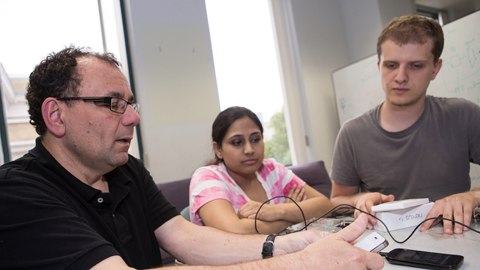
Whether it’s turning canola oil into diesel fuel or a wristband that unlocks your smartphone with your heartbeat, the source of a truly transformational idea can often seem mysterious or coincidental.
Do they come from mentorship and training? Timely investment? A specially designed space? Or, the right mix of diverse people working together?
To engineering professor Jonathan Rose (ECE) and Professor Emeritus Joseph Paradi (ChemE, MIE), brilliant ideas come from all of the above – and they’re no accident.
Rose and Paradi are both leading initiatives at U of T – an engineering business minor and entrepreneurship certificate, respectively – aimed at encouraging students to grow new ideas into entrepreneurial ventures that equip students with the necessary skills to succeed.
“Sometimes,” said Rose, “you find the skills for success only when you learn how to fail. We give students a safe environment to try things out.”
U of T Engineering’s Sydney Goodfellow spoke with Professors Rose and Paradi about the importance of entrepreneurial education and how the Faculty is helping students realize their own game-changing ideas.
Why is entrepreneurship and business knowledge important for engineering students?
Joseph Paradi: Entrepreneurship isn’t just important; it’s endemic to the learning process. Engineers are inventors, innovators and builders by nature. We call it ‘applied’ science because we solve real-world problems that benefit mankind. It makes sense that what drives us to pursue engineering may also lead us to be interested in business. It’s a way to deliver – to apply – our results.
Jonathan Rose: The rate of change of technology and its applications are increasing exponentially, and engineers have the right skill set to drive this innovation, but it will also help them greatly to have some business knowledge. Learning about entrepreneurship and business creates opportunities for students to have an exciting career.
The Faculty offers an engineering business minor; how does it enhance the engineering curriculum and engage students with business and finance?
Rose: The Engineering Business minor works in partnership with U of T’s Rotman School of Management, and requires students to complete six relevant credits. This includes three courses in the fundamentals of finance, marketing, strategy and people management.
The minor’s goal is to introduce students to the language and concepts of business, so that they can participate in all discussions that happen in a company. What is a market? How do you know your idea is competitive? If there are competitors, what strategies do you need to stay on top? If you can inform technical knowledge with business knowledge, you’re already way ahead.
There is also an entrepreneurship certificate offered in U of T Engineering. How does it benefit the engineering student?
Paradi: The [Entrepreneurship] certificate serves as a tangible reflection of the fact that a student has gone through this intensive two-term course – one credit in fall and one in spring – that challenges them to shadow successful entrepreneurs, write business plans, learn the technical aspects of business and finance and much more.
In addition to the technical know-how, we also engage in less tangible challenges, posing ethical questions that encourage students to trust their instincts. In order to have confidence, it’s important for students to have a solid understanding and knowledge of business to draw from.
In addition to this minor and certificate, what are some other entrepreneurship initiatives and opportunities on campus?
Paradi: There are myriad opportunities on campus… Of course, there’s the [Entrepreneurship] Hatchery. Undergraduates are remarkably inventive; they don’t know what can’t be done, so they try anything. To encourage that innovational spirit, we’ve made all our resources available to them – hundreds of millions of dollars worth of tools and facilities, mentors, professors, teams of like-minded students – all available through the Hatchery’s program. At the end of the summer, these empowered students present a business idea to carry forward.
Rose: The goal of the Hatchery is exactly that, in 10 or 15 years, we’ll be able to look at graduates who are successful entrepreneurs and say that they had a formative and enabling experience at the Hatchery. It’s not about winning, or culling applicants and ensuring success, or combing for the next Zuckerberg, it’s about giving students an opportunity to try their ideas and see what works and what doesn’t – to experience potential failure and grow from it.
[The Hatchery] works in collaboration with a lot of other entrepreneurial ventures on campus, like the Institute for Leadership Education in Engineering (ILead), the Impact Centre, the Creative Destruction Lab and more. We create a community where students can learn from each other, network and share ideas.
What impact do you see U of T’s investment in entrepreneurship having on the Canadian economy?
Rose: The impact is crucial: the economy of the future rests on the start-ups of today. Technology is changing more and more rapidly, so there’s a risk in not investing in innovation. We don’t want to get left behind.
In Canada, we have everything we need to be a world leader in business – infrastructure, financial support and amazing institutions – but sometimes we can be conservative in our approach. We need to teach our students to take risks, be ambitious. With initiatives like the Hatchery, we are giving our students the confidence they need to challenge that conservatism and change the economy.
Paradi: We have to take charge of life, and take charge of Canada – we can’t give things away. That’s what entrepreneurship is about: improving our country.