
Whether it’s turning canola oil into diesel fuel or a wristband that unlocks your smartphone with your heartbeat, the source of a truly transformational idea can often seem mysterious or coincidental.
Do they come from mentorship and training? Timely investment? A specially designed space? Or, the right mix of diverse people working together?
To engineering professor Jonathan Rose (ECE) and Professor Emeritus Joseph Paradi (ChemE, MIE), brilliant ideas come from all of the above – and they’re no accident.
Rose and Paradi are both leading initiatives at U of T – an engineering business minor and entrepreneurship certificate, respectively – aimed at encouraging students to grow new ideas into entrepreneurial ventures that equip students with the necessary skills to succeed.
“Sometimes,” said Rose, “you find the skills for success only when you learn how to fail. We give students a safe environment to try things out.”
U of T Engineering’s Sydney Goodfellow spoke with Professors Rose and Paradi about the importance of entrepreneurial education and how the Faculty is helping students realize their own game-changing ideas.
Why is entrepreneurship and business knowledge important for engineering students?
Joseph Paradi: Entrepreneurship isn’t just important; it’s endemic to the learning process. Engineers are inventors, innovators and builders by nature. We call it ‘applied’ science because we solve real-world problems that benefit mankind. It makes sense that what drives us to pursue engineering may also lead us to be interested in business. It’s a way to deliver – to apply – our results.
Jonathan Rose: The rate of change of technology and its applications are increasing exponentially, and engineers have the right skill set to drive this innovation, but it will also help them greatly to have some business knowledge. Learning about entrepreneurship and business creates opportunities for students to have an exciting career.
The Faculty offers an engineering business minor; how does it enhance the engineering curriculum and engage students with business and finance?
Rose: The Engineering Business minor works in partnership with U of T’s Rotman School of Management, and requires students to complete six relevant credits. This includes three courses in the fundamentals of finance, marketing, strategy and people management.
The minor’s goal is to introduce students to the language and concepts of business, so that they can participate in all discussions that happen in a company. What is a market? How do you know your idea is competitive? If there are competitors, what strategies do you need to stay on top? If you can inform technical knowledge with business knowledge, you’re already way ahead.
There is also an entrepreneurship certificate offered in U of T Engineering. How does it benefit the engineering student?
Paradi: The [Entrepreneurship] certificate serves as a tangible reflection of the fact that a student has gone through this intensive two-term course – one credit in fall and one in spring – that challenges them to shadow successful entrepreneurs, write business plans, learn the technical aspects of business and finance and much more.
In addition to the technical know-how, we also engage in less tangible challenges, posing ethical questions that encourage students to trust their instincts. In order to have confidence, it’s important for students to have a solid understanding and knowledge of business to draw from.
In addition to this minor and certificate, what are some other entrepreneurship initiatives and opportunities on campus?
Paradi: There are myriad opportunities on campus… Of course, there’s the [Entrepreneurship] Hatchery. Undergraduates are remarkably inventive; they don’t know what can’t be done, so they try anything. To encourage that innovational spirit, we’ve made all our resources available to them – hundreds of millions of dollars worth of tools and facilities, mentors, professors, teams of like-minded students – all available through the Hatchery’s program. At the end of the summer, these empowered students present a business idea to carry forward.
Rose: The goal of the Hatchery is exactly that, in 10 or 15 years, we’ll be able to look at graduates who are successful entrepreneurs and say that they had a formative and enabling experience at the Hatchery. It’s not about winning, or culling applicants and ensuring success, or combing for the next Zuckerberg, it’s about giving students an opportunity to try their ideas and see what works and what doesn’t – to experience potential failure and grow from it.
[The Hatchery] works in collaboration with a lot of other entrepreneurial ventures on campus, like the Institute for Leadership Education in Engineering (ILead), the Impact Centre, the Creative Destruction Lab and more. We create a community where students can learn from each other, network and share ideas.
What impact do you see U of T’s investment in entrepreneurship having on the Canadian economy?
Rose: The impact is crucial: the economy of the future rests on the start-ups of today. Technology is changing more and more rapidly, so there’s a risk in not investing in innovation. We don’t want to get left behind.
In Canada, we have everything we need to be a world leader in business – infrastructure, financial support and amazing institutions – but sometimes we can be conservative in our approach. We need to teach our students to take risks, be ambitious. With initiatives like the Hatchery, we are giving our students the confidence they need to challenge that conservatism and change the economy.
Paradi: We have to take charge of life, and take charge of Canada – we can’t give things away. That’s what entrepreneurship is about: improving our country.
When U of T Engineering first opened the Entrepreneurship Hatchery two years ago, executive director Joseph Orozco had an ambitious goal: 20 student teams annually by the program’s fourth year.
Now, a year ahead of schedule, the early-stage ideas factory has sailed past expectations – unveiling 37 groups at a recent Hatchery Kick Start event on May 2.
“[The Hatchery] owes such remarkable engagement to our students’ interest in entrepreneurship and the value this experiential learning opportunity brings to them,” said Orozco. “With the support of our mentors and the passion and hard work of our students, we look forward to a lively and engaging journey. I can already see a lot of promise and potential in the ideas the students have brought forward so far.”
The Hatchery – which offers students mentorship, along with unprecedented access to the Faculty’s vast research infrastructure – encourages students to form new ideas and turn them into start-up companies. Popularity for the program continues to grow, with organizers attracting students through outreach events, like speaker series and “idea markets”.
At the Kick Start event, several student groups presented innovative ideas they want to develop through the program – from a new jacket with customized heating abilities to a showerhead that offers live commentary on your water usage.
Take a closer look at three teams in this year’s cohort:
The Shour
Aakash Goel, Govind Peringod & Kramay Patel (all EngSci 1T6)
(Photo: William Ye).
Have you ever felt like time stops when you’re in the shower? You think you’re in for five minutes, but 30 minutes go by, the water runs cold and you hear your roommate banging on the door?
Here to help with this thoroughly first-world problem is the Shour, conceived by co-inventors Aakash Goel (EngSci 1T6), Govind Peringod (EngSci 1T6) and Kramay Patel (EngSci 1T6). The Shour is an innovative showerhead that provides live feedback on showering habits, as well as customized controls to save water, time and money.
“Shour is an amazing team to mentor,” said Isis Caulder (EngSci 8T9, ElecE MASc 9T1, LLB 9T5) Partner, Intellectual Property at Bereskin & Parr LLP and head of B&P’s Clean Tech Practice Group, and the team’s new mentor. “Not only are they creating customer-friendly technology with potentially far reaching environmental impact, they are also an incredibly talented and passionate team.”
Northern Spark
Tammi Hawa, Jenniver Rovt & Katie Gwozdecky (all MechE 1T7)
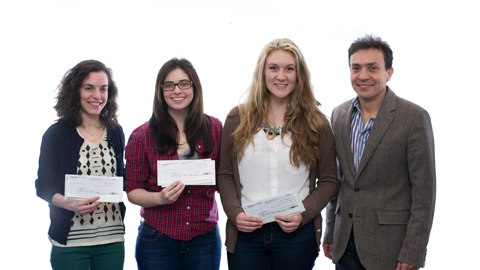
successful together,” said team mentor Hadi Aladdin (Photo:
Natasha Ouslis).
The team behind Northern Spark invented a new type of temperature-controlled outerwear – a jacket that gives its wearer the ability to individually control heating within various parts of the garment.
“When we commute to school or work, we leave feeling comfortable, yet arrive feeling sweaty in some areas and cold in others,” said Tammi Hawa (MechE 1T7), who developed the technology alongside co-inventors Jennifer Rovt (MechE 1T7) and Katie Gwozdecky (MechE 1T7). To solve this everyday problem, they set out to design a product that would, “overhaul the current standards for comfort and style.”
The team’s mentor, Hadi Aladdin (ECE 1T2), co-founder and CEO of Coursepeer, was very impressed by the group. “I see in these three smart ladies the ingredients of being extremely successful together.”
Northern Spark’s designers also won $500 at a Hatchery accelerator weekend earlier this year.
Dabble It
Maxim Antipin (ECE 1T6), Amir Motahari (Biology 2016) & Victor Chen (MIS 1T5)

amrsgram via Instagram).
“Express your creativity with Dabble It – where your style speaks for itself.”
This is the tagline and promise of Dabble It, a new social media platform designed by Maxim Antipin (ECE 1T6), Amir Motahari (Biology 2016) and Victor Chen (MIS 2015) where users can annotate pictures, such as details of their outfit and where their friends can purchase it. Other users can “dabble it,” or request more information on the image.
The product’s current target is young fashionistas, but ultimately the goal of the product is to expand the way users interact with all images by adding new layers of meaning and communication.
Dabble It’s mentor, Chris Ouslis (EngSci 8T5, ElecE MASc 8T8), saw “great potential in their concept. Dabble It is a way of changing how we interact, using pictures on social media and in e-commerce.”
With the guidance of experienced mentors and peers, students are working towards the creation of their start-ups throughout the summer. They’ll present their final pitch at a Hatchery Demo Day this September, competing for two Lacavera prizes of $20,000 each.
With such rapid increases in enrolment, the Entrepreneurship Hatchery looks forward to having dedicated space in the new Centre for Engineering Innovation & Entrepreneurship (CEIE). Read more about the CEIE.

When engineering science student Kimberley Cota (EngSci 1T7) decided to travel halfway across the globe for a summer research exchange in Singapore, she never imagined what would be waiting on the other side – a vibrant alumni community eager to engage with their alma mater.
Earlier this month – and two days after Cota’s arrival – the Singapore alumni group announced their donation of a ‘Singapore Malaysia Alumni Room’ in the forthcoming Centre for Engineering Innovation & Entrepreneurship (CEIE). The group has already exceeded their fundraising goal of $250,000 by close to $85,000.
Local alumni held a celebratory event, attended by U of T Engineering Dean Cristina Amon; the Honourable Heather Grant, Canadian High Commissioner to Singapore; as well as alumni and students, like Cota, on exchange at the National University of Singapore (NUS).
“The best part of the event was talking to U of T alumni who are now based in Singapore,” said Cota. “Their perspectives on the value of an engineering education at U of T were inspiring. Talking to them also gave me a deeper insight into some of the career paths that EngSci graduates take.”
Jianwei Sun (EngSci 1T6), a second-year student also on exchange at NUS, said the event demonstrated how greatly U of T values its students.
“The personal meeting with the dean and high commissioner shows how strongly U of T cares about its relationships. Not only to other countries and universities, but also to its own students.”
The summer research exchange program at NUS, which was established in 2008 and strongly supported by U of T’s Centre for International Experience, gives EngSci students the opportunity to conduct research at one of the world’s top universities, while providing incomparable cultural experiences and networking opportunities. More than 42 students have embarked on the exchange since its inception.
The reception in Singapore was just one of many for Dean Amon. Following a successful trip last November, she returned to Asia-Pacific to reconnect with alumni in Hong Kong and Taiwan and to recognize their support of the CEIE. In addition to Singapore’s achievement, Hong Kong alumni have raised just over $4 million of their $5 million goal, while Taiwan grads have raised $125,000 of their $300,000 goal to date.
“The Centre for Engineering Innovation & Entrepreneurship will take engineering education and research to a new level, providing the physical space to strengthen collaborative learning, stimulate innovation and foster entrepreneurial endeavours,” said Dean Cristina Amon. “We are tremendously grateful to have received such strong support from our Asia-Pacific alumni.”
Make a donation to the CEIE.
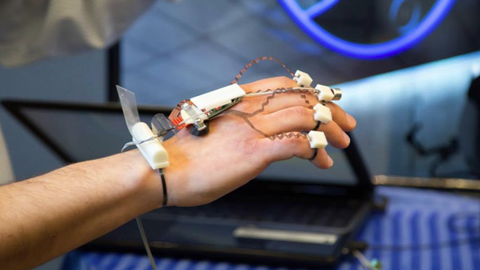
demonstrates ExoGlove at Rotman’s Creative Destruction Lab (Photo:
Graham Huber).
As he rotates his palm upwards and wiggles his fingers slowly, Martin Labrecque’s hands take him down the dark alley of a video game. One finger flicks two zombies into oblivion, another heals a teammate – all without cumbersome controllers.
Welcome to the ExoGlove, an early-stage invention from U of T Engineering alumnus Martin Labrecque (CompE MASc 0T5, PhD 1T1). The prototype uses a “glove” of sensors that could soon help surgeons, video editors, gamers and those with diminished motor skills interact more intuitively with technology.
The ExoGlove is one of five projects that recently received Heffernan Commercialization Fellowships, a program that awards promising inventors with $32,000 to develop their products into viable businesses.
The fellowships are part of a $5 million gift to the Faculty from U of T Engineering alumnus Gerald Heffernan (MMS 4T3), and they continue to enable graduate students to transfer their research into new Canadian technology companies.
Past recipients have included James Dou (ECE MASc 1T6), whose disease-detecting biomedical devices led to founding the company ChipCare; and Carlos de Oliveira (CivE MASc 0T6), who worked alongside Professor Constantin Christopoulos (CivE) to develop earthquake-resistant structural casting, founding Cast ConneX.
Take a closer look at this year’s five projects receiving Heffernan Commercialization Fellowships:
ExoGlove
Martin Labrecque (CompE MASc 0T5, PhD 1T1)
A promotional video from Breq Labs Inc. highlights the many uses of ExoGlove.
With ExoGlove, a doctor can interact with a computer screen in the middle of surgery or an elderly person could answer a call by holding her hand in the phone symbol. The device allows users to control a computer simply by moving their hand.
Despite its name, Labrecque’s invention is not an actual glove. It’s a clip-on wireless attachment consisting of five rings – one for each finger – connected by wires that fasten around the wrist. It does not interfere with the palm of the hand, so it can be used easily in combination with other tools.
Because it does not use cameras to track movement, the ExoGlove has no line-of-sight issues like other motion-tracking tools currently in development. It can be used with any level of light, and with any USB-compatible device.
“Working on other people’s start-ups taught me a lot about what works and what doesn’t,” said Labrecque. “I think business knowledge is very important. Equally valuable, though, is being able to connect with people who are good in the areas where you lack.”
Labrecque hopes to have ExoGlove in mass production and on the market within the year. Gamers are his initial target, but secondary markets include those with accessibility issues, rehabilitation, 3D rendering, video editing artists and much more.
A new catalyst for carbon-carbon bonds
Adam McKinty (Chemistry PhD 2013)

Forming carbon-carbon bonds – best understood as chemical reactions that join carbon atoms together – is important to the manufacturing process in many industries, including pharmaceuticals, cosmetics, plastics and more. Forming these bonds can make bulletproof plastics, and even turn canola oil into diesel fuel.
Despite their wide application, there are few technologies available capable of catalyzing – or creating – these valuable bonds, with one of the major methods controlled through a single company’s monopoly.
Adam McKinty (Chemistry PhD 2013) has developed a new method to perform virtually the same bonding reactions as this monopoly company, and at a low cost – called olefin metathesis – in partnership with his advisor Professor Douglas Stephan (Chemistry).
Their technology has already demonstrated success in a number of uses, and the next step is using the powerful method across a wide variety of applications in order to showcase its impact to potential buyers.
Commercializing a new organic electronic material
Andrew Paton (ChemE PhD 1T3)

Many of our modern solar cells and LEDs – which use non-organic semi-conductors made from silicon – are becoming less desirable for use in the next generation of technology. They require high processing temperatures and return on investment can take up to 30 years.
In Professor Tim Bender’s (ChemE) lab, Andrew Paton (ChemE Phd 1T3) and colleagues are developing organic semi-conductors with fewer materials, making them smaller and more cost effective for tomorrow’s electronics. Made out of organic components, they also have high conductivity and light absorption, properties which allow for thinner and more flexible television screens and monitors.
Paton is exploring several commercialization streams for his product, including organic light-emitting diode (OLED) and organic solar cell (OSC) manufacturers.
Novel ways to communicate with patients in an MRI
Garry Liu (MedBio PhD 1T3)

Being inside a magnetic resonance (MR) imaging suite can be an intimidating experience for many. The small space is uncomfortable, and the noisy operation of the scanner makes intercoms ineffective. To allow for audio communication, wireless headsets initially appear appropriate, especially due to the clinician’s limited mobility within the suite. However, an electromagnetic shield around the scanner room, called the “Faraday Box,” makes this particularly difficult.
Thinking outside that box, Garry Liu (MedBio PhD 1T3) proposed a wireless communication headset that is magnetic-resonance safe and does not interfere with the MRI’s functionality. This reduces stress for the patient, while increasing efficiency for the technician.
Interventional procedures inside a MR imaging suite are becoming more common. Many therapies turn to MR imaging to provide soft-tissue visualization without the damaging effects of radiation. In such a rapidly growing field, Liu’s mentor, Graham Wright (IBBME) sees a great deal of potential in the product.
Liu seeks to incorporate his technology in all local interventional-MRI sites, such as Sunnybrook Health Sciences Centre and the Princess Margaret Hospital. He will approach them with demonstrations of early-adopter material and, through the niche research network, continue to market the technology at tradeshows and events.
Improving drug screening using microfluidics
Oleg Chebotarev (MechE MASc 1T2)

Testing and releasing a new drug can cost the pharmaceutical industry up to $1 billion – with only one in approximately 10,000 drugs ever reaching market. Often, this time and money is wasted due to poor drug testing platforms that don’t reflect the environment in which the drug will be administered: the human body.
That’s why Oleg Chebotarev (MechE MASc 1T2) developed a new platform for drug screening – one that closely resembles the conditions of common drug target organ tissues (brain, liver, vasculature, etc.). This commercially viable system has seen remarkable results, and enables early stage drug discovery because of its similarity to human physiology.
Chebotarev plans on marketing his technology to pharmaceutical and therapeutic biotechnology industries. He’s already piqued the interest of several companies, and continues to develop both the technical and business sides of his enterprise.
The Heffernan Commercialization Fellowships encourage development of Canadian technology-based start-ups by asking professors to nominate students and their promising ideas. The professors then mentor the students through the process of development, availing them of expertise, resources and feedback.
Read more about this year’s fellowship opportunities, as well as on Gerald Heffernan and his significant contribution to the forthcoming Centre for Engineering Innovation & Entrepreneurship.

Ten.
That’s how many iterations 15-year-old Maya Burhanpurkar went through to design an experimental apparatus that demonstrates a previously elusive physics concept – winning the Platinum Award at last week’s Canada-Wide Science Fair.
Burhanpurkar’s project, titled “Time-Integral of Distance: Uncovering A New Property of Fundamental Physics”, was guided by professor Steve Mann and PhD student Ryan Janzen (both ECE), in collaboration with Brad Bass of Environment Canada and the International Panel on Climate Change.
The award-winning project validated the concept “absement”, a term originally coined by Professor Mann to describe the time-integral of distance, which was historically a mysterious phenomenon.
“Professor Mann had been thinking about the possible influence of the time integral of displacement in nature, mostly music, for a few years already,” said Burhanpurkar. “I came up with the design of a novel experimental apparatus consisting of a fluid reservoir with a microprocessor-controlled, linear valve whose motion resulted in the precisely controlled release of fluid at continuously varying, pre-programmed rates.
“I built about ten iterations of the device before finally getting it right.”
Since the days of Sir Issac Newton, we have known that the time-integral of acceleration is velocity (shown by the formula a=Δv/Δt), and the time-integral of velocity is distance (v=Δd/Δt), yet the time-integral of distance has remained an elusive concept. This is the first time the change in distance over time had been demonstrated in physical space.
Burhanpurkar took top honours at last year’s Google International Science Fair with the same project, but winning at this event was still a thrill. “I was beyond excited!” she said. “I had won the Grand Platinum award a couple of years ago at the national science fair, so I was really surprised to be given it again.” She also brought home several category awards, including the Discovery Challenge Award, the Actuarial Foundation of Canada Award, a Gold Medal and university scholarships.
The mentor group met with Burhanpurkar several times to discuss the project design in advance of the fair. She and Janzen spoke frequently, especially as she picked up the calculus necessary for the work. Their next goal is to get the work published.
“We’re happily continuing to work with Maya as well as some new students, and would welcome any additional highly-gifted students to apply absement to other areas of biology, physics, ecology and medicine,” said Janzen.
Watch Burhanpurkar’s recent invited talk at TEDxYouth@Brampton.

It may have hydrogen fuel cells, a solar panel and three lithium-ion batteries, but a new electric vehicle from students at U of T won’t be found on the highway – it’ll be working on the farm.
A group of engineering students has proposed a new type of sustainable soybean harvester, recently winning first place in a unique graduate design course on campus. The machine produces zero emissions while powering its driving, threshing, storage and cleaning phases.
The idea was born in MSE558: Nanomaterials in Alternate Energy Systems, a course that brought together students from various engineering disciplines, including exchange students from Brazil’s Science without Borders program. It took participants outside their comfort zones of engineering problem-solving, and added business skills development such as market analysis, branding and education.
Now in its tenth year, the course taught by MSE professor Steve Thorpe is modeled after the National Hydrogen Association Design Contest and puts students through the whirlwind experience of launching a start-up.
It was the “Dragon’s Den” of engineering – not only did Engineering students Shahed Mirmohammadi (ECE 1T4+PEY), Jonathan Hoo (MSE 1T0, MEng 1T6), Renan Gomes (Science Without Borders – Brazil) and Ricardo Barnasky (SwB – Brazil) have to invent the potentially world-changing combine, but they had to sell a team of judges on its business viability, safety and practicality.
The sheer scope of the challenge and the chance to apply new nanomaterials to a real product appealed to Gomes. Like Barnasky, he is a Brazilian exchange student studying at U of T through the Science Without Borders program.
“Nano is never easy – it’s always complicated, but that’s the future,” said Gomes. “Our job as engineers is to learn how to solve problems using these new technologies.”
PURE – Powerful, Unique, Reliable and Efficient
All four team members shared excitement about the vision of greener farming with international impact, and their first task was to define their corporate identity. They dubbed their new company PURE, for Powerful, Unique, Reliable and Efficient.
Hoo, the team’s technical lead, conducted extensive research into load profiles of the current state-of-the-art machines, including phoning competitors, who wanted to sell him a combine, and Ontario’s Ministry of Agriculture & Food. The team even phoned the Brazilian government to inquire about a similar project there.
“Was it like detective work? No, it was like espionage,” said Hoo. “The harvester, you don’t just drive it – you have to cut the crops and process them and store them in a tank and empty them. Our load profile was pretty complex.”
Mirmohammadi said: “I learned so much about hydrogen fuelling, fuel cells, hydrogen storage and the issues with it, the cost of actually doing something like this. It’s doable, but it’s very expensive at this time.”
Pitching time
Similar to the television show Dragon’s Den, Team PURE presented their ideas to a panel of judges – including Professor Thorpe, Amy Jiang of BP and Alex Ayers of Pratt & Whitney. For Barnasky and Gomes, it was the first professional presentation they had ever delivered in English.
“These people are sharp, they know their stuff — if you screw up, they’re going to pick up on it,” said Hoo.
After handling a 20-minute question period with the judges, the team emerged victorious, winning an engraved plaque and $180 in prize money.
The second-place team designed a food truck serving First Nations cuisine to Bay Street bankers without using an atom of fossil fuels. The third-place team invented a zero-emissions personal-delivery drone.
Holistic solutions
“The whole point of this is to come up with a holistic solution,” said Thorpe. “We teach tools for screening new ideas quickly and performing failure analysis… keeping them in the box is challenging!”
Mirmohammadi said the course opened the team’s eyes to the incredible complexity of creating a product like this.
“If you were in a firm and you had all these different departments you work with, you can’t ever come up with one option thinking, ‘It’s technically feasible, let’s do it!’ Well, did you take into consideration that this is going to kill 100,000 fish? Or you’re going to have to spend billions of dollars trying to get the infrastructure to even build this thing. That’s definitely something that we’ve never done before.”
Despite the trial, would they enter this Dragon’s Den again?
Absolutely.
