

In vitro fertility treatments can be intensely emotional and medically invasive, not to mention expensive.
But technical developments from a research group at the University of Toronto may soon be able to shorten the journey to pregnancy – and that potential has piqued interest from international investors.
The research group, QSperm, is looking to turn their research into a biotech startup leveraging an innovative sperm sorting design that could help the many human couples looking to conceive—and maybe a few cows and horses, too. QSperm likes their device to the “sperm Olympics,” in that it selects the highest quality sperm, increasing chances of fertilization.
Their concept won out over more than 100 competitors in the world’s largest biotech entrepreneurship competition, OneStart, which offers bootcamp sessions, mentorship, pitch feedback and access to venture capital investors in the US and the UK. Now in the top 35 finalists, they will vie in the finals on May 22 in San Francisco for $150,000 of funding, a year of lab space and business support.
QSperm involves three researchers linked to U of T Engineering: Professor David Sinton (MIE), PhD student Reza Nosrati (MechE PhD 1T6) and alumna Lise Eamer (MechE 0T8, MASc 1T3). They were one of two U of T teams competing in the finals of the OneStart challenge – the other being Munc-Key Therapeutics, which plans to commercialize a new approach to therapies for type 2 Diabetes. (Read more about Munc-Key Therapeutics)
Lise Eamer spoke with U of T News about how the university’s entrepreneurship supports helped her team transform research know-how into an internationally competitive business plan, with the support from the Innovations & Partnerships Office, U of T Engineering, MaRS Innovation and more.
What is QSperm?
QSperm selects the best sperm for in vitro fertilization or other assisted-reproductive technologies. We wanted something that was going to be simple to use and implement in a clinic so that it wouldn’t be expensive but that would help more couples conceive.
Our primary research pertained to humans but in our lab we were using bull semen to test the device to see if it worked, and then we realized that there might be applications for animal IVF because there’s a lot of artificial reproduction happening in the animal world as well as humans.
How does it work?
The device has very tiny channels the sperm swim through, and it’s basically like sperm Olympics: whichever ones get to the end first or within an allotted time period, then we select those. They are the ones that we tested and were shown to be the best.
How is this better than what’s currently available?
The current techniques for sperm sorting all require centrifugation—they spin the sperm, and that movement can damage the sperm. If you think of those teacup rides at the amusement park, sometimes you feel a little pushed up against the side, you don’t feel so good. And with sperm, we spin them so much faster, it can actually cause damage. With our technique, we can not only select good sperm but the procedure itself won’t damage good sperm.
How has U of T helped you transition from science research to an entrepreneurial path?
I wanted to use my engineering ability to help others, especially in the healthcare field, so instead of needing to find myself a job to allow me to do that, we’ve created one based on research I was already deeply involved in.
QSperm is a technology that originates from work done in the Sinton Lab. I am very grateful to Professor David Sinton for having not only initiated research work in microfluidics for health applications but also for his assistance and continued support as we work together to commercialize QSperm.
At U of T, I work very closely with the Innovations & Partnerships Office (IPO). They are always telling me about different seminars I can attend and keeping me in the loop in terms of resources that are available to learn more about entrepreneurial skills or networking with the right people.
And at the OneStart competition, emphasis was placed on the importance of having a strong IP position which makes me very grateful to the IPO at the University of Toronto and MaRS Innovation because they helped us to secure our IP and develop our business strategy. They’re working with us to assess the technology’s market potential and explore other commercialization options. MaRS Innovation also gave us a $25,000 grant, helping us get the device market-ready.
In terms of entrepreneurial skills, I’ve been participating in MaRS Discovery District’s weekly ‘Entrepreneurship 101’ series to gain skills about the pitch and meet veteran entrepreneurs. It’s great when an entrepreneur comes in and talks about their experiences. I find it really helpful to hear their stories about what works and what doesn’t and how they learned from their experiences.
How have these entrepreneurship supports changed your approach with QSperm?
It’s really helped me learn how to describe the technology to anyone and not scare them away with technical terms. Not everyone knows what microfluidics is, so instead we can bring it to something that’s more understandable, like with ‘sperm Olympics.’
How could your product change our readers’ lives?
If everything works well then we’ll increase the success rate of these procedures so that more people will get pregnant in that first try. Now, obviously semen preparation is only one part of the equation, but if we can ensure that only the best quality sperm are used then it eliminates that variable.
And what about the animal world—how could QSperm affect animal breeding?
In the animal market there’s a lot of breeding with a mind to developing the best animals for milk or cheese—they need a certain percentage of fat and protein in the milk. So if breeders know specific bulls will give the parameters that they want, they can use semen from those bulls with cows that give the outcomes that they want, and have surrogates host the ‘ideal offspring.’ We’re focusing on bulls right now because that’s where our contacts are but in the long run there could certainly be applications for competition horses and that kind of thing.
That said, when talking about the business, I focus on the human aspect because it’s something a lot of people can relate to. So many couples have problems trying to conceive, so people likely know someone who’s gone through it, or they themselves are going through it. The human side is easiest to explain to people, since they can relate, and it is the field where we can have a large impact. (Read more about QSperm’s road to the OneStart finals)
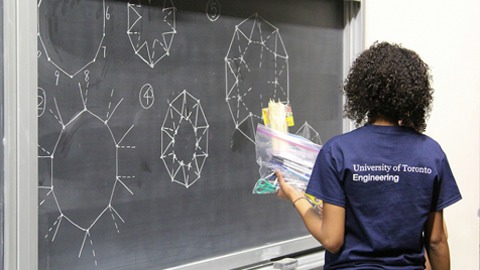
Always dreamed of being a doctor, lawyer or business leader? Try taking physics, math and engineering.
Students who score highest on the MCAT – the standardized exam for entry to medical school – are those who didn’t take pre-med, physiology or even biology, said Damian Pope of the Perimeter Institute of Theoretical Physics. Instead, they took physics, math and electrical engineering.
The same holds true for the LSAT, the law school entrance exam, and GMAT, for business school, he told the 2014 conference of the Ontario Association of Physics Teachers (OAPT), hosted by The Edward S. Rogers Sr. Department of Electrical & Computer Engineering.
A solid education in science, technology, engineering and math, called “STEM disciplines”, is the best background a student could bring to any 21st-century career, Pope told physics teachers from across Ontario who had gathered to discuss novel approaches to STEM education, from high school through university.
“STEM for university is the wrong message—it’s STEM for life, it’s STEM from elementary school,” said Dr. Bonnie Schmidt, president of the science advocacy group Let’s Talk Science. “STEM is driving the jobs…and kids are not making the connection, and parents are not making the connection.”
In her keynote address, Schmidt pointed out that only 27 per cent of 16 to 18-year-olds believe science has relevance in their everyday lives, and only 11 per cent of Ontario students take Grade 12 physics. Meanwhile, more than 50 per cent of undergraduate students in China are studying science or engineering. “Kids’ perception that science takes place in a laboratory is an impression we have to change,” she said.
The three-day conference featured talks from the Perimeter Institute for Theoretical Physics, Sir Wilfred Laurier University, University of Ontario Institute of Technology, Queen’s University, University of Guelph, Trent University and Ryerson University, as well as workshop sessions led by physics teachers from dozens high schools across the province.
Students were the focus of every discussion—how can teachers engender fascination in science and technology, improve retention and lead their students to fulfilling careers? “I would leave you with a challenge,” said Dave Fish, a teacher at Sir John A. MacDonald Secondary School in Waterloo, Ont. who also works on outreach with Perimeter Institute. “How are you preparing students for the world? For careers, yes, but what about as global citizens?”
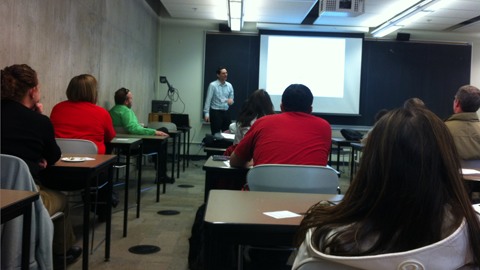
inverted classroom approach at OAPT 2014 (Photo: Marit Mitchell).
Professor Micah Stickel, director of outreach for ECE and First Year Chair for the Faculty of Applied Science & Engineering, led a session on his experience teaching with an inverted classroom approach. An inverted classroom has students introducing themselves to new material in video tutorials at home, then coming to class prepared for discussion and problem-solving activities. “It’s really the learner who creates their own meaning, and if they don’t create it, it won’t be with them in six months,” said Professor Stickel.
Professor George Eleftheriades led a session about his electromagnetics work, and Professors Nazir Kherani, Olivier Trescases and Zeb Tate gave an overview of their work within the context of energy research in ECE. Professor Stewart Aitchison and Willy Wong closed out the day with a session on their activities in photonics and biomedical engineering.
“For me, the beautiful thing about this conference is that it’s an opportunity for me to engage with a group that I don’t normally get to talk with and that I really love to,” said Professor Stickel.
“Our primary goal is to provide teachers with opportunities to network, to build a community of physics educators,” said Lisa Lim-Cole, vice-president of the OAPT and conference organizer. “We need to recharge that motivation of why we teach, and in this environment we can inspire each other.”
The OAPT organizing committee received enormous support from the Engineering Outreach Office. Next year’s event aims to expand the scope even further to consider best approaches to STEM education in Grades 7 and 8.

If you’re like many others using Twitter and LinkedIn, you’ve probably overdosed on articles headlined, “How to be more like Steve Jobs”, “Gandhi’s five tricks to success”, or “What Sir John A. Macdonald ate for breakfast.”
But to those at U of T’s Institute for Leadership Education in Engineering (ILead), the key to becoming a great leader isn’t copying others; it’s understanding yourself.
This is one of many lessons taught through ILead’s unique programs, which won the prestigious national Alan Blizzard Award for Collaborative Teaching earlier this week. The institute was recognized for integrating innovative leadership education into the U of T Engineering student experience.
Through several curricular and co-curricular programs, ILead provides new opportunities for engineering students to practice leadership skills – including teamwork, self-awareness and emotional intelligence – in a living laboratory both inside and outside the classroom.
“ILead plays an important role in preparing our students for leadership throughout their entire careers,” said Dean Cristina Amon. “This award signals the significance of the team’s work in fostering the next generation of influential engineers. My heartiest congratulations to the ILead team, and thank you to the Society for Teaching and Learning in Higher Education for granting them this award.”
What does leadership have to do with engineering?
This is a question that ILead’s faculty, staff and leadership practitioners hear all the time.
“Employers tell us leadership skills are necessary for their companies to thrive, and we all know that teams that function effectively are more fun and more successful,” said ILead’s founding director, Professor Doug Reeve, who was joined by colleagues Professor Greg Evans (ChemE), Annie Simpson (ILead), Professor Robin Sacks (ILead), Dr. David Colcleugh (ChemE 5T9, MASc 6T0, PhD 6T2), Estelle Oliva-Fisher (ILead), Dr. Cindy Rottmann (ILead), Professor Alison McGuigan (IBBME), Patricia Sheridan (MechE 0T9, MASc 1T1, PhD candidate in Engineering Leadership), Cecilia Konney (ChemE), Deborah Peart (EngSci), Kristina Minnella, Brian Tran (ILead), Amy Huynh (ILead), Nick Evans (ILead) and Wayne Stark (ILead) in receiving the Alan Blizzard Award.
“At ILead,” Reeve continued, “our collaboration is enriched by the diversity of perspectives on the team: the social scientists inform us about humanist ideas and ideals, the educators teach us about teaching and learning, and the engineers insist on systems, frameworks, analysis and data.”
Successful engineers need more than just technical proficiency
The Institute’s message is that technical proficiency is no longer enough for today’s engineers. Engineering is, after all, about building systems and processes that have human impact. Engineers need to develop critical interpersonal skills, and learn how to self-reflect to leverage their unique strengths.
The ILead team wants leadership learning to be a universal experience for students – and a hallmark of a U of T graduate. Since its birth fours years ago, the Institute has grown to offer enrichment opportunities through experiential courses, seminars, certificate programs and retreats.
In September, U of T Engineering will offer a new academic certificate in engineering leadership, coinciding with the growth spurt of leadership courses in the Faculty.
“We want students to articulate their individual passion and channel it into creating something great,” said Annie Simpson, ILead’s assistant director. “As teachers of collaborative teamwork, this award validates the fact that we make every effort to practice what we preach, that we truly believe that this material has impact.”
Many students who have participated in ILead’s programs have won Gordon Cressy Student Leadership Awards upon graduating from U of T – and have gone on to launch careers in diverse fields such as international development, venture capitalism and advanced research, in addition to traditional engineering career paths.
Reinventing the undergraduate experience
In his installation address in November 2013, U of T President Meric Gertler challenged the University to re-examine and perhaps reinvent undergraduate education. This was a call that ILead continues to answer by aiming to reach more students each year with new, innovative programs that teach leadership skills, whatever the participant’s career trajectory might be.
In so doing, ILead aims to strike a balance between the demand for career-readiness and the University’s broader social mission to educate the next generation of responsible citizens.
Learn more about the Institute for Leadership Education in Engineering and connect with them via Facebook and Twitter (@ILeadUofT).
From the Society for Teaching and Learning in Higher Education (STHLE), the Alan Blizzard Award for Collaborative Teaching recognizes groups or projects that exemplify collaboration in university teaching that enhances student learning. Only one award is given out each year.
This is the third time U of T has won the Alan Blizzard Award. Previous wins include the Faculty of Medicine’s Communication & Cultural Competence Website team in 2010 and the Faculty of Applied Science & Engineering’s Engineering Strategies and Practice team for their project ‘Team Teaching a Service Learning Course for a Large Class’ in 2007.
The award will be presented at the STHLE Annual Conference Awards Reception on June 18 in Kingston, Ontario. The team will present their paper, “Curricular and Co-Curricular Leadership Learning for Engineering Students,” at the Alan Blizzard Plenary on June 19.
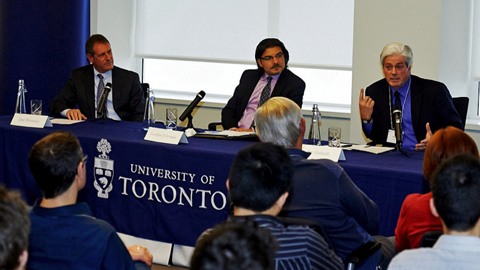
D’Orsogna and Jay Godsall (Photo: Brian Summers).
Drone delivery service. Autonomous personal aircraft. Circumnavigating super-ships. These aren’t excerpts from a sci-fi movie script – they’re the future of aerospace. And they were just some of the industry projections that three aerospace leaders shared with U of T Engineering alumni and friends at BizSkule: Next Generation Air Travel.
The panel event, held April 30 at law firm Bennett Jones’ offices in Toronto’s First Canadian Place, was the second installment of 2014 for the esteemed speaker series, which kicked off in California with a panel on cloud computing earlier this year.
Moderator David Zingg (7T9 EngSci, 8T1 MASc AeroE, 8T8 PhD Aero), professor and director at the University of Toronto Institute for Aerospace Studies (UTIAS), steered the panel through a variety of topics, from environmental sustainability to solar technology, but the discussion began with predictions that hit closest to home — personal air travel.
Getting personal
“I think you’re going to find that the overall experience, as a passenger, is going to deteriorate,” said panellist Dan Breitman (UTIAS MASc 7T9), retired vice-president of engine development programs at Pratt & Whitney Canada. “In the next 15 years, it’s going to be an even more unpleasant experience. But born out of that, you’re going to see alternatives.”
One such alternative is the growth of the private aircraft sector. A second panellist, Carmine D’Orsogna, manager of engineering for Bombardier Aerospace’s Global Express line of premium business jets, already sees this happening.
“When we started the [Global Express] program 20 years ago, it was forecasted to sell 200 airplanes,” he said. “We’ve now sold five times what we initially thought. I see that growth continuing in the near future with more people being able to afford that type of travel.”
Jay Godsall, CEO of Solar Ship and the evening’s third panellist, predicted personal air travel going in a completely new direction.
“What’s going to open up a lot in the next 15 years is remote areas, and getting away from the city and being able to get to these locations hassle-free,” he said. “I don’t think it’ll be a helicopter, it’ll be a different kind of aircraft.”
Autonomy in the skies
Last year, when Amazon CEO Jeff Bezos announced that the online retailer would use autonomous aerial vehicles for deliveries within the next five years, it cast an exciting light on the future of aerospace.
All three BizSkule speakers agreed on the benefits of drones for delivering goods, especially, according to Godsall, the delivery of medicines and diagnostics to areas with outbreaks of infectious diseases. Breitman, however, applied a word of caution to the pilot-free mode of transportation.
“Employment is going to shift dramatically,” he said. “You’re going to find that, literally overnight, huge industries no longer need people to do certain tasks and their costs are going to come tumbling down. It’s going to create wealth on one side, and agony and pain on the other. It’s going to be an extremely disruptive technology.”
Long-term forecasts from the panel emphasized the development and use of electric, non-fossil fuel burning and autonomous personal aircraft within the next 50 years. The dream of parking a self-flying vehicle in your driveway could very well become a reality. “When your kid asks for the keys to the airplane,” Zingg joked, “autonomy sounds pretty good.”
Make that super-sized
While soaring above the clouds in your own autonomous aircraft may seem like a blue-sky idea, Godsall offered up the most fantastical vision of the evening.
“There will be super-ships that will go around the world,” he said. “They won’t land. They won’t stop. They’ll be hydrogen and solar powered … and smaller ships will come up and service them. These littler ships will be able to go down and service — point to point — the largest cities, and these super-ships will just keep going.”
Is it as far-fetched a projection as it sounds? Only time will tell. The sky no longer seems to be the limit.
Download photos from the event.
Watch video of the panellists.
The final BizSkule event of the year is scheduled to take place in the fall.

Decades ago, schools across Canada installed wired glass as an effective fire barrier for students’ safety. But is it really all that safe?
Sean Lloyd, a former student of Burlington’s Assumption Catholic Secondary School, thinks not, and he has the scars to prove it.
As Lloyd pushed open the door in the hallway of his school, the glass broke from the force of his push and severely lacerated his arm. He filed a $5 million lawsuit against the Halton Catholic District School Board, advising that all schools get rid of the potentially harmful material.
Doug Perovic, a forensic engineer and U of T professor of materials science and engineering, is serving as an ongoing witness in the case, and recently shared his insights with several media outlets across the GTA.
“It’s an inherently unsafe material from the perspective of impact,” he said in an interview with the Toronto Star. “Even from the very beginning, they knew that its strength capabilities were not anywhere near where it should be for a true safety glass. But it was sort of exempted because they needed a fire glass material.”
Perovic hopes schools will remove or reinforce the wired glass. He points out to The Star that the material’s structural integrity is jeopardized during production, as the wire and the glass cool at different rates, causing cavities and inconsistencies.
Read more:
- 680 News
- Burlington Post
- CHML Radio
- CFRB Radio
- CBC.ca
- Toronto Sun
- CityTV
- Global News
- Toronto Star
- CHCH News
Perovic, of the Department of Materials Science and Engineering, teaches a fourth-year forensic engineering course – the only university course in Canada that reviews case studies surrounding engineering design and applications in relation to public safety.
He has also provided his expertise surrounding the incidents of falling glass in Toronto’s high-rise buildings and materials failure on the Gardiner Expressway.
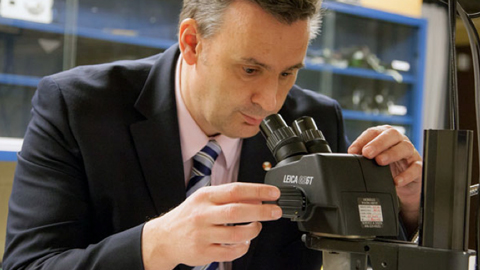
An estimated 768 million people in the world – about one tenth of the world’s population – do not have access to safe water. In Canada alone, five million people lack access to a reliable source of safe drinking water, especially in rural areas or on reserves.
Now, the Indian Government’s Department of Biotechnology (DBT) and IC-IMPACTS – a Canadian Network Centre of Excellence, have announced a joint “Water for Health” initiative, supporting collaborative research projects focused on developing and evaluating new technologies in the research areas of water and health.
“Access to safe water is a significant issue around the world,” said University of Toronto electrical engineering professor Stewart Aitchison, one of the founders of IC-IMPACTS. “This is an excellent opportunity for Canadian and Indian researchers to partner on projects which will develop new solutions to ensure access to safe and clean water for communities in both countries.”
DBT and IC-IMPACTS (the India-Canada Centre for Innovative Multidisciplinary Partnerships to Accelerate Community Transformation and Sustainability) will each commit $1.5 million to strengthen innovative partnerships between researchers working in India and Canada, and to stimulate practical research applications in both nations.
U of T News reporter Terry Lavender talked to Aitchison, IC-IMPACT’s associate scientific director and theme lead for public health: disease prevention and treatment, about the announcement and the research it supports.
What exactly is IC-IMPACTS?
IC-IMPACTS is basically a funding organization for research collaborations between Canada and India. It provides funding for research in one of three theme areas − integrated water management, safe and sustainable infrastructure or public health − that affect both Canada and India.
It was established in 2012 through the Canadian Networks of Centres of Excellence, and one of its goals is to demonstrate technologies and give Canadian companies the opportunity to commercially develop these technologies. Another goal is to stimulate trade between the two nations.
What’s U of T’s role?
The University of Toronto is one of the three founding institutions; the others are the University of British Columbia and the University of Alberta. But IC-IMPACTS funding is available to any Canadian researcher.
You’re a professor of photonics – the study of light and its functions. How does photonics connect with health?
There is actually a significant overlap between photonics and public health. A large number of electrical engineering projects have medical implications. For example, the ChipCare project, which I am involved, in is developing a handheld tester for monitoring infection-fighting white blood cells.
That type of technology is being driven by advances in image processing. Your smart phone can now do quite complex number and data processing, so with advances in imaging, in processing, you have all these health apps now in your hand that measure how many steps you take or your heart rate. We’re not at the Star Trek tricorder stage – you can’t wave a device at somebody and get a full medical analysis yet – but these devices are getting more versatile all the time.
What excites you about IC-IMPACTS?
After 30 years of doing research, it’s the opportunity to take technology that’s come out of our labs and make a real impact.
We prototyped ChipCare in 2007, and now that technology has developed to the point that is almost ready to give to a field worker to go out and test. A lot of technologies – power systems, communications, electronics, computer engineering, control systems, photonics, biomedical and electromagnetics – are coming together to make these devices work, but you need to layer on that an understanding of real health care problems. That’s the opportunity that IC-IMPACTS gives us.
In India, some areas have limited access to primary health care and people who are sick are often a long way from any source of help; so these mobile technologies will have applications in that setting. They will also have applications in remote communities in Canada that are not within easy distance of getting to a hospital.
What other U of T projects fall under IC-IMPACTS?
Professors Shamin Sheik and Frank Vecchio, both in civil engineering, are working on what you could call “green concrete” technology. Sheik is working on developing durable and more economical structural concepts and innovative life extension techniques to create sustainable and robust infrastructure, while Vecchio is developing state-of-the-art analysis tools for concrete structures.
Professor Ted Sargent in electrical and computer engineering is working with the University of Alberta on solar cells for powering local remote treatment sensors for water.
Do students benefit from IC-IMPACTS?
These projects provide training opportunities for students because they are applied and they directly benefit students. Students also gain the opportunities to collaborate with Indian researchers.
We are planning a week-long workshop later this year on optical sensing technologies for infrastructure, water and health care. The session will bring together Canadian and Indian students and speakers from Canadian and Indian industry. Students will learn from international experts, they will learn about industrial problems and have a chance to present a poster, participate in a panel discussion, and other activities.
You’ve been involved with IC-IMPACTS since it began in the fall of 2012. What are the highlights of the organization’s first 18 months?
The connections I’ve made with researchers in India. For example, one of our first tasks was to develop a workshop at Baba Farid University in Faridkot in the Punjab. It’s a relatively small institution that trains nurses and others in health care. They gave a number of presentations on issues and problems in that part of the Punjab. The workshop was focused on water for health and that workshop plus our meetings with DBT and the Public Health Foundation of India led eventually to the Water for Health initiative.
How can U of T researchers benefit from IC-IMPACTS?
It’s a great opportunity for researchers to engage with India. We provide funding, we provide opportunities to travel and we provide opportunities to support students. I see it as a way of pump-priming future opportunities to partner with India and develop strong research relations.
What else are you working on these days?
One of the projects we’ve been working on is blood glucose monitoring. The process is relatively simple; you shine some laser light onto the tissue and the molecules all vibrate and the light is scattered. Most of the light goes off at the same wavelength but some of it comes off at slightly different wavelengths. That process can be used to monitor the amount of glucose in the skin or – if you get close to a vein – in the actual blood. It is a way of blood glucose monitoring with no contact, no pinprick, no sample that we need to take. The trouble is the box is a very sensitive $20,000 piece of equipment with a laser and spectrometer, so what we’re working on is designing an integrated system that could allow that to be miniaturized onto a chip.
We still have a long way to go, but it’s a project that developed out of telecoms technology that has applications for biomedical, non-invasive health care technologies.