
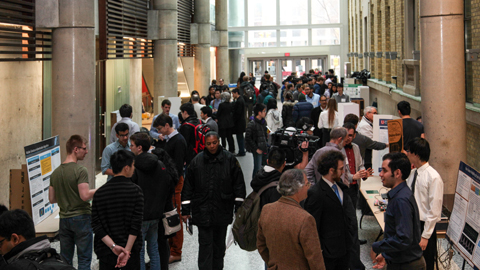
If you stood among the crowd at this year’s ECE Design Fair, you’d spot a drone helicopter that can find any charging station, a power grid that can sense its own flaws, a surgeon’s scope that detects internal abnormalities and even an app that helps a child deal with cancer.
This month, U of T undergraduate students in The Edward S. Rogers Sr. Department of Electrical & Computer Engineering shared more than 75 final-year projects in a four-day public showcase. Their ideas wowed packed audiences of professors, alumni, media and other guests.
Here’s a snapshot of three projects that were included in the event’s grand finale:
A program that spots polyps using machine learning
Nikhil Goyal, Dhaval Miyani and Jyoti Tripathi (all CompE 1T4) designed a program to help surgeons identify lesions and polyps during endoscopic surgery. (See their video – warning: graphic surgery content). Using machine-learning techniques, their image-processing platform identified anomalies in real time, making it much easier for surgeons exhausted during long operations to make sure they catch anything unusual.
“We worked on this project in collaboration with two researchers at St. Michael’s Hospital here in Toronto,” said Goyal. “It was exciting to work on something that has a real application, and get feedback on that.”
Drones that locate nearby charging stations
Lightweight drones could deliver your mail or drop medical supplies into disaster zones, if not for their limited battery life. Kevin Lee (ElecE 1T4), Zerzar Bukhari (ElecE 1T4), Sachin Siby (CompE 1T4) and Pranoy De (ElecE 1T4) tackled that challenge by creating SPARQ, an autonomous charging station for quadcopters. When batteries run low, quadcopters can home in on the nearest charging station, and automatically navigate the entry point and touch down to charge. (Watch SPARQ’s video).
Controlling your home from your smartphone
Want the lights in your creepy basement to turn on when you start down the stairs? Sumbul Alvi (CompE 1T4), Sumit Kumar (ElecE 1T4) and Edmund Phung (ElecE 1T4) designed a home automation system that lets you control your home—including lights, appliances, temperature and more—from your mobile phone. Reconfigurable sensors can operate independently, or be connected together so that, for example, your kettle turns on when you flip on the bedroom light.
“Lots of people have now heard about smart home control systems, such as Google’s Nest,” said Alvi. “We wanted to create something a little easier to use, that you can change around without having to rewire anything within your walls.”
“The quality of projects this year was extremely high,” said ECE Professor Khoman Phang, one of the course coordinators. “I’m always so impressed and inspired by the creativity and ingenuity of our students, and all they accomplish over the course of the year.”
At a reception following the final showcase event, alumnus Arshia Tabrizi (CompE 9T5) congratulated graduating students and encouraged them to stay engaged with the U of T Engineering alumni community.
“Don’t just think of your alumni group as your current classmates,” said Tabrizi. “Think about the ten years of graduates who came before you, and the ten years who will come after. That’s your network.”
Watch for some of the grand finale projects on Space Channel’s InnerSpace later in April 2014.

When it comes to solving complex problems, some of U of T’s engineering students take it from the classroom to the playing field.
At the ninth annual President’s Reception on March 28, four engineering students – Frank Despond (MechE 1T5), Mario Kovacevic (MechE 1T2, IBBME MASc 1T4), Veljko Lukovic (EngSci 1T3) and Corey Wright (MinE 1T5) – were awarded Silver T awards, a prestigious honour given for outstanding athletic performance in their graduating year.
At this year’s event, President Meric Gertler presented 23 Varsity Blues athletes with the award. Founded in 2006 by former president David Naylor, the reception celebrates athletic excellence at the University.
U of T Engineering’s Silver Ts
A 2013–2014 team co-captain, Frank Despond has been a member of five OUA and two CIS championship teams. He is a four-time OUA all-star and three-time CIS all-Canadian, having won three provincial and two national individual titles. Despond won the 400 freestyle at the OUA championships in both 2012 and 2014, while earning gold in the 200 freestyle in 2013. At the national level, he is a two-time 400 freestyle gold medalist and capped off his five-year career with a silver medal in that event. Despond also competed at the 2013 FISU Games in Kazan, Russia.
A three-time Ontario University Athletics (OUA) all-star, Mario Kovacevic has led the Varsity Blues men’s soccer team in scoring for the past three seasons. He was a member of the 2010 OUA championship team in his rookie season, and he helped the Blues to a silver-medal finish in 2011. Kovacevic represented Canada at the 2013 FISU Games in Kazan, Russia, and ends his four-year career with 29 goals in 48 regular season games.
Veljko Lukovic rejoined the Blues in 2011 after playing a single season in 2009. Since then, the native of Belgrade, Serbia, has been an integral member of Toronto’s midfield, amassing seven goals in 28 games. Lukovic was recognized as an OUA East second team all-star in 2013 after ranking second on the team with four goals.
Fourth-year defenceman Corey Wright has led Toronto’s men’s lacrosse team to four consecutive playoff berths. Wright is a three-time Canadian University Field Lacrosse Association all-Canadian and ends his four-year career with 16 goals and 16 assists in 44 regular season games.
Male Rookie of the Year
The week rounded out with another celebration of sports achievement at U of T with the annual athletic banquet awards. Football lineman and first-year engineering student Danny Sprukulis (MechE 1T7) took home the Varsity Blues prestigious male rookie of the year award.
Sprukulis was the only first-year athlete to start on the Toronto Varsity Blues football offensive line this season. He and the Blues offence ranked fifth in the OUA with 420 yards per game and were a vital part of U of T’s run and pass protection. He was named a member of the OUA all-rookie team in helping the Blues to their best team finish since the 1993 Yates- and Vanier Cup-winning season.
“It’s difficult balancing both engineering and football,” he said, when asked about playing high-level sports and navigating the challenging engineering curriculum. “Education always comes first with me…[but my] coaches and I work together, so that there are as few conflicts as possible, and I can try my best in both areas.”
Faculty Registrar Barbara McCann—an avid tennis player and runner who understands the benefits of sport—applauded the achievements of U of T Engineering’s varsity athletes. “I appreciate our varsity athletes’ efforts to excel in both their sports and demanding engineering programs.”

Professor Andreas Mandelis (MIE) sits at the intersection between engineering and applied physics, where his work with lasers is helping to diagnose diseases like breast cancer, manage diabetes and even spot flaws in the manufacturing of electronics and other goods.
This pioneering research has recently garnered Professor Mandelis a 2014 Killam Prize, one of Canada’s most prestigious scholarly awards. Administered by the Canada Council for the Arts, this award comes with $100,000 and is given to only five researchers annually.
Professor Mandelis uses light to see small differences in the human body or other materials that have previously gone undetected. He uses physics to understand light’s basic properties, while engineering new tools with wide potential for application.
“Being able to do the science is very important to me,” he said, “while at the same time, applying engineering principles and seeing it materialize in new technology for areas that need it, like breast cancer tumour detection.
“It brings the science to its ultimate goal – the service of our community and country.”
X-ray and ultrasound are two of the most common techniques used in medical diagnosis, but they are limited by how far and how well they can “see” into tissue. That’s where lasers come in.
“For example, when a tumour starts to grow, it is accompanied by the growth of new blood vessels,” he explained. “Non-invasive lasers can spot these blood vessels earlier than ultrasound machines, because blood in the vessels absorbs light differently than surrounding tissue. Using laser light energy converted to ultrasound (known as the photoacoustic effect), we can detect tumours earlier.”
The same theory applies for diabetics who currently prick their finger to measure their blood glucose level. Glucose absorbs into our skin at different rates, and lasers can help detect these small differences through light conversion to heat. This provides an accurate measurement without the prick.
As our technology becomes more sophisticated, lasers can also make advanced manufacturing techniques more efficient. Current methods involve testing products after several assembly steps are completed, and often involve destroying components through the process.
Professor Mandelis’ multi-disciplinary research has introduced novel laser probing and imaging methods in wide ranges of manufacturing – from aerospace and automotive to optoelectronics and nanoscale materials. In some areas, they allow for testing at every step of the manufacturing process in a non-destructive manner.
“We are delighted that the Canada Council of the Arts has recognized Professor Mandelis for his exceptional contributions,” said Dean Cristina Amon. “The widespread use of his research in so many fields demonstrates the impact that engineering has in improving our daily lives.”
Mandelis is the director of the Centre for Advanced Diffusion-Wave Technologies in the Department of Mechanical and Industrial Engineering (MIE). He is also cross-appointed to the Institute for Biomaterials and Biomedical Engineering (IBBME) and The Edward S. Rogers Sr. Department of Electrical & Computer Engineering (ECE).
He has been widely recognized for his contributions to both applied science and engineering, including the Canadian Association of Physicists (CAP) Medal for Outstanding Achievement in Industrial and Applied Physics (2009), the CAP-INO Medal for Outstanding Achievement in Applied Photonics (2012), the ASME Yeram Touloukian Award in Thermophysics (2009), and the American Physical Society’s 2012 Joseph F. Keithley Award for Advances in Measurement Science (2012). In 2006, he was also elected a Fellow in the Academy of Sciences of The Royal Society of Canada.
Read more in the Toronto Star.
about black box data.
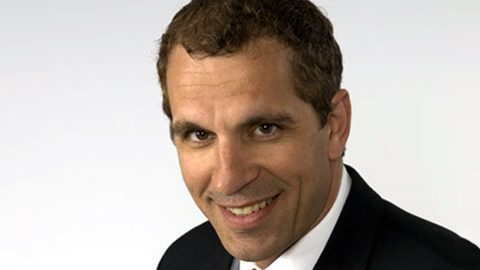
Forensics engineer Doug Perovic, professor of materials science and engineering at U of T, recently shared his expertise with CBC and Global News about black box technology and its role in the Flight MH370 disaster.
- Malaysia Airlines MH370: Why airlines don’t live-stream black box data – CBC News (March 31, 2014)
- How live-streaming black box data could prevent another Flight MH370 disaster – Global News (April 9, 2014)
Professor Doug Perovic currently teaches the only forensic engineering course in Canada, where he challenges students to apply engineering design concepts to real-world problems – learning the tools they need for high-level sleuthing.

Just a year after launching a Kickstarter campaign resulting in more than $200,000 in investments, alumni startup Nanoleaf has banked support from Hong Kong business mogul and philanthropist Li Ka Shing (dubbed “Asia’s richest man” by Bloomberg News) and Silicon Valley-based venture capital firm Kleiner Perkins.
Nanoleaf was profiled by U of T News last February when the Kickstarter campaign for the stylishly-designed innovation from engineering alumni Gimmy Chu (ElecE 0T6), Tom Rodinger (IBBME PhD 0T7) and Christian Yan (ElecE 0T6), regarded as “the world’s most energy-efficient light bulb,” began to draw investments well beyond their original $20,000 goal. (Read more about Nanoleaf’s beginnings)
Now they’ve scored influential global funding while keeping the U of T connection alive, adding three new team members from the university (two alumni and one current student on internship) and even mentioned the support of President Meric Gertler when speaking with international media. (Watch Nanoleaf’s interview with Bloomberg Asia)
Nanoleaf co-founder Gimmy Chu spoke with U of T News from the company’s base in Shenzhen, China, about how they’ve grown from humble startup to global upstart.
What’s changed for Nanoleaf since we last spoke?
It’s been crazy over here! Since the last time we talked, we started production and received a great deal of media attention globally. I think people are drawn to the high energy efficiency design of our bulb as well as our story—a David vs. Goliath sort of thing—you know, just three entrepreneurs with no funding and just a bright idea. We used our passion for efficiency to build a light bulb that was well ahead of the competition. I’m actually surprised that the bigger companies haven’t hit our efficiency rates yet, but sadly I don’t think efficiency is their primary focus.
Around the end of November, we were put in touch with the U of T advancement team when they ordered some Nanoleaf bulbs to give to alumni donors. Emily Pimblett, on the advancement team, was high school friends with one of our co-founders, Christian Yan. She saw our Kickstarter and said, “Wait a second, I went to school with that guy!” and reached out to us. Tom and I were invited over to the university last summer and we were featured in one of the promo videos. I’d never expected to be on a video from U of T—it’s pretty incredible. (Watch the video here)
Then President Meric Gertler visited Asia and met with Li Ka Shing’s investment group, Horizons Ventures. They asked if anything was sparking his interest and he gave them one of our bulbs. It was crazy, the next day we got a call from David Palmer, U of T’s vice-president of advancement, saying that Solina Chau, one of the most powerful women in Asia, wanted to meet with us tomorrow—can we make it?
At the time we didn’t know much about venture funding; we were just a couple of engineers passionate about technology. But we realized that this was an opportunity of a lifetime, so we put together a quick presentation and trekked to Hong Kong for the meeting.
We are very honest, open people. So at the meeting we said frankly that we didn’t know anything about funding but here’s some cool technology that we’ve been working on. We also learned that Horizons Ventures is not your typical venture capital group just looking to make a profit. They actually put earnings towards philanthropy—healthcare and education in communities all around the world. For us, it was a perfect match with our mission.
Horizons Ventures told us to return in a few days with an estimate of how much money we needed. While most startups typically spend a lot of time in delivering pitches, for us it was a new world: we had no idea how to value our company but at the very least we could share our vision for the company.
At the second meeting, the team at Horizons Ventures was fascinated by the technology that we planned to introduce to the market and they were excited to jump on board. We ended up getting funding from them, as well as a Silicon Valley venture capital group called Kleiner Perkins.
This funding was a big win for us because it gave us the opportunity to grow a team. We now have an office here in China instead of working out of Christian’s aunt’s factory and our apartments. We started hiring more U of T grads – Ian Liu (ECE) and Henry Chow (MSE 1T0) – and we also have an intern, Tiffany Hu (MechE 1T4). Henry and Tiffany were both members of the Blue Sky Solar Racing team that one of our co-founders, Tom, met while working with the team.
How has the past year changed your lives?
It has been a bit of a Cinderella story. We have been connected with people that we wouldn’t have even dreamed of being connected to. Our lifestyle hasn’t changed all that much because even before we were working nonstop. But the major change is that the funding allowed us to work on Nanoleaf full-time. Last year both Christian and I had our full-time jobs and were trying to do this on the side.
Also, the major investments opened up a lot of doors for us to people and resources all around the world. We’re learning more about running a business and the importance of staying connected. The Li Ka Shing Foundation donates to many top universities around the world so they’re able to connect us with valuable resources that we need.
Sounds like despite the long hours you’re still passionate about your work?
It’s definitely a dream come true. I’m working with two of my best friends and creating a little Nanoleaf family right here. We stay late at the office to hang out—we even have beanbag chairs in our lounge area. We’re also lucky to be working on something that we all feel very passionate about, the world needs more technology innovations that can really help create sustainability. We’re definitely on a mission to really make an impact on the planet and we have been fortunate enough to be well positioned to do so.
What’s next for Nanoleaf?
We plan to introduce a new product this summer and it’s going to be really, really cool. We made improvements to the light quality of our original Nanoleaf bulb and added features and functions — it’s also going to be dimmable—and I think it’s going to be a big hit.
Stay up to date with Nanoleaf on their Kickstarter blog.
NanoLight Test Evidence from NanoLight on Vimeo.
Every day, 42 Canadians learn they have epilepsy. This chronic disorder touches 50 million people worldwide, and in the past, it’s even affected geniuses like Napoleon Bonaparte, Beethoven and Vincent Van Gogh.
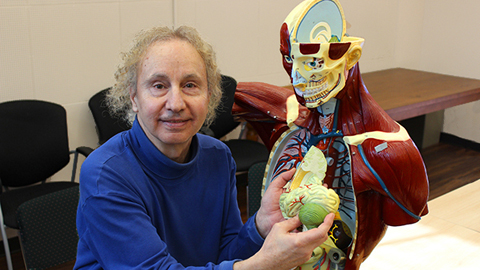
For Epilepsy Awareness Month, U of T’s Erin Vollick sat down with a leading neurological researcher at the University of Toronto, Professor Berj L. Bardakjian (IBBME, ECE) to better understand what causes the disorder.
Professor Bardakjian – from the Institute of Biomaterials & Biomedical Engineering (IBBME) and the Edward S. Rogers Sr. Department of Electrical & Computer Engineering (ECE) – works with a team of neurological specialists to classify different brain states. They use recordings of the brain’s electrical rhythms to pinpoint seizure zones in the epileptic brain.
This research could reduce the amount of tissue cut during corrective surgical procedures, and lead to better surgical outcomes.
What is epilepsy?
Contrary to what most people imagine, epilepsy is not considered a disease, but a disorder characterized by changes in the brain that lead to seizures. But epilepsy actually covers a wide range of disorders. There is not just one type of epilepsy, but many.
Our present theory is that seizures are caused when the brain is in a state of hyper-excitability. I think of the brain as a symphony. The electrical activity in the brain is polyrhythmic, as there are many interacting rhythms, and none of them are “regular.” But with an epileptic seizure, suddenly, all the cells in the brain start synchronizing together and they enter a singular, regular rhythm, which means that all the other normal functions of the brain are not occurring.
What are some of the historical associations surrounding epilepsy?
Epilepsy used to imply “possession.” Historically, people who suffered epileptic seizures were thought to be possessed by the devil, or were entering mythical or mystical states. Personally, I wonder about many of our geniuses – Napoleon Bonaparte, Beethoven, and Van Gogh, for instance, all had epilepsy. Was their genius related to their epilepsy? Is hyper-excitability what gave us Beethoven’s 9th symphony?
What causes hyper-excitability?
Hyper-excitability occurs due to possible chemical environment changes in the brain, at times even visual changes. A few years ago, for instance, people in Japan who were watching TV were getting seizures from the flickering lights in their television programs.
How is epilepsy managed?
There are three main courses of treatment. Children who have epilepsy can be put on a “ketogenic diet” – it’s a horrible diet, very high in fat, but it can help control the seizures.
Drugs are the next step, and these drugs are designed to reduce the excitation of the brain that leads to this synchronous brain activity and seizures.
Drugs don’t work for some people, so surgery is an option. Surgeons will try to cut out that part of the brain that is the focal point of the seizures. But there are some areas of the brain that can’t be cut, such as those vital cognition areas. Also, you can only perform surgery if the epilepsy is “focal” to one region, and not “generalized” in multiple sites of the brain.
What kind of research is your team conducting?
The big buzz term right now is “deep brain stimulation.” We’re trying to create implantable devices that can predict seizures and stimulate the brain in such a way as to prevent seizures.
Using electrodes, we want to input into the brain high complexity electrical signals – like a symphony – that would mimic the rhythmic signals that normal, functioning brains produce. The simulator we’re working on is a model of the electrical rhythmic activities of the functioning brain.
This kind of therapy wouldn’t have the drawbacks that drugs have. For one thing, this is a more localized treatment, and this kind of therapy would sidestep any drug sensitivity and side-effect issues.
But currently we’re trying to pinpoint those regions in the brain where seizures are occurring with a greater degree of accuracy.
How can you pinpoint or predict seizures?
We record the electrical activity of the brain and then classify the various state transitions between these activities. We then look for differences in pre-seizure states. Sometimes we simply detect the seizures.
What has changed in epilepsy research in the last 20 years?
What’s new about our research, and the best part of the research we’re conducting right now, is that we work as part of a team: neurologists at Toronto Western Hospital, neurosurgeons, pharmacologists, neurophysiologists, physicians and neural (biomedical) engineers.
What breakthroughs do you think are imminent or potentially imminent?
First, and we’re nearly there: we’re trying to help surgeons cut out the focal region in the brain that needs to be removed to stop seizures. Currently, surgeons just cut as much as they can rather than what needs to be cut, and even that doesn’t guarantee they cut out the right region.
From an ongoing research perspective, we’re trying to understand more about the hyper-excitability that leads to epileptic seizures. This is still an outstanding mystery – and we’re using various models, such as computer models, to answer those questions.