
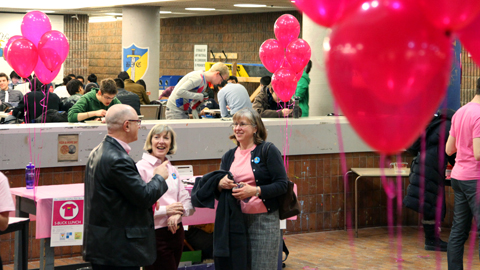
Pink shirts, pink balloons, pink cupcakes – and a cannon.
On February 26, hundreds of U of T Engineering students, staff and faculty headed to the Sandford Fleming Atrium in support of Pink Shirt Day, a growing cross-Canada initiative to stop bullying.
Hosted by Engineering Positive Space for the second year at U of T, the pink-shirted participants gathered to celebrate diversity and constructive relationships. Passing students stopped to inscribe anti-bullying messages on helium balloons, while others enjoyed pink desserts supplied by Veda, and mingled amongst each other in a shared positive spirit.
The event also went off with a bang. The Lady Godiva Memorial Band and the Cannon Guard made a special appearance to fire the Skule Cannon. If the ear-splitting sound wasn’t heard beyond the building’s walls, their joyous musical march certainly was.
“What was most gratifying to me,” said Peter Weiss, Senior Lecturer and Director of the Engineering Communications Program, “was the extent to which we heard, when planning and asking for the participation of groups like LGMB, Cannon Guard or Veda: ‘Yes. Of course. This is a tradition!’”
“What a great tradition to establish. I am so proud of the leadership role U of T Engineering has taken in promoting inclusivity in the Faculty, in the university and beyond.”
Pink Shirt Day began in 2007 when a group of Nova Scotian teenagers wore pink shirts in protest of homophobic bullying at their high school. Since then, the one-day celebration has spread across Canada and beyond.

It was an evening filled with live marimba music, international cuisine and energetic debate.
To mark the end of this year’s Black History Month on campus, the National Society of Black Engineers (NSBE) U of T Chapter hosted the first annual ‘Reflect, Unite, Celebrate: A Black History Month Affair’. The event brought together U of T students and alumni to celebrate the heritage, traditions and culture of African-Canadians.
“Every one of us has a very different background – African, Caribbean, British, you name it – and it makes us unique,” said Andrew Brown (MIE 1T3 + PEY), President of NSBE’s U of T Chapter. “Part of Black History Month is to celebrate that uniqueness. We all have something to offer, and it’s something different.”
The evening opened with a trio of marimba players, led by Dimpho Radebe (IndE 1T4 + PEY), NSBE’s Administrative Director, that literally had guests dancing out of their seats. The melodic tones of the marimba, which originated in Zimbabwe, continue to grow in popularity across Canada, she said.
Guests also participated in a lively round-table discussion moderated by biomedical engineering PhD student Mikhail Burke (MSE 1T2). The debate focused on modern-day issues of young engineers in the workplace, including those of different ethnicities, ages, sexual orientation and gender.
“[NSBE] has had a very positive impact on my own perception of black engineers and the influence we can have,” said Burke, “not just on each other, but within the engineering realm and the wider community.”
NSBE’s U of T Chapter also held a series of outreach workshops with students in nearby high-schools for Black History Month. Along with sharing practical advice on time management and study tips, the sessions also allowed teenagers to interact and ask questions of older peers already in university. NSBE is hoping to continue these workshops in May and June.
With over 23,000 members worldwide, NSBE was founded in 1975 and is the largest student-managed organization in the world. Their mission focuses on increasing the number of culturally responsible and professionally successful black engineers, with a strong emphasis on giving back to local communities.
Find out more about NBSE on their website.

Professor Stewart Aitchison (ECE) has been elected a Corresponding Fellow of the Royal Society of Edinburgh (RSE). Originally established in 1783, the RSE is Scotland’s national academy of science and letters. Benjamin Franklin and economist Adam Smith were among its Founding Fellows. Of the more than 1500 RSE Fellows, there are only 62 Corresponding Fellows (Fellows who are not resident in the UK).
Professor Aitchison is one of the world’s most prominent researchers in the field of nonlinear optics, particularly the area of spatial optical solitons. His pioneering work in this area has led to the creation of new all-optical devices for signal processing applications, the demonstration of “the world’s fastest switch” in 1991, and the development of new types of light sources. In parallel, his work on optical biosensors has resulted in a lab-on-a-chip device that enables accurate monitoring of HIV in remote communities. His 250 journal publications have been cited over 9,850 times. He also holds eight patents, which have led to the creation of four new companies.
Professor Aitchison served as Vice Dean, Research for the Faculty from 2007-2012. During his term he oversaw a 45 per cent increase in federal funding and a 75 per cent increase in major partnership funding in the Faculty. He also supported the creation of a Faculty-wide energy initiative and helped initiate major projects on sustainable cities and research collaborations with India. He is currently the U of T Associate Scientific Director for the Network Centre of Excellence, IC-IMPACTS, which funds collaborative research between Canada and India in the areas of safe infrastructure, clean water and public health.
“We are delighted that this prestigious academy has recognized Professor Aitchison’s world-leading research achievements,” said Cristina Amon, Dean of the Faculty of Applied Science & Engineering. “His election confirms the global impact of the research being conducted at the Faculty and the outstanding international reputation our professors have earned.”
Professor Aitchison will be formally inducted into the RSE in a ceremony in Edinburgh on May 19, 2014.
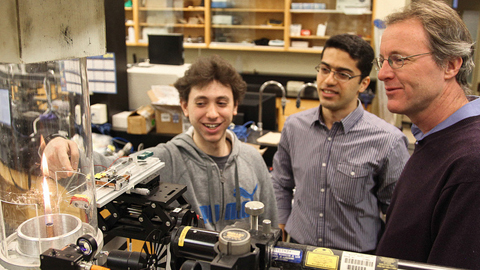
What do more sustainable steel mills, a flow sensor capable of working at harsh temperatures and new engineering leaders have in common? They are part of the dynamic partnership between Tenova Goodfellow Inc. (TGI) and U of T Engineering that has reached its 20-year anniversary.
TGI is a global leader in process optimization for steelmaking operations. They provide advanced industrial equipment that greatly improves the efficiency and sustainability of steel mills in many areas of the world.
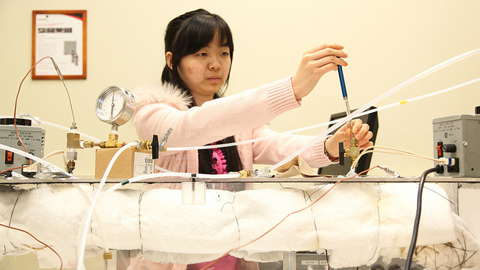
For the last two decades, TGI has engaged in research collaborations with U of T engineers at Professor Murray Thomson’s (MIE) Combustion Research Laboratory. Here, researchers are developing new sensor technology, computer modeling and optical spectroscopy to help TGI stay ahead.
“We are excited to celebrate a landmark 20 years with Tenova Goodfellow,” said Professor Ted Sargent (ECE), Vice Dean, Research. “Partnerships with leaders in industry enable us to work on important problems whose solutions have major societal and economic impacts. They can help us to transfer the fruits of basic and applied research into commercial implementations.“
Commercialization
In 2011, Professor Thomson’s group developed a cross-correlation passive optical flow rate sensor that measures the rate of gases passing through various stages of the manufacturing process.
With its ability to operate in harsh, high-temperature environments, TGI purchased the sensor’s patent, and in 2012, they incorporated the real time data it supplied into process models and control algorithms at three of their customers’ steel mills.
This sensor and others developed through the U of T collaboration have been integrated into TGI’s award-winning systems, eliminating greenhouse gas emissions by more than 200,000 tonnes and electricity consumption by over 300 gigawatt-hours, as well as reducing operating costs in the electric arc furnace market by as much as $90 million.
Training Engineering Leadership
This successful partnership also continues to train the next generation of engineering leaders. Currently, three masters students and one post-doctoral fellow from Professor Thomson’s group are actively engaged in novel sensor development and combustion modeling projects with TGI.
To date, more than ten U of T graduates have joined TGI’s ranks, including Nick Kournetas (MIE MASc 9T8), Mohamed Boutazakhti (MIE PhD 0T4), and Salvador Rego (MIE PhD 0T8).
Continuing Impact
This unique exchange of research and commercialization expertise has also been validated through outside investment from the federal government, specifically the Natural Sciences & Engineering Research Council (NSERC) and Sustainable Development Technology Canada (SDTC).
And it isn’t stopping there. With boundless possibility, researchers will continue to apply their findings across more and more intensive combustion processes – from biomass and coal-fired boilers to cement and oils sands applications.
Together U of T and TGI will continue training new engineering leaders and raising the bar of sustainability and efficiency in steelmaking and beyond.
—
Awards and Recognition for the Tenova Goodfellow EFSOP Technology:
- 2011 Consulting Engineers of Ontario Award of Excellence for the installation and commissioning of the Slop Detection System (SDS) Technology on five BOF vessels in Italy.
- 2009 Consulting Engineers of Ontario Award of Excellence for achieving EAF control at TenarisDalmine, Italy, using EFSOP® Technology.
- 2009 Tenova Goodfelow identified as a Cleantech company engaged in world-class research and environmentally friendly product innovation through the proprietary EFSOP® technology.
This September, U of T Engineering, in collaboration with the Ontario Institute for Studies in Education (OISE), launches Canada’s first master and PhD-level program in engineering education – the EngEd.
EngEd gives students and faculty the opportunity to explore learning concepts at the nexus between engineering and education, from the engineer’s perspective. Research will focus on many of the distinct aspects of training engineers, such as the inherent emphasis on design, quantification, application, systems, constraints and problem solving.
“The EngEd program brings together a long legacy of innovative research and education at U of T Engineering,” said Greg Evans, Professor of Chemical Engineering and Applied Chemistry, who chaired the task force that proposed the initiative. “By focusing on cross-disciplinary collaboration, we look forward to wonderful new ideas and insights that enhance engineering education for generations to come.”
Through their coursework, students will acquire expertise in the application of educational theories within the context of engineering, and apply the use of engineering methodologies towards the promotion of learning.
Approved by U of T Engineering Faculty Council in December 2013 and by the U of T Committee on Academic Policy and Programs – the highest level of university approval – on February 25, 2014. The master and PhD in EngEd will be offered through the Department of Mechanical & Industrial Engineering (MIE), the Department of Chemical Engineering & Applied Chemistry (ChemE) and the Department of Civil Engineering (CivE) as well as OISE’s Department of Curriculum, Teaching and Learning (CTL)*.
*No offer of admissions will be made to the program pending final approval by the Quality Council.

Although he doesn’t have an engineering degree and admits to being hopeless at constructing IKEA furniture, Andy Byford, head of Canada’s largest transit system, knows that engineers with savvy leadership skills are a force to be reckoned with.
“Engineering as a discipline is amazing,” say Byford, TTC CEO, who joined over 80 University of Toronto students on campus last week, “because [they] have to have an ability to think under pressure… think logically… see the bigger picture and be able to grapple with complex equations.”
Students with an engineering degree can aspire to the top career positions, Byford told students, but only if they “can combine the fantastic skillset engineers have with the softer skills.” He focused heavily on people management and customer service abilities.
Hosted by U of T’s Institute for Leadership Education in Engineering (ILead) as part of National Engineering Month, Byford brought some of the TTC’s biggest challenges with him. In small groups, students debated solutions to popular transit topics, like: ‘Subways, streetcars or buses?’ to ‘How do you best allocate the TTC’s limited funding?’
They also engaged Byford through an informal question period, where they could ask questions about his leadership and experiences at the helm of the TTC. They also explored his rise through the ranks of transit authorities in the United Kingdom and Australia.
“I think where the [London] Tube, and definitely the TTC, went wrong in the past was there was an absolute focus on engineering and on the disciplines of engineering – so actually just looking at the way the machines worked, and not paying enough attention to the softer side.”
Working closely with Byford, the goal was to have students see beyond the technical specifics of running the TTC, and critically understand the many aspects of leadership in large, complex organizations.
“It wasn’t what I expected. He was really down to earth,“ said Master of Engineering student David King (CivE), who had a chance to share his recent research with Byford. King is using pedestrian microsimulation to examine how slight changes in pedestrian behaviour – like moving people to the back of a bus – can have greatly limit transit delays.
”You expect CEOs to have a stiff upper lip, but that’s not what you get with [Byford],” he said. “It’s a refreshing take, and I think it bodes well for a future vision for the TTC and our city.”