

A total of $3,613,649 worth of grants has been awarded to U of T researchers, with the bulk of it directed to Engineering. The support comes from the Strategic Projects Grants (SPG) program of the Natural Sciences and Engineering Research Council (NSERC). The funding was part of $43 million awarded to universities across the country.
“NSERC and Canadian industry are jointly investing in six new projects that will transform breakthrough science into practical designs and prototypes. The projects leverage deep expertise in Engineering at U of T, ranging from sustainable energy solutions to cloud computing to microfluidics,” said Ted Sargent (ECE), Vice Dean, Research. His team is also a grant recipient.
The SPG program is designed to enhance Canada’s economy, society and environment over the next 10 years. The grants encourage collaboration among academic researchers, industry and government partners in line with four target areas: Environmental Science and Technology, Information and Communications Technologies, Manufacturing and Natural Resources and Energy.
“In U of T Engineering, we are exceedingly proud of our record of partnership with industry, and with our translation of research results into new products and processes. U of T engineers unite world-leading science with its application to important practical problems that affect society, the economy and the environment. This outstanding result from NSERC’s highly competitive Strategic Grant Program is yet another testament to the calibre and the dedication of U of T Engineering researchers,” Sargent said.
Professor Paul Young (CivE), U of T’s Vice President, Research and Innovation adds “This is research that focuses directly on problems and challenges that, in one way or another, affect us all…Being able to move forward on investigation of these areas is enabled by creative investment programs like the Strategic Project Grants. We are extremely grateful to the Government of Canada and NSERC for continuing to support this program.”
The six U of T Engineering faculty and projects awarded are:
Peter Herman (ECE), Controlling femtosecond laser processing: smart fibers, catheters and lab-on-fiber concepts
Baochun Li (ECE), A cloud-assisted crowdsourcing machine-to-machine networking platform for vehicular applications
Ben B. Liang (ECE), Cloud in the air: A heterogeneous data communication framework for mobile cloud computing
Ted Sargent (ECE), Solar-driven removal of organic contaminants from water
David Sinton (MIE), Nanoparticle-CO2 foams: New methods for carbon storage and oil recovery via pore-scale microfluidics
Brent Sleep (CivE), Optimizing performance of integrated green roof photovoltaic systems

A boost of over $1.7-million worth of grants from the Canadian Foundation for Innovation (CFI) has been directed toward Engineering and will be used for infrastructure that will advance research in everything from testing drinking water to cancer. The funding comes from the CFI’s John R. Evans Leaders Fund, a program designed to help universities attract and retain the very best researchers.
Forty-four projects across the U of T have been awarded a total of $12.1 million, and of that, 17 are from Engineering.
“CFI’s support for research infrastructure will enable U of T Engineering – particularly our emerging research leaders in the Faculty – to continue to make breakthroughs that have global economic, societal and environmental impact,” said Ted Sargent (ECE), Vice Dean, Research.
One project being supported is led by Jeffrey Siegel (CivE). ‘Exploring the Secret Life of Indoor Air Particles’ investigates a little-known threat to human health – airborne microscopic particles.
According to Siegel there are between 100 and 10,000 microscopic particles in every cubic centimetre of air. “We can’t see them, but they’re all around us. We’re breathing them all the time. Even if we’re very conservative in our estimates, the average Canadian eats about seven kilograms of dust over a lifetime. And that’s just ingestion. We inhale a lot more.”
Indoor particles can be outdoor pollutants that migrated inside, or they can originate from indoor sources. Some particles are benign, but others cause serious long-term health problems ranging from heart disease to lung cancer.
On average, Canadians spend 90 per cent of their time indoors. Yet, “compared to what we know about outdoor particles, we know nothing about indoor ones,” Siegel said.
He is working to understand the physical, chemical and biological characteristics of indoor particles – they are all made up of chemicals that can be analyzed and microbes that can be identified using DNA sequencing. His CFI funding will go towards equipment that will allow him to study the physical characteristics of particles too. This is important because the size of a particle is directly related to how dangerous it is to human health.
He plans to conduct what he calls “filter forensics,” examining used filters from residential forced air heating and cooling systems. The CFI-funded equipment will allow him to extract filter dust, which can be invisible to the naked eye, and study it. The data collected can be combined with more easily generated chemical and biological data to make more realistic predictions about people’s long-term exposure to indoor particles.
For another recipient, Professor Stark Draper (ECE), CFI support will help transition his theoretical work on algorithms for digital communications into working technological models.
With the CFI’s support “my research team will be able to move our work in communication theory and algorithm design towards implementation significantly faster. We will use infrastructure provided by the CFI to shorten the journey from ideas to real-world applications,” he said.
The support will also help with the training of students who will have the opportunity to learn a mix of communication theory, algorithmic implementation and computer architecture. “These are areas that don’t typically mix in academia but which regularly come together in industry. CFI support will provide a unique academic training environment for our students.”
“Congratulations to all the winners,” said Professor Paul Young (CivE), U of T’s vice-president (research and innovation). “CFI funding has been essential to our ability to attract the world’s best researchers, and has, in turn, allowed those researchers to make progress on some of the most pressing problems of our time.”
For a list of U of T’s CFI-funded projects, please visit the U of T Research and Innovation website.
CFI grants to Engineering awarded to:
Jan Andrysek (IBBME, MIE)
Vaughn Betz (ECE)
Arthur Chan (ChemE)
Jennifer Drake (CivE)
Stark Draper (ECE)
Ron Hofmann (CivE)
Jonathan Kelly (UTIAS)
Yuri Lawryshyn (ChemE)
Antonio Liscidini (ECE)
Keryn Lian (MSE)
Prasanth Nair (UTIAS)
Jun Nogami (MSE)
Jeffrey Siegel (CivE)
Chandra Veer Singh (MSE)
Joshua Taylor (ECE)
Edmond Young (MIE)
Ding Yuan (ECE)
London-based Women in Mining (UK), a non-profit association aimed at promoting the achievements and position of women in all levels of the global mining industry, has named Samantha Espley (GeoE 8T8) as one of their top 100 inspirational women in mining worldwide.
Espley is part of a Canadian contingent of 12 honourees in the 100 Global Inspirational Women in Mining Project, a list designed to promote the significant impact of women in the traditionally male-dominated industry.
“WIM (UK) has collaborated with WIM groups all over the world in order to reflect a broad cross-section of global industry talent in The 100 Global Inspirational Women in Mining project,” said Amanda Van Dyke, chair of WIM (UK). “From engineers and geologists, to finance professionals and investors, each woman has been selected because of the lasting impact she makes on those around her as a positive role model and her contribution to the industry.”
Currently the General Manager (Mine and Mills Technical Services) at Vale – Sudbury Operations, Espley’s lengthy curriculum vitae reflects this impact.
She was a founding member of Women in Science and Engineering, a local group dedicated to promoting women in the broad science and technology academic disciplines, in 1998 during her graduate work. One year later, she received the Governor General’s Gold Medal, an award that honours the doctoral student with the highest standing at each university.
From 2003 to 2008, she chaired the science committee and held a position on the Board of Directors at Sudbury’s Science North, one of the leading science educational centres in Canada. Espley is currently the Co-chair of the Underground Working Group, Global Mining Standards and Guidelines Committee.
She has been recognized for her hard work, too, having received the International Women’s Week Award in 2004, the Canadian Institute of Mining, Metallurgy and Petroleum (CIM) Distinguished Service Medal in 2009, and the Trailblazer Award from Women in Mining Canada in 2013.
Espley was also recently honoured by the University of Toronto Engineering Alumni Association, receiving the 2013 2T2 Mid-Career Achievement Award. This award recognizes a graduate who has earned respect within the profession and broader community, attained significant achievement and exhibits promise of further contributions.
“Samantha is truly a trailblazer,” said Professor Brent Sleep, Chair of the Department of Civil Engineering. “Her work to promote women in the Canadian and global mining industries is inspiring to our community of future engineers. We congratulate her on this recognition and are honoured to count her as one of our alumni.”
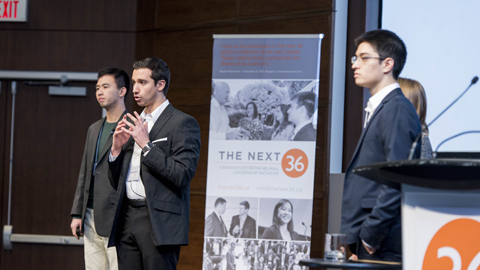
U of T Engineering nurtures a culture of entrepreneurship in its students – a strategy that pays off over and over again. It’s no surprise then that 10 of 40 students from across North America selected for The Next 36 program are once again from U of T’s Faculty of Applied Science & Engineering.
This increasingly popular program is designed to train Canada’s next generation of innovators and business leaders. Competition this year was tough, with close to 1,000 applicants.
Those who are selected are given the opportunity to develop their business ideas and put them into action with help from Canadian business leaders, mentorship and lectures from world-class faculty over a nine-month period, according to Jon French, spokesperson for The Next 36. This entrepreneurship-immersion program also provides those selected with up to $95,000 in seed investment for new ventures.
“It is very rewarding from the work we are doing that the spirit of entrepreneurship is coming alive. Seeing 10 of our students among The Next 36 shows the message of innovation and an understanding of business is coming through,” said Joseph Orozco, Executive Director, Entrepreneurship – The Entrepreneurship Hatchery and Adjunct Professor of the Centre for Management of Technology and Entrepreneurship (CMTE). He noted that one of The Next 36 students has applied to the Hatchery program, which offers similar services, and he hopes to see more.
“I personally believe we all have an entrepreneurial seed inside of us. What we do here is allow that seed to flourish. It’s not always about creating your own business but being able to work in any environment, any company. These students are going to be better members of society,” he said.
That the spirit is alive is evidenced by the fact five of U of T’s Next 36 students are either enrolled in, or have completed Engineering entrepreneurship courses. And impressively, nine of those selected from the U of T came from Engineering’s enriched program, Engineering Science.
“There is a renewed emphasis on design and innovation in the Faculty of Applied Science & Engineering, and this is contributing to a culture of entrepreneurship in our students. Needless to say, I am extremely pleased with the performance of our students in this year’s The Next 36 competition and confident that they will make the most of this outstanding opportunity,” said Professor Mark Kortschot (ChemE), Chair, Division of Engineering Science, and himself an experienced entrepreneur.
Timothy Ahong (EngSci 1T3 + PEY) and James Schuback (EngSci 1T3) are two who made it onto The Next 36 list. They are on a team developing a wearable motion sensor which provides feedback on athletic technique and motion for a variety of sports. The device compares a person’s motion, whether it’s a tennis or golf swing, or other motions, to that of the pros.
“The Next 36 is an amazing opportunity, and I still can’t believe I’m doing this. Entrepreneurship is the path I’ve chosen after graduation, and I plan to pursue this or a related project,” said Schuback.
The U of T Engineering students in The Next 36 will be building their startups along with their co-founders (small teams applied) and mentors. The ideas presented by students included: a motorized blimp for filming events, a fashion consulting platform, leveraging GPS and Bluetooth to help parents monitor young children, and wearable technology for athletes.
Projects may change from the initial idea over the course of the program as Venture Day in mid-August 2014 gets closer – the program’s annual Capstone Event where ventures are showcased to investors and business leaders from across North America. It is also when the students will officially graduate from The Next 36 program.
The Next 36 was started as a way to address Canada’s shortage of high-impact entrepreneurs. The organization provides a resource-rich program to a select group of promising undergraduates, and was founded by a small group of entrepreneurs, business leaders and academics, a number of whom are U of T Engineering alumni.
This year’s student selection include: Timothy Ahong (EngSci 1T3 + PEY), Amir-Hossein Karimi (EngSci 1T4), Shums Kassam (EngSci 1T5), Vivek Kesarwani (EngSci 1T3 + PEY), Drew MacNeil (EngSci 1T5), Tejas Mehta (EngSci 1T4 + PEY), James Schuback (EngSci 1T3), Jonathan Yam (EngSci 1T3), Victor Zhang (ElecE 1T3) and Cheng Zhao (EngSci 1T2 + PEY).
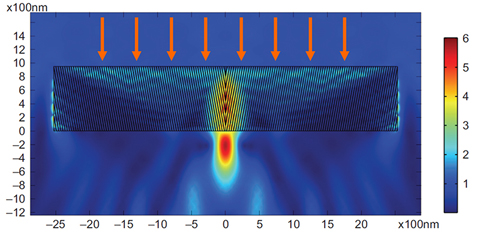
Researchers in The Edward S. Rogers Sr. Department of Electrical & Computer Engineering have designed a new way to focus light over extremely short distances, technology with big applications in photovoltaics and optical imaging.
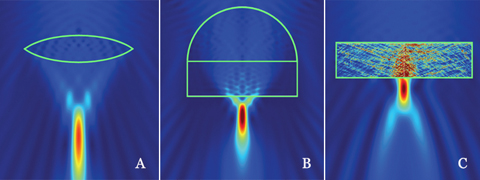
Picture a typical lens, shaped like half a grapefruit lying face-down. Light rays pass through the lens and focus some distance away from its surface. This distance is the focal length. In order to achieve short focal length and focus light relatively close to the lens’s bottom surface, the lens needs to be very thick, and therefore heavy. To gather the maximum amount of energy from the sun and minimize cost, solar panels concentrate light through lenses onto single cells for absorption. Such current solar panel designs are relatively bulky and heavy to accommodate these thick lenses.
But what if you could concentrate light directly on the underside of a solar panel, and make it thin and light at the same time? Metamaterials hold the solution.
Professor George Eleftheriades (ECE) and PhD student Mohammad Memarian (ECE) have demonstrated a way to stitch together a class of light-channeling metamaterials such that light is funneled to focus much closer to the exit surface of the flat lens.
“It works like a sink full of water, with all the light flowing into the drain in the middle,” said Eleftheriades. “Nobody’s done this before, and the reviews were very enthusiastic.”
“What’s attractive about this is its broad impact — everyone can see why it’s important and how we can use it,” said Memarian. “I’m hoping to follow this up, and I think it’s valuable to take this further and apply it either to solar cells or to other ideas that we have.”
This work was published in the Nov. 22, 2013 issue of the online Nature journal Light: Science & Applications, and since its publication has been the most-downloaded paper from the journal. This work received support from the Natural Sciences and Engineering Research Council of Canada and Defence Research and Development Canada.

When you win a competition by time measured in milliseconds, it’s like being in the Olympics. That’s what happened to Shang Wang (ECE 1T7) at the first Connect6 game competition, organized as part of Engineering’s APS105 computer programming course.
Connect6 is a cross between the popular Chinese board game Go, and tic-tac-toe. The board measures 19 squares by 19 squares, and the object is to get six game pieces in a row – either up and down or on a diagonal.
But the game Wang played – held in the atrium of the Bahen Centre for Information Technology on Nov. 29 – came with a twist. The ‘players’ were actually computer programs that first-year Engineering students wrote as part of an assignment. Students’ programs were pitted against each other, and the games were projected onto a screen. If a game was a draw, the program that took the least amount of time to play, won.
The Connect6 competition attracted close to 150 students. The event added a whole new dimension to making an assignment exciting, according to Professor Jason Anderson (ECE) who came up with the idea.
“It was the first time we’ve given first-year students an open-ended programming problem, and the first time we’ve created a project-related event like this. The solutions students produced were remarkable and shows you can encourage excellence in ways that are fun,” he said.
Prior to the event, all students’ programs were played against each other (more than 400 first-year U of T Engineering students take this introductory programming course), until there were eight finalists. The winning game was a draw, but Wang’s program beat that of his classmate, Rongzhen Cui (ECE 1T7) by 11 milliseconds. Cui came in second, overall.

“I was surprised I was selected for the finals,” Wang said. He had never played board games before, and relied on help from a classmate to work out game strategies to improve the odds of winning.
Jake Kutkevicius (TrackOne) came in third. All three students described the project as fun, and enjoyed the challenges of the assignment. They were each awarded a Google Nexus 7 Tablet.
According to Professor Jonathan Rose (ECE), it was the first time instructors tried using a game as a way of exposing first-year students to the type of problem-solving conundrums they’ll encounter later in life. “We were impressed with the quality of the programs the students wrote,” he said.