
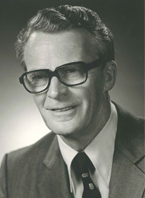
Professor Arthur Porter (MIE), (1910-2010), founding Chair of U of T’s Industrial Engineering program, has been posthumously inducted into the Canadian Science and Engineering Hall of Fame.
The Hall of Fame is a central part of the Canada Science and Technology Museum in Ottawa. It honours individuals whose outstanding scientific or technological achievements have had long-term implications for Canadians.
In a lifetime that spanned a century, Arthur Porter was a groundbreaking engineer, scientist and academic, as well as an influential advisor to industry and governments. He was a pioneer in a number of fields, including control theory, servomechanisms and industrial engineering.
In 1962, Professor Porter became founding Chair of the new Industrial Engineering Department at the University of Toronto, one of the first industrial engineering programs in the world. Under Professor Porter’s leadership it focused on two brand new fields, operations research and human factors, which are now used throughout commerce, industry and health care. He was also instrumental in working with the Dean of Medicine to establish the Institute of Biomedical Electronics (now the Institute of Biomaterials & Biomedical Engineering).
In the early 1960s, Professor Porter chaired the Ontario Commission on Automation and Employment. He was subsequently Scientific Advisor for the creation of a new Ontario Science Museum, which became the Ontario Science Centre. He also served as Chair of the Canadian Environmental Advisory Council, a group of scientists established by Prime Minister Pierre Elliot Trudeau to advise him on environmental problems. In 1975, he resigned from U of T to take on the position of Chair of the Ontario Royal Commission on Electric Power Planning.
Arthur Porter was awarded the Order of Canada in 1988. Other honours include the Canadian Centenary Medal, the Canadian Confederation Medal, the Queen’s Silver Jubilee Medal and the Queen’s Golden Jubilee Medal.
“Professor Porter has joined the many U of T alumni and professors recognized by this prestigious institution,” said Cristina Amon, Dean, Faculty of Applied Science & Engineering. “A key figure in the development of U of T Engineering into a world-leading program, he is most deserving of this honour.”
Professor Porter was inducted into the Hall of Fame on October 22, as part of National Science and Technology Week.

University of Toronto researchers have developed a method that can rapidly screen human stem cells and better control what they will turn into. The technology could have potential use in regenerative medicine and drug development. Findings are published in this week’s issue of the journal Nature Methods.
“The work allows for a better understanding of how to turn stem cells into clinically useful cell types more efficiently,” according to Emanuel Nazareth, a PhD student at the Institute of Biomaterials & Biomedical Engineering (IBBME) at the University of Toronto. The research comes out of the lab of Professor Peter Zandstra, Canada Research Chair in Bioengineering at U of T.
The researchers used human pluripotent stem cells (hPSC), cells which have the potential to differentiate and eventually become any type of cell in the body. But the key to getting stem cells to grow into specific types of cells, such as skin cells or heart tissue, is to grow them in the right environment in culture, and there have been challenges in getting those environments (which vary for different types of stem cells) just right, Nazareth said.
The researchers developed a high-throughput platform, which uses robotics and automation to test many compounds or drugs at once, with controllable environments to screen hPSCs in. With it, they can control the size of the stem cell colony, the density of cells, and other parameters in order to better study characteristics of the cells as they differentiate or turn into other cell types. Studies were done using stem cells in micro-environments optimized for screening and observing how they behaved when chemical changes were introduced.
It was found that two specific proteins within stem cells, Oct4 and Sox2, can be used to track the four major early cell fate types that stem cells can turn into, allowing four screens to be performed at once.
“One of the most frustrating challenges is that we have different research protocols for different cell types. But as it turns out, very often those protocols don’t work across many different cell lines,” Nazareth said.
The work also provides a way to study differences across cell lines that can be used to predict certain genetic information, such as abnormal chromosomes. What’s more, these predictions can be done in a fraction of the time compared to other existing techniques, and for a substantially lower cost compared to other testing and screening methods.
“We anticipate this technology will underpin new strategies to identify cell fate control molecules, or even drugs, for a number of different stem cell types,” Zandstra said.
As a drug screening technology “it’s a dramatic improvement over its predecessors,” said Nazareth. He notes that in some cases, the new technology can drop testing time from up to a month to a mere two days.
Professor Peter Zandstra was awarded the 2013 Till & McCulloch Award in recognition of this contribution to global stem cell research.
About IBBME
The Institute of Biomaterials & Biomedical Engineering (IBBME) is an interdisciplinary unit allowing a remarkable degree of integration and collaboration across three Faculties at the University of Toronto: Applied Science & Engineering, Dentistry and Medicine. The Institute pursues research in four areas: neural, sensory systems and rehabilitation engineering; biomaterials, tissue engineering and regenerative medicine; molecular imaging and biomedical nanotechnology; and, medical devices and clinical technologies.
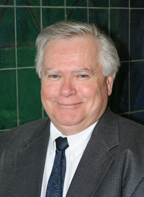
U of T Engineering Professor Doug Hooton (CivE 7T4, MASc 7T5) is the 2013 Robert E. Philleo Award winner from the American Concrete Institute (ACI).
The award, given by the ACI Foundation Concrete Research Council, honours exemplary teaching, research and service to the profession in the areas of durability of concrete, properties of concrete-making materials and preparation of standards and specifications.
“We are delighted Professor Hooton has been recognized for his outstanding contributions to the integrity of our physical infrastructure,” said Cristina Amon, Dean, Faculty of Applied Science & Engineering. “He is an exceptional leader in improving standards in this field.”
The Department of Civil Engineering professor is one of the country’s top experts in the durability and sustainability of cement and concrete. He has worked for years with industry and government to improve the design, construction and repair of concrete structures.
Hooton, who is currently serving as NSERC/CAC Industrial Research Chair in Concrete Durability and Sustainability, received his award on October 20 at the council’s annual convention in Phoenix.
Hooton also recently received the Frank E. Richart Award, presented by the American Society for Testing and Materials (ASTM) and was inducted as a 2013 Fellow in the Canadian Academy of Engineering (CAE).
 Professor Yu Sun (MIE) has been elected Fellow of the American Society of Mechanical Engineers (ASME). Fellowship is the highest elected grade of membership within ASME, the attainment of which recognizes outstanding engineering achievements and contributions to the engineering profession.
A global leader in the development of micro-nano robotics and device technologies for biomedical, clinical and precision instrumentation disciplines, Professor Sun has invented automated processes for cell manipulation that are impacting clinical cell surgery, clinical diagnostics and genetics. He is a Canada Research Chair in Micro and Nano Engineering Systems, a Fellow of the Canadian Society of Mechanical Engineering (CSME) and a Fellow of the Engineering Institute of Canada (EIC). He currently holds an NSERC E.W.R. Steacie Memorial Fellowship.
“I am delighted that Professor Yu Sun has been recognized by his colleagues of the American Society of Mechanical Engineers,” said Professor Jean Zu, Chair of the Department of Mechanical & Industrial Engineering. “This honour attests to his ongoing recognition as a leader in his field. On behalf of the Faculty, I congratulate him on this notable distinction.”
The ASME Board of Governors confers the Fellow grade of membership on exceptional candidates as nominated by their peers.
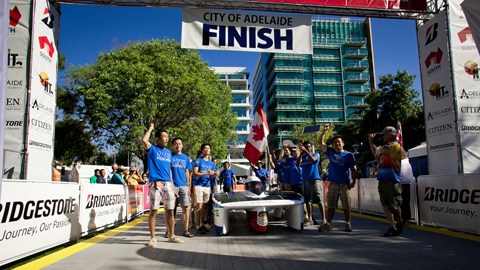
U of T’s Blue Sky Solar Racing team is heading home after a successful eighth-place overall finish, and second among North American teams, in the 2013 Bridgestone World Solar Challenge, a gruelling 3,021-kilometre race for solar-powered cars across Australia from Darwin in the north to Adelaide in the south.
The Blue Sky team achieved its goal of finishing in the top 10 among the 23 teams. Blue Sky’s car, B7, completed the race, which ran down the Stuart Highway through some of Australia’s most isolated countryside , in 45 hours and 38 minutes, achieving an average speed of 65.71 km/hour.
Team members are on their way home from Australia and unable to comment on the experience, but according to their blog the race didn’t always go smoothly. There were minor glitches such as steering wheel problems. And on day 4 of the 6-day race, Blue Sky Solar’s support trailer jack-knifed and a crate containing crucial supplies fell off. Blue Sky Solar was helped out by the University of Calgary team which stopped and lent a hand to their U of T competitors.
Blue Sky Solar has been building and racing solar cars since 1996, when a small group of Mechanical and Electrical & Computer engineering students formed the Advanced Solar Electrical Vehicle Program. The team includes students from different faculties, but is mostly comprised of Engineering students. Built and driven entirely by students, B-7 features the latest advancements in photovoltaic technologies, a brand new aerodynamic design and improved vehicle dynamics systems, weighing about 20 per cent less than its predecessor, Azure, which placed 24th out of 37 teams in the 2011 World Solar Challenge.
“We are all very proud of Blue Sky Solar,” said Cristina Amon, Dean, Faculty of Applied Science & Engineering. “To go against the best teams in the world and finish in the top 10 is a testament to their hard work, ingenuity and drive. I congratulate all the members of the team on this tremendous achievement.”
Blue Sky Solar competed in the Challenger class race, which was won by a team from the Netherlands, which completed the race in just 33 hours.
For full race results, visit the World Solar Challenge website.
The launching of new start-up company Interngration is the most recent success of U of T Engineering’s Entrepreneurship Hatchery. It went live officially on Tuesday, October 15, 2013.
Started by recent Electrical and Computer Engineering grads Anirudh Ganti (ElecE 1T3), Hargun Suri (CompE 1T3) and Ian Xiao (ElecE 1T3), Interngration is a software service designed to help match students to employers for potential internships and employment opportunities.
The idea was inspired by the chaos and the frustration with long lines and crowds at job fairs, says Ganti. He and his two partners came up with an idea to alleviate that problem, and on the advice of a professor, took it to the Hatchery. There, they received advice and guidance on how to develop the idea into a business, and had mentors who had started up businesses themselves share their experiences.
It was a steep learning curve, but the three learned about business plans, testing the viability of the idea with metrics, adjusting the idea for the real world, how to approach potential investors and much more. Then, of course, there was creating the framework which took a lot of time. It was a steep learning curve, says Ganti.
The end product is a web application that is free for students to use, but supported by businesses that use it in their quest to find talent for their companies. At this point, Interngration is limited to small companies and start-ups – places that are often overshadowed in large job fairs, Ganti said.
The project attracted the attention of the City of Toronto which presented Suri with the International Student Excellence Award in the entrepreneurship category.
“Interngration is a terrific example of what the Hatchery is all about,” said the Hatchery’s executive director, Joseph Orozco. He is also Adjunct Professor of the Centre for Management of Technology and Entrepreneurship (CMTE).
In fact, the new start-up is one of two success stories to come out of the Hatchery in its first year of operation. The other is Cytospan, a new company based around a technology to better measure the life span of living cells.
The Hatchery is open to students from all disciplines at the U of T. But there is a requirement that at least one engineering student be on each team. The Hatchery fosters multidisciplinary teamwork, Professor Orozco says.
“The Hatchery is about defining business models, creating viable products, finding opportunities that are real and hopefully generating revenue and jobs,” he says.
There is little that can inspire someone to take their first steps towards actual entrepreneurship better than a helping hand that offers expertise and guidance.