
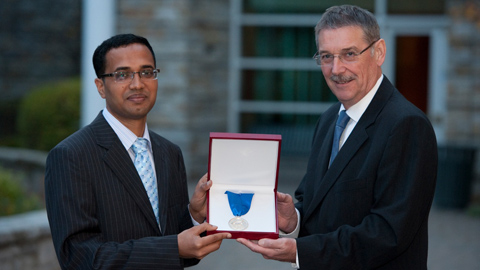
Dr. Muhammad Zulfiker Alam, a post-doctoral fellow in The Edward S. Rogers Sr. Department of Electrical & Computer Engineering, has been announced as the 2013 recipient of the Douglas R. Colton Medal for Research Excellence. Alam received the award at a ceremony Tuesday evening in Gatineau, Que. at CMC Microsystems’ 2013 Annual Symposium.
The Douglas R. Colton Medal for Research Excellence recognizes excellence in research leading to new understanding and novel developments in microsystems and related technologies, such as photonics/optoelectronics, microelectromechanical systems (MEMS), microelectronics, microfluidics and embedded software, or the application of microsystems and related technologies in Canada. The annual award includes a medal and a monetary prize of $4,500 and is presented by CMC Microsystems.
Alam’s doctoral work, co-supervised by Professors Mo Mojahedi (ECE) and Stewart Aitchison (ECE), focused on theory and applications of hybrid plasmonic waveguides; specifically, on overcoming the limitations of plasmonics posed by high loss. Alam’s most significant contribution was the first proposal of the hybrid plasmonic waveguide, which utilizes the plasmonic confinement property but does not suffer large loss— this has been widely accepted as one of the most promising plasmonic waveguides proposed to date.
Alam’s PhD thesis resulted in 13 publications in high-impact journals, 20 conference publications and eight invited talks.
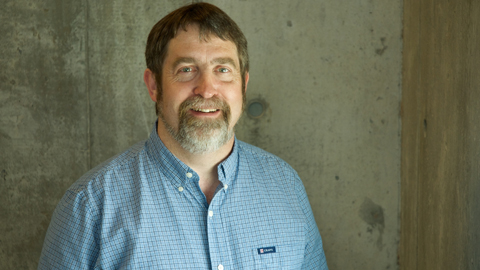
Ever wonder about the forces of nature, how they work and how life manages to survive amongst these forces? U of T Professor Bryan Karney from Civil Engineering and Engineering’s Cross-Disciplinary Programs Office is launching the department’s first Massive Open Online Course (MOOC), a free, multimedia online course open to anyone who is interested.
Our Energetic Earth explores the dynamics of the planet. It covers topics as diverse as what causes wind and the ocean currents, to what drives thunderstorms and how energy from sunlight is converted to thermal energy. It also addresses why, in the cold vastness of space, Earth’s surface is able to support life. Course content will give students a better sense of the complexity, challenges and wonder of living on such an energetic planet.
A MOOC allows for the participation of large numbers of people in non-credited courses. It includes videos, reading material, problem sets and interactive forums which include both students and instructors. Anyone can enrol.
Professor Karney explains more about the course.
Why choose this topic for Engineering’s first MOOC?
A few years back, we created a course that covered energy and thermodynamics. Instead of being about exploiting sources, it looked at the energy that is around us as part of a dynamic Earth. We looked at understanding the forces behind hurricanes, tsunamis and more. The first year, the course attracted 35 students, but within five years that number jumped to 550. There is a huge interest in this topic.
What will students get out of it?
Students will become part of the discussion about renewable energy and sustainability, and this course gives them a ‘big picture’ view. This gives them something that’s applicable to the world and not just machines.
Often we stop noticing some of the extraordinary things going on around us – in a windstorm, the flash of lightning or when the ocean waves are crashing. What happens around us is amazing, and it’s even more special if we understand the causes.
What triggered you to offer a course in this format?
I like going beyond lecturing and exploring other creative ways to teach, including using the Internet and social media. A course delivered in this format has the ability to reach a huge audience and is available to people who otherwise would not have heard of this topic.
What do you hope to accomplish?
I like the idea of reaching a wider audience and developing new materials we can use in conventional settings too. What I hope students will get from this course is the ability to participate in debates and discussions about energy in a more informed and broader way.
Classes start October 28, 2013, and course length is six weeks. Sign up for the course here: Our Energetic Earth
Professor Karney is known for his enthusiastic teaching style. He was one of 10 lecturers selected for Television Ontario’s (TVO) Best Lecturer Competition in 2007, and in 2009 received the Northrop Frye award for excellence in combining teaching and research. His research focuses on water resources and energy systems.
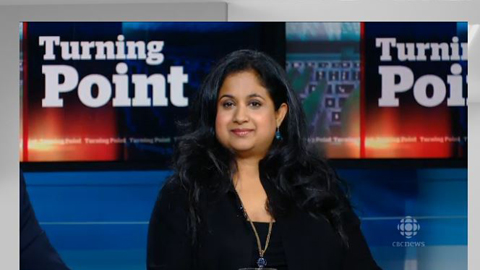
Professor Deepa Kundur of The Edward S. Rogers Sr. Department of Electrical & Computer Engineering appeared on CBC News’ The National as part of a ‘Turning Point’ panel on the topic of ‘Canada’s Cyber-Spying.’ The segment aired Wednesday, October 8.
Professor Kundur, whose research focuses on identifying potential weaknesses in cyber-enabled systems, joined host Peter Mansbridge and panellists Brian Stewart, distinguished senior fellow at University of Toronto’s Munk School of Global Affairs, Dr. Samantha Nutt, founder of War Child Canada and Mark Raymond of the Centre for International Governance Innovation at University of Waterloo.
The panel discussed the recent accusations of cyber-spying levelled at the Canadian government by Brazil, and potential ramifications cyber-spying could have on Canadians.
“I think one concern we should have as Canadians is if our government wasn’t doing this, from a perspective of national security,” said Professor Kundur during the discussion. “But I think what is raising concern is because there are economic reasons for this particular event. It is true, and likely, that a lot of people are doing this, and I think as the NSA documents are further leaked and it’s discussed, we’ll see that this is part of a very large scheme that’s going on.”
Asked whether this week’s revelations will make Canadians pause to consider Canada’s position on cyber-security, both foreign and domestic, Professor Kundur was optimistic. “I think people will start to realize that they have to take responsibility for cyber-securing their own personal information and assets, because this is a global issue that came out. But we as Canadians can start to realize how widespread this problem is, and the tools that are available out there,” she said. “So I think that people will start to see this as a focus area, and will start to demand services from various vendors, for example, their portable devices, that promote privacy, anonymity and security.”
Watch the entire panel interview on CBC’s The National.
Professor Timothy Chan (MIE) is featured in the Canadian Business cover story about his research into the use of sports analytics to quantify the value of hockey players.
He and David Novati (IndE 1T1 + PEY) developed a unique “Split Personality” model to analyze NHL player performance. Professor Chan continues this research, working with Swapneel Mehta (IndE 1T3 + PEY) and Daniel Biancolin (IndE 1T5 + PEY) to extend the model to junior hockey player analysis.
Read the full article on the Canadian Business website. The issue comes to newsstands, October 14.

On October 3, 2013, the Department of Materials Science & Engineering (MSE) hosted the 8th Annual MSE Alumni-Industry Day at the University of Toronto. Over 20 alumni, industry associates and current Professional Experience Year (PEY) students gathered to share professional insights, advice and experiences with current undergraduate and graduate students.
As with previous years, Professor Jun Nogami, Chair, Department of Materials Science & Engineering, hosted a luncheon for all industry representatives just prior to the networking fair, where he provided the latest updates about the MSE curriculum, new faculty members, laboratory facilities and strategic research opportunities with industry. Alumni and industry representatives then engaged with over 200 undergraduate and graduate students in the Wallberg Building foyer later that afternoon.
One of this year’s representatives was recent alumnus, Alex Di Ilio (MSE 1T2 + PEY), an Engineering New Grad Trainee at Ontario Power Generation (OPG). “I remember being introduced to career opportunities at OPG at this very same event as a third-year student,” said Di Ilio. “It was an honour for me to return and attend MSE Alumni-Industry Day this year, now as an OPG employee, to discuss the rewarding and diverse opportunities available to MSE graduates.”
“The annual MSE Alumni-Industry Day is a very important and popular event for our students. This invaluable networking opportunity with alumni and professionals in the materials engineering industry provide our students with tangible examples and insights into the opportunities available to them as a result of their education,” said Professor Nogami. “I would like to express my sincerest thanks to all of our alumni and industry associates for taking their time to aid in the development of our future materials engineers.”

The University of Toronto hosted Canada’s top schools at the first-ever Engineering Graduate Studies Fair on October 2.
Earlier this year, U of T Engineering partnered with engineering faculties at four other Canadian schools: University of Alberta, University of British Columbia, McGill University and the University of Waterloo, to form the Canadian Graduate Engineering Consortium.
The Consortium is collaborating on a series of graduate recruiting events at each member campus to attract the very best engineering students across the country.
The Fair, organized by Laura DeBartolo, Faculty Research & Graduate Coordinator, included an information session, an open-panel discussion and a networking reception at the Bahen Centre for Information Technology. More than 200 students were in attendance, taking the opportunity to have informal conversations with U of T Engineering professors and current graduate students about their experiences, their cutting-edge research and potential degree options, as well as discover the opportunities available at other Consortium-member faculties.
“Many students see graduate work as the first step in a career in academia,” said Professor Markus Bussmann (MIE), Vice-Dean, Graduate Studies. “While that is one noble ambition, we also want to highlight the other excellent career paths that could benefit from a master’s or a PhD, as well as the industry and leadership opportunities graduate study at U of T can provide.”
Armed with brochures and pamphlets from the information session, students filed into the Adel S. Sedra Auditorium to hear a panel discussion on innovative engineering research and the need for specialized skills within the Canadian industry.
The panel featured Professor Craig Simmons (MIE, IBBME), Hatch engineers Dr. Kinnor Chattopadhyay and Dr. Ghazaleh Nazari, as well as Telus’ Dr. Tim Poon and Waterloo Dean of Engineering Pearl Sullivan.
They discussed their personal and professional experiences with graduate programs, emphasizing the need for continued research and discovery, while highlighting the executive options graduate study makes available.
They then answered questions from students about the right time to pursue graduate work, the expectations across the various programs, and the benefits of having a graduate degree when it comes to the workforce.
“Graduate work really helps to develop and hone professional skills like project management, scientific writing and presenting,” said Professor Simmons, the Canada Research Chair in Mechanobiology, and an award winner in both research and teaching. “Those skills translate across all fields of engineering and help you address all challenges, even if they’re outside your area of study.”
Professor Simmons underscored the importance of taking advantage of other university programs offered during graduate study that can help complement students’ research. Those include the graduate leadership and certificate courses offered at U of T Engineering through ILead or business experience gained through work at The Entrepreneurship Hatchery.
After the panel discussion students were invited to a networking reception back in the Bahen atrium where they could discuss what they had learned and connect with industry officials to further discuss the advantages of a graduate degree in the workplace.
“We are very pleased with the response to tonight’s event and very thankful to our panelists and participants,” said Professor Bussmann. “We look forward to continuing to engage prospective graduate students and promoting U of T Engineering’s graduate programs in this world-class city to our students and those across Canada and around the world.”