

HFIG shares this honour with 13 student chapters recognized at the gold level including, Georgia Institute of Technology, University of Wisconsin-Madison, and Virginia Tech. HFIG is the only Canadian chapter to be recognized by the Society this year. In 2012, HFIG received a bronze level award.
Human factors – or ergonomics – is the scientific discipline concerned with the understanding of interactions among humans and other elements of a system. The research area applies theory, principles, data and other methods to optimize human well-being and overall system performances.
The HFES’ mission is to promote the discovery and exchange of knowledge concerning human characteristics that are applicable to the design of systems and devices of all kinds.
HFIG is recognized as a HFES student chapter at U of T.
Of the group’s major accomplishments over the past year, HFIG hosted the Inter-University Workshop between U of T, the University of Buffalo, and the University of Waterloo. The annual event is an example of the ongoing collaboration between the three institutions.
“This year’s dedicated executive committee worked hard to organize insightful guest lectures, information sessions, mentorship events and fun social gatherings, so the U of T community can have a great time learning about the exciting world of Human Factors,” said David Canella (MASc IndE 1T3), co-president of the U of T HFIG chapter.
“I am delighted the Human Factors and Ergonomics Society has selected the MIE Human Factors Interest Group as a gold level student chapter,” said Professor Jean Zu, Chair of the Department of Mechanical & Industrial Engineering. “We take pride in our active graduate student associations for their contributions to research, and to student life. I congratulate their executive committee and faculty advisor, Professor Paul Milgram, for this highly-deserving honour.”
HFIG was recognized October 1 during the Society’s student reception in San Diego, CA.
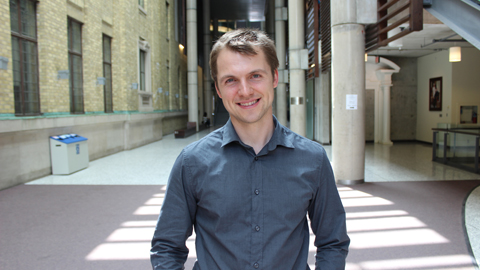
The Banting Postdoctoral Fellowships program, administered through NSERC, provides $70,000 annually for two years to national and international postdoctoral applicants who positively contribute to the country’s economic, social and research-based growth. It is arguably the most prestigious postdoctoral fellowship available in Canada. Only 23 were distributed this year.
Lessard plans to use the funding to support his research into the synthesis and characterization of Boron Subphthlocyanine-containing copolymers and optimization of their use in organic electronic devices; for example, photovoltaic cells (OPVs) to light-emitting diodes (OLEDs) and thin-film transistors (OTFTs).
“The synthesis and characterization of these novel polymers, as well as their implementation into lab scale OLEDs and OPVs will allow us to study whether these classes of polymers can produce cost-effective and sufficiently efficient materials to be used in next-generation plastic electronics,” says Lessard.
Development of inexpensive and flexible organic electronics provide a number of benefits to society, including increasing the availability of low cost organic solar cells, vibrant and flexible visual displays and even plastic computers. Lessard’s research might very well uncover new classes of materials, which could be utilized for these applications.
“The Department is very proud of Benoit’s achievement and looks forward to help him explore the potential of his research,” said Professor Grant Allen, Chair of the Department of Chemical Engineering & Applied Chemistry at U of T.
Preserving food. The changing demographics of Canadian society. Horizontal enlightenment through meditation.
These were just some of the topics attendees learned about at the fifth annual TEDxToronto conference last week. The University of Toronto co-sponsored the event, and U of T Engineering boasted two of the 12 provocative presenters: Professors Brendan Frey and Steve Mann from The Edward S. Rogers Sr. Department of Electrical & Computer Engineering (ECE).
Both Professors Frey and Mann galvanized the more than 1,000 attendees with their presentations. Frey discussed how he and his colleagues uncover and decipher genetic recipes, and Mann related his experiences with wearable computing and its implications for surveillance and openness.
Professor Frey was impressed with the level of engagement of the attendees.
“The audience was very responsive during my talk and afterward I chatted with about two dozen attendees. They had interesting comments about my research and also I found that they were very smart, creative people who are doing interesting things themselves. It was a terrific experience,” he says.
[youtube https://www.youtube.com/watch?v=hzLp0QETUhY?feature=player_embedded]
Professor Mann says he gained a lot from the experience.
“It was a lot of fun, and I met lots of very interesting people afterwards. The whole process was quite enlightening,” he says.
[youtube https://www.youtube.com/watch?v=z82Zavh-NhI?feature=player_embedded]
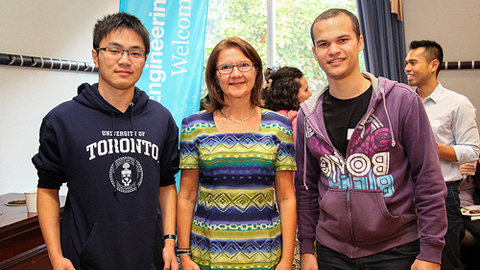
Aditya Shankar, a third-year electrical engineering student on exchange from the Indian Institute of Technology Bombay, had the option to study almost anywhere in the world. He chose U of T Engineering for its high ranking, reputation for research excellence and a chance to immerse himself in the local culture.
Shankar was one of more than 80 international students attending a welcome breakfast for international exchange students on September 27.
“I’ve cherished the people I’ve met, so far, here at U of T,” said Shankar. “Here, I’m able to compare cultures, learn about different perspectives and compile new experiences.”
The Faculty of Applied Science & Engineering is hosting more than 45 international exchange students, plus 280 from Brazil’s Science Without Borders program, which sends Brazilian university students to study at top universities worldwide. U of T Engineering was the top program choice among Science Without Borders applicants for this fall.
“Enjoy this exciting opportunity to study at Canada’s top Engineering Faculty, one of the very best in the world,” said Cristina Amon, Dean, Faculty of Applied Science & Engineering in her opening remarks. “You have come to one of the world’s most cosmopolitan cities, where 50 per cent of Torontonians were born outside of Canada. We hope you will find your experience with us enriching, as we are enriched by having you amongst us.”
“You have chosen to invest in yourself, here at the Engineering Faculty in one of Canada’s pre-eminent institutions,” added Judith Wolfson, Vice-President, University Relations for University of Toronto. “Our strength is a testament to the quality of students like you and your willingness to share your experience and your ideas with us.”
Participants in U of T’s expansive international exchange program partner with more than 130 universities around the world to provide immersive, global perspectives to students.
Chemical engineering student Danielly Pierozan Cortes, from Brazil’s Universidade Federal de Alagoas, enjoyed her Science Without Borders experience so much, she decided to extend her exchange by another year.
“U of T has a great reputation for both research and academics,” she said. “Plus, it’s so beautiful!”
Pierozan Cortes’ enthusiasm for her exchange experience has led her to help other students explore similar global opportunities through U of T’s AIESEC chapter, which aims to promote global understanding through leadership development and international exchange.
When she arrived last September her interest was in petroleum engineering but thanks to a research position with Professor H.N. Tran (ChemE) at U of T’s Pulp & Paper Centre, Pierozan has switched her focus.
“My professors at U of T work with researchers and industry in Brazil, so I know I am getting experience here that will directly help me at home,” she said.
Civil engineering student Anke Wetser arrived to Toronto from the Netherlands only a month ago but has already engaged herself in all the city has to offer, from attending Blue Jays games to picnics at the Toronto Islands and exploring the city on her bicycle.
“I wanted an opportunity to experience more of the world,” said Wetser of her motivation for coming to U of T Engineering.
In addition to expanding her cultural horizons, Wetser is broadening her academic pursuits. “At my home university, Technical University Delft, I studied core areas of civil engineering. Here at U of T, I am taking courses in environmental engineering, energy systems and engineering economics.”
Wetser has yet to settle on a career path, but she knows the experiences she is gaining while at U of T Engineering will open doors. “I already feel much more self-confident,” she said.

U of T Engineering alumnus Hargun Suri (CompE 1T3) won this year’s City of Toronto International Student Excellence Award in the entrepreneurship category. With ECE classmates Anirudh Ganti (CompE 1T3) and Ian Xiao (CompE 1T3), he co-founded Interngration.com, a web-based application to bring students seeking internships into contact with start-ups in need of talented people.
The app is still in the beta stage, but already the former classmates have signed up 200 U of T Electrical & Computer Engineering students and 10 companies.
“At this stage when an engineer looks forward to a 4×4 cubicle at a Fortune-500 company, me being a rebel, I want to own a Fortune-500 company,” said Suri, originally from India. “This award is very encouraging for me and provided the official stamp – Entrepreneur.”
The award is designed to recognize the significant contributions that international students make to Toronto’s economic and socio-cultural development. Categories include entrepreneurship, community service, academic excellence, sports, arts and culture and professional achievement.
“We are delighted that Hargun Suri has been recognized for his innovative and entrepreneurial project,” said Cristina Amon, Dean, Faculty of Applied Science & Engineering. “He is an excellent example of the forward-thinking and creative engineers who graduate from the University of Toronto.”
Suri is one of just six recipients, including U of T graduate Junko Asano, a double major in Economics and Ethics, and Society and Law; and Stephanie Shaw, a PhD candidate in Department of Speech-Language Pathology. The winners received a certificate, gift and $500 cheque at an award ceremony at the International Students Festival on Sept. 28 at Toronto’s Metro Hall.
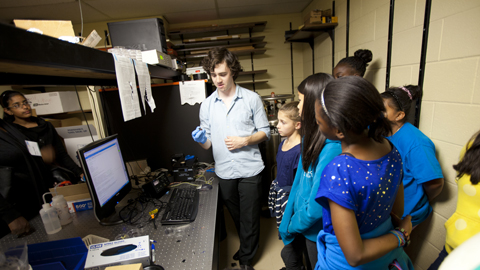
U of T student-instructors gathered Sept. 27 with some of their young charges from an innovative camp they helped run this past summer.
The Big Ideas: Creativity, Design and Innovation Camp is meant to develop the next generation of business-savvy, science-literate entrepreneurs.
The camp, which ran for the first time this summer, drew 450 youth from across southern Ontario to various provincial universities. About 100 of those campers came to U of T for an in-depth experience in applying engineering and technology insights to business challenges.
Campers learned how to put themselves in someone else’s shoes and identify what users of technology need, and how to prototype a project to meet those needs. Finally, they learned how to develop a business strategy for making ideas and products successful in the real world.
The Big Ideas camps were developed and run by the Institute for Competitiveness and Prosperity (ICP), the Rotman School of Management at the University of Toronto and Actua, a national charity that engages youth in STEM (science, technology, engineering and math).
The Sept. 27 gathering was a celebration of the camp’s success, and included the Honourable Gary Goodyear, Minister of State for FedDev Ontario, which funded the camp.
Micah Stickel, Chair, First Year and Senior Lecturer, Electrical and Computer Engineering, helped coordinate the three undergraduate and graduate student-instructors through U of T’s Engineering Outreach Office (ESOO). The ESOO team delivers a wide variety of interactive pre-university programs to engage youth in science, technology, engineering and math, year-round.
“Having students think creatively about designing solutions to problems is a great experience,” said Stickel. “And age 10 to 13 is a good time to get them thinking about the needs of others and how to best address these needs through innovative ideas.”
But the learning is a two-way street.
U of T’s ESOO model is meant to give students opportunities to serve as confident and enthusiastic role models, which enhances their abilities as teachers.
“As an instructor, I was able to develop my communication and facilitation skills, while gaining the satisfaction of inspiring youth in the field of business and entrepreneurship,” said third-year Mechanical Engineering student Michael Lucky (MechE 1T5).
As former Dean of the Rotman School of Management and current Chair of the ICP Professor Roger Martin noted, the question that sparked the camp was “can we teach a young audience, as young as 10, the core elements of innovation?”
“Now that it is up and running, and we see that these kids are fully engaged, we have an answer. Yes, of course we can,” said Martin.
The ICP is an independent, not-for-profit group that serves as the research arm of Ontario’s Task Force on Competitiveness, Productivity and Economic Progress. It is supported by the Ontario Ministry of Economic Development and Innovation.
The University of Toronto’s Engineering Student Outreach Office (ESOO) seeks to engage youth in STEM. ESOO designs and delivers a host of interactive pre-university programs taught by our undergraduate and graduate students. Outreach programs foster the engagement of pre-university students – particularly among underrepresented communities. The programs also play an important role in enhancing Engineering students’ abilities as teachers.