

Interface Biologics, Inc, the spin-off company begun by Professor Paul Santerre (IBBME), has received its second FDA clearance in less than a year for AngioDynamic’s BioFlo Port catheter. The catheter is made with Endexo technology, a biomaterial substance invented by the U of T spin-off company. Added to existing medical devices such as the BioFlo PICC Catheter and the BioFlo Port during the manufacturing process, the Endexo polymer prevents blood clots from accumulating on the surface of catheters or ports, devices implanted under the skin for long-term delivery of medication and access to a patient’s system.
During testing, the BioFlo Port catheter showed significant promise, with a 96% reduction in thrombus, or the accumulation of blood platelets, Santerre said.
The FDA announced its clearance of the BioFlo PICC (peripherally inserted) catheter with Endexo in mid-September 2012. The catheter’s performance was compelling, reducing the occurrence of blood clots by 48%.

The new port catheter could bring enormous savings to the healthcare system, Santerre said. An estimated $1 billion is lost annually in the U.S. healthcare system due to blood clots forming in ports and catheters. Up to 50,000 deaths per year are attributed to this issue, with cancer patients being the most susceptible population.
Now that the port catheter has received approval by the FDA, AngioDynamics plans to move it swiftly into the marketplace. AngioDynamics already holds an approximate 15% market share of the U.S. PICC catheter market worth an estimated $375 million.
Santerre, who has remained at Interface Biologics, Inc. as its Chief Scientific Officer, was encouraged by the announcement. “Having the FDA approve two products with the Endexo technology from Interface Biologic Inc, within one year provides an amazing opportunity for on-going applications and new innovations by this local young spin-off company from the University of Toronto,” he said.
Santerre is a Professor in the Faculty of Dentistry and the Institute of Biomaterials & Biomedical Engineering (IBBME), as well as IBBME’s former Director. He was the recipient of the 2013 NSERC Synergy Innovation award, which recognizes outstanding achievements in collaborations between universities and industries.

From September 27th to the 29th, the University of Toronto is presenting the first annual Toronto Science Festival, a three-day celebration of science that explores the theme of Life in the Universe.
On Friday, September 27th, the festival opens with alumna and Canadian astronaut Julie Payette (ECE MASc 9T0) delivering the keynote address.
Payette has flown aboard the Space Shuttles Discovery and Endeavour and worked onboard the International Space Station twice. Over the course of two missions, she has spent more than 25 days in Earth orbit and traveled over 16 million kilometres.
Born in Montreal, Payette received a Master of Applied Science, Computer Engineering, from U of T. She became the COO of the Montréal Science Centre in July 2013.
The Toronto Science Festival is about celebrating science. Why is this important to you?
Today, ours is a scientific and technological society, so having knowledge of science and technology is as fundamental as knowing how to read, write and count. We all need to know the fundamentals so that we can function well in society, contribute to it, and help solve today’s problems. And so having access to science is critical—through science centres, museums, universities, and through events like the festival.
Does your experience as an astronaut continue to inspire your work?
Part of being an astronaut is sharing the privilege of being in space and seeing the Earth from above. So I do a lot of work in raising awareness of our planet. And today, I do a lot of work with ArcticNet, a Networks of Centres of Excellence in Canada, at Université Laval, a consortium of 120 researchers studying the Arctic.
With the Earth warming and the Arctic warming faster than the rest of the globe, we will see great changes in the north. There is a huge potential for development in the Arctic and how we develop the region is critical. The consortium has been gathering data for a long time, and is very proactive in advising policy makers. Because without good data, you can’t make good decisions.
As one of the few humans to explore beyond our planet, what do you envision for the future of human exploration of space?
In our lifetime, we’ll see people return to the Moon; we will see people go to Mars. But the Universe is immense. The star closest to our Sun is just over four light-years away. If we traveled as fast as possible using today’s technology, it would take us some 400,000 years to get there. So you and I probably won’t see people go to another star—unless we discover something fundamentally new about the physics of our current means of travel.
[youtube https://www.youtube.com/watch?v=QQBBQ348724]
The festival’s theme of Life in the Universe includes extraterrestrial life. What are your thoughts on SETI, the Search for Extraterrestrial Intelligence?
What are the chances that somewhere out there, there are other forms of life? Probably good. What are the chances of detecting that life? I think, quite minute. But I think it’s very worth looking and I know we have astronomers at the U of T that are part of that search.
And it’s very presumptuous to think that we are alone, that we are “it.” Five hundred years ago, we thought we were the centre of the Universe and that everything revolved around us. We thought we were the absolute centre of the Universe, and today we know absolutely that we are not.
You spent three years at U of T. Are you looking forward to returning to the university and to Toronto?
I’m always very delighted to return to the city and the university. I had a very good experience in Toronto. I was very privileged because I was a Junior Fellow at Massey College. I sang with Tafelmusik Baroque Orchestra during my three years there. It was just a very, very good experience and I’m looking forward to the festival in September.
Chris Sasaki is a writer with U of T’s Dunlap Institute for Astronomy & Astrophysics.
See the original article on the U of T News website
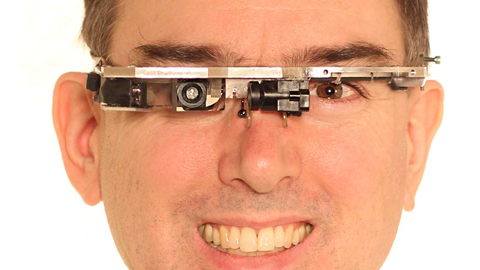
Two of the 12 speakers chosen to present at TEDxToronto this fall are U of T Engineering professors.
Professor Steve Mann (ECE), widely recognized as the father of wearable computing and inventor of the concept of ‘sousveillance’, will speak about his quest to “understand the world in more than one way” through technology. For more than 35 years Mann has been wearing some version of his EyeTap Digital Eye Glass system, an ever-evolving glasses-like set that allows him to ‘augmediate’ his reality, both adding and subtracting information. “Now I see through that glass into the future: a future where the boundaries between cyborg space and the real world will disappear,” he says.
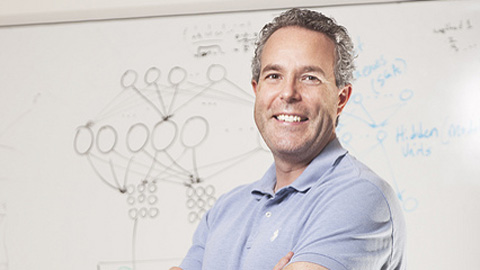
Professor Brendan Frey (ECE) unravels genetic mysteries using scientific and engineering tools such as machine learning. Frey and his group developed a computer program to simulate how cells use “genetic recipes” to create mind-boggling complexity from a limited number of genes. Says Frey, “Deciphering these genetic recipes may unlock unique aspects of the human brain and provide a way to detect and treat human genetic disease.” He has held the Canada Research Chair in Information Processing and Machine Learning since 2007.
TEDxToronto, now in its fifth year, is Canada’s largest TED event. TEDx is a program of local, self-organized events aimed to propagate the core TED concept of ‘ideas worth spreading’. The theme of this year’s TEDxToronto is ‘The Choices We Make’, after Jean Paul Sartre’s famous quote that “We are our choices.”
Each speaker is featured in a compelling preview video ahead of the conference opening Sept. 26, 2013 at the Royal Conservatory of Music’s Koerner Hall.
Delegates from around the world came to U of T August 18-23 to to hear about new advances in nanomaterials and photovoltaics at the 25th international conference on amorphous and nanocrystalline semiconductors.
This silver anniversary conference marks almost half a century of scientific and technological progress in this field which in the early years was dominated by chalcogenide glasses and hydrogenated amorphous silicon and today has grown to cover a multitude of disordered and nanocrystalline materials including oxides, organics, and more.
This biennial conference took place in the Medical Sciences Auditorium and the Bahen Centre for Information Technology. The conference began with the Mott Lecture (a keynote plenary presentation named after the Nobel Laureate Sir Neville Mott) followed by the 25th Anniversary Plenary Lectures. The Mott Lecture was delivered by Hideo Hosono of the Frontier Research Center, Tokyo Institute of Technology, Japan who spoke on Amorphous Electrides: A Novel Class of Oxide Semiconductors.
The week-long conference attracted over 250 delegates from around the world, providing an opportunity for scientific exchange, collegial discussions, and fostering a venue amenable to understanding, discovery and innovation vis-à-vis new materials and devices, said ECE and MSE Professor Nazir Kherani, local-chair and co-chair of the organizing committee. Delegates attended sessions covering such topics as new photovoltaic nanomaterials, nano- and microcrystalline silicon growth, medical imaging devices and organic/inorganic heterojunction solar cells.
“We were truly honoured to be able to host this conference at the University of Toronto and in particular we were delighted to have this ICANS conference come to Canada for the first time in nearly 50 years since its inception,” said Professor Safa Kasap, of the University of Saskatchewan and general chair of the organizing committee.
The Faculty of Applied Science & Engineering has leaped forward on the world stage once again. According to the 2013 Academic Ranking of World Universities (AWRU), which is prepared by Shanghai Jiao Tong University, U of T Engineering ranks 12th in the world, up from 13th in 2012.
This is the seventh consecutive year U of T Engineering has been named the top engineering school in Canada in the Engineering/Technology and Computer Sciences category.
“It is gratifying that U of T Engineering has once again been recognized as one of the very best universities in the world,” said Dean Cristina Amon. “This is a reflection of our research contributions, our vigorous pursuit of excellence and our impact in the field of engineering, in Canada and the world.”
The Engineering/Technology ranking is based on institutional measures in categories such as, highly cited researchers; papers indexed in science or social science citations; percentage of papers in the top 20 per cent of journals in the engineering field; and, total engineering-related research expenditures, with respect to the size of the institution.
Other Canadian universities ranked in the top 200 engineering schools include: the University of Waterloo (ranked 43rd), McGill University (51–75), University of Alberta (76–100), University of British Columbia (101–150), University of Montreal (ranked 101–150), Simon Fraser University (151-200) and University of Saskatchewan (151–200).
View the full list of rankings and U of T Engineering’s rankings performance over the last few years.
The fifth Conference on Quantum Information and Quantum Control launched Monday at the Bahen Centre for Information Technology. Jointly hosted by the Centre for Quantum Information and Quantum Control (CQIQC) and the Fields Institute, the conference unites physicists, mathematicians and engineers from around the world.
This year’s event is particularly significant as it coincides with the imminent 50th anniversary of the discovery of the Bell Inequality, a cornerstone in the field discovered by John Bell, whose insights have changed our view of reality.

The five-day conference aims to foster debate and encourage participants to expand their exposure to the field outside their particular area of expertise, says ECE Professor Amr Helmy, CQIQC chair and a member of the organizing committee. “There are no parallel sessions here—the idea is to get you to listen to talks you might not have heard before,” he says.
The prestigious John Stewart Bell Prize for contributions to the field of quantum mechanics will be presented to Michel Devoret and Robert Schoelkopf, both of Yale University, in a special session Thursday. The Bell Prize recognizes the researchers’ pioneering work in the field of quantum mechanics.
“Through their enormous contributions, Michel and Robert have set forth an optimum platform for the community to further explore, examine and exploit quantum mechanical effects, that is likely to fuel astounding advances in the field,” Helmy said. Devoret and Schoelkopf will deliver a public lecture on their trailblazing work.
The conference continues. Website:http://cqiqc.physics.utoronto.ca/conferences/cmf_event.2013-08-12.html