
According to the World Health Organization, nearly 600,000 perinatal deaths, and more than 100,000 maternal deaths are caused by iron deficiency each year.
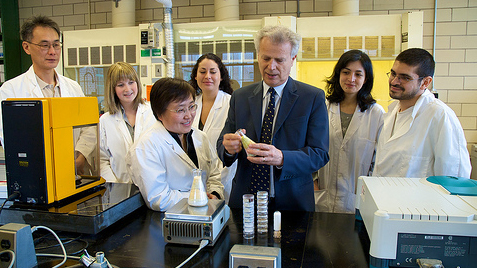
Professor Emeritus Levente Diosady (ChemE) believes these numbers can be reduced by creating an ‘iron brew,’ or in other words, developing iron-fortified tea leaves for consumption.
He was recently awarded a $250,000 grant for his research idea from the prestigious competition, Saving Lives at Birth: A Grand Challenge for Development. Professor Diosady was the lone Canadian among 22 grant recipients.
The international competition, now in its third year, calls on the brightest, most innovative minds across the globe to identify transformative prevention, as well as treatment approaches, for pregnant women and newborns in the developing world.
Professor Diosady was part of a team that was first to fortify salt with iodine, then later with iron. Speaking to The Globe and Mail, he said trying to fortify tea with iron was the next logical step.
“Tea is really consumed in South Asia by practically everybody, but the problem is the chemistry is much, much more difficult,” he said. “The last couple of years we’ve been working on the delivery system.”
According to Professor Diosady, the biggest challenge is overcoming a biomolecule in tea called tannin. When iron and tannin meet, a compound is formed that the body can’t absorb. The technology he has developed encapsulates the iron in a coating, preventing it from reacting with the tannin.
His goal is to get the encapulated iron to the intestines, where it can then be absorbed by the body. The Saving Lives at Birth grant will allow his research team to determine what kind of coating will work best with tea, as well as withstand hot water.
Professor Diosady hopes his research will be fully developed within the next five years.
To find out more, read about Professor Diosady’s research at The Globe and Mail and on the UK Government website.
U of T’s Centre for Quantum Information and Quantum Control (CQIQC) has announced Michel Devoret and Robert Schoelkopf, both of Yale University, as winners of the prestigious John Stewart Bell Prize for their enormous contributions to the field of quantum mechanics.
Quantum mechanics is the theory physicists believe describes everything in nature, according to ECE Professor Amr Helmy, director of the Centre. Yet, with predictions such as the fact that any small particle, an atom for example, can be in two places at the same time, the story it tells is so remote from our everyday experience that it looks — and is — deeply mysterious. Over the years, scientists have learned to live with these bizarre ideas and even harness them for practical purposes.
Devoret and Schoelkopf are honoured for pioneering experimental advances which have opened up a new regime for studies of fundamental quantum physics and the development of quantum technologies. By spearheading the development of ‘circuit quantum electrodynamics’ (cQED), they have extended the study of entanglement to the arena of solid-state ‘artificial atoms.’ In the past few years, this area of research has grown immensely, catching up quickly with decades of research in atom-based quantum optics, and the awardees have been responsible for much of the ground-breaking work, developing superconducting qubits and harnessing their interaction with microwave photons. Thanks to their efforts, such systems are now among the most promising candidates for practical, scalable, quantum information processing devices.

“Through their enormous contributions, Michel and Robert have set forth an optimum platform for the community to further explore, examine and exploit quantum mechanical effects, that is likely to fuel astounding advances in the field,” Helmy said.
The Bell Prize will be awarded at 1:30 p.m. on Thursday, Aug. 15, 2013, in a ceremony at the bi-annual conference hosted jointly at U of T by CQIQC and the Fields Institute for Research in Mathematical Sciences. Devoret and Schoelkopf will deliver a public lecture on their trailblazing work.
This year, the prize celebrates the imminent 50th anniversary of the discovery of the Bell Inequality, a cornerstone in the field discovered by John Bell, whose insights have changed our view of reality. The award recognizes major advances relating to the foundations of quantum mechanics and to the applications of these principles. This includes quantum information theory, quantum computation, quantum foundations, quantum cryptography and quantum control. The prize highlights the continuing rapid pace of theoretical and experimental research in these areas, both fundamental and applied, and consists of a medal, a certificate and $1,000 honorarium.
For more information on the Bell Prize and the CQICQ-Fields conference, visithttp://cqiqc.physics.utoronto.ca/bell_prize/home.html.
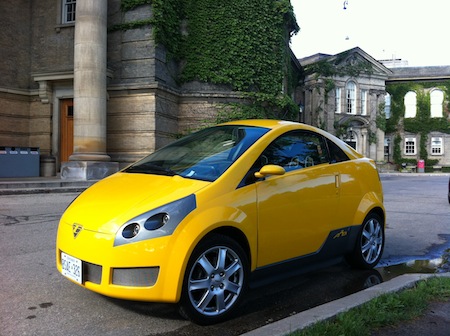
A2B, the world’s only completely Canadian-designed, Canadian-fabricated electric car, is rolling onto the U of T campus.
After collaborating over the past two years with the car’s manufacturer, Toronto Electric, Olivier Trescases, a professor in the Energy Group of The Edward S. Rogers Sr. Department of Electrical & Computer Engineering, struck a deal with the company’s president, Steve Dallas, to bring the one-of-a-kind vehicle to U of T.
“It’s definitely unique – nowhere in Canada will you find a vehicle like this,” says Trescases. “It’s exciting because this is far beyond what we could possibly build in-house. Even the chassis is custom-designed to house the massive 380-kilogram lithium battery pack. Aside from my own projects, I hope that this car gets our ECE students excited about electric mobility, in the same spirit of Team Blue Sky. We even have a rooftop solar installation that can be used to charge this EV and turn it into a true zero-emission vehicle.”
A2B was born out of Dallas’s drive to create a powerful and zippy electric car unlike anything the American auto-makers were producing. “I wanted to create something that was Canadian,” says Dallas. “Something that if you looked at it, you’d say, ‘What is that? It doesn’t look like a GM or a Ford.’”
Dallas and Trescases had worked together to analyze A2B’s energy consumption and battery performance in the past, and it became apparent to both what a rare testbed the car provided. Through their ongoing collaboration on battery management and hybrid energy storage systems, Trescases’ group gains unfettered access to all the vehicle’s hardware and software systems – an unprecedented opportunity for modification and testing. “It’s an open platform to us, and that’s what makes it incredibly valuable,” says Trescases.
Trescases has a few modifications to make before he and Dallas show the vehicle this fall at EVVÉ2013, Electric Mobility Canada’s annual conference and trade show in Gatineau, Quebec. In the future, he hopes to test out new power converters, control algorithms and a different battery management system – modifications that would be impossible on commercially available electric vehicles.
A2B is an extraordinary engineering platform, and it’s road-worthy and licensed. But how does it handle? “It’s a really fun car on the racetrack,” says Dallas. “It drives like a tank because it’s done with all race-car gear –completely custom-made everything.”
Watch out for Trescases and his students tearing around campus starting this summer – in the name of research, of course.

“When it doesn’t really exist anywhere you have to build your own,” said Ryan Fobel (IBBME PhD candidate), who is the mastermind behind the DropBot, a ‘digital microfluidics’ research tool that may just spark a revolution in biomedical engineering research. According to Associate Professor Aaron Wheeler, who holds the Canada Research Chair in Bioanalytical Chemistry at the Department of Chemistry, the Institute of Biomaterials & Biomedical Engineering (IBBME), and the Donnelly Centre for Cellular and Biomolecular Research (CCBR), microfluidics can be understood as a tiny “bit of plumbing that we can apply to lots of interesting things: diagnostics, chemical synthesis, tissue engineering, cell culture and analysis.” But it’s also a very new – and relatively untried – research field. “We’d been holding high-voltage probes with our hands, touching these to microchips we built ourselves. The results were not reproducible,” said Fobel. So he enlisted the help of his brother Christian, a recent PhD in Computer Science, to help him create a machine that the Wheeler lab has affectionately named “DropBot.” The machine digitally navigates droplets across a surface in much the same way one would navigate a game of Ms. Pacman. In fact, when viewed on the computer screen, the tiny microfluidic device bears an uncanny resemblance to a chessboard as drops are pushed from one square to the next by computer-controlled signals. According to Fobel, “Now we can be doing 10 things simultaneously, which allows you to scale up your productivity. We should get better results, too, as we’re removing a source of error from our experiments.” The machine works. There’s just one problem. “Digital microfluidics is still in an early stage,” said Professor Wheeler. “There are a few of us working very hard, demonstrating some interesting ideas. But for the technique to really explode and be widely used we need to get it in to the hands of more people. Until now we haven’t had a chance to see what it can really do,” he said. Rather than trying to sell his invention, Fobel, who built his machine largely on popular open-source technology such as the Arduino board, a major component in 3-D printing technology, decided to post the source code on the Internet as an open-source file. Anyone can download the blueprints, instructions and software for DropBot and build their own instrument. Users are encouraged to individualize their new Dropbots, and post their changes and results. For Fobel, it’s a move that makes sense. “This is a really good way to advance microfluidics research quickly,” he explained. “I’d love it if people would use it. I hope this is the way we can share this technology with people all over the world. Besides, if everybody out there was building their own system it would be like reinventing the wheel.” But, he added, there’s another reason for making the code public: “Nothing is ever finished with these things. You would always want to make the tools better and easier to use.” Already the move has been a popular one. Since publishing a paper on the DropBot in Applied Physics Letters last month, Fobel has been contacted by several researchers from as far away as Germany and California interested in building a DropBot prototype. According to Wheeler, Fobel is “unique” among his graduate students. “Ryan has transformed the capabilities of my lab,” he said. Fobel has been tapped to share his experiences with the DropBot at a conference on open-source hardware at MIT in the fall. In the meantime, Fobel has another DIY project on tap: he and his lab mates are building their own 3D printer, which will allow them to print parts for the next DropBot prototype.
Two U of T Engineering graduate students were nationally recognized at the annual AUTO21 Conference in Toronto recently for contributions to Canadian automotive research and development.
The students, Phillip Mireault (MechE MASc 1T4) and Manuel Ramos (MechE MASc 1T4) were awarded first place in the Toyota Canada-AUTO21 HQP Poster Competition, taking home a $4,500 prize. The competition is open to student researchers within the AUTO21 Network of Centres of Excellence program. Nearly 60 teams took part in the competition. This is the second year in a row that Mechanical Engineering graduate students have won the competition.
The University of Toronto team contributes to the Mitigating GDI Particulate Emissions Through Ethanol Blends project, under the supervision of Professor James Wallace (MIE).
“Toyota is pleased to support the HQP Poster Competition as it recognizes the next generation of leaders in automotive engineering,” said Sandy Di Felice, Director of External Affairs, Toyota Canada Inc. “Working with AUTO21 allows Toyota insight into the collaborative research project opportunities that advance Canada’s contribution to the domestic and global auto industry.”
“Our Highly Qualified People (HQP) or student researchers are among some of Canada’s top minds and future leaders,” said Peter Frise, AUTO21 Scientific Director and CEO. “Working on collaborative projects with industry, each student demonstrates cutting-edge knowledge and expertise as they contribute to a sustainable automotive industry for Canada.”
The annual HQP Poster Competition boasts a total prize purse of approximately $15,000. Sixteen semi-finalist teams were selected from the initial pool of entrants, with each team member receiving a $50 bookstore voucher. The semi-finalists provided an oral defence of their research poster and the final winners were selected upon this evaluation. The U of T Engineering winners received a cash prize to be divided amongst the team members. Judges include senior industry, government and R&D experts.
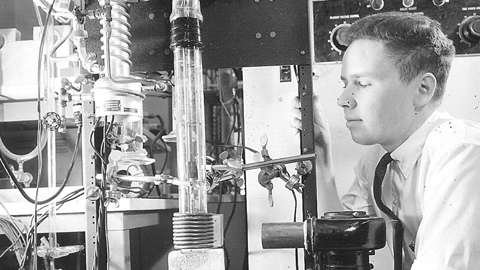
Professor Emeritus John W. Rutter (EngPhys 4T9, MMS PhD 5T2) passed away peacefully at home on June 18, 2013 at the age of 88.
Professor Rutter graduated from U of T Engineering Physics (now Engineering Science) in 1949 and subsequently completed his PhD in Metallurgical Engineering (now Materials Science & Engineering) in 1952 under the supervision of the late Professor Bruce Chalmers.
After completing a post-doctoral fellowship at U of T in 1956, Professor Rutter accepted a research and development position at General Electric in Schenectady, New York, until he returned to the University of Toronto in 1967 as a professor in the Department of Metallurgy & Materials Science. He retired in 1990 and took on the title of ‘Professor Emeritus’ but continued to conduct research and author papers until recently.
In his career, Professor Rutter made significant contributions to the understanding of solidification microstructures and was a renowned expert in lead-free eutectic soldering alloys. He mentored numerous students in his tenure at U of T Engineering, published volumes of research papers, and left long-lasting memories among those he mentored and collaborated with.
Dr. Mary Ruggiero (EngSci 7T7, MMS MASc 7T9, PhD 8T3) was one of his former graduate students. She will always remember Professor Rutter for his selfless, caring nature, his humanity and his dedication to his students.
“I was fortunate and privileged to be [one of his] students, and over time, his mentorship turned into friendship,” said Ruggiero.
“Professor Rutter was always generous with his time and expertise. Even after completing my graduate studies and working in industrial R&D, I often called on him to discuss technical issues and together, we published a number of papers on solidification of eutectic solder alloys,” she said. “It was a privilege to know him and have him as a friend for so many years and I will miss him.”