

What’s smarter than the Internet?
It just might be the network demonstrated at the SAVI testbed workshop and annual general meeting, held Thursday and Friday in the Bahen Centre at U of T.
“Keep in mind, the Internet itself was a testbed 50 years ago,” said Hadi Bannazadeh, SAVI’s testbed platform architect. “In 20 to 30 years, one of these testbeds could become the next Internet—that’s what we’re competing for.”
Smart Applications on Virtual Infrastructure, or SAVI, is an NSERC Strategic Network that includes nine universities, more than 20 industry partners, research and education (R&E) networks, and high-performance computing (HPC) centres.
SAVI’s distinguishing feature is the breadth of its scope. The national network is pioneering an infrastructure for connecting things and services that haven’t even been invented yet — everything from SmartGrids for more efficient power distribution and consumption, to e-health information, to telecommunications applications.
“We’re not trying to do this in isolation, but as part of the community,” said SAVI’s Scientific Director Professor Alberto Leon-Garcia (ECE). “We’re focused on the future — on developing infrastructure technologies so as to create what we call an open marketplace.”
Now completing its second year, SAVI is deploying the first phase of its testbed network and teaching all its partners how to use it. It has converged clusters of heterogenous resources, or ‘nodes’, at University of Toronto, York, Waterloo, McGill and University of Victoria. Carleton is expected to join soon.
At the annual general meeting, researchers and students from 10 universities across Canada presented more than 45 posters and demonstrations on SAVI’s key themes: smart applications, extended cloud computing, integrated wireless/optical access and smart edges. The term ‘smart edge’ refers to aggregated data centres closer to where end users need their processing power, providing a local boost to massive remote cloud servers.
Program highlights included keynote addresses from Dr. Dongmyun Lee, executive vice president of Korea Telecom’s Infrastructure Research Lab; Dr. Chip Elliott, PI and project director of the United States’s national testbed, GENI; Professor Tho Le-Ngoc of McGill; as well as Leon-Garcia, SAVI Scientific Advisor David Mann and Zouheir Mansourati, vice president of technology strategy at TELUS.
Learn more on the SAVI website: http://www.savinetwork.ca/
This story was originally posted on December 7, 2012. Updated on July 4, 2013.
Electrical and Computer Engineering Professor Edward (Ted) Sargent is the winner of the 2012 Steacie Prize. The U of T community – including Dean Cristina Amon, Peter Lewis, Associate Vice-President, Global Research Partnerships, and Dr. John Smol, Chairman of the Board of Trustees of the E.W.R. Steacie Memorial Fund – celebrated his award at a reception on July 4, 2013.
Not only is Professor Sargent the fourth consecutive University of Toronto recipient of the prestigious award, but he’s ensuring the award stays in the family: last year’s recipient was his wife, U of T Pharmacy Professor Shana Kelley.
The Steacie Prize is awarded each year to one person 40 years of age or less who has made notable contributions to research in Canada. The Prize is administered by the Trustees of the E.W.R. Steacie Memorial Fund, a private foundation dedicated to the advancement of science and engineering in Canada.
Professor Sargent, who is also the Vice-Dean, Research, of the Faculty of Applied Science & Engineering, is widely known as the inventor of full-spectrum solution-processed solar cells, a new class of solar energy harvesting devices based on colloidal quantum dots (CQD). He also holds the world record for the highest-performing solar cell in this promising new class of materials. Professor Sargent has also made fundamental contributions to understanding how electronic transport proceeds in CQD solids and to advancing the materials chemistry of novel nanomaterials.
Professor Sargent has been named one of the ‘Scientific American 50’, one of ‘Canada’s Top 40 Under 40’ and one of the world’s 100 top young innovators by MIT Technology Review. He is also a Fellow of the American Association for the Advancement of Science and the Institute of Electrical Electronics Engineers.
His publications have been cited over 6,000 times. In the past six years, he has authored 18 papers in some of the world’s most prestigious journals, includingScience, Nature, Nature Materials, Nature Chemistry, Nature Nanotechnology andNature Photonics. His research has also been featured in The Economist, The New York Times, National Geographic, The Wall Street Journal and The Financial Times. Professor Sargent’s book The Dance of Molecules: How Nanotechnology is Changing Our Lives (Penguin 2005) has been translated into French, Spanish, Italian, Korean and Arabic. He is a KAUST Investigator.
“This award celebrates the remarkable advances made by a team of incredibly skilled, and deeply dedicated, graduate students, post-doctoral fellows, undergraduate students, research associates, and research engineers,” Sargent said. “Many of these talented people have since gone on to start their own research groups and companies, and many continue to push the frontiers of nanotechnology and its applications, both at U of T and in the wider world,” he said.
“I wholeheartedly congratulate Ted Sargent on receiving this prestigious award, and I thank the selection committee of the Steacie Prize,” said U of T Engineering Dean Cristina Amon. “Ted is a brilliant researcher. The work of Ted and his team in solar cell technology is rapidly moving us toward the reality of an efficient and economical source of solar energy.”
The award has been won 18 times by U of T researchers since its inception in 1964. Last year, Professor Kelley won the award for her work on development of nanomaterial-based detection systems that can track minuscule quantities of biomolecular analytes.
A team of Toronto-based researchers may be one step closer to a ‘recipe’ for large-scale production of stem cells for use in research and therapy.
Induced pluripotent stem cells (iPSCs) can be of great value for medical research because they can flexibly develop into many different types of cells. However, producing these cells is challenging because the proteins that control their generation are largely unknown.
But researchers from the University of Toronto, the Hospital for Sick Children and Mount Sinai Hospital (with colleagues from the United States and Portugal) say they have identified certain proteins that play a key role in controlling pluripotency, which may mean a potential breakthrough in producing these cells.
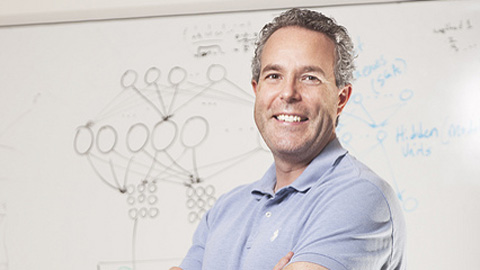
The findings were recently published in Nature. One of the authors is Professor Brendan Frey (ECE). He said the researchers discovered the proteins using the splicing code developed a few years ago by a team led by he and U of T Donnelly Centre researcher Benjamin Blencowe. “The mechanisms that control embryonic stem cell pluripotency have remained a mystery for some time. However, what Dr. Blencowe and the research team found is that the proteins identified by our splicing code can activate or deactivate stem cell pluripotency,” Frey said.
When asked why the identification of these proteins is important, Frey gave the following analogy: “Suppose you’ve tasted many wonderful gourmet dishes, but you have absolutely no idea what’s needed to make them. Then, one day, you discover that there’s something called a ‘measuring cup’ that is used by all of the gourmet chefs. Now you understand something important about how dishes are prepared, and you also know about a ‘control knob’ that can be turned in order to make different dishes, just as adjusting the amount of butter and flour will give a different kind of pastry.”
And while a complete recipe for producing iPSCs may not be available yet, Frey said, it’s beginning to look more likely.
The Nature Letter can be found here: http://www.nature.com/nature/journal/v498/n7453/full/nature12270.html

ECE PhD student Kevin Banovic’s poster was one of the top 12 posters from around the world in the Broadcom Foundation University Research Competition last month.
Banovic’s poster, “Mixed-Signal Architectures for Spectrum Sensing,” was presented at a poster session at Broadcom’s annual Technical Conference June 5-6. The finalists shared insights into their engineering research and how its future application can improve lives and contribute to society. He received a cash prize of $1,000 in recognition of the quality of his presentation.
A PhD student in the electronics group, Banovic is studying how to provide low power and direct spectrum-estimation solutions that can be used to improve the spectrum efficiency.
“I was introduced to cognitive radio as a possible research area a few years back and spectrum sensing is the enabling technology,” he said. “Cognitive radio is a method to increase spectrum efficiency by identifying unused segments of the licensed frequency spectrum that can be utilized for data transmission on a non-interfering basis with licensed signals. My research focus is on mixed-signal architectures for spectrum sensing applications including cognitive radio application, interference detection and buit-in test applications.”
The Broadcom competition celebrates academic excellence and social awareness among students who perform extraordinary academic research, said Paula Golden, Executive Director of the Broadcom Foundation. “The intellectual power of the finalists, who come from universities throughout the world, is profound and we are honored to have them compete on the eve of Broadcom’s Technical Conference.”
Broadcom Foundation’s mission is to advance education in science, technology, engineering and mathematics (STEM) by funding research, recognizing scholarship and increasing opportunity.

Two U of T Engineering students have been named the 2013 winners of the Personal Scholarship, a $5,000 award offered by the Ontario Society of Professional Engineers (OSPE) and The Personal insurance company. Stefan Hadjis (EngSci 1T3 + PEY) and Lorne Mlotek (CivE 1T3) submitted the winning applications for the undergraduate scholarships, competing against other Ontario Engineering students entering or completing their fourth year of study in 2013.
The Personal Scholarship includes four awards, two each for undergraduates and graduates. The scholarship recognizes students with strong academic performance who also demonstrate creative thinking, relationship building, leadership qualities and a commitment to serving the engineering community and the public. In their applications, students were asked to share their future plans, extracurricular involvement, and how they intend to contribute to the engineering profession after graduation.
Hadjis’ impressive accomplishments to date include developing a prostate cancer treatment system, which uses high-intensity ultrasound, and working with The Edward S. Rogers Sr. Department of Electrical & Computer Engineering on a Computer-Aided Design tool for the growing technology of Field Programmable Gate Arrays (FPGA). He also travelled to California to present the work at an international symposium in 2012, where he represented U of T and was the symposium’s lone undergraduate speaker. Hadjis intends to continue his research at the graduate level in order to explore new fields and applications for emerging technologies. He eventually plans to apply his research towards starting his own technology company.
“I’m honoured to receive the Personal Scholarship and motivated to continue working towards a level of professionalism and excellence required to be an engineering leader who envisions the technologies of tomorrow,” he said. “I feel grateful to attend the University of Toronto and for the level of enthusiasm and commitment of the engineering Faculty.”
Throughout the past four years, Mlotek has demonstrated his dedication to making an impact on the engineering profession through his participation in co-curricular activities which foster leadership, volunteerism, social equity and environmental sustainability. He has also already begun to make contributions towards the engineering profession and the public by founding LeadingGREEN, a non-profit advocacy organization and education provider for green building certification. LeadingGREEN currently serves more than 500 students and professionals throughout North America.
Lorne intends to put the scholarship towards furthering LeadingGREEN and bringing his affordable LEED training course on a tour across the U.S. in the coming months. He aims to teach the course at over 50 schools between September 2013 and May 2014. Asked what winning the Personal Scholarship means to him, Mlotek said, “The award signifies the profession’s growing recognition outside a strictly technical profession. I believe this is the direction the industry must continue towards in order for engineers to reach their full potential.”
U of T Engineering purple was prominent among the rainbow of colours on display at the 33rd annual Toronto Pride parade on June 30, as Engineering students, faculty, staff and supporters – including the Lady Godiva Memorial Bnad (sic) – proudly marched behind their float.
The U of T Engineering student organization, LGBTQ and Allies in Science & Engineering (LGBTQase), joined forces with the Blue and Gold Committee (the Engineering Society’s spirit committee) to create the float. LGBTQase also worked with the University of Toronto’s Sexual and Gender Diversity Office (SGDO) to organize campus-wide celebrations in the days leading up to the annual parade.
The Blue and Gold committee continued the engineering tradition of encouraging people to dye themselves purple before the march, while LGBTQase organized tie-dying of t-shirts in rainbow colours at its two ‘Tie-Dye ’till you Drop’ events.
The float, which represented Finn and Lady Rainicorn, characters from the popular animated TV show Adventure Time, was a communal effort. The idea for the float was brainstormed and voted on by LGBTQase and Blue and Gold Committee members in various executive meetings. Both organizations then invited the engineering and U of T community at large to participate in the building of the float.
“The SGDO, Blue and Gold Committee, Lady Godiva Memorial Bnad, faculty members in Engineering, countless students and individuals just wanting to get involved all deserve a gigantic thank you for their efforts, as do the members and executive team at LGBTQase and Blue and Gold who planned and attended our events,” said LGBTQase Co-president Teresa Hulinska. “Perhaps most importantly, we could not have done half of what we did without the incredible financial support from the Alumni Association. This was definitely a community effort and everyone’s vision and contribution made this pride phenomenal.”
Founded in September 2011, this is LGBTQase’s second year participating in Pride festivities. It hopes to increase its participation in Pride events as well as other U of T and city events throughout the year, Hulinska said.
LGBTQase enjoys support from other campus student groups and continues to collaborate with them to increase the presence of engineering and science communities in the LGBTQ scene and vice versa. “There are so many ways to spread love, acceptance, awareness and representation of LGBTTIQQ2SAA people and issues, and Pride is a time to do all of these things in a very celebratory, positive and highly visual way,” Hulinska said. “Most of all, this is really a chance to allow people who want to be a part of this to participate, and we should make sure we are extending this opportunity to as many people as possible.”