

aerodynamic design and improved vehicle dynamics systems, weighing about
20 per cent less than its predecessor.
Intrepid U of T students unveiled a new solar vehicle they hope will carry them more than 3,000 kilometres across the harsh Australian outback. The car, called B-7, hit the track for the first time at a ceremony at Varsity Stadium on June 28.
U of T’s Blue Sky Solar Racing team has been working on the car for more than 18 months in preparation for their ultimate goal: a top-10 finish in the 2013 World Solar Challenge this fall.
Built and driven entirely by students, B-7 features the latest advancements in photovoltaic technologies, a brand new aerodynamic design and improved vehicle dynamics systems, weighing about 20 per cent less than its predecessor. Due to drastic changes in race regulations this year, B-7 is U of T’s first single-seater, four-wheeled solar car with an upright driver-seating position. At the last race in 2011, U of T placed 24 of 37 teams with their vehicle Azure.
“I’ve never been in the race before, and I don’t know what it will feel like,” said Zhe Gong (ElecE 1T4), Blue Sky’s electrical team lead. “Right now it feels pretty good.” Gong said the team spent the past five days preparing the solar array for installation, and they “pulled two all-nighters to install the panels.”

Kamran Behdinan (who was one of the team’s faculty advisors), Susan McCahan,
Vice-Dean, Undergraduate, and Jean Zu, MIE Chair.
The World Solar Challenge begins October 6, 2013 in Darwin, in Australia’s Northern Territory, and snakes south across the continent, ending in Adelaide. Once the team reaches Australia, they will concentrate on testing the car and getting through the qualification rounds. About 50 teams from around the world are expected to participate.
“The Faculty is proud to support the Blue Sky project,” said Cristina Amon, Dean, Faculty of Applied Science & Engineering. “But more than that, I’m extremely proud of the students’ commitment, dedication and achievements, and look forward to cheering the team as it competes with the best in the world in October ‘down under.’”
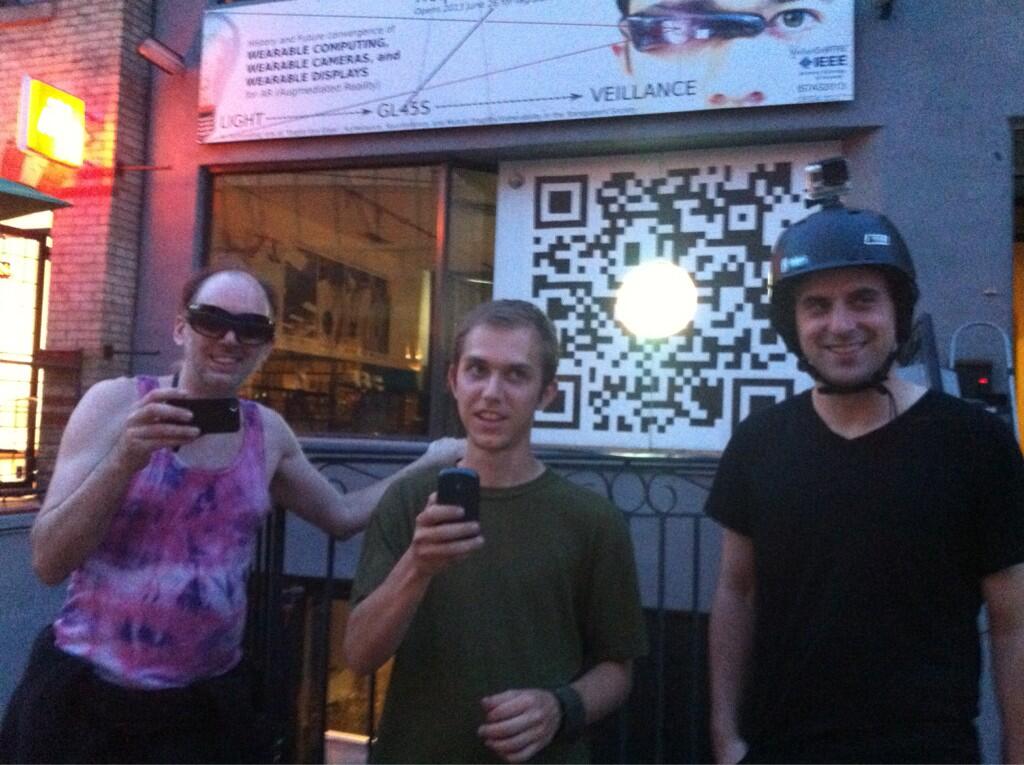
Future-minded thinkers from around the globe descended on the University of Toronto Thursday as the International Symposium on Technology & Society, or ISTAS 2013, launched its three-day program on the theme Smart World: People as Sensors.
Attendees received a warm welcome from Laura Jacob, president of the IEEE’s Society on Social Implications of Technology, and Professor Farid Najm, chair of The Edward S. Rogers Sr. Department of Electrical & Computer Engineering. Conference Organizing Chair Ryan Janzen, an ECE PhD student in Professor Steve Mann’s EyeTap Laboratory, officially opened the event.
Mann, often called ‘the father of wearable computing,’ delivered the day’s first keynote on the opposing concepts of surveillance (to watch from above) and sousveillance (to watch from below). “Surveillance and sousveillance is kind of 21st century, us vs. them.” said Mann. “Sousveillance is the veillance of integrity, of honesty.”
Mann proposed extracting the value-neutral term, veillance, to describe our new watchful society — a world in which everything, and everyone, is equipped with cameras and monitoring devices.
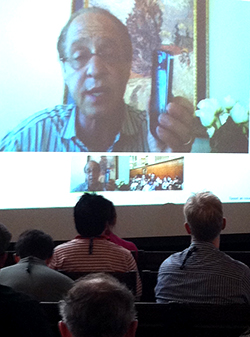
Ray Kurzweil, renowned futurist, author, inventor and now director of engineering at Google, delivered his keynote in a Google+ ‘hangout’ session from his office in California. Kurzweil spoke of a disconnect between how the human mind conceives of progress, and the pace at which society is actually progressing.
“Our intuition about the future is linear, not exponential,” said Kurzweil. We predict the future in direct proportion to the past, and “anticipate things will change at a constant pace.”
Not so, he said — our technological capability is growing exponentially, even as its cost decreases exponentially.
“Ultimately [computers] will go inside our brains and become gateways for our neocortical structures into the cloud,” he said. “We will create a brain to overcome the greatest challenges of humanity.”
The ‘father of artificial intelligence,’ Marvin Minsky, delivered the morning’s final keynote. “2001 is past, but where is Hal?” he asked in his presentation. “Soon we’ll need machines that use more commonsense knowledge and reasoning.”
Minsky argued that soon machines will know the millions of tiny facts adult brains accumulate to let them navigate the world. “When we reach the singularity, where do we go from there?” he asked, referring to the time at which some people think that machine learning will overtake human capability. “Once someone knows a lot, what’s the point of having more than one of that person or thing?” said Minsky. “What’s the future of the future, you’re asking? I have no idea.”
The future of the future is exactly what the diverse group in the room had come to discuss. ISTAS’13 continues Friday and Saturday; read more from the conference at http://ieeexplore.ieee.org/xpl/mostRecentIssue.jsp?punumber=6596466.

It’s an electrifying step forward for cardiac research.
University of Toronto researchers have announced a new method of maturing human heart cells that simulates the natural growth environment of heart cells while applying electrical pulses to mimic the heart rate of fetal humans. The discovery, reported this week in the scientific journal Nature Methods, offers cardiac researchers a fast and reliable way to create mature human cardiac patches in a range of sizes.
“You cannot obtain human cardiomyocytes (heart cells) from human patients,” explains Milica Radisic (IBBME, ChemE), Canada Research Chair in Functional Cardiovascular Tissue Engineering and Associate Professor. Because human heart cells – integral for studying the efficacy of cardiac drugs, for instance – do not naturally proliferate in large numbers, researchers have been using heart cells derived from reprogrammed human-induced pluripotent stem cells (hiPSC’s), which tend to be too immature to use effectively in research or transplantation.
“The question is: if you want to test drugs or treat adult patients, do you want to use cells that look like and function like fetal cardiomyocytes?” asks Radisic, who was named a ‘Top Innovator Under 35’ by MIT Technology Review and more recently was awarded the Order of Ontario and the Young Engineers of Canada 2012 Achievement Award. “Can we mature these cells to become more like adult cells?”

In response to the challenge, Radisic and her team, which includes graduate student Jason Miklas and Dr. Sara Nunes, a scientist at the University Health Network (UHN) in Toronto, created a ‘biowire’. Stem-cell derived human cardiomyocytes are seeded along a silk suture typical to medical applications. The suture allows the cells to grow along its length, close to their natural growth pattern.
Like a scene lifted from Frankenstein, the cells are then treated to cycles of electric pulses, like a mild version of a pacemaker, which have been shown to stimulate the cells to increase in size, connect and beat like a real heart tissue.
But the key to successfully and rapidly maturing the cells turns out to be the way the pulses are applied. Mimicking the conditions that occur naturally in cardiac biological development – in essence, simulating the way fetal heart rates escalates before birth, the team ramped up the rate at which the cells were being stimulated, from zero to 180 and then 360 beats per minute.
“We found that pushing the cells to their limits over the course of a week derived the best effect,” says Radisic.
Grown on sutures that can be sewn directly into a patient, the biowires are designed to be fully transplantable. The use of biodegradable sutures, important in surgical patches that will remain in the body, is also a viable option.
Miklas says the research has practical implications for health care. “With this discovery we can reduce costs on the healthcare system by creating more accurate drug screening.”
The development takes cardiac research just one step closer to viable cardiac patches, Nunes, a cardiac and a vascularization specialist, says. “One of the greatest challenges of transplanting these patches is getting the cells to survive, and for that they need the blood vessels. Our next challenge is to put the vascularization together with cardiac cells.”
Radisic, who calls the new method a “game changer,” is quick to point out just how far the field has come in a very short time.
“In 2006 science saw the first derivation of induced pluripotent stem cells from mice,” she says. “Now we can turn stem cells into cardiac cells and make relatively mature tissue from human samples, without ethical concerns.”
The paper, “Biowire: a platform for maturation of human pluripotent stem cell–derived cardiomyocytes,” can be found at www.nature.com/nmeth/journal/vaop/ncurrent/full/nmeth.2524.html

U of T Engineering’s solar car team, Blue Sky Solar Racing, is about to pull the wraps off B-7, its entry in the 2013 World Solar Challenge – a grueling 3,000-kilometre race across Australia.
B-7 will be unveiled at Varsity Stadium on June 28. The race takes place in October, and the U of T car has been under construction for the past 18 months by student volunteers representing every U of T Engineering department as well as other U of T Faculties.
The biggest motivation for the team members has been to see the car built. “This is the kind of experience you cannot find in the classroom, and we find it very rewarding,” said Tiffany Hu (MechE 1T4), who heads Blue Sky Solar’s advancement team.
The interdisciplinary nature of the project allows for students from a variety of fields to work towards a common goal. Blue Sky began in 1996, and over the years, team alumni have continued to mentor new team members, sharing their expertise and experience for optimal results.
Unlike previous Blue Sky cars, the B-7 is a single-seater, four-wheeled solar car with an upright driving position. It features the latest photovoltaic technologies and aerodynamic design, and is 20 per cent lighter than its predecessors.
The team’s biggest challenge is fundraising, Hu said. Although Blue Sky Solar has more than 100 sponsors, the loss of student levy funds in 2012 means the team had to complete the construction of B-7 in half the time that previous versions of the car had available. The additional challenge of scheduling construction had to be resolved by careful planning and mobilization of resources involving all team members, Hu said.
The club’s faculty advisors, Professors Kamran Behdinan (MIE) and Olivier Trescases (ECE), have also provided vital support and advice, she said.
Fundraising is ongoing, and Blue Sky Solar welcomes new sponsors and venues for funding. “How much we can do with the project depends on the resources we have available,” Hu explained.
Once the team reaches Australia, they will concentrate on testing the car and getting through the qualification rounds. The race itself stars in Darwin, in northern Australia, and crosses the continent from north to south, ending in Adelaide. About 50 teams from around the world are expected to participate, and Blue Sky’s goal is to place among the top five, which would be a significant achievement for one of the few entirely-student teams in the competition, said Hu.
U of T Engineering Dean Cristina Amon will help the Blue Sky Solar team unveil B-7 on Friday, June 28 at Varsity Stadium. Everyone is welcome to come out and see the car in action. Registration begins at 12:30 pm, and the car will be unveiled at 1:20 pm, followed by a demonstration drive and a meet and greet with team members. For more information, see blueskysolar.utoronto.ca.

Among them are 13 members of the U of T Engineering community.
Thirteen members of the U of T Engineering community were inducted into the Canadian Academy of Engineering (CAE) on June 20, during the CAE Annual Meeting in Montreal.
Faculty members honoured were:
- Yu-Ling Cheng (ChemE);
- Doug Hooton (CivE);
- Andrew Jardine (MIE);
- Mark Kortschot (ChemE);
- Alberto Leon-Garcia (ECE); and,
- Andreas Mandelis (MIE).
Alumni inducted were:
- William (Bill) Buckley (MechE 7T1);
- Tongwen Chen (ElecE MASc 8T9, PhD 9T1);
- Thomas Darcie (UTIAS MASc 7T9, PhD 8T3),
- Savvas Hatzikiriakos (ChemE MASc 8T8);
- Suong Van Hoa (MechE MASc 7T3, PhD 7T6);
- Chris Twigge-Molecey (MechE MASc 6T9, PhD 7T2); and,
- James Wilcox (MechE 5T9)
The U of T engineers are among the 48 new Fellows elected by the Academy. The CAE comprises the country’s most accomplished engineers, who have demonstrated their dedication to the application of science and engineering principles in the interests of Canada and its enterprises.
Faculty Members Honoured
Professor Cheng serves as Director of the Centre for Global Engineering and was recently named Distinguished Professor in Global Engineering. Among her many research and educational initiatives focused on the developing world, she is leading a project funded by the Bill & Melinda Gates Foundation to reinvent the toilet to provide people with affordable sanitation that doesn’t rely on running water, sewer systems or electricity.
Professor Hooton holds the NSERC/CAC Senior Industrial Research Chair in Concrete Durability and Sustainability. Well known as an expert on cementitious materials and concrete, he has been active in more than 40 standards, technical and code committees. Several new test methods and building code changes related to concrete durability have been developed or championed by him based on his research.
Professor Emeritus Jardine is an internationally recognized expert in engineering asset management whose research, teaching and seven textbooks have influenced generations of reliability engineers and industry best practices around the world. While Chair of the Department of Industrial Engineering, he spearheaded its development into a world leader in academic/industrial collaborations.
Professor Kortschot’s research in fibre composites and paper has resulted in 60 refereed journal publications and his engineering design work has resulted in four patents. A successful entrepreneur, he co-founded Légère Reeds Ltd. and invented the Sole Skate. Currently serving as Chair of the Division of Engineering Science, Professor Kortschot received the Alan Blizzard Award for his role in creating the Engineering Strategies and Practice course.
Professor Leon-Garcia is the Distinguished Professor in Application Platforms and Smart Infrastructure at the University of Toronto. He has conducted groundbreaking research in the areas of switch architecture and traffic management, the impact of which has been felt throughout the telecommunications industry. He has also spearheaded the creation of several unique educational programs in network engineering.
A pioneer in several fields related to photonic engineering, Professor Mandelis holds the Canada Research Chair in in Diffusion-Wave Sciences and Technologies. He created the field of dental photonic engineering through his development of a thermophotonic imaging technology to detect dental caries. Professor Mandelis is also the creator of Photocarrier Radiometry, a technique for detecting defects in semiconductor-based devices.
U of T Engineering Alumni Inducted
Bill Buckley is President and CEO of ShawCor Ltd. His leadership has resulted in the growth of the company from a small, Canadian-focused pipe coating business into a global leader in the energy services industry. Buckley has been the driving force behind many of the programs responsible for ShawCor’s success, including the ShawCor Manufacturing System and other programs based on best practices in governance and business processes.
Tongwen Chen is an international authority on computer controlled systems and control over networks. He has authored more than 100 journal articles and is one of the top 1 per cent most highly cited researchers in his field. He has led three NSERC Strategic Projects focusing on better control and monitoring of various industrial processes. Dr. Chen has trained more than 50 graduate students and post-doctoral fellows.
Thomas Darcie’s research accomplishments include laying the foundation for fibre-optic access systems that are used in all modern cable television and telecommunications companies worldwide. At AT&T/Bell Labs, he has led innovation in technologies in widespread use in fibre-optic, photonic, Wi-Fi and 3G wireless systems. A successful entrepreneur, he has co-founded five companies.
One of the world’s most accomplished experimental rheologists, Savvas Hatzikiriakos is particularly known as a pioneer in the areas of polymer rheology, processing and surface science. He has partnered with major companies such as ExxonMobil, DuPont and Chevron, and two new companies have been created based on his research. Dr. Hatzikiriakos has served as President of the Canadian Society of Rheology.
Suong Van Hoa has made tremendous contributions to the advancement of knowledge and the application of that knowledge in the field of composite materials and structures. He has developed novel composites and structures which demonstrate outstanding performance in a number of applications. Dr. Hoa has worked closely with several aerospace companies to advance the use of composite materials in that industry.
Throughout his career at Hatch, Chris Twigge-Molecy has been a leader in the minerals and metallurgical field. His innovations include developing a new way to maximize arsenic elimination when processing gold ores. He has contributed widely to the profession through his leadership in the Canadian Institute of Mining Metallurgy and Petroleum, the Canadian Mining Innovation Council and the China-Canada Business Council.
From platforms at companies such as Procter & Gamble and St. Lawrence Cement, James Wilcox has led innovations in computer-controlled manufacturing, including motor vehicle production line techniques adopted across North and South America. As Warden of Camp 1, he is instilling a sense of heritage and tradition in young engineers receiving their Iron Rings. Mr. Wilcox was inducted into the Engineering Hall of Distinction in 2002.
“The induction of so many U of T engineers into the CAE is both an honour and a testament to our position as Canada’s leading engineering school,” said Cristina Amon, Dean, Faculty of Applied Science & Engineering. “The citations for these new Fellows illustrate the depth and breadth of the achievements of our faculty and alumni.”
June 19 holds a lot of significance for Lorne Mlotek (CivE 1T3). On the back of his watch, once owned by his grandfather, it is inscribed ‘June 19, 1955.’ It’s also the date of his birthday. And now, it’s the date he proudly graduated from U of T Engineering.
“I’m really happy to be graduating. I was terrified four years ago, because I knew I was going into the best engineering school with the best engineering students – and I was right. But I had a great time and I made it here today,” said Mlotek, who is now focused on creating his very own start-up company.
Mlotek is one of the Faculty’s approximately 1,500 newest alumni who celebrated the end of their academic career – and new beginnings – during two ceremonies at Convocation Hall yesterday. Among them, 932 undergraduates and 569 graduate students earned degrees (261 receiving MEng degrees, 203 obtaining MASc degrees and 105 earning PhD degrees).
“Today we celebrate the tremendous accomplishments of the U of T Engineering class of 2013 …You are here today because you rose to the challenge. You met and you exceeded our expectations,” said Dean Cristina Amon in her Convocation address.

She also spoke about the impact alumni have made after graduating from U of T Engineering. “The graduates of our Faculty have made remarkable contributions that have transformed the practices of our profession and improved our society. They took risks with the confidence that comes from the solid preparation provided by U of T Engineering.”
Dr. Donald Sadoway (EngSci 7T2, MSE MASc 7T3, PhD 7T7) and Paul Cadario (CivE 7T3) are shining examples. Both received Honorary Doctorates for their influential and inspiring contributions to not only the engineering profession, but also society.
Dr. Sadoway, a John F. Elliott Professor of Materials Chemistry at the Massachusetts Institute of Technology, is a renowned educator and influential voice in the advancement of sustainable energy research.
In speaking to the engineering class of 1T3, he advised them to “Aim high. Find your passion and pursue it, and don’t live life in beige,” he said. “As engineers, ask, ‘What are the big problems?’ Engineering is science to serve societies.”
Cadario, with years of senior-level experience at The World Bank, is a distinguished name in international development and global policy. He had a similar message to the new engineering alumni, encouraging them to take a leadership role and invent a future that is inclusive, secure and sustainable.
“As new graduates, the future belongs to you,” he said. “Give back often, and as often as you can. And when you are asked to do something unexpected, or something risky – remember, you’re a U of T engineer. You can do anything.”

For Loic Markley (ElecE MASc 0T7, PhD 1T3), Convocation marks the beginning of his teaching career at the University of British Columbia. During his time as a graduate student at U of T Engineering, he got the opportunity to hone his teaching skills as a TA for third-year Engineering Science students. “My experience at U of T has been fantastic, there are just so many great professors here. I’m very excited about the next step.”
While some graduates will go on to teach, others are going into industry, like Huda Idrees (IndE 1T2 + PEY), who is looking to delve into the software-design sector. During Idrees’ five years at the Faculty, she got involved in a slew of student clubs and initiatives, which won her a Gordon Cressy Student Leadership Award in April. After being such an active member of the U of T Engineering community, Idrees says graduating feels bittersweet. “I came here as an international student, and yet felt right at home. My time here has just been unbelievable.”