
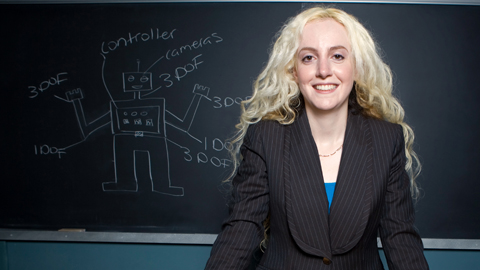
Two members of the U of T Engineering community were recently recognized with Engineers Canada awards for their contributions and achievements in engineering. Professor Goldie Nejat (MIE) received the Young Engineer Achievement Award and alumnus Tyler Irving (ChemE MASc 1T0) garnered the inaugural Award of Journalism Excellence in Engineering. Established in 1972, the Engineers Canada Awards are national awards which honour the contributions of Canadian engineers to their profession, their community and to the safety and well-being of Canadians.
Professor Nejat is researching the development of intelligent assistive robots that can help find victims in disaster scenarios, improve the quality of patient-centered care and transform the way hospital wards and nursing homes function. Her research is helping Canada meet the challenges posed by an aging population – and keeping both the province and country at the forefront of the multi-billion-dollar personal and service robotics industry.
Her contributions in this area include the development of assistive technologies, including socially intelligent assistive robots to aid cognitive and physically impaired individuals with the activities of daily living. In particular, she and her students have developed a unique robot named Brian for healthcare applications. Brian is a human-like robot designed to remind, monitor, aid, stimulate and motivate elderly individuals suffering from dementia. Professor Nejat received the 2012 Ontario Professional Engineers Young Engineer Medal in recognition of this work.
Irving is the Science Writer/News Editor at ACCN, the Canadian Chemical News. While at U of T, his Master’s research focused on bioprocessing and biotechnology. However, his true passion was communicating the excitement of science and engineering to the public. His education and outreach roles include science camp counselor, outreach program coordinator, museum host, high school teacher, lecturer, radio broadcaster, tutor and science writer.

Irving was recognized for his article ‘Nature’s Industrialists’ in the November/December 2012 edition of Chemical Engineering News, which featured the research of U of T chemical engineers Radhakrishnan Mahadevan and Emma Master. The article not only explains this cutting-edge research – which focuses on producing chemicals from biological materials that could eventually replace those made from non-renewable resources – it demonstrates why this work matters to Canadians.
“These prestigious awards recognize the wide range of contributions made by U of T engineers and the impact our early-career professors and alumni are already making,” said Cristina Amon, Dean, Faculty of Applied Science & Engineering. “I congratulate these two outstanding young engineers on this recognition and on their achievements.”
The award recipients will be honoured at the Engineers Canada Awards Gala in Yellowknife on June 8, 2013.
In a special section devoted to engineering in The Globe and Mail, several U of T Engineering research groups, professors and alumni were mentioned in the six-page spread. The supplement, which was published on June 6, was dedicated to covering the state of engineering in Canada.
Among those featured are: Professor Reza Iravani (ECE), giving expert comment on the demand for engineers in the cleantech sector; a collaborative research group developing a 3D printer for customized bone implants; Professor Susan McCahan (MIE), Vice-Dean, Undergraduate, on strengthening diversity in the profession; Professor Goldie Nejat (MIE), who received a Young Engineering Achievement Award from Engineers Canada; and Tyler Irving (ChemE MASc 1T0), a U of T alumnus who received an award for Journalism Excellence in Engineering from Engineers Canada.
The Government of Canada and the Natural Sciences and Engineering Research Council of Canada (NSERC) announced $46.2 million in research and scholarship investment to the University of Toronto on May 21. Several U of T Engineering faculty members and students received either research grants or scholarships.
On the research side, $36,841,718 will go to 224 U of T faculty members through NSERC’s Discovery Grants and Discovery Accelerator Supplements programs.
The Discovery Grants fund ongoing programs of research in every scientific and engineering discipline. Many U of T Engineering researchers received grants, including Tim Barfoot (UTIAS), who received two grants totalling over $300,000 for robotic research,Warren Chan(IBBME), who received a one-time grant of $150,000 for wireless nanotechnology for global surveillance, and Joyce Poon (ECE) who received a five-year grant of $145,000 for integrated photonics for communications and communication.
Discovery Accelerator Supplements are valued at $120,000 over three years and are awarded to researchers whose proposals explore high-risk, novel or potentially transformative concepts and lines of inquiry and are likely to contribute to groundbreaking advances. U of T Engineering Discovery Accelerator Grants recipients are Aimy Bazylak (MIE), Constantin Christopoulos (CivE), Brendan Frey (ECE), Christopher Kennedy (CivE) and Shaker Meguid (MIE).
On the scholarships side, $9,359,500 is going to 211 U of T students through the Alexander Graham Bell Canada Graduate Scholarships, NSERC Postgraduate Scholarships and the Postdoctoral Scholarships.
“We are grateful to the Government of Canada and NSERC for this magnificent investment in our research community and our students,” said Professor Paul Young (CivE), vice president (research and innovation). “This funding will result in two major outcomes – discoveries of importance to global society and a boost to the next generation of university researchers.”
For the complete lists of recipients, visit http://www.nserc-crsng.gc.ca/NSERC-CRSNG/ProgramNewsDetails-NouvellesDesProgrammesDetails_eng.asp?ID=412.

The Department of Civil Engineering (CivE) and the Department of Materials Science & Engineering (MSE) were recently honoured with two 2013 Hermes Creative Awards from the Association of Marketing and Communication Professionals.
CivE was given the Gold Award in the Publications: Newsletter category for its alumni publication The Civilian, while MSE was recognized with a Gold Award in the Publications: Magazine category for the second issue of its alumni magazine, Impact.
The Civilian is currently managed by Colin Anderson, the department’s Communications and Student Programs Coordinator. “Gold-level recognition affords us a wonderful opportunity to celebrate all the people that contribute to our storytelling projects,” said Anderson.

“U of T Civil Engineering is full of amazing people doing amazing things, and it is important that we take the time to share our successes with the world,” he added.
“It has been a privilege to share these amazing stories of dedication, talent and accomplishments of our students, faculty and alumni with our community,” said Luke Ng (MSE), External Relations & Student Life Officer, who developed and is the editor-in-chief of Impact. “Working under Professor Jun Nogami‘s (MSE, Chair) steadfast leadership is a real treat and I cannot thank my colleagues enough for their efforts in making Impact a collaborative success.”
The Hermes Creative Awards is an international competition for creative professionals involved in the concept, writing and design of traditional materials and programs, and emerging technologies. The international organization consists of several thousand marketing, communication, advertising, public relations, media production, web and free-lance professionals.
On the weekend of May 25-26, U of T Engineering empowered 90 newly admitted female students through a slew of activities at the Girls Leadership in Engineering Experience – also delightfully known as GLEE.
Now in its second year, GLEE is an initiative that aims to inspire graduating female high-school students to join the U of T Engineering community. As Dean Cristina Amon explained, the young women would be joining a community where women are leaders in their field, making a positive impact as educators, researchers and entrepreneurs.
“U of T Engineering is a meeting place for people like you who are seeking new challenges, new ideas and new solutions to help improve the world and our society,” Dean Amon said. “I can only tell you what I honestly believe. That the University of Toronto gives you the greatest range of engineering opportunities of any university in Canada.”
Attendees got the chance to learn more about student life and seek guidance from current engineering students, faculty and alumni. Events included a morning of hands-on workshops, a lunch hosted by the U of T chapter of Women in Science and Engineering (WISE), a panel discussion with successful female alumni, as well as a semi-formal dinner with members of the U of T Engineering community.
The semi-formal was especially exciting, featuring not only a flash mob including members of Skule Nite, but also a flying robot – courtesy of keynote speaker, Assistant Professor Angela Schoellig (UTIAS).
Professor Schoellig, who works at the interface of robotics, controls and learning, demonstrated the robot to show how an engineering innovation like that could one day be applied to address real-world issues, such as search and rescue.
“For me it is important to encourage female students who like math and science to consider engineering as a career path,” said Professor Schoellig. “In my talk, I tried to communicate my passion for engineering and show them that engineering work is innovative, creative, exciting and rewarding.”
That message got across to high school student Cindy Park, who also enjoyed talking to engineering alumni about entrepreneurship. “It was the first time I got a chance to meet women who own their own companies. I never thought about that as an option, but now I am.”
GLEE follows in the steps of many other initiatives and events that seek to cultivate the next generation of women engineers. Just this Spring, U of T Engineering hosted the first-ever Women in Science and Engineering National Conference. Currently, more than a fifth of the Faculty’s undergraduates are women, while they make up a quarter of graduate students.
How can we improve teaching and student learning? Can we connect with students through texting, or invert the traditional classroom experience altogether? These were just a few of the questions posed at U of T’s second EdTech Workshop, held at the Bahen Centre on May 28.
The workshop showcased leading applications and best practices for innovative teaching and learning. The 250 attendees learned about everything from webinars and lecture capture, to online office hours, group-marking software and e-textbooks. They also listened to presentations from 13 of U of T’s leaders in educational technology, including engineering Professors Jim Wallace (MIE) and Susan McCahan (MIE), Vice-Dean, Undergraduate, and Lecturers Jason Bazylak (MIE), Jason Foster (EngSci) and Dr. Micah Stickel (ECE), First Year Chair.
This year’s workshop was led by Allison Van Beek, Instructional Technology Specialist, who, in the spirit of the event, tried some innovative ways to capture the day’s activities.
“We broadcasted our opening remarks into a smaller room to demonstrate how that could work for a distributed-learning environment,” said Van Beek. “We also asked one of our vendor participants, Akindi, to help us design a custom bubble-sheet trivia game.” What’s more, all the sessions throughout the day were lecture captured and will be posted online.
“This day was designed to be a ‘show and tell’ experience, where instructors could share what they’ve learned as educators,” said Van Beek. “I hope that it inspired people to try something new … I also hope that people become more aware of how much interest there is to implement technology in the classroom.”
This is the second time U of T Engineering has hosted the EdTech Workshop. The first was in 2011, and was chaired by the late Harpreet Dhariwal , former Instructional Technology Specialist for the Faculty.
“The 2013 workshop continued the spirit of his work,” said Van Beek.
Van Beek is already looking ahead to next year’s EdTech Workshop, where she hopes to live-stream the sessions, add more interactive elements and have more collaborative sessions.
“I expect to see some big jumps in how we use technology in the classroom at U of T this year, especially in U of T Engineering,” she said. “I can’t wait to showcase those efforts next year.”
Learn more about this year’s EdTech presenters.