

When Lana Osusky (AeroE PhD candidate) went to Boston to present her research, she didn’t expect to end up presenting in her hotel room, while under lockdown.
The Massachusetts Institute of Technology’s (MIT)Women in Aerospace Symposium, which took place on April 18 and 19 at the MIT campus, was an opportunity for female doctoral candidates from across the globe to present their research and network with professionals. Participants came from top schools such as Stanford, Harvard, Cornell, CalTech, MIT, the University of Colorado, Penn State and the University of Toronto.
Unfortunately, the event took place during a harrowing time – the tragic Boston Marathon bombing took place just a few days before. And unbeknownst to attendees, they would soon be affected by its aftermath.
“The first day was an amazing day of talks,” said Osusky. “After going out to dinner, we went back to our hotel, which was on the MIT campus.”
That night, the two bombing suspects allegedly shot and killed an MIT police officer. “I heard a loud ‘boom’ noise, but thought it was a car backfiring,” said Osusky.
“I woke up to a bunch of missed emails and texts from friends and family, asking if I was OK,” she said. That’s when she found out what had happened, and that the hotel was now under lockdown on what was supposed to be the second day of the symposium. It also happened to be the day she was going to present her research.
As she and fellow attendees tried to digest what took place just a short distance from where they were staying, one of the attendees suggested that the conference could continue at the hotel so that the remaining participants could still present their work.
“We went up to my room, set up a video stream so that other participants who were not at the hotel could watch, and we presented,” said Osusky. An MIT faculty member even managed to get to the hotel to attend the talks, bringing with her a projector so that the presentations could be shown on the wall.
Osusky, who works under the supervision of Professor David Zingg (Director, UTIAS), was able to present her work on an aerodynamic shape optimization algorithm that can facilitate the design of more efficient aircrafts. “Everything that was supposed to happen on the second day of the conference ended up happening… just in the hotel room,” she said.
Osusky says she’s come away inspired by the people of Boston and the teamwork of her colleagues. “MIT took such good care of us during the whole ordeal,” she said. “And I was already so inspired by the women I met there – but after all of that? You could not be part of a more amazing group of people. I was so inspired by how we worked together and supported each other,” she said.
Before heading home, Osusky made sure to visit Boston’s Copley Square, the site of the memorial for the victims of the marathon bombing. “It was very emotional,” she said.
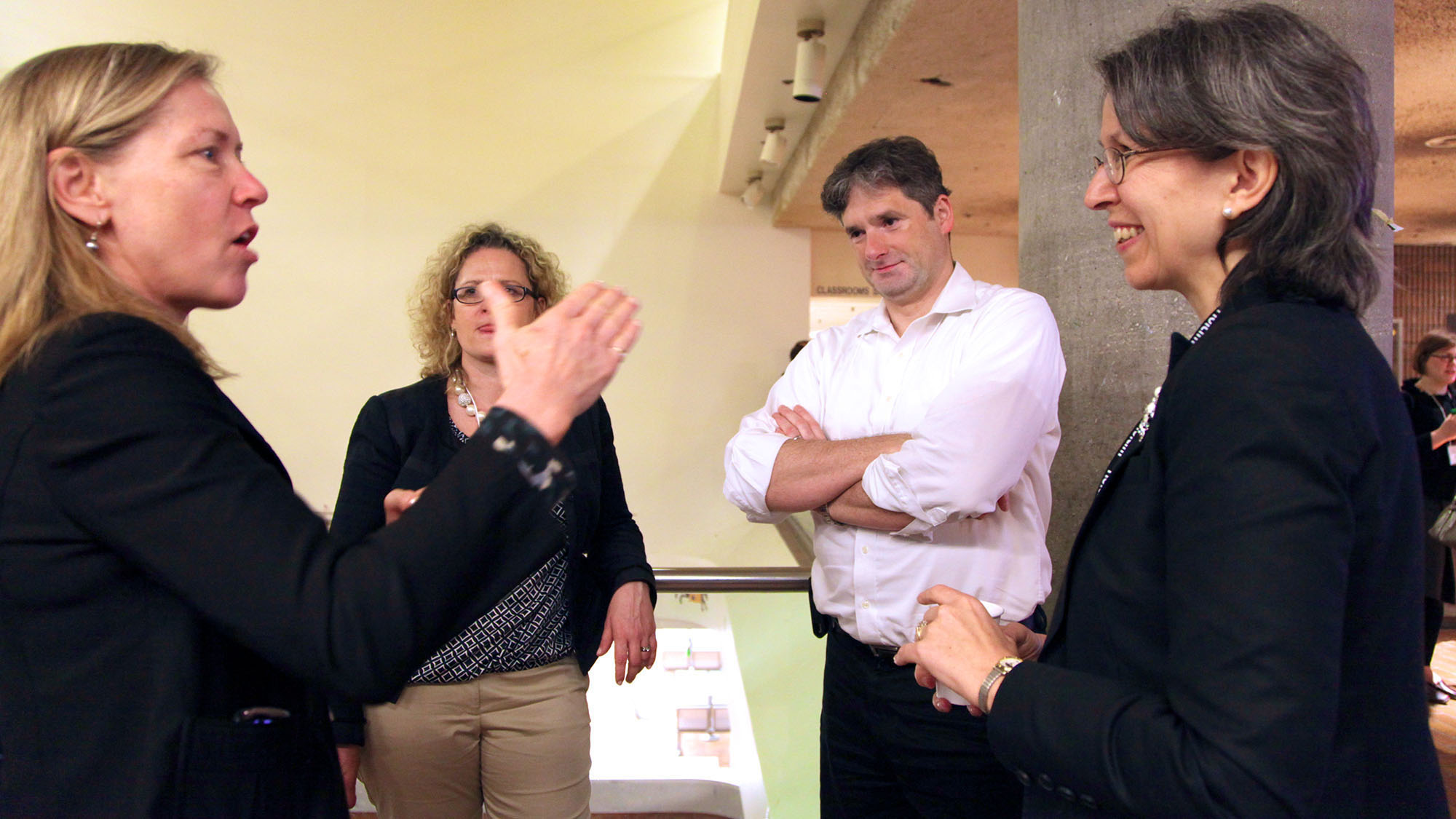
More than 100 professionals from engineering, architecture, planning, development and academia came to the Sandford Fleming Building April 30 to discuss the future of building envelopes.
The forum, “Sustainability, Durability Design: The Future of Building Envelopes,” was moderated by Toronto Star architecture critic Chrisopher Hume and featured a keynote by Kevin Hydes, past chair of the World Green Building Council.
Planned as the first in a series of forums on sustainable development, it was organized by U of T Civil Engineering, along with Holcim Canada and the John H. Daniels Faculty of Architecture, Landscape and Design.
Discussion centred on how urbanization is driving development and how to address efficiency needs in both new construction and existing stocks of older buildings.
“U of T is delighted to partner with Holcim Canada on this initiative.” said Professor Brenda McCabe, Chair of Civil Engineering. “Because of Civil Engineering’s strong focus on urban sustainability, being part of the hosting team was a fabulous opportunity to demonstrate how industry and academia can collaborate to achieve great things. We look forward to working with the forum participants to take steps toward improving our building infrastructure.”
“We are incredibly pleased with the success of our first forum. We brought together thought leaders who can bring to the table the real issues we are facing in developing Canada’s sustainable infrastructure and work together, across disciplines, to tackle these issues and make tangible progress. From a building material producer and supplier perspective, Holcim Canada aims to take a leadership approach and to be a part of this discussion to explore solutions and innovations for our changing needs to provide sustainable and resilient infrastructure,” said Nick Caccavella, Senior Vice President, Holcim (Canada) Inc.
U of T and Holcim plan to develop a white paper from the day’s discussions and organize a similar forum this fall to explore some of the more detailed topics that were explored in the first forum.
For more information, visit the forum website at:http://holcimuoftsdf.wordpress.com/about/.
At a one-day conference held at the Bahen Centre for Information Technology April 22, researchers from across the University of Toronto came together to discuss an issue of global proportions: health.
What emerged was a snapshot of the kinds of thoughtful, innovative solutions that U of T professors are cooking up, with the help of community partners, to help developing nations achieve cost-effect, lasting solutions to some of the world’s greatest health challenges.
Professor Shana Kelley has been developing a sensor that detects multiple diseases in a single test.
“We’ve been working with the US Department of Defence and DARPA,” said Kelley, who is also Director of Biomolecular Sciences, cross-appointed to the Institute of Biomaterials & Biomedical Engineering (IBBME). “They said, now give us something that can detect everything.” The resulting technology can rapidly detect up to 20 different pathogens and 10 types of antibiotic resistance on one chip, and can sell for as low as $5.
Public health, though, is about comprehensive solutions. Professor Yu-Ling Cheng (ChemE), Director of the Centre for Global Engineering, has been working with the Gates Foundation to develop innovative strategies for a leading cause of death in developing nations: sanitation.
According to statistics released by the United Nations, over 1 billion people currently lack clean water, and 2.6 billion lack adequate sanitation. Of those, 3.6 million people die from sanitation-related illnesses each year – including an estimated 1.8 million children.
Cheng, whose team is currently perfecting a prototype of a toilet that will incinerate waste, argued that “until you do something you really don’t know what challenges you’ll face.”
Professor Cheng’s challenges in building a better toilet taught her the value of community partners to understand the variables of public health problems, from the way flooding can cause pit toilets to flow right up to the steps of peoples’ homes to the fact that different cultures need to embrace the new technologies.
“Once you get real partners, you get a real sense of the problems you’re facing,” Cheng added.
Dr. Clare Pain, Associate Professor in the Department of Psychiatry, has been working closely with community partners in Ethiopia to create a residency program for mental health professionals in that country. The results of the program has seen a sharp increase in practising professionals, and a 97 per cent retention rate of new practitioners in a country that has historically carried only 2,000 doctors for 60 million people.
There are real-world consequences to these programs, Pain pointed out, where “with minimal interventions,” schizophrenics can go from being chained in their huts to living productive, active lives. But, she said, “Ninety-nine per cent of your success is the quality of the partnerships you develop.”
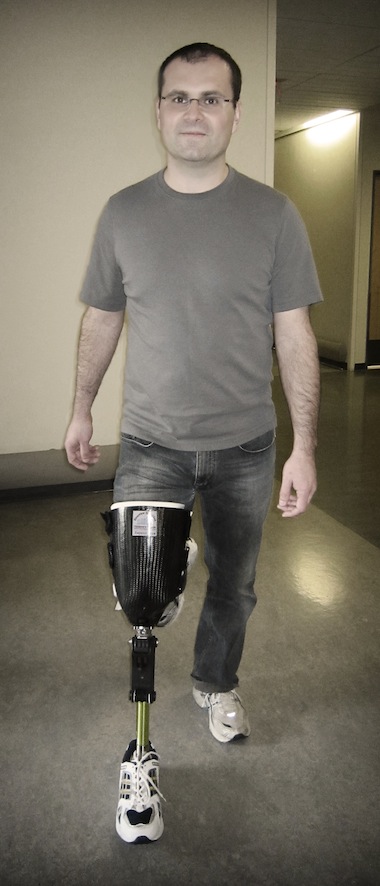
“In dealing with global health issues, the goal is to provide simple solutions with large potential impact,” Jan Andrysek, Scientist at the Bloorview Research Institute, Holland Bloorview Kids Rehabilitation Hospital and Assistant Professor at IBBME, said. Andrysek’s low-cost artificial knee is one of several discussed during the day that was funded through Grand Challenges Canada, a competition that asks the country’s greatest thinkers to develop high-impact solutions to some of the world’s most pressing health and development challenges.
Peter Zandstra, IBBME Professor and co-organizer of the symposium, argued that part of the challenge of finding lasting solutions to global health issues lies in understanding the shifting nature of world health priorities.
“Infectious diseases were once highest on the list of mortality rates for developing nations,” Zandstra said, “but by 2030, cancers and ischemic heart disease may be leading causes of death in many of these countries as well as for high income nations like our own.”

The Centre for Industrial Application of Microcellular Plastics (CIAMP) officially opened May 2, bringing with it the promise of lighter, stronger and more cost effective plastic materials for the automotive and construction industries.
Located in Mississauga, CIAMP is a state-of-the-art research and development centre with industry-scale facilities for developing innovative, commercially viable plastic foaming and composite technologies, according to University of Toronto Engineering Professor Chul Park, Director of the Centre.
It is funded by a $9.2-million grant from the Canada Foundation for Innovation – Leading Edge Funds and the Ontario Research Fund – Large Infrastructure Fund and is part of the Network for Innovative Plastic Materials and Manufacturing Processes, a Natural Sciences and Engineering Research Council network of 21 researchers across Canada. CIAMP is also supported by the Consortium of Cellular and Microcellular Plastics (CCMCP), a network uniting more than 20 leading plastic companies around the world.
CIAMP’s goal is to collaborate with industry to develop innovative microcellular plastic products and commercially viable processing technologies, Park says, who is also the Canada Research Chair in Microcellular Plastics. The techniques that CIAMP will work on should lead to lighter weight, stronger plastics that use less raw material, he says. The construction and automotive industries will benefit in particular, but other uses are possible too, for example, electrical insulators and household electronic devices.

Representatives from collaborating research organizations, government, funding agencies and industry partners were on hand for the official opening of the facility.
“Chul Park’s research and leadership has already led to significant advances in the field of foamed plastics,” said Professor Jean Zu, Chair of U of T’s Department of Mechanical & Industrial Engineering. “CIAMP will allow him and his colleagues to build on this cutting-edge work and apply it at an industrial scale. ”
“This is the kind of advanced manufacturing that we should all be excited about because it creates jobs, contributes to economic growth and showcases Canadian innovation,” said the Honourable Gary Goodyear, Minister of State (Science and Technology). “That is why our Government has made significant research investments in the Centre.”
“Plastics are a ubiquitous part of our lives and we taken them for granted,” said Allison Barr, director of the research branch of the Ontario Research Fund. “But that doesn’t mean that we’re immune to rising costs, and there are many potential applications for plastics that are lighter, stronger and longer-lasting, especially in the auto industry to reduce fossil fuel consumption and cut down on the costs of pollution. If Ontario can develop these plastics and the methods to manufacture them, we will have an important advantage. In Ontario, we’re very fortunate to have a leader in research such as Chul Park who can help us realize the promise of these plastics.”
Park is a world leader in the development of innovative, cost-effective technologies for foamed plastics. He has been extensively involved in industrial projects through research contracts on various foaming processes including microcellular processing, inert gas-injection processing, rotational foam molding, wood-fibre composites and open-cell foams.
More information about CIAMP can be found here

U of T Electrical Engineering Professor Reza Iravani is one of several beneficiaries of federal ecoENERGY funding grants announced May 3.
Iravani heads the Centre for Applied Power Electronics (CAPE), which received a $560,000 grant for circuit breaker technology for fast protection or isolation of battery storage systems.
Thirteen ecoENERGY grants totalling over $21 million were announced by The Honourable Bal Gosal, federal Minister of State (Sport) and MP for Bramalea-Gore-Malton, in a ceremony in the Galbraith Building. CAPE was also involved in two other projects receiving funding; a $1.98-million grant to Hatch Ltd. for a commercially viable controller for electricity distribution systems in remote communities; and a $5.3-million grant to Opus One Solutions Energy Corp. to develop a smart grid platform to manage electricity generation, storage and resource demand.
U of T Forestry Professor John Caspersen also received funding under the program; a $300,000 grant for a feasibility study to develop forestry feedstock supply for the production of bioenergy.
“These projects are a clear signal of Canada’s growing competitiveness in clean energy technologies,” Gosal said. “Smart grid technologies will indeed lead to a brighter, greener economic future for Canada. We need the smart grid that is both responsive and dynamic. This investment is also good news for the Greater Toronto Area as we strive to position ourselves as a clean energy leader. New, innovative clean energy projects, like those announced today, stimulate our local economy while helping protect the environment.”
Iravani also spoke at the event, thanking the federal government for demonstrating its commitment to smart grid research.
The ecoENERGY Innovation Initiative has received $268 million in funding over five years to fund research, development and demonstration projects that produce and use energy in a more clean and efficient manner.
The projects announced were:
- $560,000 to the University of Toronto for a smart grid project;
- $300,000 to the University of Toronto for a bioenergy feasibility study;
- $5,317,600 to Opus One Solutions in Toronto for a smart grid project;
- $1,500,000 to Prolucid Technologies in Mississauga for a smart grid project;
- $1,962,870 to Owens Corning of Scarborough to integrate renewable energy and conservation measures in the building of five Net-Zero Energy Housing communities;
- $1,985,988 to Hatch in Mississauga for a smart grid project;
- $1,836,800 to the Canadian Standards Association in Toronto to develop electric vehicle safety standards;
- $1,065,609 to the Toronto and Region Conservation Authority to develop a solar energy yield test standard;
- $1,864,069 to Dana Canada to improve the thermal characteristics of lithium battery systems;
- $1,192,765 to Dana Canada to development thick-film electric heaters for the thermal modulation of battery systems;
- $1,870,000 to the University of Waterloo to develop materials for high-energy density battery systems for electric vehicles;
- $600,000 to GTRenergy to design and field test new wind turbine blade technology; and,
- $1,025,125 to The Pollution Probe Foundation for the development of an electric vehicle integration analysis tool.
Prompt use of an automated external defibrillator, or AED, can greatly increase the survival rates of people who suffer a cardiac arrest. And MIE Professor Tim Chan, working with Dr. Laurie Morrison at St. Michael’s Hospital, has developed a formula to determine where best to place these costly but life-saving devices.
In a paper published in Circulation, Chan and Morrison note that publicly registered AEDs in Toronto are not in the best locations to help victims of cardiac arrest. In fact, less than one in four of all cardiac arrests had an AED close by (within 100 metres is the required distance). The average distance to the nearest AED was closer to 300 meters.
Current guidelines suggest areas associated with the highest risk of cardiac arrest should be targeted for AED deployment, after they have been placed in obvious high-traffic areas such as transportation hubs or major sports venues. But it’s not clear how to identify these “cardiac hot spots.”
Chan and Morrison looked at the locations of all 1,310 public cardiac arrests in Toronto between December 2005 and July 2010 and the locations of all 1,699 AEDS registered with Toronto Emergency Medical Services.
They found that 304 cardiac arrests occurred within 100 metres of at least one AED (23 per cent).One hundred metres was chosen as the yardstick because it’s the approximate distance a bystander could transport an AED in a 1.5-minute walk—the maximum recommended by the American Heart Association.
There were almost three times as many public cardiac arrests in downtown Toronto as the rest of the city – 3.5 per square kilometer per year vs. 0.4 – said Chan. Almost half of all downtown cardiac arrests were near an existing AED compared to only 17 per cent those outside of downtown.
“If you have a cardiac arrest, every second counts. Out-of-hospital cardiac arrest kills an estimated 300,000 people in North America annually,” she said. “Only five per cent of people who suffer out-of-hospital cardiac arrest survive to be discharged from hospital. The probability of survival decreases up to 10 per cent with each minute of delay between collapse and treatment.”
Chan said his mathematical model is more accurate than a population-based model, in which AEDs are placed in areas of densest daytime population.
“Our optimization model should be viewed as a decision-support tool to help prioritize placement of AEDs, make efficient use of public, donor or private funds directed toward public access defibrillator programs, and potentially maximize survival on the basis of geographic patterns of cardiac arrest,” said Chan. “Because AEDs are expensive and cannot be placed everywhere, our model allows a decision-maker to quantify the trade-off between the number of AEDS deployed and coverage.”
While it was not part of the research paper, Chan used his mathematical model to indicate the top 10 cardiac hot spots in Toronto not currently covered by AEDs:
- Jarvis and Gerrard
- Queen and Bay
- Jarvis and Dundas
- Brimley and Progress
- Eglinton and Warden
- Wellington and Strachan
- Dundas and Spadina
- Queen and Shelbourne
- Danforth and Pape
- Jarvis and Adelaide