

The first things you notice upon entry to the University of Toronto Institute for Aerospace Studies (UTIAS) Space Flight Laboratory are the bright flecks twinkling against the inky blackness – in the granite floors, not the sky.
This is, after all, an Earth-bound facility, though its work is all about space. It is here that Canada’s academic, business and government partners are collaborating to create cheaper, quicker-to-launch space missions using small satellites – one of which involves Communitech’s new Intelligent Media Networks (IMN) project.
In February, FedDev Ontario awarded $6.4 million to Communitech, Waterloo Region’s commercialization hub for digital media, to oversee a project to monetize marine shipping data gathered by satellites built at the UTIAS lab in Toronto.
Communitech will use the funds, to be matched by public and private-sector partners, to work with Cambridge, Ont.-based exactEarth and UTIAS to build, launch and mine real-time data from the two small satellites.
On March 28, Communitech’s IMN team travelled to the UTIAS Space Flight Laboratory for a tour led by Dr. Robert E. Zee (AeroE MASc 9T4, PhD 9T7) its Director throughout its 15-year history. Zee oversees 30 full-time staff and a complement of 13 graduate students.
“We get the box as small as possible so that it’s easier to launch, less costly to launch, and we do this for organizations around the world,” Zee told the group as they stood in the brightly-lit lab, its many work tables covered with circuit boards, wires and other components.
Those organizations include universities, governments, “anyone who needs a small satellite,” Zee said. “Otherwise, we’d have a hard time getting into the space arena, so we’ve lowered the entry barrier for people needing data from space.”
Compared to 2003 when it launched its first microsatellite, which was Canada’s first space telescope, the lab now has six satellites in orbit, 10 more under construction “and lots of interest from all over the world,” he said.
All have been in the microsatellite range, meaning each weighed less than 100 kilograms, and most have been under 10 kilograms, qualifying as nanosatellites. “The smallest was about 3.5 kilograms, so the size of a small milk carton,” Zee said, adding that the size of a satellite is sometimes dictated by the amount of space available on the rockets from which they are deployed.
The first Communitech satellite, to be sent into space from India later this year, will weigh seven kilograms, and the second will clock in at about 15 kilograms.
Once in space, the satellites will occupy a low orbit (below 1,000 kilometres in altitude) and gather real-time data exchanged between the estimated 100,000 ships at sea around the world on any given day. The ship-to-ship data is shared through technology called the Automatic Identification System, which alerts marine crews with the location and other details of other vessels nearby.
exactEarth, a four-year-old subsidiary of Cambridge-based satellite maker COM DEV, is receiving up to $2.49 million in FedDev funds to update the satellite data-gathering and processing capabilities for the Communitech IMN project.
Communitech, which boasts a 1,000-company network of tech firms, will work with exactEarth, UTIAS, the Insititute for Quantum Computing in Waterloo and a host of other institutions across Ontario to find new applications for the data gathered, and for the technology. Future uses could include monitoring of atmospheric carbon and global water levels.
During the UTIAS lab tour, a microsatellite similar to one of the two IMN units was clearly visible behind the glass of a clean room, where the people who assemble them work to exacting standards – for obvious reasons.
“We can’t fix anything once it’s in space,” Zee explained, “so we need to get it right the first time.”
UTIAS lab workers also build XPODs – ejection systems that fling the satellites into space, jack-in-the-box style, from their launch vehicles – to the custom requirements of each satellite launch.
Zee said the small satellites are typically designed for one to three years of service in orbit, but some continue to collect valuable scientific data for five or 10 years post-launch.
Of the many stages of testing each satellite goes through, one of the last is the thermal vacuum chamber, which “simulates the environment of space” by producing the vacuum and coldness of space, using a liquid nitrogen shroud that wraps around the chamber. Alternatively, infrared lamps are used to simulate the level of solar heat a satellite will experience from its particular position in orbit, Zee said.
From there, the tour continued to the mission control room.
“It’s a small room; it’s not like Cape Canaveral or anything like that,” Zee said. “You don’t need a big room to do what we need to do. This room is really just screens, computers and software.”
Ground stations in other locations relay the signals from the control room to the satellites, he said.
“At about the time I was graduating [from UTIAS], I had the opportunity to form a new lab and work on Canada’s first microsatellite, and Canada’s first space telescope, called MOST (for Microvariability and Oscillations of STars),” he said.
When MOST launched in 2003, the lab “didn’t really have a plan for the future,” since it had been established just for that one project, Zee said. “We found ourselves without any work, so we had to develop our own business plan.”
Since it had developed expertise in building a small, low-cost satellite, “I decided to get us involved with these nanosatellites that were just coming up at the time,” he said.
Today, with six satellites in orbit, another 10 in production and interest from around the world, the strategy has proven to be an effective one – and the Communitech IMN project marks another step in the lab’s evolution.
“With Communitech, we now are part of a network of organizations that can contribute to this Intelligent Media Networks project,” Zee said, “so there are even more possibilities there for new collaborations in new areas.”
In addition to tapping into Communitech’s network of technology companies in southwestern Ontario, UTIAS sees the IMN project as a chance to raise awareness of its capabilities across Canada and around the world.
“Raising awareness … creates opportunity; it creates new mission ideas, new ideas for data services, new ideas for approaching government with specific mission concepts, or even foreign customers,” Zee said.
“So, potentially there could be a new partnership established as the result of a Communitech connection, whereby UTIAS Space Flight Lab partners with one of these other organizations that are part of Communitech, and we go after some international opportunity that we wouldn’t have otherwise gone after.” In other words, the future looks bright.
“I can see a lot of potential there,” Zee said.
Story reposted with permission from Communitech.

The appetizers may have been organic, but the server was mechanical at a reception held April 15 to celebrate the University of Toronto Engineering’s Institute for Robotics & Mechatronics.
The reception was held to celebrate the Institute, which was established in 2010 to bring focus on research and education in the fields of robotics and mechatronics. It is headed by Professor Gabriele D’Eleuterio (UTIAS) and involves researchers and students from across the Faculty, particularly Electrical & Computer Engineering, the Department of Mechanical & Industrial Engineering, the University of Toronto Institute for Aerospace Studies (UTIAS) and the Institute for Biomaterials & Biomedical Engineering.
U of T Engineering Dean Cristina Amon called the Institute a wonderful example of the cross-disciplinary synergy that makes U of T Engineering the leading Engineering school in the country and among the very best in the world.
“Today, we are on the cusp of a robotics revolution not unlike that in computer technology 30 to 40 years ago,” she said. “From health care to industry to interplanetary exploration, our researchers and students are leading the way in this robotics revolution, developing the next generation of mechatronic and robotic systems.”
For more information about the Institute for Robotics & Mechatronics, visit their website at irm.utoronto.ca/
How can we forgive people who commit atrocities? Is China the new model for state-run capitalism? Do the humanities matter anymore?
For the answers to these and other questions, check out Vidoyen, a new interactive website created by ECE alumnus Arshia Tabrizi (CompE 9T5).
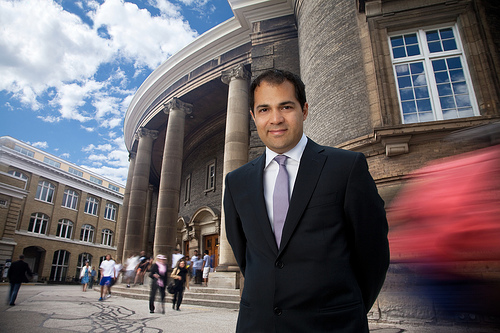
Tabrizi, a technology lawyer and former software engineer, started Vidoyen because he felt there was a need for concise, reliable answers to questions using the Internet. Vidoyen provides the platform where anyone can ask a question, and responses are short, video answers of two minutes or less by professors and experts such as ECE Professor Jonathan Rose (What is an FPGA?) and former Toronto Mayor David Miller (What cities are global models of urban sustainability?).
“It goes down to my interest in technology, as well as general public education,” Tabrizi told the Toronto Standard in a recent interview.
By way of further explaining his vision for Vidoyen, Tabrizi says, “I’ve always viewed the Internet as a platform to share thoughts, but there was a disconnect in my mind in terms of how people filter out reliable information from unreliable information. I wanted to create a space where engaged academics, thought leaders and intellectuals could have a well-informed exchange with citizens on topics of importance to the world.”
Tabrizi sees Vidoyen as a site for dialogue, not just questions and answers. People can write comments or pose additional questions in response to the videos. “The idea is to develop a mini-forum where people can go and engage in conversation and debate on important and topical issues, not only locally but globally,” Tabrizi told the Standard.
The Toronto Standard article is available here. To visit Vidoyen and get the answers to your questions (or nominate an expert to contribute to the site), click here.
As the academic year comes to an end, final exams begin – which is a major source of stress for most students.
That’s why U of T Engineering’s First Year Office staff organized the Faculty’s first-ever Exam Jam on April 16. The event was aimed at preparing students before the deluge of exams, while also helping them fight the inevitable stress.
“We were impressed with the similar Arts & Science event, so we decided to translate it into an Engineering-specific, one-day event. Ours would necessarily be on a smaller scale, but we tried to keep the same spirit of balance between academic review, fun and stress relief,” said Colleen Kelly, Acting Assistant Registrar, First Year.
Students were primarily drawn to the Exam Jam for review sessions held by several professors of large first-year courses, but there were a range of other activities offered. Hart House generously provided free, ten-minute massages to students throughout the day, and the MoveU crew brought giant jenga and stressball-making to the ‘Pit’ in the Sandford Fleming building.
Healthy snacks were also provided, and students were encouraged to get creative at the ‘Crafts with Colleen’ booth. The Academic Success Centre also contributed to the event by holding a seminar on effective study skills.
The highlight of the Exam Jam for many was visiting with Maggie May and Albert, therapy dogs from Therapeutic Paws of Canada, who helped students to de-stress in the afternoon.
Reaction to the event was overwhelmingly positive. TrackOne student Albertina Baosaid, “I think it’s a good mix of relaxing, socializing and review – I like it.” With the success of the inaugural event, plans are in the works to make the Engineering Exam Jam a regular exam-time occurrence.
A yoga chair to help homebound seniors exercise. A vibrating belt to alert deaf cyclists to traffic noises. A transit alarm strip with a built-in intercom. These were just some of the solutions to Toronto problems devised by first-year U of T Engineering Science students displayed at a day-long showcase at Hart House on April 16.
The showcase is the culmination of a unique EngSci design course known as Praxis. In the course, students were encouraged to identify problems throughout the city that can use new answers. The best projects were identified, and multiple teams of students worked to design innovative solutions. The public was invited to the showcase to see the students’ answers to the following challenges:
- Preventing repetitive strain injury (RSI) in librarians
- Heat stress in firefighters due to thermal protective clothing
- Developing an arthritis-friendly bicycle handling system
- Exercise for low-income children
- Handwriting for Parkinson’s patients
- Improving the emergency systems on the TTC
- Increasing physical activity in homebound seniors of Toronto
- Improving road safety for deaf cyclists
- Improving street food cart sanitation
- Reducing struck-by injuries in the road construction industry
The showcase gave the students an opportunity to practise their communication skills, explain their proposals and get immediate feedback from city officials, professional engineers as well as members of the general public.
Among those on hand was a group of Toronto firefighters who encouraged the students working on the heat stress problem to continue work on their projects. “This is a problem that really needs a solution,” firefighter Patrick Hayter told the students.
“Overall, I was very pleased with the quality of the solutions and presentations,” said Praxis course instructor Rob Irish. “It showed that the students had synthesized their learning from across the year.”
More information can be found at www.praxis.uoftengineering.com.
CBC Radio’s Mary Ito interviewed Engineering Science students Katlin Kramer-Tonin and Andrei Dranka about their projects. You can listen to the interview here.
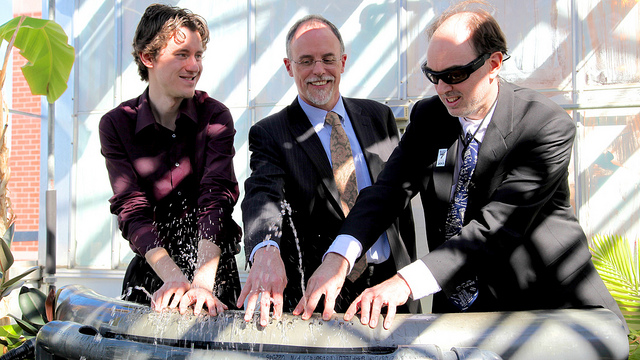
Delegates were treated to a water show Wednesday morning when they visited ECE Professor Steve Mann’s lab in a greenhouse atop the Faculty of Forestry building.
The group was led by Robert Bell, co-founder of the New York-based Intelligent Community Forum, and included members from Waterfront Toronto, Cisco, IBM, Beanfield Metroconnect, Element Blue and Telus. Bell was in Toronto conducting two days of site visits to evaluate Toronto’s place as a leading 21st century community.
Toronto has been named one of seven finalists in the running for the title Intelligent Community of the Year, competing against Stratford, Ont.; Columbus, Ohio; Oulu, Finland; Tallinn, Estonia; Taichung City, Taiwan and Taoyuan County, Taiwan.
Mann presented the delegates with his vision to make Toronto the world epicentre of water research and culture by establishing a world-class facility called Hydraulikos, to celebrate water through art, science, innovation, music and design.
Often called the father of wearable computing and augmented reality, Mann’s current research concentrates on the intersections between humans, technology and nature. Hydraulikos aims to bring humans closer to nature through technology, rather than distancing us from the natural world.
PhD candidate and collaborator Ryan Janzen played two musical numbers on the hydraulophone, the world’s first water instrument, and Mann demonstrated a water-based video game called First Mover Advantage that teaches game theory by activating touch-sentitive fountains embedded in the floor. Bell then joined Janzen and Mann on the hydraulophone.
“I think [the group] connected with it,” said Janzen. “They’re interested in combining fundamental scientific research with societal issues in communities, and that’s what we’re trying to do in this lab and at U of T as a whole.”

ECE alumnus Pete Scourboutakos (ElecE 0T9) collaborated with Mann and Janzen to integrate a green energy project with the wet and wild hydraulophones. He pedalled an exercise bike modified to power the pump running water through the musical instruments, representing ECE’s work on alternative energy and SmartGrid systems.
Bell is “one of those thinkers who’s simultaneously broad and deep,” said Mann. “You get that through his writings, but it was wonderful to see it in person.”
Mann’s Hydraulikos lab was the only ICF stop on the University of Toronto campus. The group also visted E.T. Technologies, Ryerson’s Digital Media Zone, MaRS Discovery District, George Brown’s Gaming Incubator, Evergreen Brickworks, Waterfront Toronto, Pinewood Toronto Studios, Corus Quay and Telus.
The ICF will name 2013’s Intelligent Community of the Year in June.
Past Intelligent Communities of the Year include Riverside, Calif. (2012); Eindhoven, Netherlands (2011); Suwon, South Korea (2010); Stockholm, Sweden (2009) and Gangnam District, Seoul, South Korea (2008).
Read more on the Top Seven Intelligent Communities of the Year here.