

High expectations.
That’s what Mengqi Wang (ECE 1T3) has for the University of Toronto Supermileage Team in 2014.
Wang is co-president of the team, which competed for the first time ever in the Shell Eco-Marathon Challenge held in Houston earlier this month, an annual competition where student teams from around the world design, build and test ultra energy-efficient vehicles. Though the 90-pound, 1.3 horsepower U of T car – powered by a Honda leafblower motor – failed to place in the final race because of technical problems, it did achieve an impressive 626 miles per gallon in the preliminary round.
“I’m very proud of this team. We faced a multitude of challenges over the last year or so, and there were times we were worried about the future of the project. But despite all that every member put in their utmost, and helped the team pull through to the end,” Wang said.
The team’s other co-president, Jonathan Hamway (MechE 1T3 + PEY), said the team has come a long way since they started about 18 months ago. “It’s been mostly design work because this is the first time we’ve ever done this so we had to start from scratch.” He said working on the car gave the team members practical experience to go along with the theory they learn in their coursework. “That practical component is an essential part of an engineering education.”

Team members are already looking towards next year, Wang said. “While we’re all happy to have gotten as far as we did, we’re not content with the results just yet. Now that we have a better idea of what this competition truly entails, we’re much better equipped than before to make an impact at next year’s event. And with the dedication this team has shown, I have high expectations for our performance in future.”
Team supervisor Professor David Sinton (MIE) said he was proud of the team. “They started from scratch and built a competitive team and vehicle in one year. Other groups that saw them on the track said ‘wow, and this is your first year?’ The learning curve was steep and they have an impressive preliminary mileage result which provides a benchmark for next years’ effort.”
Wang in turn thanked Professor Sinton and the team’s other supporters in U of T Engineering. “We really couldn’t have done this without them.”
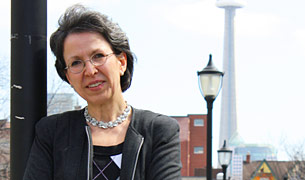
Professor Brenda McCabe, Chair of the Department of Civil Engineering (CivE), has been selected to receive the 2013 SWAAC Recognition Award from the Senior Women Academic Administrators of Canada. This award is given to a SWAAC member who has continually demonstrated innovative leadership in advancing the mission of, and achieving outstanding contributions to, her institution.
Professor McCabe joined the Faculty in 1997 and was appointed Vice-Dean, Graduate Studies in 2006 – the first female Vice-Dean in the Faculty. In that role, she championed a new series of courses that brought professional and management learning to our MEng program. These ELITE (Entrepreneurship, Leadership, Innovation, and Technology in Engineering) courses have grown substantially and are now integral to the MEng curriculum.
In 2008, Professor McCabe was appointed Chair of the Department of Civil Engineering, making her the first woman to chair CivE and only the second female Chair in the Faculty’s 140-year history. In this role, she has worked to further increase the department’s profile, improve the student experience, integrate sustainability into the curriculum, and promote a sense of community amongst students, alumni, faculty and staff.
Professor McCabe approaches her position as a role model for female students and professors with dedication and responsibility. For example, she recently initiated the creation of five new scholarships acknowledging the first five women to graduate from CivE. Her efforts are successfully increasing the participation of women in a field which has traditionally not been gender balanced.
“Professor McCabe has shown exceptional leadership as a senior academic administrator and serves as an outstanding role model for women academics and engineers,” said U of T Engineering Dean Cristina Amon. “I am delighted that SWAAC is honouring her extraordinary contributions.”
Professor McCabe will receive her award at the annual SWAAC conference’s gala dinner in Brandon, Ontario on May 3.
In the latest issue of U of T Magazine, Professor Emma Master (ChemE) discusses how she is using plants to create new materials and chemicals.
The article poses the question: What if we could make plastic from renewable biomaterials instead of environmentally harmful petrochemicals?
“The implications could eventually affect large segments of the economy,” states the article, “Research by Master and others in the field could lead to new kinds of organic packaging to replace Styrofoam, plastic wrap and drink cartons – and new markets for wood and other fibres.”
To read the full article on Professor Master, visit the U of T Magazine site.
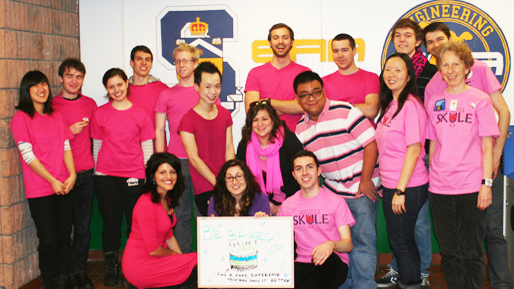
Five years ago in a Nova Scotian high school, two teens started an anti-bullying movement in support of a ninth grader who was picked on for wearing pink.
In 2008, Pink Shirt Day involved a mere 50 students. Today, schools and institutions across Canada take part by wearing pink on the last Wednesday of February. You can add U of T Engineering to that list.
“Pink Shirt Day began as a rare act of compassion and understanding,” said Dr. Peter Weiss, Senior Lecturer and Director of the Engineering Communications Program. “It was initiated by students who viewed the homophobic bullying as unjust and inhumane. They realized that they could do something to make a statement, and make a difference.”
As a member of Engineering Positive Space, Weiss and team want to make a statement, and a difference, too. That’s why they brought Pink Shirt Day to U of T Engineering this year, and hope to do it again next February.
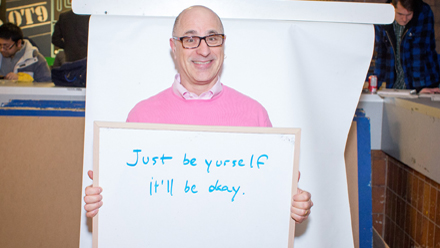
“The Faculty’s first Pink Shirt Day was very well received,” said Amanda Bell (IndE 1T2, MASc candidate), a Positive Space member and event organizer. “We had about 30 people write anti-bullying messages of all kinds.”
The event is among a number of initiatives the group have introduced to inspire inclusiveness and tolerance within the Faculty.
Over the course of the last two years, Engineering Positive Space have worked to raise awareness of issues related to marginalization due to difference – especially issues around hurtful and offensive language.
“The term ‘gay’ is a good example,” said Weiss, “In the gay community, it has been adapted as a neutral term to describe a sexual preference. But in common conversation, it often carries a negative connotation.”
To address the problem, the group launched workshops, and ran a poster and badge campaign last year. On the poster, a student holds a rainbow-adorned hard hat, as the caption reads: “My hard hat isn’t gay, but I might be.”

“It created opportunities for people to discuss, in objective and constructive ways, the issues around marginalization,” said Weiss.
While the poster campaign focused on Lesbian, Gay, Bisexual, Trans and Queer concerns, marginalization is much wider. “[That’s why] opening discussion of problems related to it makes Engineering and the university much more welcoming for everyone,” said Weiss.
Engineering Positive Space is part of a wider university effort – the U of T Positive Space Campaign is a groundbreaking program that identifies safer and more inclusive spaces for students, staff, faculty, alumni and allies of all sexual orientation.
For U of T Engineering’s part, Weiss said that he’s amazed by the commitment the Faculty and its students have shown to deal with bullying and discrimination.
“Engineering Positive Space has made an enormous difference,” he said. “The presence of our posters and the Faculty’s support, has allowed me to feel much freer in expressing myself and being myself than I felt before.
“As someone who has been deeply traumatized by marginalization, I always assume that I will not be accepted… Even when people are not openly hostile, it’s hard to turn around and think that in reality they will be accepting when they have given no sign that this would be true – Engineering Positive Space has been that ‘sign’ for me.”
Off the heels of National Engineering Month, the Institute for Leadership Education in Engineering (ILead) celebrated U of T Engineering’s emerging student leaders on April 3.
ILead’s annual Leaders of Tomorrow (LOT) Appreciation Night was an opportunity to build community and student engagement, while acknowledging the many ways its students, staff and faculty enrich the engineering experience.
Guest speaker Emily Moore, Director of Water Technology at Hatch and esteemed ILead board member, delivered a moving speech. Moore underscored the importance of building engineering leadership capacity to engage the broader world more effectively, as well as marshalling people around ideas fuelled by passion.
“I’ve always encouraged my employees to be asking questions, not just ‘What do I need to do?’ But ‘How does that fit into things? How does this fit in the bigger picture? How does my organization work? How does my neighborhood work? How do I make change?’” said Moore.
“If you continually ask those questions, you will become a leader. That’s what leaders do. That’s how you identify those opportunities that you can develop and apply your passion,” she added.
Speaking to ILead’s diverse programming, which teaches students the process of leading through experiential learning, Dr. Moore had encouraging words:
“If you keep this up, Toronto will be the engineering capital of the world. U of T is absolutely stellar in the academics. When you add leadership education on top of that – it’s world-leading.”
ILead Director, Professor Doug Reeve (ChemE), carried on the spirit of the event, speaking to the Institute’s groundbreaking research around engineering leadership in industry, as well as its ambitions to have even more impact with students across the Faculty.
Professor Reeve ended the celebration of engineering leadership with a call to think big. “We want to open your thinking to not just the ‘How?’ and ‘What?’ questions, but beyond that, to the ‘Why?’ question. Why do you do what you do?”
ILead’s vision is for engineers leading change to build a better world. Learn more about ILead and leadership education at U of T Engineering
Mind-controlled computing, an app for diversifying your stock portfolio, a new chip that could one day revolutionize airport security – these were just a few of the futuristic concepts brought to life by enterprising fourth-year undergraduates at this year’s ECE Annual Design Fair.
More than 100 projects debuted over the three-day event, and the most spectacular finalists were featured in a project showcase on April 5 in the atrium of the Bahen Centre for Information Technology.
Mustafa El-Hilo’s (CompE 1T3) group built a device for controlling your environment – think raising or lowering temperature, turning lights on and off, or opening your garage door – that reacts based on where the user taps on its surface. It’s inexpensive, and incredibly valuable for people with multiple disabilities.
“We wanted to take on an application that was going to solve a real problem,” said El-Hilo. “We learned that 54 per cent of disabled people are unemployed, and the environmental control units available now are much too expensive, around $700. This unit costs about $200 if you mass-produced it.”
The group envisions more frivolous uses for the acoustic-localizing surface too, such as responding to darts thrown in a bar, or as an interactive ad in shopping centres.
Fourth-year electrical engineering students Shahrzad Pouryayevali and Saeid Wahabi devised a method of identifying individuals by the personal signature of their heartbeat. The pattern is unaffected by exercise or anxiety because it zones in on the unique ECG phase of the current, rather than the T-wave, which changes under stress. They’ll be expanding their work into master’s projects this fall.
“To build a system from scratch and know every component we’d included was exciting,” said Wahabi. “But we’re not finished yet – we’re just getting started!”
Other finalists included an English-to-Braille translator, an app for restaurants that eliminates the need to flag down your server, a program that converts live video to animation in real time, and hardware that seriously cuts down frustrating troubleshooting in analog electronics labs.
“We had an exceptional group of students this year, and it showed today,” said Professor Phil Anderson, course coordinator. “Their hard work is clearly evident in the high quality and applicability of projects in this room.”
The Design Fair is sponsored by Telus, which had representatives on hand to check out the work. “There are a lot of innovative projects here, and we’re interested in grassroots outreach and connecting with new innovations,” said Jaushan Singh of Telus’s Technology Leadership Development Program.
Students went head-to-head for more than $10,000 in awards recognizing innovation, teamwork and execution. Some past projects have continued on as start-up companies or filed for patents.