
The accidental discovery by Chemical Engineering Professor Tim Bender and Post-Doctoral Fellow Benoit Lessard of an unexpected side product of polymer synthesis could have implications for the manufacture of commercial polymers used in sealants, adhesives, toys and even medical implants, the researchers say.
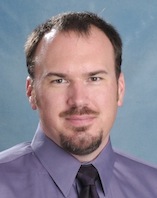
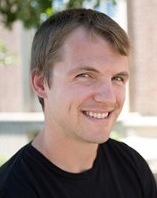
Bender and Lessard discuss their discovery in a paper published this month in Macromolecular Rapid Communications and online at MaterialsView.com. The paper was featured on the cover of the journal, which is dedicated to the rapid publication of items deemed of immediate significance to the polymer community. Only the top 10 per cent of accepted articles appear on the MaterialsView website, Bender said.
“People in polymer synthesis would be very interested in the process described in our paper, as we document the discovery of a side-product. This side-product is quite unexpected based on our current knowledge of polymer chemistry,” Bender said.
Bender and Lessard describe a synthesis of Boron subphthalocyanines (BsubPcs) containing polymers that can be used in organic electronic devices. What makes the article significant is that it also describes their discovery of a new side product of a common polymer synthesis technique, which would not have been observed without the addition of the BsubPc to this standard polymer.
“Currently BsubPc polymers do not have any commercial applications. However, by studying their properties and finding new and inexpensive ways to synthesize them, we are able to open the door for potential applications in the field of organic electronics,” Lessard said.
Commercial polymers may also contain this particular side product, Bender and Lessard wrote. If the side product can be reduced or eliminated, more of the polymer could be produced with more consistent quality.
Bender and Lessard are also investigating the optical and electrical properties of BsubPc polymers for possible use in organic electronic devices, such as organic field-effect transistors, organic light emitting diodes and organic photovoltaics. Applying polymers in organic electronics may lead to more flexibility, lighter weight and lower manufacturing costs, they wrote.
To read Bender and Lessard’s article, visit http://www.materialsviews.com/boron-subphthalocyanine-polymers/
Mary Qiu (IndE 1T3 + PEY) has placed first in the individual category of the Health Council of Canada’s nation-wide Health Innovation Challenge for her paper “Preventing Acute Care Hospital Readmissions Through the Use of a Virtual Ward.”

More than 100 students across Canada participated in the Challenge, submitting a total of 74 essays explaining which innovative practices they think could change the future of health care. Winners received a cash prize and the chance to apply for a summer internship at the Health Council of Canada office in Toronto.
Qiu said she felt honoured to win the Challenge. “While I was certainly hoping to be announced as one of the winners, I definitely was not expecting it! I have not had the chance to read any of the other shortlisted entries, but I am sure that they are all of equally high calibre.”
She said she entered the Challenge because she felt it was a good opportunity to explore and learn more about health care in Canada. Winning has made her even more determined to pursue a healthcare career, she said. In fact, she will have to decline the Health Council of Canada’s internship offer because she’s heading to Kenya with Students for International Development this summer to work on healthcare infrastructure development and health promotion.
Qiu wrote the paper which she wrote while doing her Professional Experience Year (PEY) placement at St. Michael’s Hospital. In the PEY program, second- and third-year students complete 12- to 16-month paid internships in their areas of interest. “Being in the hospital environment on a daily basis has exposed me to numerous and exciting endeavours that are currently being developed.”
“Mary Qiu’s success speaks to her ability to see beyond the obvious and to seize opportunity rather than wait to be assigned tasks,” said Jose Pereira, who as director of the Engineering Career Centre oversees the PEY program. “She is also a selfless individual who will contribute greatly to the profession and society. She is a shining example of the student potential in U of T Engineering.”
Professor Jean Zu, Chair of Mechanical & Industrial Engineering, also congratulated Qiu on her win. “Our Centre for Research in Health Care Engineering provides education and research expertise in healthcare engineering, and it’s rewarding to see one of the centre’s undergraduate students excel in this field.”
For the Challenge, students were asked to submit a written submission describing how they see an innovation shaping health care through a practice, program, service or policy. Specifically, students had to write a 2,500-word paper that answered the question “What new innovations in health care are having a positive impact in Canada? Identify and describe an innovative practice that is improving health outcomes, and tell us why it is working.”
“The winners of this year’s Challenge truly showed us the importance of sharing innovation” said John G. Abbott, CEO, Health Council of Canada. “They found some great practices that are working locally and we should pay attention to see if we can learn from them and use them in our own work.”
For the full list of winners and more information about the Health Innovation Challenge, go to the Health Council of Canada website
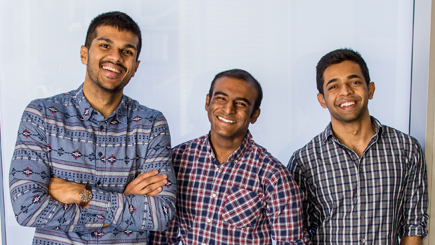
About a year ago, three University of Toronto undergraduate students, Fahd Ananta (Computer Science), Guru Mahendran (EngSci 1T3), and Thariq Shihipar (EngSci 1T3), began developing a web services aggregator, Chime. Officially launching in January of this year, Chime, which is available on the Google Chrome browser, offers users one place where they can access all of their Facebook notifications, e-mails, Tweets, etc., in a stream of real-time updates.
The product was met with a great deal of excitement, gaining almost 30,000 users since it first launched. Hubspot, an inbound marketing software company, took notice and acquired Chime as an “innovative company that could help them continue to transform the marketing landscape.” Lauding the company’s neatly organized format, Hubspot will be bringing the three founders to their headquarters in Cambridge, MA by the end of the spring.
Fahd, Guru and Thariq, who met at a DemoCamp event on U of T’s St. George campus, reflected on the growing climate of entrepreneurship at U of T, and on the general atmosphere of the university as supporting factors for their success. “The student environment and culture were probably the most influential,” Fahd shared. “The talent, innovation, and drive to succeed at the university [creates] an amazing place to grow ideas and stay motivated.”
Thariq added, “Guru and I took the [Engineering] entrepreneurship course, 488 series, and that was very helpful.” While the group wasn’t able to use Engineering’sEntrepreneurship Hatchery incubator, Thariq noted, “If it had been around when we were in second or third year, we would have definitely made use of it; it’s going to be a great resource for current undergrads!”
Finally, when asked if they have any advice for young entrepreneurs, Fahd was adamant: “It’s always the right time to get started. If you have an idea, build it now and sweat the details later. Get involved with the Toronto startup community and make connections … If you have no idea where to start, get a Github account to start hacking away on side projects – and follow Hacker News.”
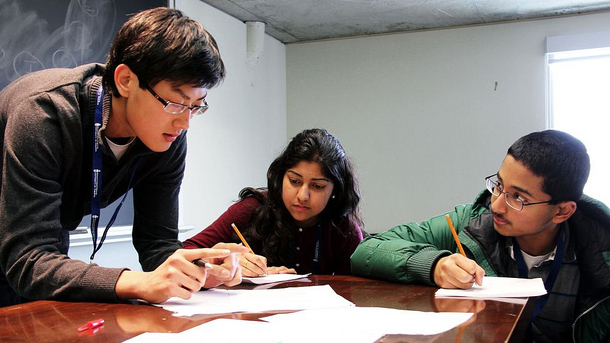
How do you program a robot to navigate a zombie-infested campus? That was one of many problems that 80 high school students from grades 9 through 12, had to solve during the third-annual Operations Research Challenge (TORCH).
TORCH is a one-day contest that introduces students to the field of operations research. “Operations research combines ideas from many quantitative fields. Students learn to utilize these skills in finding a solution to interesting problems,” said Professor Timothy Chan (MIE). Interesting problems can range from ‘How do you devise a treatment plan for lung cancer?’ to ‘How can you help Katniss Everdeen survive the Hunger Games?’
Operations Research, or simply OR, is an interdisciplinary science that uses scientific methods like mathematical modelling, statistics and algorithms to make decisions related to the coordination and effectiveness of any organization. Applications of OR can be found in business, health care, financial engineering, military, supply-chain management, manufacturing, public policy and more.
The March 16 event has grown from just 37 students in its first year – a remarkable sight for Professor Chris Beck (MIE), whose research group, the Toronto Intelligent Decision Engineering Laboratory (TIDEL), initiated TORCH in 2011. “TORCH has introduced and inspired an interest in OR among high school students in the GTA,” said Professor Beck.
The day included an introductory lecture by Professor Dionne Aleman (MIE), presentations by MIE graduate students, a discussion of the solutions and an awards ceremony. During the day, representatives from Hi-Skule, U of T Aeronautics Team (UTAT) and U of T Space Design contest spoke to students about the exciting programs available at U of T Engineering. A team from Don Mills Collegiate Institute shared a $300 top prize, and were invited to attend a week of DEEP Summer Academy.
TORCH was made possible through the organization of six executive team members including, MIE PhD Candidates Maliheh Aramon Bajestani, Tony T. Tran, and Janet Sung, MIE MASc students, Tze YanJane Ip and Peter Yun Zhang, and Sebastian Kosch (EngSci 1T3).
TORCH would like to thank their many volunteers and sponsors, including the Faculty of Applied Science & Engineering, the Department of Mechanical & Industrial Engineering, the Rotman School of Management, Ontario Ministry of Research and Innovation, the Engineering Outreach Office at University of Toronto, Engineering Alumni Association, and Skule™ Lunch and Learn Series attendees.
Traffic lights that think. Apps that use drivers’ input. These are some of the ideas that U of T Engineering experts offer for easing Toronto’s traffic problems.
Their ideas are outlined in “The Road Out of Gridlock City,” an article in the March 23 Ontario edition of The Globe and Mail. In the article, Civil Engineering professors Baher Abdulhai, Khandker Nurul Habib and Eric Miller and Electrical and Computer Engineering professor Alberto Leon-Garcia discuss Toronto’s growing transportation woes and outline possible solutions.
“Some congestion is a sign of vibrancy,” says Abdulhai, “but too [much] congestion has many negative consequences … The good news is that there are plenty of approaches to address congestion, traditional and nontraditional, technical and nontechnical.”
For example, Professor Abdulhai’s MARLIN project marries cameras with computers to create traffic lights that can measure vehicle flow, understand what it means, and adapt signal patterns to reduce gridlock. Professor Nurul Habib is investigating ways to manage demand for road space, and Professor Miller is advocating controlling how fast cars merge onto highways. Professor Leon-Garcia suggests making traffic lights smarter by having them adapt to real-time data.
“The Road Out of Gridlock City” is available on the Globe and Mail website (access may be restricted).

National Engineering Month (NEM) is the biggest national celebration of engineering and technology.
Across Canada, engineering schools and volunteers stage more than 500 events and activities to bring more awareness to the exciting and rewarding world of engineering.
This year’s NEM theme is Design the Future – something U of T Engineering certainly knows a lot about. On this page, we share U of T Engineering’s successes, spotlighting our innovative faculty, students and alumni, as well as our forward-thinking educational programs and centres, along with our NEM activities. We hope you’ll join us in discovering Engineering at U of T – in all its wondrous facets.
Our Events

- Purple Power at the CN Tower: At dusk on March 26, U of T’s Engineering Society will flip the switch on an amazing Rube Goldberg machine to light the CN Tower purple – the colour traditionally associated with the engineering profession.
- WISE National Conference: For the first time ever, the Women in Science and Engineering (WISE) chapter at U of T will be hosting the WISE National Conference. The two-day event will focus on women’s leadership, confidence and involvement in research and technology. Also, check out WISE’s 30 in 30 campaign, celebrating 30 influential female engineers for every day of NEM – that includes U of T Engineering innovators Dean Cristina Amon, Katherine Moshonas Cole (EngSci 8T6), Valerie Davidson (ChemE PhD), Louise Grondin (MechE 8T4), Beatriz Martin-Perez (CivE MASc 9T5, PhD 9T9), Anne Sado (IndE 7T7, HonDoc 1T1) and Beth Vary (IndE MASc 0T9).
- Global Engineering Innovation Challenge & Symposium: Featuring several of our renowned faculty members, this event aims to inspire Canadians to solve problems that matter to all of us.
- Skule Nite 1T3: This year marks the 92nd anniversary of U of T Engineering’s legendary Skule Nite production. From March 13-16, engineering students, as well as students across all disciplines, came together to put on a lively and hilarious comedy/musical variety show. Check out the photos below by photographer Mike Hawkins.
Our People
A 3-D printer to revolutionize burn care around the world

Imagine a future where inexpensive 3-D tissue printers are used to save lives, revolutionizing burn care around the world.
That’s how mechanical engineering PhD student Lian Leng is designing the future. Under the supervision of Professor Axel Guenther (MIE, IBBME), she is developing a printing device that forms sheets of soft tissue.
The printer, which is still in prototype stage, can also build up the material – made mostly from living cells – to varying thicknesses, textures and densities.
If successful, Leng’s tissue printer could mark a huge advance in quality of life and survivability for severely burned patients, and dramatically reduce treatment costs. What’s more, it could morph into a machine for fabricating internal organs.
The world’s smallest space telescopes
[youtube https://www.youtube.com/watch?v=8eh5cu5tys4]
Our University of Toronto Institute for Aerospace Studies (UTIAS) is shining BRITE, after designing the world’s smallest space telescopes.
Developed by U of T Engineering’s Space Flight Laboratory (SFL), the mini telescope satellites are now circling the Earth, prepared to find and study the brightest stars in the sky.
Measuring only 20 centimetres a side, and weighing less than seven kilograms, the nano-satellites are the smallest astronomical satellites ever built. They were launched February 25 from the Satish Dhawan Space Centre in Sriharikota, India. Funded by Austria, they are the first two components in the planned six-satellite BRIght Target Explorer (BRITE) mission.
The most energy-effecient light bulb
[vimeo 55252822 w=760 h=428]
Three U of T Engineering graduates have invented the world’s most energy-efficient light bulb, the NanoLight.
According to Gimmy Chu (ElecE 0T6), Tom Rodinger (IBBME PhD 0T7) and Christian Yan (ElecE 0T6), it’s a breakthrough in LED lighting technology.
Made out of printed circuit-board material that’s folded into the shape of a light bulb, it has what Chu describes as a ‘funky’ shape, but for good reason. It uses only 12 watts of electricity to generate the equivalent output of a 100-watt incandescent bulb.
Reinventing the toilet
Engineers at U of T’s Centre for Global Engineering (CGEN) are working on a revolutionary project that could change millions of lives all over the world.
Led by Professor Yu-Ling Cheng (ChemE), Director of CGEN, a team of U of T engineers hope to reinvent the toilet to provide people in developing worlds with affordable, alternative, sanitation that does the impossible: works for only five cents per user, per day and doesn’t rely on running water, sewerage systems or supplied electricity.
Last summer, the team’s design garnered third place at the Gates Foundation’s Reinvent the Toilet Challenge. And in November 2012, the Gates Foundation awarded them a grant worth $2.2 million for 15 months, to continue their inspiring work.
Learn more about our engineering community’s recent activities, discoveries and awards at: In the News
Our Programs
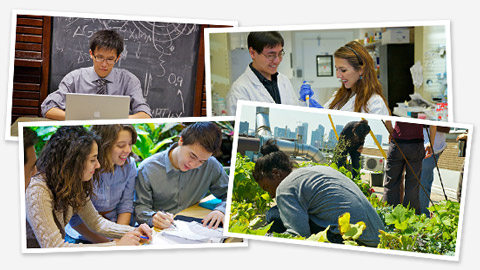
At U of T Engineering, we’re constantly renewing our educational offerings to be at the leading edge, while also meeting the needs of students and industry.
Our undergraduate minors span an array of engineering areas, from engineering business, to robotics and mechatronics, to sustainable energy. We also offer a diverse selection of certificates that focus on entrepreneurship, nuclear engineering, mineral resources and global engineering, just to name a few.
We’re not just strengthening our undergraduate program, either. Graduate Studiescontinues to flourish here, with new and exciting offerings in our Master of Engineering (MEng) program. That includes new time offerings, the launch of an MEng in Cities Engineering and Managment (MEngCEM) in September 2013, and the development of an MEng in Advanced Water Technologies and Process Design.
What’s more, U of T Engineering is home to institutes and centres aimed on making a world of positive difference: the newly established Institute for Sustainable Energy,The Entrepreneurship Hatchery, the Centre for Global Engineering and the Institute for Leadership Education.
To learn more about National Engineering Month, visit the NEM Ontario page or the national page .
U of T Engineering was recently featured in a special NEM supplement in theToronto Star. Make sure to pick up the February 28 issue to read about our impact – from Lian Leng’s 3-D skin grafts, to the creation of Bionym, a tech start-up founded by graduates Foteini Agrafioti (ElecE PhD 1T2) and Karl Martin (ElecE PhD 1T2).