
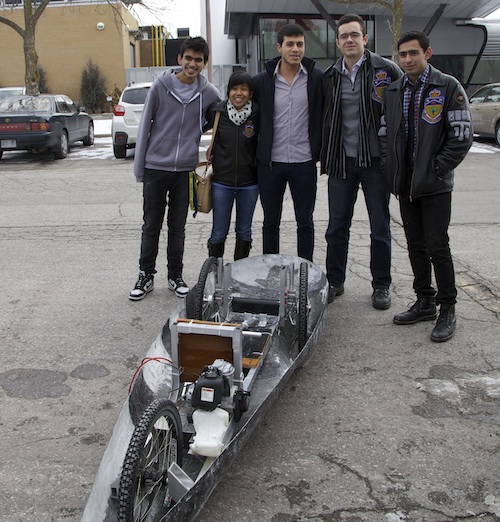
Imagine driving almost 900 kilometres on one litre of gas.
A U of T Engineering student team is hoping to do just that at the annual Shell Eco-Marathon Challenge in Houston, Texas in early April. The aptly named University of Toronto Supermileage Team will be racing its 90-pound, 1.3 horsepower vehicle – powered by a Honda leafblower motor – against teams representing other universities from Brazil, Canada, Guatemala, Mexico and the United States.
The annual event challenges students to compete with other schools in their energy-efficient vehicles to see who can travel the farthest distance using the least amount of energy.
The teams will be competing for a variety of prizes in categories such as eco-design, safety, technical innovation, team spirit and perseverance in the face of adversity. U of T’s car, called Journey 1, will be driven by Monika Torio (EngSci 1T3+PEY).
“I’m really pumped up about driving the car,” Torio said as the team demonstrated the car at the University of Toronto Institute for Aerospace Studies (UTIAS) in North York. “At first I was very nervous about getting into something we hadn’t done before. But after getting to know these people and how committed they were to the team, I knew I really wanted to help build and drive this car.”

Team co-president Jonathan Hamway (MechE 1T3+PEY) said the team has been working on the car for about 18 months. “It’s been mostly design work because this is the first time we’ve ever done this so we had to start from scratch.” He said working on the car has given the team members practical experience to go along with the theory they learn in their coursework. “That practical component is an essential part of an engineering education.”
He said working on the car has been difficult because several of the 10 team members – including both Torio and himself – are in their Professional Experience Year, working at full-time jobs right now. “We can usually get together only on weekends. It’s hard to get everybody here at the same time.”
But he’s confident they’ll do well in Houston. “This is a better car than any team has ever built at U of T, because we have the best people working on the car.”
MIE Professor David Sinton, Director of the Institute for Sustainable Energy, echoes that confidence.
“The University of Toronto Supermileage Team is a group of bright, hard-working students who are passionate about energy efficiency in transportation,” he said. “Their work in preparation for the competition has been a ‘supermileage’ effort in itself, requiring high output in the context of resource constraints. Time is tight but they are pulling the elements together.”
For more information, please see the Shell Eco-Marathon Challenge website.
What does a discussion among approximately 140 high school students, volunteers, teachers and world-leading scientists on the subject of stem cells sound like?
Oddly personal, important and revolutionary.
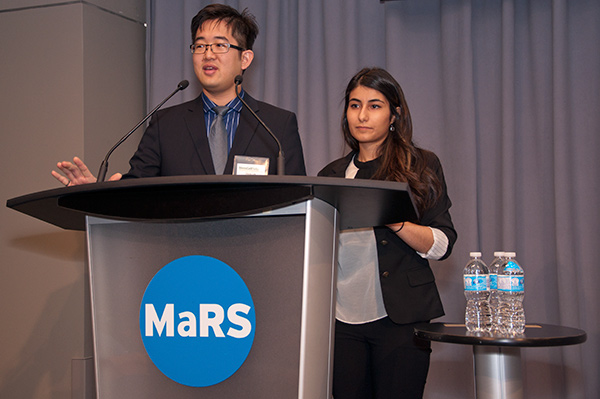
“A student was saying that one of his friends died of leukemia and asked whether cord blood would have made a difference,” relates Biomedical Engineering PhD student David Lee, co-organizer of StemCellTalks, an invite-only conference for high school students held at the MaRS Auditorium last week.
Lee joined fellow Biomedical Engineering PhD student Nika Shakiba in organizing the annual event. A collaborative effort between the national volunteer science organization Let’s Talk Science and the Stem Cell Network, the one-day symposium highlights important areas in the science and ethics of stem cells to an audience of students hand-picked by their high school science teachers.
The brainchild of IBBME grads Angela McDonald and David Grant along with head organizer Paul Cassar, who ran the first event in 2010, StemCellTalks draws on deep roots at the University of Toronto.
“We have a rich tradition in stem cells here in Toronto,” explains Lee. “The discovery of blood stem cells happened right here.”
The one-day conference consisted of an introduction to stem cell science by Assistant Professor Penney Gilbert (IBBME), followed by lively debates by world-renowned leaders in stem cell science, including IBBME Professor Peter Zandstra and Dr.Armand Keating, Professor of Medicine, cross-appointed professor to IBBME, and Director of the Cell Therapy Program at the Princess Margaret Cancer Centre.
While Zandstra made the case for hematopoietic stem cell treatments for diseases such as Acute Lymphocytic Leukemia (ALL), fellow scientist Peter Tonge argued for the use of induced pluripotent stem cells (iPSC)– cells that can be programmed to become any type of cell in the body. Students then launched their own debates during breakout sessions and real-time Twitter feeds.

Although virtual keyboards are increasingly common, they can sometimes be frustrating to use. That frustration helps explain why the “Minuum”, a new keyboard developed by Will Walmsley (MASc IndE 1T2) and computer science assistant professor Khai Truong, is creating a lot of buzz lately.
Described as the “the little keyboard for big fingers,” Minuum is squeezed on to the screen’s edge, enabling quick and precise typing from one row of keys. Current smartphones and tablets use a standard keyboard touchscreen, but this touch-type approach can be error-prone and the keyboard often covers most screen space, Walmsley said.
The Minuum has both a cleaner design and more accuracy than other virtual keyboards, he said. “What distinguishes Minuum from other touchscreen keyboards is that it takes up less space. Users of smartphones know that keyboards can take up to half or up to 80 per cent of their screen. If you’re sending an email or text message, you often can’t see anything of what has been sent previously; it’s a frustration that people have. Minuum satisfies their craving for more screen space.”
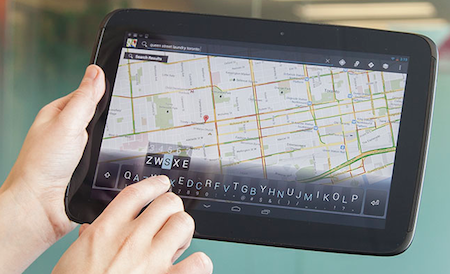
Walmsley and Truong began their research during a course project on human and computer interaction in Walmsley’s first year of graduate studies. They started by looking at alternate ways to text, for example, just by selecting letters by tilting the phone. With the Minuum, the researchers’ specialized auto-correction algorithm translates in real-time the difference between what is typed and what is meant, and corrects it even when a letter is missed.
“It’s very simple, and lends itself to new ways of typing,” says Walmsley, who as CEO of Whirlscape is devoting full time to Minuum. “The way we’re currently developing Minuum is to continually tap on letters. We’ve designed the keyboard based on the common QWERTY keyboard, to make it immediately usable.”
According to Whirlscape’s website, “Current technology assumes that sticking a full typewriter into a touchscreen device is the best way to enter text, giving us keyboards that are error-prone and cover up half the usable screen space (or more) on most smartphones and tablets. Minuum, on the other hand, eliminates the visual clutter of archaic mobile keyboards by adapting the keyboard to a single dimension. What enables this minimalism is our specialized auto-correction algorithm that allows highly imprecise typing. This algorithm interprets in real time the difference between what you type and what you mean, getting it right even if you miss every single letter.”
Walmsley and Truong plan to commercialize an Android version of the Minuum keyboard shortly. Other applications are expected to follow.
They received support from UTEST, the University of Toronto Early Stage Technology. UTEST accepts companies in the very earliest stages of idea generation – before they’re ready for traditional incubators – and awards each company up to $30,000 in start-up funds. UTEST is jointly administered by the Innovations & Partnerships Office at the University of Toronto and MaRS Innovation.
Top tech blogs Techcrunch.com, Mobilesyrup and iClarified, among others, are already buzzing about Minuum. The researchers have recently launched an Indiegogo campaign to raise awareness and additional funds to support the ongoing development of the project. In less than 10 hours after the campaign launch on March 18, they reached 33% of their crowd funding goal.
To learn more, visit http://minuum.com/
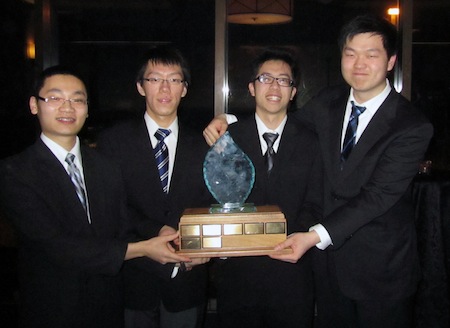
Four EngSci students are heading to Calgary for the first-ever International Engineering Competition in September. The four, Jun Tao Luo (EngSci 1T4), Zane Luo (EngSci 1T4), Aleck Wu (EngSci 1T4) and Ling Zhong (EngSci 1T4), placed second in the senior design team category at the Canadian Engineering Competition. Another student, Amr Ahmed (IndE 1T3), placed third in the engineering communications category at the national event, held in Ottawa in March. The Canadian Engineering Competition is organized by the Canadian Federation of Engineering Students. The competition is now in its 28th year and saw 150 teams compete in seven categories – extemporaneous debate, consulting engineering, engineering communications, innovative design, junior design team, senior design team and re-engineering. Teams had to compete first at their own university and then at the provincial level, before heading to the national and finally the international championships. The competitions at all levels provide a chance for students to develop and hone their skills and impress their peers. Prior to the national competition, U of T Engineering students excelled at the provincial level, winning awards in five of the six competition categories, including three first-place wins. U of T winners at the provincial level were:
Parliamentary Debate
- First place: Inderraj Singh Grewal (EngSci 1T3), Karl Qin (EngSci 1T3 + PEY)
- Third place: Rahul Gopalkrishnan (CompE 1T2), Saminur Majumder (MechE 1T2)
Consulting
- First place: Ankit Bhardwaj (CivE 1T4), Edvard Bruun (CivE 1T4), Ivan Damnjanovic (CivE 1T4), Laura Manusco (CivE 1T4)
- Second place: Reza Abasi (EngSci 1T2 + PEY), Aditya Dhoot (EngSci 1T2 + PEY), Jason Hambrey (EngSci 1T2 + PEY), Eric Ma (EngSci 1T2 + PEY)
Communications
- First place: Amr Ahmed (IndE 1T3)
- Second place: Lorne Mlotek (CivE 1T3)
Innovative Design
- Second place: Rahul Goel (EngSci 1T6)
Senior Design
- First place: John Luo (EngSci 1T4), Zane Luo (EngSci 1T4), Aleck Wu (EngSci 1T4), Ling Zhong (EngSci 1T4)

Ontario Minister of Research and Innovation, Reza Moridi, announced $35 million in matching funding from the Ontario Research Funding for U of T researchers, including U of T Engineering faculty members Omer Gulder (UTIAS), Charles Mims(ChemE) and Ted Sargent (ECE).
Gulder received funding for a High-Pressure Blow-Down Facility for Gas Turbine Combustion Research, Mims for an Ontario Centre for Characterization of Advanced Materials (which is co-led by MSE Professor Doug Perovic) and Sargent for research into nanomaterials for energy. More information on their projects can be found here.
|
|
|
|

The funding matches grants announced by the Canadian Foundation for Innovation (CFI) in January. In total, U of T has received over $100 million in research funding thanks to the two funding agencies. Other U of T faculty members receiving funding are:
- U of T Host Microbiome Research Network, Dana Philpott, Immunology
- Centre for Biofouling Control, Gilbert Walker, Chemistry
- Centre for Chemical Analysis, Andrei Yudin, Chemistry
- Development of Open-Access Research Tools for Epigenetics, Cheryl Arrowsmith, Medical Biophysics
- Technology and Instrument Developments for Space and Ground-based Astronomy, Dae-Sik Moon, Astronomy & Astrophysics
- Centre for the Evaluation of Technological Innovation (CETI), Murray Krahn, Leslie Dan Faculty of Pharmacy
The funding comes from these sources:
- CFI: $35 million for purchase of infrastructure and $10.5 million through the Infrastructure Operating Fund for operating and maintenance of infrastructure
- ORF: $35 million for purchase of infrastructure
- Other sources such as partnerships with the private sector and institutional investments: $22 million
“As researchers across Ontario continue to excel, their work depends increasingly on access to state-of-the-art equipment and infrastructure,” said U of T President, Professor David Naylor. “We are therefore very grateful to the Province of Ontario for this forward-thinking investment. It will support world-leading innovation ranging from fundamental science in diverse disciplines to projects involving technologies that have rapid industrial applications.”
Professor Yu-Ling Cheng, acting dean of the Faculty of Applied Science & Engineering, also expressed her gratitude. “I am delighted that the work being done by Professors Gulder, Mims and Sargent and their teams has been recognized at both the federal and provincial level. It is not only an indication of the importance of their research, but it will provide them with the resources they need to carry out that research.”
These successes are also notable in terms of the national and provincial share of the awards, noted Professor Paul Young, U of T’s vice president (research and innovation):
- 46 per cent ($76.4 million) of the total CFI funds awarded ($166 million) in the January 15 announcement were awarded to Ontario
- U of T and its partner hospitals received $35 million (20 per cent) of the $166 million
- U of T and its partner hospitals received $35 million (46 per cent) of the $76.4 million of the Ontario awards.
“This is a fantastic success rate and is due to the innovation and relevancy of the research and to the talented U of T faculty and staff who developed the proposals,” he said.
U of T research got a big boost on March 15, when the federal government announced $18.7 million in funding for 23 new and renewed Canada Research Chairs (CRCs), seven of which come from U of T Engineering.
Chairholders will use the funds to investigate everything from lung transplantation to the efficiency of wireless networks.
“The Canada Research Chairs program is a key component of the university’s efforts to attract and retain the world’s most promising researchers,” said Professor Peter Lewis, U of T’s Associate Vice-President, Research and Innovation. “We are grateful to the government of Canada for its continuing support of this program.”
Among the new CRCs are U of T Engineering professors:
- Glenn Hibbard (MSE), CRC in Cellular Hybrid Materials;
- Ashish Khisti (ECE), CRC in Wireless Networks; and,
- David Lie (ECE), CRC in Secure and Reliable Computer Systems.



U of T’s total number of Canada Research Chairs is 238, the largest number of any university in the country.
“Our government is committed to attracting and retaining the world’s best and brightest researchers, supporting innovation, creating jobs and strengthening our economy,” said Gary Goodyear, Minister of State (Science and Technology). “By investing in programs such as the Canada Research Chairs, we are fostering cutting-edge research and the generation of new innovations for the marketplace, for the benefit of Canadians.”
The announcement also included the advancement of two existing chairholders from Tier 2 to Tier 1. (Tier 1 Chairs are for outstanding researchers acknowledged by their peers as world leaders in their fields. Tier 2 Chairs are for exceptional emerging researchers.)
U of T Engineering professors include:
- Brendan Frey (ECE), CRC in Biological Computation; and,
- Wei Yu (ECE), CRC in Information Theory and Wireless Communications.
Finally, two existing chairs from the Faculty were renewed:
- George Eleftheriades (ECE), CRC in Nano- and Micro-Structured Electromagnetic Materials and Applications; and
- Molly Shoichet (ChemE, IBBME), CRC in Tissue Engineering.
“The CRCs celebrate world-class research going on in Canada. The Faculty of Applied Science & Engineering is thrilled to see our researchers – and the impact of what they do – recognized through this considerable honour,” said Professor Ted Sargent, Vice-Dean, Research, and the CRC in Nanotechnology. “I congratulate our new and renewed chairholders on this further recognition of their outstanding research and its impact on the economy and society.”
To read about all the new and renewed CRCs at U of T, please visit U of T News.