
Mary Qiu (IndE 1T3 + PEY) has been named a finalist in the Health Council of Canada’s Health Innovation Challenge, an annual contest to find the best papers from university and college students about innovative practices in Canadian health care.
Qiu’s paper, “Preventing Acute Care Hospital Readmissions Through the Use of a Virtual Ward,” is one of five chosen from 74 submissions from across the country. The winning paper will be announced April 2.

Qiu is currently doing her Professional Experience Year (PEY) at St. Michael’s Hospital in Toronto. She’s hoping to pursue a career in the health sector.
“Over the past few years, my desire to work in this field has increasingly solidified, as I have learned more about the complexities and intricacies in health care, and how it encompasses so many different areas,” she said. “More importantly, it’s a field that has the ability to directly impact the lives of individuals, both at home and around the world.”
She entered the health innovation challenge because she felt it was a good opportunity to explore and learn more about health care in Canada, “And the timing of it tied in well with my current PEY placement at St. Michael’s Hospital. Being in that environment on a daily basis has exposed me to numerous and exciting endeavours that are currently being developed.”
For the challenge, students were asked to submit a written submission describing how they see an innovation shaping health care through a practice, program, service or policy. Specifically, students had to write a 2,500-word paper that answered the question “What new innovations in health care are having a positive impact in Canada? Identify and describe an innovative practice that is improving health outcomes, and tell us why it is working.” Winners will receive a cash prize and a chance to apply for a summer internship with the Health Council.
Qiu chose to write about the “virtual ward” because she thought it was a unique concept and a possible solution to the problem of an aging population.
A virtual ward, she explained, functions by transferring key components of health care out of the hospital and into the community.
“Patients are ‘admitted’ to the Virtual Ward, and are then cared for by a team who assess the patient on a regular basis. The care team is readily accessible around the clock, while the patient remains at home,” she wrote in her paper. Currently being tested in Toronto, the virtual ward could be used in other urban areas to help patients remain at home while still receiving the care they need.
“Not only does it address the patient experience, but also the caregiver experience, in addition to minimizing resource use in the community,” Qui said.
Qiu said she’s excited at being a finalist in the Health Innovation Challenge. “I feel very lucky to have made the short list. To have been selected from amongst students all across Canada is both an honour and a privilege.”
More information about the Health Innovation Challenge can be found on the Health Council’s website.
When UTIAS Professor Reza Emami began teaching a new AER525 Robotics course recently, he had a problem: No robots.
At first, Emami and his students had to make do with rudimentary simulations. Eventually he managed to procure a few tabletop robots. However, these were too simple to allow him to demonstrate all aspects of industrial robotics. But buying enough examples of each type of robot taught in the course so that all the students would have a chance to work with them would have been prohibitively expensive.
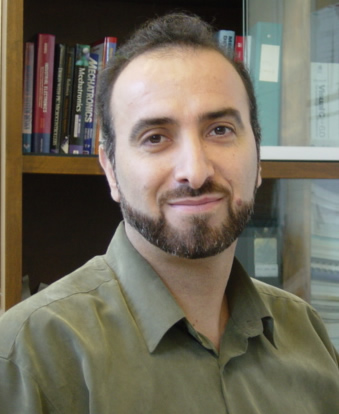

So Emami and his team developed a reconfigurable robot manipulator and an Integrated Design and Simulation Environment (IDSE) using MATLAB and Simulink, software programs developed by Mathworks Inc. The robot manipulator will allow students in the course to design, simulate, optimize and operate most configurations of robot manipulators used in industry today, Emami said.
“Our students now have a reconfigurable platform that enables them to explore the various robot configurations they are likely to encounter in industry. They are learning to design optimized robots for a given task, which would be impossible if they were working with only one type of robot manipulator with a fixed configuration.”
Mathworks is now featuring Emami’s innovative solution on its website. More information on how he did it can be found here.

What can sports teams learn from the manufacturing industry? Plenty, according to Professor Timothy Chan(MIE) and Douglas Fearing, an Assistant Professor in Technology and Operations Management at the Harvard Business School.
Professor Chan and Fearing took first place in the 2013 MIT Sloan Sports Analytics Conference research paper competition for their paper, ‘The value of flexibility in baseball roster construction.’
Chan and Fearing are former graduate-student colleagues of MIT’s Operations Research program. Their paper’s cue came from the research of Professor Stephen Graves, Abraham J. Siegel Professor of Management at MIT Sloan.
Graves studied how flexibility in automotive manufacturing networks helps companies continue to operate efficiently even when changes occur in supply and demand. Similarly, a baseball team wants to keep winning games if players are injured.
Using statistics from the 2012 season, Chan and Fearing found that positional flexibility – the ability of a player to play multiple positions – is valuable, responsible for up to 15 per cent of the team’s runs, as was the case with the Chicago Cubs. Other teams like the Washington Nationals and the Tampa Bay Rays were less robust to injuries.
“Flexibility is important because it provides a team with options and allows a team to field a good line-up even if some players are injured,” said Professor Chan.
Last year, during the 2012 MIT Sloan Sports Analytics Conference, he and David Novati (IndE 1T2) proposed a new methodology for quantifying the value of a hockey player. Professor Chan continues this research with his recent proposal to analyze performance of junior hockey players.
Professor Chan will develop a novel classification system for junior hockey players using advanced mathematical methods, in order to find patterns in performance data that may be otherwise hard to detect. The proposed project represents the first effort to analyze junior hockey players, using similar mathematical models that he developed for the NHL.
“Eventually, we may be able to relate performance at the junior level to the professional level,” said Professor Chan. “Such research may inform strategies for drafting or targeted recruitment of high-potential players.”
Professor Chan is the only U of T Engineer to be awarded funding from Research Program in Applied Sport Sciences (RPASS) of the Ministry of Tourism, Culture and Sport (MTCS) in conjunction with the Canadian Sport Centres: Ontario (CSC-O) and the Centre for High Performance Sport at U of T. The goal of the RPASS program is to fund research that will assist the provincial plan for developing excellence in sport.
Since its inception in 2006, the MIT Sloan Sports Analytics is the premier forum for industry professionals (executives and leading researchers) and students to discuss the increasing role of analytics in the global sports industry. MIT Sloan is dedicated to fostering growth and innovation in this arena, and the conference enriches opportunities for learning about the sports business world. The conference is open to anyone interested in sports.
Professor Chan, whose research delves mostly into operations research in health care, is enthusiastic about the growing interest in sports analytics by statisticians, mathematicians, computer scientists and engineers. “The mathematical tools I develop to solve healthcare engineering problems have broad application in other domains. It is exciting to be able to combine my interest in sports with my methodological research.”
ECE Professor and father of ‘wearable computing’ Steve Mann has granted readers a rare glimpse behind the glass in a feature article for IEEE Spectrum Tech Alert. In the profile, titled ‘Steve Mann: My Augmediated’ Life,’ Mann addresses the pros and pitfalls of embracing mediated reality, and what he’s learned over his 35 solid years of field testing.
As the concept of ‘augmented reality’ goes mainstream with Google’s high-profile Project Glass, Mann’s research gives us a taste of what millions may be in for in adopting the technology. Google Glass is an internet-enabled device that overlays digital information on what look like regular eyeglasses. Mann says the project is much less ambitious than the computer-mediated vision systems he was building decades ago.
“I have mixed feelings about the latest developments,” Mann writes. “On one hand, it’s immensely satisfying to see that the wider world now values wearable computer technology. On the other hand, I worry that Google and certain other companies are neglecting some important lessons … my concern comes from direct experience.”
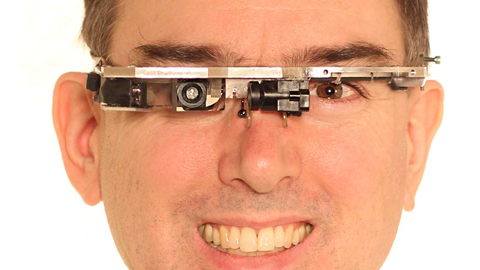
Mann touches on an apprehension already emerging in popular discourse around Google Glass – that early versions of his designs “marked [him] as a nerd” – and moves on to a substantial analysis of the display design decisions revealed so far.
“Google Glass and several similarly configured systems now in development suffer from another problem I learned about 30 years ago that arises from the basic asymmetry of their designs, in which the wearer views the display through only one eye,” Mann writes. “Using lenses in this way forces one eye to remain focused at some set distance while the focus of the other eye shifts according to whatever the wearer is looking at, near or far. Doing this leads to severe eyestrain.”
As for the future, Mann predicts cameras will continue their forward creep into everyday gizmos, but whether the net result will be a gain or loss for humanity it’s too early to say.
The topic has been capturing imaginations across Canada and around the world, and Mann was recently featured in a CBC segment cryptically called ‘Google Glass is just the beginning.’
Expect the conversation to continue when Mann chairs the 2013 IEEE International Symposium on Technology and Society, running from June 27-29 in Toronto. This year’s conference tackles the social implications of wearable computing and augmented reality in everyday life.
[youtube https://www.youtube.com/watch?v=ygcm0AQXX9k]
Read more about Steve Mann and commercial advances in wearable technology on the MIT Technology Review website.
A new technique developed by Electrical and Computer Engineering (ECE) Professor Ted Sargent , Canada Research Chair in Nanotechnology, and his research group could lead to significantly more efficient solar cells, according to a recent paper published in the journal Nano Letters.
The paper, “Jointly-tuned plasmonic-excitonic photovoltaics using nanoshells,” describes a new technique to improve efficiency in colloidal quantum dot photovoltaics, a technology which already promises inexpensive, more efficient solar cell technology. Quantum dot photovoltaics offers the potential for low-cost, large-area solar power – however these devices are not yet highly efficient in the infrared portion of the sun’s spectrum, which is responsible for half of the sun’s power that reaches the Earth.
The solution? Spectrally tuned, solution-processed plasmonic nanoparticles. These particles, the researchers say, provide unprecedented control over light’s propagation and absorption.
The new technique developed by Sargent’s group shows a possible 35 per cent increase in the technology’s efficiency in the near-infrared spectral region, says co-author Dr. Susanna Thon. Overall, this could translate to an 11 per cent solar power conversion efficiency increase, she says, making quantum dot photovoltaics even more attractive as an alternative to current solar cell technologies.
“There are two advantages to colloidal quantum dots,” Thon says. “First, they’re much cheaper, so they reduce the cost of electricity generation measured in cost per watt of power. But the main advantage is that by simply changing the size of the quantum dot, you can change its light-absorption spectrum. Changing the size is very easy, and this size-tunability is a property shared by plasmonic materials: by changing the size of the plasmonic particles, we were able to overlap the absorption and scattering spectra of these two key classes of nanomaterials.”
Sargent’s group achieved the increased efficiency by embedding gold nanoshells directly into the quantum dot absorber film. Though gold is not usually thought of as an economical material, other, lower-cost metals can be used to implement the same concept proved by Thon and co-workers.
She says the current research provides a proof of principle. “People have tried to do similar work but the problem has always been that the metal they use also absorbs some light and doesn’t contribute to the photocurrent — so it’s just lost light.”
More work needs to be done, she adds. “We want to achieve more optimization, and we’re also interested in looking at cheaper metals to build a better cell. We’d also like to better target where photons are absorbed in the cell — this is important to photovoltaics, because you want to absorb as many photons as you can as close to the charge-collecting electrode as you possibly can.”
Thon estimates that solar cells based on the technology could begun to be integrated into building materials, automobiles, mobile devices and other products in about five years.

The research is also important because it shows the potential of tuning nanomaterial properties to achieve a certain goal, says Professor Paul Weiss, Director of the California NanoSystems Institute at the University of California at Los Angeles (UCLA).
“This work is a great example of fulfilling the promise of nanoscience and nanotechnology,” Weiss says. “By developing the means to tune the properties of nanomaterials, Sargent and his co-workers have been able to make significant improvements in an important device function, namely capturing a broader range of the solar spectrum more effectively.”
Besides Sargent and Thon, other ECE authors were Daniel Paz-Soldan, Anna Lee,Michael Adachi, Haopeng Dong, Pouya Maraghechi, Mingjian Yuan, André Labelle and Sjoerd Hoogland. Kun Liu and Eugenia Kumacheva from the Department of Chemistry also contributed.
Chakameh Shafii (MechE MASc 1T4) is offering a word to the WISE for female engineering students and new graduates: Join us for a weekend of innovation at the first-ever Women in Science and Engineering (WISE) national conference on March 16 and 17 at U of T.
Shafii, who is chairing the conference, says it will provide a great opportunity for students and young alumni to come together, to network and hear the stories of some really interesting people, leaders and fellow students from across Canada. And it’s not just for women, she adds.
The theme of the conference is “Imagine, Innovate, Inspire” and its goal is to inspire a younger generation of female leaders to explore different possibilities, to think outside the boundaries and to appreciate the opportunities they are given, Shafii says.
The conference is being organized by WISE’s University of Toronto branch. It will include workshops on topics such as work-life balance, leadership and health & wellness, panel presentations on the future of energy, personalized medicine and digital health, as well as networking breaks.
U of T Engineering Acting Dean Yu-Ling Cheng will open the conference with welcoming remarks. Keynote speakers include MaRS Discovery District President Ilse Treurnicht, former Hydro One CEO Laura Formusa and Google litigation director and U of T Engineering grad Catherine Lacavera (CompE 9T7). All the keynote speakers will be in attendance for the entire conference to meet and talk to attendees.
There will also be a career fair with companies such as General Electric, Cisco Canada, Cisco US, MDA, Accenture, Deloitte, Altera, Hydro One and many more on hand to hire for full-time, internship and Professional Engineering Year (PEY) placements. The conference also includes a ‘Tech-Case’ competition presented by Cisco, which gives attendees the chance to practise their solving skills using their engineering and science backgrounds.
Registration costs $100 and tickets are going fast. U of T Engineering students have 60 per cent subsidies, which means they only pay $40 for the two-day conference. For more information, go to wise.skule.ca/conference/.
The WISE conference is just one of many events taking place during National Engineering Month. To see what else is happening at U of T Engineering this month, visit our National Engineering Month page.
