
Internet-connected eyeglasses and similar technologies will soon be on the market, but their benefits and dangers are little understood. Professor Steve Mann (ECE) hopes to change that at a groundbreaking conference at U of T in June 2013.
Professor Mann, a pioneering researcher in the fields of wearable computing and ‘augmediated reality’ (AR), is bringing together renowned experts in wearable technology, artificial intelligence and virtual reality to discuss both the potential and the pitfalls of these technologies. Speakers will include renowned artificial intelligence researcher Marvin Minsky, futurist and inventor Ray Kurzweil, legendary computer scientist Gordon Bell, privacy expert Helen Nissenbaum and American Civil Liberties Union president Susan N. Herman.
The conference, the annual Institute of Electrical and Electronics Engineers International Symposium on Technology and Society (ISTAS), is called ‘The Social Implications of Wearable Computing and Augmediated Reality in Everyday Life.’ It will be held at U of T Engineering’s Bahen Centre for Information Technology, June 27-29, 2013.
Papers on topics such as surveillance and sousveillance in society, humanistic intelligence, artificial intelligence, augmediated reality, geolocation mapping, Web 3.0, biofeedback, privacy, security, as well as legal, moral and ethical issues will be accepted through the conference website until February 28, 2013, said Professor Mann, the general chair of the conference.
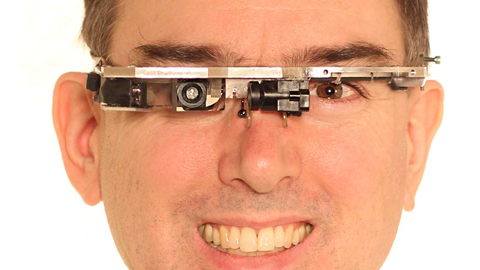
Known as the ‘father of wearable computing,’ Professor Mann has been inventing, designing, building and wearing computer vision systems for more than 35 years, and has also written extensively on the legal, social and ethical implications of such technology. Among his inventions is the EyeTap, which he described as a device which allows the eye itself to function as both a display and a camera. “EyeTap is at once the eye piece that displays computer information to the user and a device which allows the computer to process and possibly alter what the user sees.”
“The environment around us is becoming ‘smarter,’ said Professor Mann. “Soon, there will be a camera in nearly every streetlight to do better occupancy sensing, and ultimately a camera in every light fixture. Many appliances and everyday products, such as automatic flush toilets, faucets and sensor-operated showers, are starting to use more sophisticated camera-based, computer-vision technologies,” he added.
Wearable technology and AR are not something from science fiction or the distant future. They need to be discussed today, Professor Mann contended. He noted that Google has already beta-tested internet-connected glasses similar to the EyeTap.
“Soon your built-in, 3-D camera in your eyeglasses will be able to display onto your retina the names of people it recognizes, and then let you see through walls and buildings to show you your friends sitting in a nearby restaurant. Then it reads your brainwaves, and if it senses you want to join them, it guides you to them.”
“In a world of smart things like smart lights, smart toilets, smart grids, smart meters, smart roads, and the like, what happens when you have ‘smart people,’ – when you put sensors on people? What do we make of the growing numbers of businesses like department stores and restaurants that prohibit cameras, yet display QR codes that require cameras to read and understand? These are some of the things we’ll discuss at ISTAS. We’re very excited and proud to host this conference.”
For more information about the conference, go to http://ieeexplore.ieee.org/xpl/mostRecentIssue.jsp?punumber=6596466.
A detector so sensitive it can register a single molecule of carbon dioxide: that’s the goal that Professor Harry Ruda (MSE) and his colleagues are working towards.
And that goal is getting a little closer, thanks to a $350,000 three-year grant from Carbon Management Canada.

Professor Ruda, holder of the Stan Meek Chair in Advanced Nanotechnology, directs U of T Engineering’s Centre for Advanced Nanotechnology. He’ll be working with David Risk of St. Francis Xavier University on the carbon dioxide sensor project.
Current sensors used to detect carbon dioxide at surface sites are either very expensive, or they use a lot of energy, Professor Ruda says. And they’re not as accurate as they could be. Improving the accuracy of measuring and monitoring stored carbon dioxide is seen as key to winning public acceptance of carbon capture and storage as a greenhouse gas mitigation method.
The sensor technology needed to monitor and validate the amount of carbon dioxide being emitted has not kept pace with the development of other technologies required for carbon capture and storage, says Professor Ruda.
“This is especially true when it comes to surface monitoring verification and accounting (MVA),” he says. “Improving MVA is essential to meet the potential of carbon capture and storage.”
And that’s where the ultra-sensitive sensor comes in. “It’s good for sounding the alarm,” says Professor Ruda. “But it’s also good from a regulatory point of view because you want to able to tell people to keep things to a certain level, and you need sensors to ensure accurate monitoring of industrial and subsurface environments.”
His concept is a single nanowire transistor that would have unprecedented sensitivity for detecting carbon dioxide emissions. “The way things behave at the nano scale is different than the traditional or micron scale. We’ve been working in this area for nearly 20 years, and we are among the leaders in developing the know-how for nano sensors.”
The sensors could provide complete topographic and temporal mapping of carbon emissions, which would help in the design of new protocols for carbon storage and recovery systems as well provide the means for enforcing regulations – all of which will enable markedly reduced emissions.
Carbon Management Canada (CMC) is a national network with representatives from academia, government and industry that supports research to reduce carbon dioxide emissions in the fossil energy industry, as well as from other large stationary emitters. The grant is part of CMC’s third round of funding which saw the network award $3.75 million to Canadian researchers working on eight different projects.
[vimeo 55252822 w=760 h=428]
Three U of T Engineering graduates have invented the world’s most energy-efficient light bulb, the NanoLight.
According to Gimmy Chu (ElecE 0T6), Tom Rodinger (IBBME PhD 0T7) and Christian Yan (ElecE 0T6), it’s a breakthrough in LED lighting technology.
Made out of printed circuit-board material that’s folded into the shape of a light bulb, it has what Chu describes as a ‘funky’ shape, but for good reason. It uses only 12 watts of electricity to generate the equivalent output of a 100-watt incandescent bulb.
“We wanted to take our knowledge and skills to create real-world products,” Chu told the Toronto Star. The group, who became friends while on U of T’s Blue Sky Solar Racing team, are now reaching out to distributors and investors, and have also launched a Kickstarter campaign to fund the project. So far, they’ve raised more than $125,000 and hope to sell the bulb through the website.
According to Chu, the co-founder of NanoLight, if you burn the bulb for an average of three hours a day, the bulb would last 20 years. “Really, the future of the lighting industry is LEDs,” he said.
To learn more, visit the Toronto Star and U of T News.
Although entrepreneurship is sometimes perceived as a one-person show – think Steve Jobs – in many cases, the next big, successful business idea is ignited through teamwork.
That’s the basis behind U of T’s first-ever Idea Ignition Weekend, hosted by U of T Engineering’s The Entrepreneurship Hatchery and the Nspire Innovation Network. The weekend event, which took place on January 19 and 20, encouraged U of T students – from engineering, to commerce, to criminology – to join forces, molding ideas into a winning business pitch.
“The goal of the event was to promote not only entrepreneurial thinking around an idea, but to encourage team-building,” said Adjunct Professor Joseph Orozco, Acting Director of The Entrepreneurship Hatchery. “Students were working in groups with people they’ve never met before, from different programs – that’s how ideas morph.”

More than 50 students participated in the inaugural event, which saw them split into 15 teams to develop an innovative idea to pitch to judges on the final day. Many of the business concepts were rooted in software engineering, including the team behind ‘Code 101,’ who came up with an online software development learning platform.
They were among the six teams who made it to the final round, where they got to pitch to a panel of three generations of entrepreneurs. Among them, emerging entrepreneur and recent engineering graduate Hadi Aladdin (CompE 1T2) of CoursePeer Inc., young alumnus Somen Mondal (CompE 0T2), CEO of Field ID, and seasoned entrepreneur Arthur H. Watson (CivE 7T5) of Convergent Bioscience Ltd.
The winning teams were ‘Fashion Choice,’ who presented a social, mobile-based platform for fashion lovers, designers and brands to connect; ‘SKUA,’ who pitched a collapsible, multi-purpose bag to be used by the day-to-day consumer; and, ‘SizeRight,’ who got an honourable mention for their mobile-based, e-commerce platform that facilitates the sale of denims between retailers and consumers.
“The weekend was a great success,” said Orozco. “Students came together in a fun and practical environment to build the next generation of business ideas.”
It may not be as popular as Angry Birds, but the Corrosion iPhone app developed by Jason Tam (MSE 1T2 + PEY) is finding a grateful audience among professional engineers and engineering students. Tam created the app last year when Professor Steven Thorpe asked his MSE 315 Environmental Degradation of Materials students whether anyone would be interested in developing an app that provided corrosion terminologies, formulae and benchmarking data.

Thorpe had originally hoped to find an existing app that students could use in the course, which primarily deals with electrochemical and corrosion behaviour of engineering materials in various applications. He could only find one less than ideal app in the iTunes store that didn’t even spell ‘corrosion’ correctly. “So I thought to myself, why not bring the course content into smartphones and engage students in a medium they fully comprehend?”Although Tam had no background in application development, he taught himself to use Objective C — the programming language for Apple applications — and completed a working draft of the program in only four months, just before he had to fly out to Nunavut for his year-long Professional Experience Year (PEY) term at Agnico-Eagle Mines Limited. He completed the app during his time off and on monthly 12-hour trips back home to Ontario.


Almost 3,000 students crowded into the McCaul Street Exam Centre for the fourth annual You’re Next Career Fair last week to meet with 81 potential employers ranging from A Thinking Ape to Xtreme Labs.

That number was sixty percent higher than last year’s turnout, said Denizcan Karadadas (IndE 1T3), associate director of the career fair. Though most attendees were engineering students (the event is organized by the You’re Next Career Network, a U of T Engineering Society initiative), students from other disciplines such as business administration, geology and computer science also showed up to see what companies such as Hatch, Goodyear, Microsoft, Syncrude and CanadaHelps had to offer.
Besides the career fair, You’re Next Career Network also hosts a start-up career expo, held in October, where students can meet with representatives of start-up companies.It also organizes Launchpad, a year-long series of events to help students build their professional skills such as networking and resume writing. “We help them get to know what’s out there, and get them ready for life after school,” said Karadadas.
Yi Wei Ang (IndE 1T3), president of You’re Next Career Network, said U of T Engineering’s Engineering Career Services staff deserved thanks for helping the organization connect to potential employers, and also for organizing several events leading up to the fair, including resume and interview workshops and mock interviews.
Karadadas said he was very pleased with the fair this year. “I talked to a lot of employers, and they’re all very happy about the way we organized things. Everything’s been going really well so far, and all the feedback I got was along the lines of how much more professional this looks this year.” The students were also happy with the fair, and the chance to meet face to face with potential employers.
He looked at the steady stream of students coming through the exam centre’s doors and smiled. “We’ve come a long way since 2010 when we began with only 18 employers. We might have to move to a bigger venue next year, but that’s a good problem to have.”