
Toronto’s electrical system is a little smarter now, thanks in part to a U of T team led by Professor Reza Iravani (ECE).
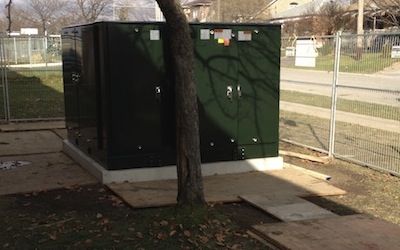
Toronto Hydro has installed a 250-kW, 48-module battery storage unit at the Roding Arena and Community Centre in North York. The battery system can power a small street for one hour. But what makes the unit unique, according to Professor Iravani, is that it is connected to the Toronto Hydro power grid, and can store energy during off-peak times and release it back into the grid as needed. The system can also store and release power added to the grid by solar energy panels installed at the community centre.

The project was developed by a consortium consisting of Toronto Hydro, Markham-based eCAMION, Korean battery manufacturer Dow-Kokam and U of T. Professor Iravani and his team developed and implemented the algorithms that integrate the battery system, through a power electronic converter, in the Toronto Hydro grid.
“This is not just an academic research project,” said Professor Iravani, the coordinator of U of T’s Centre for Applied Power Electronics. “We had to deliver a functioning system with the high degree of reliability that Toronto Hydro requires.”
“We’re providing the brain for the operation of this battery system to appropriately integrate it into Toronto Hydro’s distribution grid.”
Depending on information the energy storage unit receives from the distribution grid, it will either store power in the battery system, or, if the grid is overloaded, discharge energy back into the system.
The Roding Community Centre battery unit is the first of three that will be installed in a Toronto Hydro ‘smart grid’ pilot project. A smart grid uses information and communications technology to automatically gather and act on supply and consumption information to improve the efficiency, reliability, cost and sustainability of electricity production and distribution.
But smart grids need coordination, timing algorithms and communication protocols in order to work. “It requires major changes in the conventional approach for the operation of utility grids,” said Professor Iravani.
Toronto Hydro notes that the current electrical infrastructure is aging, with some of it dating back to the 1940s. Upgrading the system to include “smart technology” will give the utility the flexibility to integrate renewable technologies such as solar panels and wind turbines, charge electrical vehicles, reduce peak demand, lower energy costs and reduce pollution.
The project is supported by Sustainable Development Technology Canada.
[youtube https://www.youtube.com/watch?v=wGLX0mKjmwA?list=UUPO0OTx9uIymuYmG_Ss1AEQ]
Passwords are the bane of 21st century life. But Bionym, a Toronto-based tech start-up founded by Foteini Agrafioti (ElecE MASc 0T9 PhD 1T1) and Karl Martin (ElecE BASc 0T1 MASc 0T3 PhD 1T0), promises to change that. The company develops biometric software. Its latest project may change the way we secure our digital information in the near-future.
The secret is a heartbeat away. Literally.
“HeartID is currently the only commercially available biometric authentication solution that uses the cardiac signal,” says Agrafioti.
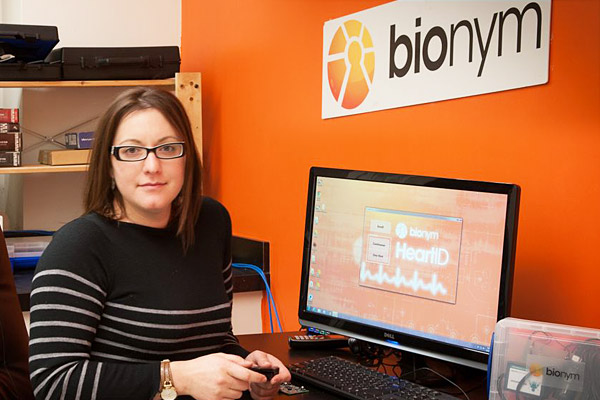
Bionym’s HeartID software detects and distinguishes a person’s unique heartbeat (cardiac signal) through sensors. The technology can be used to secure various devices with an accuracy greater than 99 per cent, roughly the same as current fingerprint-enabled security systems.
But while fingerprints require an intentional swipe, and facial and iris recognition software requires careful positioning of a person’s face in front of a camera, a heartbeat is much more foolproof and convenient.
Bionym is located in the U of T’s recently launched Banting and Best Centre for Innovation and Entrepreneurship, which supports entrepreneurs turning lab research discoveries into products and companies. Bionym is just one of more than a dozen start-ups taking advantage of the centre’s access to resources and mentorship opportunities.
A demonstration model of HeartID at Bionym’s headquarters shows how the technology works. By gripping a device resembling a computer-connected mouse with built-in sensors, the PC recognizes the authorized individual’s unique cardiac rhythm and allows them to log-in without having to enter a password.
“By embedding sensors into devices, a person can be seamlessly and continuously authenticated during normal device usage,” says Agrafioti.
Continuous monitoring means that if an authorized user logs in with the controller and hands it to unauthorized user, the computer will recognize the difference and immediately log off.
“We’re looking to usher in a new era where our devices will know who we are, enabling automatic personalization,” says Agrafioti of her software. “Imagine using the family tablet, gaming device or even car, and having it know who is using it, and loading all of their settings and accounts automatically.”
In the future, parents may never again have to worry about their unlicensed teenagers taking the family car out for a spin.
Bionym is in the early stages of licensing HeartID to hardware manufacturers and could soon be used in video game controllers, tablet computers, cell phones and even firearms and automobiles, says Agrafioti.
The algorithm behind HeartID evolved from Agrafioti’s doctoral research in Electrical and Computer Engineering, which she completed under the supervision of Professor Dimitrios Hatzinakos, chair of U of T Engineering’s Identity, Privacy & Security Institute, along with co-inventor Professor Francis Bui.
After the team developed the technology in the lab, it was transferred to Bionym, where it was commercialized into HeartID. Along the way it was helped by the U of T’s Innovations and Partnership Office (IPO) which assists the university’s research community in building successful partnerships with industry.
To read the full article on Bionym, visit U of T News
U of T Engineering’s start-up company, Cast ConneX Corporation, is helping to rebuild one of the country’s earthquake-stricken schools.
The company donated 170 of its earthquake-resistant connectors to the reconstruction of École Lakay, a trades training centre being built for young Haitians in Le Soleil, near the capital city of Port-au-Prince.
According to Carlos de Oliveira (CivE MASc 0T6), president and CEO of Cast ConneX, most buildings today are constructed to withstand wind, but are still susceptible to earthquakes.
Cast ConneX’s connectors, however, are not only simpler to design, fabricate and erect, but are seismic-resistant. “They provide laboratory-proven earthquake performance and offer significantly improved constructability and erectability,” said de Oliveira.
The technology behind Cast ConneX’s connectors was developed at U of T Engineering in 2006, based on de Oliveira’s graduate thesis work and the doctoral work of Michael Gray (CivE PhD 1T1). Both research projects were supervised by CivE professors Jeffrey Packer and Constantin Christopoulos.
In 2007, the four founded Cast ConneX as a start-up company to commercialize life-saving connectors. The impact of its technology on the well-being of society has earned Cast ConneX the Canadian Society for Civil Engineering’s 2009 Award for Excellence in Innovation in Civil Engineering.
Reception was surprisingly good on the phone call from space.
“We just flew across Canada,” said Commander Chris Hadfield, speaking from the International Space Station.
“It took about seven minutes.”
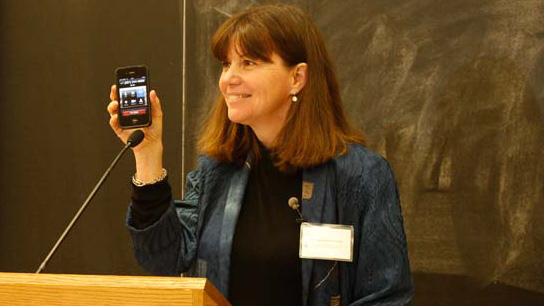
His voice travelled from the reaches of earth’s orbit to astronaut Catherine Coleman’s mobile, held up to a microphone before a packed hall of University of Toronto students and faculty.
An astronaut with the National Aeronautics and Space Administration (NASA), Coleman was at U of T on January 9 to deliver the latest talk in the Lectures on the Leading Edge (LLE) series hosted by the Department of Chemical Engineering & Applied Chemistry.
She called in a favour with her long-time friend and colleague Hadfield to connect her audience with the realities of science in space in the most immediate of ways.
After the brief call ended, Coleman shared her own stories and experiences from three trips, and more than 180 days, in space. Though Coleman was a part of two space shuttle missions (1995, 1999) her talk focused on the six months she spent on the International Space Station (ISS) starting in December of 2010, as well as how the facility offers opportunities for scientists at the University of Toronto.
“Being an astronaut is not just about going to space, it’s about being eyes and ears,” said Coleman, “it’s about representing the human point of view. Because more than just the actual stuff that gets done up there, we are part of a team that explores.”
Coleman described some of the numerous experiments on board the space station – such as using blood pressure readings from space to predict fainting and analyzing bone metabolism to further osteoporosis research. As the mission’s lead science officer, Coleman led more than 150 different investigations.
“In science and engineering, we address critical societal questions,” said Professor Molly Shoichet (ChemE, IBBME). “The purpose of Lectures on the Leading Edge is to shed light on new ideas and ways of thought. Catherine’s lecture did exactly that. She inspired members of our audience to tap into their hidden potential.”
To read the full article on Coleman’s lecture, visit U of T News.
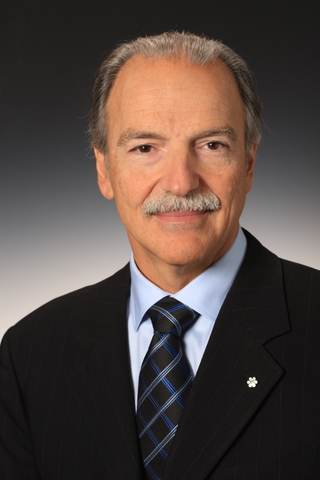
Pierre Lassonde, a generous benefactor of mineral engineering at the University of Toronto, was inducted into the Canadian Mining Hall of Fame on January 11, 2013.
Philanthropist and talented businessman, Lassonde is recognized as one of Canada’s foremost experts in the area of mining and precious metals. His cumulative giving to the University exceeds $10 million, the largest contribution to mineral/mining engineering education in Canadian university history. Both the Lassonde Institute of Mining and the Lassonde Mineral Engineering Program, as well as the Lassonde Mining Building now bear his name.
In 2001, he was granted an honourary degree by the University of Toronto. Lassonde has received many other awards, including the Order of Canada in 2002, Mining Man of the Year (1997) and Developer of the Year as well as other honourary doctorates in Canada and the USA.
“Pierre Lassonde has long been a friend and benefactor to Mineral Engineering at U of T,” said Cristina Amon, Dean of the Faculty of Applied Science & Engineering. “I am delighted that he has been honoured in this way and I extend my heartiest congratulations to him and his family on behalf of U of T Engineering.”
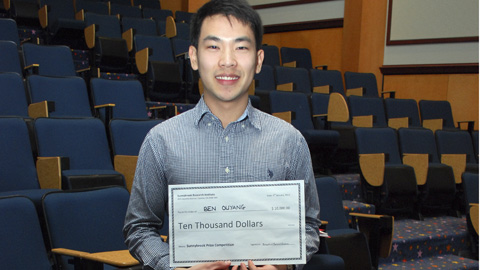
Ben Ouyang, a fourth-year Engineering Science student (Biomedical Engineering option) has been awarded first prize in the Sunnybrook Prize competition.
The national research competition recognizes excellence in undergraduate engineering and physical sciences research and promote careers in biomedical engineering, pitting 10 undergraduate finalists from across Canada against one another. Competitors give a final presentation before a panel of Sunnybrook Research Institute judges for the top $10,000 prize.
“The level of competition was pretty crazy,” said Ouyang. “There were a lot of really, really great projects.”
This year, students from Ontario schools such as Waterloo and Western presented on topics as varied as new ultrasound transducers and a new coil for an MRI machine, building upon a tradition of outstanding research. “Last year’s winning research was in quantum entanglements,” said Ouyang, “It’s really impressive.”
Two other U of T Engineering students also rounded out the top ten: Ang Cui (EngSci 1T3 + PEY) and Mark Aquilino (EngSci 1T5).
Ouyang’s winning research focused on the creation of a new, elastic biomaterial substance with ‘highly tune-able’ mechanical properties. It’s thought that the unique material will enable better drug delivery systems.
The research was a project Ouyang worked on at MIT as part of his Professional Experience Year (PEY), a year in which students explore research in a professional environment. The biomedical program Ouyang joined is a joint program between Harvard and MIT.
Ouyang worked under a PhD student Maria Pereira and Jeff Karp (IBBME 0T4), Associate Professor of Medicine at the Harvard Medical School and Brigham and Women’s Hospital. Ouyang was one of the researchers named on the patent application filed on the biomaterial research this past summer, and was an author on the article, which was recently published in high-impact scientific journal Advanced Materials.
“Ben is an outstanding, fast-paced, yet humble individual who has made a lasting impact on my laboratory,” said Karp. “I have very high expectations for Ben’s success and I am very proud of him and his accomplishments, including the Sunnybrook Prize.”
Ouyang’s prize comes on the heels of another accolade; this fall he also took top prize at the IBBME Undergraduate Summer Research Program symposium.
“Ben has been a top-performing student of the Engineering Science program, one of the toughest and most demanding engineering programs of its kind,” said Ouyang’s supervisor at IBBME, Director Paul Santerre. “His maturity, work ethic and problem-solving skills are good indicators that Ben’s accomplishments will continue to guide his success in the future.”
Graduating in the spring, Ouyang has applied to U of T’s MD/PhD program in the Faculty of Medicine to further his interests in biomedical engineering and medicine.