

On February 6, Professor Molly Shoichet (ChemE, IBBME) will be awarded the Queen Elizabeth II Diamond Jubilee Medal, an award that marks the Queen’s 60th year of reign.
“It’s a huge honour,” said Professor Shoichet. “You realize the importance of that honour when you look around at the other recipients.”
Her nomination for the Queen’s honour originates with her induction to both the Royal Society of Canada and the Order of Ontario in 2011, for her contributions to the scientific community. Professor Shoichet, a world-renowned researcher in the field of regenerative medicine, also holds a Canada Research Chair (Tier I) in Tissue Engineering.
“Molly is very deserving of this recognition,” said Professor Grant Allen, Chair of ChemE. “She is truly a pioneer in working across disciplines in applying advanced chemical and biochemical sciences and engineering to the field of regenerative medicine.”
Professor Shoichet and her students focus on neural engineering research, on ways to heal traumas to the brain or spinal cord through stimulating and transplanting stem cells. “What we bring to the area is a biomaterials approach, where innovative materials enable stem-cell survival and integration,” said Professor Shoichet.
During stem-cell transplants, for instance, usually over 99 per cent of transplanted cells never manage to integrate, resulting in cell death. Shoichet and her researchers strive to incorporate biomaterials into their transplantation strategies to promote survival, while breaking down barriers to cell integration.
The Queen Elizabeth II Diamond Jubilee honour comes on the heels of a number of high-profile recognitions for Shoichet, who was recently inducted as a Fellow into the Canadian Academy of Health Sciences. This honour distinguishes her as the first to hold fellowships in the Canadian Academy of Health Sciences, the Canadian Academy of Engineering (2012) and the Royal Society of Canada’s Academy of Science (2008).
“Molly Shoichet has made substantial contributions to the research community and it is great to see this recognized with such a significant honour,” stated Paul Santerre, Director of IBBME, where Shoichet also holds the position of Associate Director, Research.
Professor Shoichet said of this rare distinction, “I have been privileged to have great mentors and collaborators, and fantastic researchers in my laboratory.”

Women need to embrace curiosity and risk taking if they want to excel in science and engineering, says U of T Engineering alumna Natalie Panek (AeroE MASc 0T9).
Panek, a systems engineer at MDA Space Missions, emphasized her desire to see more young women become scientists and engineers in a recent TEDxYouth@Toronto talk.
“For me, my dream would be to inspire more women into challenging themselves and taking risk to enrol themselves in science and engineering fields,” said Panek. She notes that fewer than 20 per cent of students in science, technology and engineering programs are women and that these numbers have not been improving in recent years.
“We need to encourage more women to test ideas and push boundaries,” she added.
Panek practises what she preaches. She helped design and drove the University of Calgary’s car in the 2005 Solar Challenge, and at U of T, she helped design and complete combustion experiments that simulated microgravity. She’s also participated in the International Space University Space Studies Program and has been a special project intern at the NASA Goddard Space Flight Center.
In her TEDx talk, Panek urges girls to challenge themselves, to always be learning, and to take risks. “You can’t make a wrong decision,” she said. “You can just make decisions that will lead you down different paths, which give you different stories to talk about and different adventures to tell about.”
“Start thinking like leaders, start speaking like leaders, start acting like leaders,” she concluded.
Watch Panek’s talk here.
Chemical Engineering Professor Yu-Ling Cheng, Director of U of T’s Centre for Global Engineering, has been named one of the Toronto Star’s 12 ‘People to Watch’ in 2013.
Professor Cheng was singled out by The Star for her work leading a team that is designing a waterless, hygienic toilet that is safe and affordable for people in the developing world. The team recently received a $2.2 million grant from the Bill and Melinda Gates Foundation to continue work on designing the toilet.
“We are extremely proud of Professor Yu-Ling Cheng’s achievements and those to come in 2013,” said Cristina Amon, Dean of the Faculty of Applied Science & Engineering. “The toilet project addresses one of the world’s most pressing problems with the potential to improve the lives of millions of people.”
To read the Toronto Star story, click here.
For more information about the Centre for Global Engineering’s toilet project, click here.

Professor David Zingg (UTIAS) has been named the 2012 recipient of the Canadian Aeronautics and Space Institute (CASI) McCurdy Award.
One of CASI’s most prestigious awards, the McCurdy Award is presented for outstanding achievement in the science and creative aspects of engineering relating to aeronautics and space research. The award commemorates the many contributions made by U of T Engineering alumnus John A.D. McCurdy (MechE 1906) during the first stages of the development of an aviation industry in North America.
Professor Zingg is the Director of the University of Toronto’s Institute for Aerospace Studies (UTIAS) and holds the Canada Research Chair in Computational Aerodynamics and Environmentally Friendly Aircraft Design.
He has made fundamental contributions in algorithms for computational fluid dynamics and aircraft design, as well as aerodynamic shape optimization. In 2004, Professor Zingg was awarded a Guggenheim Fellowship to pursue his current area of research, the aerodynamic design of novel aircraft configurations with reduced greenhouse emissions. He has championed the need to reduce the impact of aviation on climate change and has built a team at UTIAS to address this urgent priority.
Throughout his career, Professor Zingg has collaborated extensively with Canadian aerospace companies, especially Bombardier Aerospace. Software developed by his research group has been transferred to Bombardier on several occasions, and his software for analysis of high-lift configurations played an important role in the design of the Dash 8 Q400 commuter aircraft. A leader in his professional community, he serves on the board of the Green Aviation Research and Development Network, which brings together government, academic and industrial partners to foster the development of technologies to reduce aircraft noise and emissions.
Professor Zingg is a Fellow of CASI and a Fellow of the Canadian Academy of Engineering. In 2011, he received an Ontario Professional Engineers Research and Development Medal.
“David Zingg is a groundbreaking researcher and a leader in aerospace education who has served his profession with distinction. He is most deserving of this prestigious recognition,” said U of T Engineering Dean Cristina Amon. “The Faculty is particularly honoured that Professor Zingg should receive an award named after John A.D. McCurdy, one of our most distinguished alumni.”
Professor Ted Sargent (ECE), Vice-Dean, Research, was recently awarded the 2012 Steacie Prize, an honour given each year to one person 40 years of age or less who has made notable contributions to research in Canada. And he’s not the first in his family to win the prestigious award – his wife Shana Kelley, a professor in U of T Pharmacy, won it just last year.
On December 15, both Professors Sargent and Kelley spoke to Mary Ito of CBC Radio’s Fresh Air about the synchronicity of it all. Listen to the interview here .
A 100-year-old chemical formula, co-developed by one of U of T’s first female medical graduates, has helped U of T researchers determine that the global rise in life expectancy is not benefiting everybody equally.
People are living longer on average than they were in 1970, and those extra years of life are being achieved at lower cost, the researchers, led by ChemE PhD student Ryan Hum, say in a paper published in the open access science journal eLife this month.
However, the costs for an extra year of life among adult males in lower-income countries are rising, Hum and his colleagues say, while the costs for an extra year of life among children worldwide and for adults in high-income countries continues to drop.
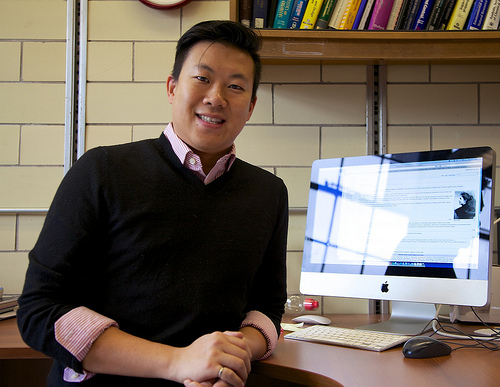
Hum, who is also a member of the Centre for Global Engineering, co-wrote the paper with Professors Yu-Ling Cheng, director of the Centre, Prabhat Jha of the Dalla Lana School of Public Health and Anita McGahan of the Rotman School of Management.
The researchers made the discovery when they took the Michaelis-Menten (MM) equation – a well-known mathematical model first used to analyze enzyme kinetics in 1913 – and applied it to adult and child mortality at different incomes. They reasoned that just as chemical catalysts affect enzyme velocity, the public health catalysts react with income to affect life expectancy.
The MM equation was co-developed by Maud Menten, who received her medical doctorate from U of T in 1911.
“We noticed the similarity in the curvature and became fascinated with the beauty of the analogy,” said Hum. The MM equation is standard curriculum for biochemistry, biology and most chemical engineering undergraduate students, and we knew there could be added knowledge that we could decipher purely from the math.”

“Over the past few decades, research and development of new technologies (drugs, vaccines, policies) have focused mostly on childhood and infectious disease, with fewer worldwide investments for adult chronic diseases,” the U of T researchers suggest. “Increasing coverage of inexpensive health interventions such as immunization, insecticide-treated nets and case management of childhood infections could be contributing to decline in critical income for child survival.”
Hum and his colleagues conclude by recommending that society invest in research and treatment of adult chronic disease, most notably the control of smoking and other risk factors for chronic diseases, and low-cost, widely useful treatments for these diseases.
In the paper, the authors expand on the analogy between enzymes and incomes: “Income directly enables certain technologies, immunization programs, epidemiological knowledge, education and sanitation systems and other areas, which may themselves be interpreted as ‘catalysts’ – agents that accelerate the rate of a reaction without being fully consumed in the process,” they write.
They came up with a new parameter, critical income, which they define as the level of income needed to achieve half of the maximal overall life expectancy found in high-income countries. For example, in 1970, the critical income for overall life expectancy (in inflation adjusted 2005 dollars) was $1.48 per day. By the year 2007, the critical income had fallen to $1.21 per day. In other words, a lower national income is needed to achieve a higher life expectancy now, compared to 40 years ago.
However, that good news is due mostly to improvements in children’s health and to increased life expectancy in high-income countries, the researchers say. For adults (aged 15 to 59) in lower-income countries, critical income has actually risen since 1970. In other words, adults in low- and middle-income countries need to have higher incomes on average in order to add an extra year of life. Adult males in these countries are especially affected, though adult females also suffer.
“Under the current conditions, an approximate national income per capita of $2.20 per day would be required in 2007 to attain the same achievable adult male survival rate with $1.25 per day in 1970. Moreover, should the critical income costs for adults continue to rise (in line with current trends),” they warn.
Hum and his colleagues noted that increases in smoking, especially among adult males, and HIV prevalence are responsible for part of the life expectancy gap. By contrast, worldwide attention to childhood health including much research on new technologies, vaccines and political attention mean a rosier future for children – it’s becoming less expensive to give children the chance for longer lives.
“Global divergence in critical income for adult and childhood survival: analyses of mortality using Michaelis-Menten“, Ryan J Hum, Prabhat Jha, Anita M McGahan, Yu-Ling Cheng