
Five engineering students are among six U of T undergrads selected as part of The Next 36, an annual program aimed at promoting Canadian entrepreneurship among undergraduate youth.
“I got in, and I was shocked,” said Simon Bromberg. “I thought there’d be no way I was going to get in, that I’d do my best and that’ll be the end of it.” Bromberg, an engineering science student majoring in biomedical engineering, said competition for a spot in the program is stiff and the selection process is rigorous.
The other winning candidates from U of T Engineering are Engineering Science students Philip Chen (EngSci 1T3), Aditya Dhoot (EngSci 1T3), Mo Yu (Lara) Fu (EngSci 1T3), and Nikita Tarakanov (CompE 1T3). Also selected was U of T Medicine student Joshua Liu.
“We had well over 500 people complete applications this year,” said Claudia Hepburn, executive director, The Next 36. “But all the University of Toronto candidates have incredibly strong academic backgrounds which made them stand out.”
“The Next 36 is a great platform to refine my thoughts, accelerate my growth, and allow my entrepreneurial career to take off,” said Fu. “It is an incredible opportunity to gain hands-on mentorship from CEOs at top and successful industries, to work with all the other young individuals who come from different backgrounds but share the same passion about entrepreneurship.”
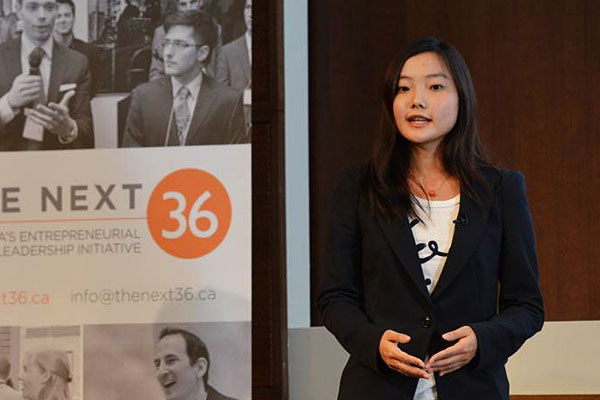
The program aims to transform the country’s most promising undergraduates into Canada’s top entrepreneurs through a mix of team work, business planning, mentoring, and intensive entrepreneurship instruction. Participants work in multidisciplinary teams of four to invent, launch and sell a product or service for the mobile or tablet market.
The Next 36 is based on ‘Economics of Entrepreneurship,’ a popular undergraduate course taught at U of T. Entrepreneurship education doesn’t stop there however – especially at U of T Engineering, where budding engineers build their business acumen through The Entrepreneurship Hatchery and the extremely popular Engineering Business minor, as well as the Entrepreneurship and Engineering Business certificates.
“What we look for are people with really strong entrepreneurship and innovative backgrounds, and also who have strong intellectual horsepower,” Hepburn said. “They need to have the ability to learn and synthesize and process information and apply what they’re learning to their ventures really quickly. Nikita and Simon and Aditya are all really strong programmers which is important because each of our ventures needs a strong programmer. And Lara has a very impressive research background and extraordinary academic credentials.”
Along with mentorship from some of Canada’s top business leaders, the eight-month program provides up to $80,000 cash from top venture capitalists, a comprehensive offering of in-kind resources and academic instruction from some of the world’s top faculty.
“This program is about moving out of your comfort zone,” Bromberg said. “Challenges are now opportunities; burdens are now chances for valuable experience.”
Engineering Science Chair Mark Kortschot said he was delighted that four Engineering Science students were chosen for the Next 36. “Engineering Science has always stressed a deep and fundamental education, and we strive to prepare our students for a wide range of things, including entrepreneurial ventures. In fact, there is a real emphasis on innovation and entrepreneurship throughout the Faculty, and this recent success suggests we are on the right track.”
“On behalf of the Faculty, I congratulate our outstanding engineering students on being chosen nation-wide as one of the Next 36,” said Dean Cristina Amon. “Since the program’s launch in 2010, our students have represented U of T Engineering every year – a testament to their entrepreneurial drive and the quality of our forward-thinking curriculum.”
Participants are selected from a variety of academic disciplines and from across Canada, based on their entrepreneurial, academic and other accomplishments and for their outstanding promise as high impact entrepreneurs. Several celebrated U of T Engineering alumni are involved in the initiative, including board members Anthony Lacavera (CompE 9T7), entrepreneur and telecommunications executive, and Francis Shen (EngSci 8T1, AeroE MASc 8T3), Chairman and Co-CEO of Aastra Technologies Ltd.
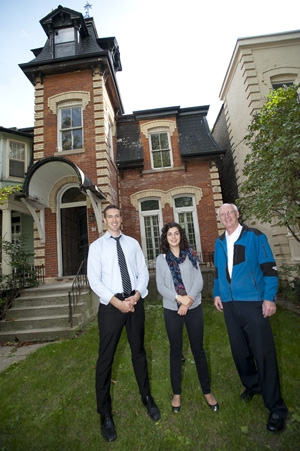
Researchers at U of T Engineering and Ryerson University are working to change the way we keep ourselves warm in the winter.
Currently, space heating is the largest contributor to residential energy consumption in Canada at 60 per cent of the total. That’s why Professor Kim Pressnail (CivE), PhD candidate Ekaterina Tzekova (CivE) and Ryerson University Professor Russell Richman (Architectural Science) are looking to cut the number down by 80 per cent.
“We have no option in a traditional home but to heat all areas, even if they are unused,” said Professor Pressnail.
The team is researching a Nested Thermal Envelop Design – a house that’s constructed to employ zonal heating. And thanks to a research grant and contributions from the Ontario Power Authority’s Technology and Development Fund and the University of Toronto, to name a few, the nested thermal envelope design will soon be implemented in a downtown-Toronto home, beginning in January 2013.
The nested thermal envelope design has two key components to recycle heat. First, the home is divided into two different zones, the perimeter and the core. The core is the home’s main living areas, while the perimeter is those less-often used rooms. Secondly, the home would have a small heating unit that cycles heat from the perimeter into the core during the winter season. The heat pump then funnels heat lost to the perimeter back into the core of the home before it is lost to the exterior of the home.
“Ordinarily, single-family homes have just one zone,” said Professor Pressnail. “Here, by having two envelopes, we effectively create two zones in which heat moisture and air movement can be controlled separately.”
Once the nested thermal envelope design is implemented into the Toronto home, the team will elect test subjects to live there, beginning with a member of their research team. Later on, the home will become a residence for visiting professors. The research team will also track behaviour patterns and get feedback from the occupants themselves. Once the data is collected from its inhabitants over the next five years, they will continue their research with a custom-built house.
“The biggest advantage is when energy prices go up or there are interruptions in the supply, it only takes a small amount of energy to keep homes comfortable,” added Professor Pressnail. “Further, this isn’t just about saving energy – it is about reducing our burden on the environment. And a low-energy home that can be operated very efficiently, treads more lightly on this earth.”
The group’s preliminary findings were published in the November 2012 issue of Energy and Buildings .
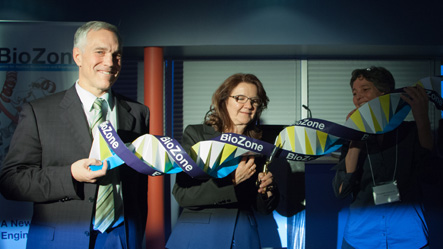
BioZone’s newly renovated and expanded space was officially opened December 4 with speeches, guided tours and a uniquely biochemical ribbon-cutting.
Close to 100 faculty, students, alumni and other guests were on hand for the event and to help celebrate the research facility, a multidisciplinary centre for collaborative bioengineering research in the Department of Chemical Engineering and Applied Chemistry. BioZone provides a nexus where the best minds from relevant engineering disciplines work together using state-of-the-art equipment to develop innovative biotechnology to protect our environment and our health.
U of T Engineering Dean Cristina Amon, helped by BioZone Director Elizabeth Edwards and ChemE Chair Grant Allen, cut the DNA-shaped ribbon, to open the space. BioZone has been in operation since 2010, but the December 4 event marked the expansion of the facility into additional space on the fourth floor of the Wallberg building.
The research conducted in the new centre focuses on providing viable solutions to urgent societal needs in energy, the environment and health. The centre is home to nine principal investigators and includes around 90 graduate students, post-doctoral fellows and research associates. In addition, the centre facilitates collaboration with researchers in a variety of fields and institutions. Research at BioZone includes anaerobic treatment of soil and groundwater contaminants, engineering cell organization and growth and economic, life cycle and policy analysis of bioproducts and biofuels.
In her opening remarks, Dean Amon noted that BioZone represents a new kind of engineering, taking advantage of recent advances in molecular biology and genomics from the field of medicine, and applies those advances to engineering challenges.
“BioZone’s goal is to have a lasting and positive impact on our environment and society, which is a goal shared by all of us at U of T Engineering,” she said.
For more information, visit the BioZone site at http://www.biozone.utoronto.ca

Professor Chul B. Park (MIE) has been recognized by the Korean Academy of Science and Technology (KAST), Korea’s national society for science and technology.
Professor Park is the Canada Research Chair in Microcellular Plastics and the founder and Director of the Microcellular Plastics Manufacturing Laboratory. A world leader in the development of innovative technologies for the manufacture of microcellular foamed plastics, he holds 20 patents and his research has been licensed by more than 700 companies.
“Professor Park is highly deserving of this recognition from the Korean Academy of Science and Technology,” said Professor Jean Zu, Chair of the Department of Mechanical & Industrial Engineering. “Professor Park’s research is world-renowned. On behalf of the Faculty, I congratulate him on this exceptional honour.”
Professor Park is a Fellow of the Canadian Society of Mechanical Engineering (CSME), the American Association for the Advancement of Science (AAAS), the Royal Society of Canada (RSC), the American Society of Mechanical Engineers (ASME), the Society of Plastics Engineers (SPE), the Canadian Academy of Engineering (CAE) and the Engineering Institute of Canada (EIC). Earlier this year, he was recognized by the American Society of Mechanical Engineers (ASME) and Society of Manufacturing Engineers (SME) with the M. Eugene Merchant Manufacturing Medal.
KAST is an organization founded in 1994 to promote the development of science and technology through use of knowledge and through the expertise of its member scientists and engineers who are distinguished in their respective professional fields.
Professor Park was recognized on November 22 during the society’s Annual General Meeting & Awards Gala in Seoul, Korea.
Professors Alberto Leon-Garcia (ECE), Andreas Mandelis (MIE) and Doug Perovic (MSE) have been elected Fellows of the American Association for the Advancement of Science (AAAS), the largest international organization dedicated to advancing science or its applications on a global basis.



Professor Leon-Garcia is the U of T Distinguished Professor in Application Platforms and Smart Infrastructure and Scientific Director of the NSERC Strategic Network for Smart Applications on Virtual Infrastructures (SAVI). In addition to his research accomplishments, he developed two industry-oriented programs in network engineering at U of T and has authored two popular textbooks, Probability and Random Processes for Electrical Engineering and Communication Networks: Fundamental Concepts and Key Architecture. Professor Leon-Garcia was elected for “distinguished contributions to the design, management and operation of communication networks and the creation of innovative educational programs in network engineering.”
Professor Mandelis is the Canada Research Chair in Diffusion-Wave Sciences and Technologies. Over the past 30 years, his wide-ranging research has helped define the discipline of diffusion wave science and extended its range to practical uses in materials research, industrial process quality control, dental caries diagnosis and soft tissue imaging, among others. Professor Mandelis has authored approximately 300 scientific papers in refereed journals, as well as the acclaimed textbook, Diffusion-Wave Fields: Mathematical Methods and Green Functions. He was elected in recognition of his “distinguished contributions to the development of diffusion-wave engineering sciences and associated technologies, and their practical application across several academic and industrial fields.”
Professor Perovic is recognized internationally for his innovative work in the fields of scanning and transmission electron microscopy of advanced semiconductors and metallic alloys, thin film nanostructures and failure analysis. A leader in program development, he created the world’s first nanoengineering undergraduate program in 2000. Professor Perovic has led more than 500 forensic investigations. He developed and teaches the only graduate level course in forensic engineering and failure analysis in Canada and recently developed U of T’s first undergraduate course in forensic engineering. His election is based on his “distinguished contributions to the study of heterostructures, microstructures and thin film nanostructures, and the development of the world’s first undergraduate degree program in nanoengineering.”
“The continued recognition of our faculty members by AAAS is a testament to the tremendous strength of our Faculty in both research and education and to our global reputation,” said Cristina Amon, Dean, Faculty of Applied Science & Engineering. “On behalf of the Faculty, I congratulate our newest AAAS Fellows for this prestigious honour and for their many achievements.”
The new Fellows were announced in the November 30 issue of Science and will be honoured at the AAAS Fellows Forum on February 16, 2013 in Boston.
How does an innovation move from the lab to the marketplace? And how do companies introduce new products and technologies to the public?
In many cases, it’s through researchers and industry joining forces.
Here’s how it works: while faculty and graduate students offer engineering research expertise, business acumen and an inside track on technologies of the future, industry partners can provide the manufacturing, testing facilities and market experience to take engineering innovations to the next level. Needless to say, the symbiotic relationship between U of T Engineers and companies is an important one – a relationship that resonates in Canada and the world.
That’s why on November 19, the Faculty held a reception to both thank its industry partners, and welcome new collaborators.
“The opportunities and initiatives that have sprung from [partnerships] are manifold – from our work with small startups, to our partnerships with larger companies like IBM, Hatch, GE Healthcare, Eco-Tec, Pratt & Whitney, Qualcomm and many others with us this evening,” said Dean Cristina Amon.
The reception – the first of its kind to take place at a Faculty-wide level within U of T Engineering – was put together by the Faculty’s research committee, led by Professor Ted Sargent (ECE), Vice-Dean, Research. The event is one of many efforts by U of T Engineering to further cultivate industry partnerships; earlier this month, the Faculty welcomed Dr. Marcius Extavour (EngSci 0T2 + PEY) to the newly established role of Director of Corporate Partnerships.
The number of industrial partnerships at U of T Engineering currently stands at a lengthy list of nearly 150, while contributions from industry is nearly four times what it was in 2001-2002.
“Our research is inherently exciting. But it’s more exciting if it has impact,” said Professor Sargent at the reception, which was attended by many faculty leaders, partners, as well as Peter Lewis, U of T’s Associate Vice President, Research. “That impact is made possible through collaboration.”
One such example is the partnership with IBM Canada. U of T is currently working with the company on the Southern Ontario Smart Computing Innovation Platform. The goal: to create a state-of-the-art computing infrastructure to solve critical problems related to cities, healthcare, water, energy and computing innovation.
There to speak more about it was Pat Horgan, Vice President, Manufacturing, Development and Operations for IBM Canada.
“One of the best things we’ve done is bring light to the leading research in Canada,” said Horgan. “We have an opportunity to do really important things here, and we have the opportunity to do something new.”