
How do you create a hydraulic arm with just water, a syringe and some cardboard?
Just ask the young students who took part in Go ENG Girl at U of T Engineering last month.
More than 100 girls from grades 7 to 10 visited the Engineering Complex with their parents to learn what it takes to pursue engineering at the post-secondary level.
Go ENG Girl events were held across the province at 15 universities. The Engineering Student Outreach office hosted the U of T Engineering session.
Each year, Go ENG Girl – organized in partnership with the Ontario Society of Professional Engineers (OSPE) – aims to inspire girls, through hands-on activities, to explore engineering; a profession that is so much more than just technology or machinery, as the girls and their parents learned that day.
“Engineering is about making a difference in the world, such as designing safer buildings as a civil engineer,” said Teresa Nguyen (CivE 1T4), answering questions from parents during a panel discussion.
As the all-female panel of current students and alumni offered parents guidance, the girls were off working in groups to create an hydraulic arm using just a few pieces of simple equipment.
With mentoring from U of T Engineering students, the girls presented their innovative designs, which even impressed their instructors.
“I was impressed by their creativity during the hands-on activity,” said Go ENG Girl instructor Yi Li (ElecE 1T4). “Some girls even asked me about how to apply to U of T Engineering. Someone mentioned genetic engineering which took me by surprise, but in a good way.”
Engineering students Muhammad Kazim Ali (CompE 1T3) and Alison Ma (ElecE 1T5) are among 45 of this year’s Electro-Federation Canada (EFC) Scholarship recipients.
The EFC Scholarship Program – which awards more than $100,000 in scholarships nationally each year – aims to encourage post-secondary students to pursue a career in electrical, electronics and telecommunications industries. Scholarships are awarded on the basis of academic achievement, areas of study, leadership and career interests.
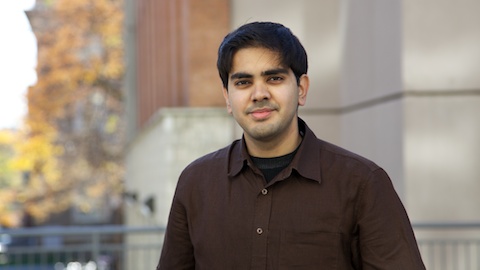
For Ali and Ma, the honour has certainly inspired them to continue to shine in their studies at U of T Engineering. “Not only has the award provided me with the encouragement to persevere here, but it gives me the affirmation that success and gratification lies in the effort,” said Ma, who received EFC’s I-Gard Corporation Student Merit Award.
“This scholarship greatly motivates me to excel, and to take part in opportunities that will develop me as a professional,” added Ali, a recipient of the EFC University Scholarship.
Ali will be graduating this summer, with plans to either pursue graduate studies or a career as a software developer.
“On behalf of the Faculty, I would like to congratulate Alison and Muhammad on their tremendous achievements,” said Dean Cristina Amon. “We take great pride in their national recognition and look forward to what they will accomplish in the future.”

Professor Eric Miller (CivE) was recently honoured with the inaugural University of British Columbia (UBC) Margolese National Design for Living Prize.
The award recognizes a Canadian who has made outstanding contributions to the development and improvement of living environments for Canadians of all economic classes.
Professor Miller has dedicated the past 30 years of his career to researching interactions between humans, urban land use, transportation and the environment, and to educating the next generation of responsible transportation engineers.
His work in the modelling of vehicle emissions, pollutant dispersion and their exposure to human populations has helped to develop a more comprehensive understanding of fundamental urban planning issues. What’s more, his Integrated Land Use, Transportation and Environment model (ILUTE), considered a world-leading contribution to the science of urban simulation, has influenced cities both internationally and in Canada.
“I have always been fascinated by how transportation helps to shape cities and thereby shapes our lives,” said Professor Miller. “I am, of course, absolutely thrilled to have received the Margolese Prize. In addition to the personal honour, I believe that it represents a recognition of the importance of ‘city engineering and science’ to the improvement of our urban design, decision-making and the quality of our lives.”
At U of T, Professor Miller served as the Director of Cities Centre, where researchers focus on crucial urban living environmental issues. Under his leadership, the Centre fostered partnerships between academics and government, involved the community, as well as invoked improved urban policies.
“Professor Eric Miller’s lifelong commitment to urban engineering issues is truly remarkable and influential to the field,” said Dean Cristina Amon. “On behalf of the Faculty, I would like to congratulate him on this richly-deserved honour.”
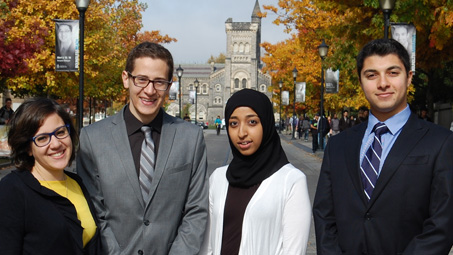
U of T Engineering students Tarek El Fedawy (IndE 1T3 + PEY), Kazem Kutob (IndE 1T3 + PEY), Layan Kutob (IndE 1T2 + PEY) and Huda Idrees (IndE 1T2 + PEY) recently took second place at the Wharton Undergraduate Consulting Club’s Case Competition.
This is the second consecutive year that they’ve beaten out teams from top universities including Yale, University of Pennsylvania and Rutgers.
The competition took place at The Wharton School of Business at the University of Pennsylvania, one of the top business schools in North America and the world. Participants were judged by major sponsoring firms including Deloitte, Ernst & Young, Accenture and Mars & Co.
Teams were required to formulate a strategic blueprint for a post-merger of two wealth-management firms. Their strategy would have to overcome significant operational complexities, and would allow the firm to regain its position as a leader in the wealth-management industry.
The U of T Engineering team proposed strategies that involved IT restructuring, re-aligning business and technology assets and operations, as well as organizational change management.
“It’s an incredible opportunity to compete against some of the world’s most respected universities and to be judged by top-tier consultants,” said team member Kazem Kutob. “We take great pride in repeating our second-place finish. And we greatly appreciate the education, support and exposure we receive here at U of T Engineering, which plays an important role in making this win possible.”
“On behalf of the Faculty, I would like to congratulate the team for their continued success in this competition,” said Dean Cristina Amon. “Strong business acumen is quickly becoming a highly sought after and essential skill for today’s engineers. The team’s second-place win is a testament to the quality of our industrial engineering program and the Professional Experience Year (PEY) program, which gives our students a chance to apply their engineering skills to the world’s most complex problems.”

An unassuming box sits on a table. One part is clear plastic, allowing you to see the empty chamber inside. You don’t think to look at it, but the empty chamber may one day hold a cell colony, or even tissue generated from a patient’s own body, to help diagnose or treat diseases such as cancer.
It’s just one of many cutting-edge devices on display at the IBBME Tomorrow’s Technology Showcase, which was part of IBBME’s 50th Anniversary celebrations from October 9-10.
The showcase highlighted an area of major growth for the healthcare industry in years to come: regenerative medicine. Regenerative medicine is a field of research to restore function in the body through the regeneration of cells, tissues and organs.
It’s also one of the hottest markets around.
One of the presenters at the showcase was the Centre for Commercialization of Regenerative Medicine (CCRM). According to CCRM, where Professor Peter Zandstra (IBBME) serves as Chief Scientific Officer, regenerative medicine is an emerging industry with a projected annual growth of 30 per cent.
And it’s not just a field for doctors.
“Regenerative medicine is a great example of the integration of engineering and medicine. IBBME’s technology showcase was a wonderful way to feature an industry that will continue to grow in importance as today’s discoveries become tomorrow’s cures,” said Stacey Johnson, Communications Manager with CCRM.
Regenerative medicine is also rapidly becoming known for tackling diseases related to aging – a central concern for the health industry as the population ages.
At IBBME’s 50th Anniversary Symposium, ‘Defining Tomorrow: Advancing the Integration of Engineering and Medicine,’ speakers discussed the many regenerative medicine strategies currently being researched by engineers and scientists – from spinal cord injuries, to Alzheimer’s disease, to stroke patients.
Professor Milos Popovic (IBBME), a Toronto Rehab Chair in Spinal Cord Injury Research at the Toronto Rehabilitation Institute, described the success of his Functional Electronic Stimulation, or FES, in the treatment of cervical spinal nerve injuries that severely limit a person’s ability to grasp, move and hold objects.
“Patients must imagine movement,” said Professor Popovic during his presentation on the rehabilitation process involving FES. “They must struggle a bit. And then we turn on FES.”
FES floods the nervous system with small, controlled bursts of electrical stimulation which has been shown to help regenerate key tissues in the nervous system. The FES treatments also shows evidence that it delays the progression of injuries to the ‘white matter,’ a trauma that further complicates rehabilitation.
To date, the treatment has been used as an additional aid to traditional physiotherapy – with exciting results. During clinical trials, when patients were administered 40 hours of FES treatment alongside a 40-hour schedule of physiotherapy, FES was seen to greatly improve or maintain function in patient groups across the board, even after six months.
On top of maximizing a patient’s ability to move, however, is the enormous potential for savings of both time and money. FES therapy could cut costs from $360,000 – the cost of yearly physiotherapy over the average life span of a spinal cord injury patient – to a mere $60,000.
Popovic is currently extending his FES research to the recovery of stroke patients.
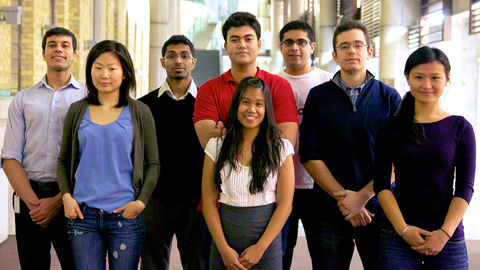
Late in the evenings, after most students have trickled out of the Bahen Centre, U of T’s Supermileage team is just getting started.
“I got the tires!” announced Michael Stranges (MechE 1T2 + PEY) as his team members cheered. The team has spent the last six months designing a vehicle that’s fuel efficient enough to compete in the Shell Eco-marathon Americas 2013.
Held annually around the world, the marathon challenges high school and university students to build a vehicle that can travel the farthest distance while using the least amount of energy.
The next Shell Eco-marathon Americas takes place in Houston, Texas, from April 5-7, 2013. And members of Supermileage, the first U of T team to ever participate in the competition, are confident they can beat last year’s record of 900 kilometres travelled per litre.
“The amount of time spent in the design stage of this project has allowed for us to investigate all possible alternatives for each individual system,” said Jonathan Hamway (MechE 1T3 + PEY), the team’s co-president. “The end result is a design that’s been optimized in all aspects to minimize weight, energy loss and ultimately, fuel consumption.”
Hamway feels Supermileage’s biggest weapon is the the team itself. The group has brought together students from diverse engineering and technical backgrounds – from mechanical engineering, to engineering science, to materials science and electrical engineering.
It also helps that they’re being supervised by Associate Professor David Sinton (MIE), Director of the Centre for Sustainable Energy, and an expert in applying fluid mechanics to energy systems.
Because the competition pushes participants to design with sustainability in mind, it’s driving the engineering students to innovate by imagining a future of earth-friendly vehicles. “[This competition] enables us to put our efforts to the test while changing public perception of what’s possible in designing for a greener future,” said Hamway.
To date, seven Canadian teams have registered to compete in the Shell Eco-marathon Americas 2013, hailing from the University of Toronto, University of British Columbia, University of Alberta and three-time champions, Université Laval from Quebec. Teams interested in competing are invited to register here.