

U of T Engineering alumna Azadeh Kushki (ElecE 0T2, MASc 0T3, PhD 0T8) is making significant strides at Holland Bloorview Kids Rehabilitation Hospital to improve the quality of care for children with autism spectrum disorders (ASD).
In a recent Toronto Star article, Kushki credits her background in electrical engineering as the foundation for her work. As a graduate student at U of T Engineering, her work focused on wireless communications and signal processing.
But it wasn’t until she began to volunteer at Holland Bloorview that she realized how her engineering experience could improve the lives of those struggling with autism.
Inspired by the children she met through her volunteer role and concerned about issues they faced, she contacted Holland Bloorview’s vice-president of research, Professor Tom Chau (IBBME) to find out about how she could apply her engineering and technical knowledge to help increase access to therapy. He encouraged her to apply for funding, which led to a postdoctoral fellowship at the Pediatric Rehabilitation Intelligent Systems Multidisciplinary (PRISM) lab.
Now a scientist at Holland Bloorview’s Autism Research Centre, Kushki and her team are developing prototypes that can enhance treatment for children with ASD, including applications that deliver interactive service to patients through an iPad or wearable technology. While these developments are results from her vision to make evidence-based treatments accessible to more patients, Kushki hopes they will eventually encourage and support children with autism to overcome barriers and fulfill their dreams.
Read the full Toronto Star article about Kushki and learn more about her work on the Holland Bloorview website.
Three U of T engineers have been awarded research grants by Canada’s Collaborative Health Research Projects (CHRP) program.
CHRP – an initiative of the Natural Sciences and Engineering Research Council (NSERC) and Canadian Institutes of Health Research (CIHR) – supports interdisciplinary research projects that will lead to health benefits for Canadians, more effective health services or economic development in health-related areas.
Faculty recipients are:
- Professor Roman Genov (ECE), for research on fully implantable wireless multi-electrode ECoG monitoring system;
- Professor Ofer Levi (IBBME/ECE), for research on developing an optical imaging system that will monitor brain dynamics in patients with epilepsy and stroke; and,
- Professor Peter Zandstra (ChemE/IBBME), for research on the development and application of stem cell counting.
“On behalf of the Faculty, I would like to congratulate this year’s CHRP recipients,” said Dean Cristina Amon. “Funding through NSERC and CIHR ensures that our professors continue their impactful research in the tremendously important field of human health.”
To learn more about this year’s recipients, visit U of T News .
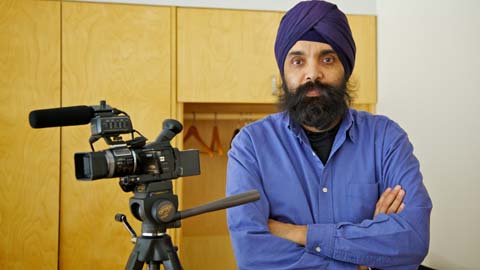
Harpreet Dhariwal, a passionate advocate for the use of technology to support student learning, passed away on September 25 following a recent illness.
Dhariwal, who served as Instructional Technology Specialist in the Faculty of Applied Science & Engineering since 2009 and worked for the University for 23 years, is being remembered for his genuine enthusiasm for his work and dedication to U of T Engineering.
“He was always willing to lend a helping hand and collaborate with others. Harpreet brought a sense of passion to what he did and won our Faculty’s Emerging Leader award this past spring, an honour that was truly deserved,” said Engineering Dean Cristina Amon.
That award recognized Dhariwal for his outstanding leadership in leveraging new developments in technology to benefit Engineering instructors and students. He not only implemented new technology but helped faculty members imagine and achieve innovative ways of using technology to improve teaching and learning.
Among the innovations Dhariwal introduced was the use of lecture capture technology, which allows instructors to record course lectures, including both slides and the lecturer simultaneously, for students to review again later. He remarked at the time that he was “… really enjoying this. I feel like we are pioneering a very exciting project, and it has been rewarding to have students and instructors come back to me with such positive feedback.”
Dhariwal was committed to studying the impact technology can have on student learning. He co-authored three academic papers on the use of technology in the classroom and presented on the subject at conferences in Canada and internationally. He was also instrumental in organizing the Engineering Educational Technology Workshop at U of T in May 2011.
Dr. Avi Hyman, U of T’s Director of Academic & Collaborative Technologies, and Institutional Strategist for Academic Technologies at the Centre for Teaching Support & Innovation, remembers Dhariwal’s commitment to collaboration.
“Over the past few years, our work increasingly overlapped, and I am grateful for the advice and support Harpreet gave me. He was definitely a go-to guy. I even had a chance to travel with him to a conference not that long ago, and I am very happy that we got a chance to get to know each other on a more personal level,” said Hyman.
Dhariwal was first hired as a Computer System Analyst in 1989, where he worked in the Office of the Vice President, Development and University Relations. He also worked in Student Information Systems before moving to U of T Engineering in 1996. There, he worked in a variety of capacities, including as Manager of the Center for Computer Integrated Engineering and Senior IT Manager for Engineering Computing Facilities, before becoming the Faculty’s first Instructional Technology Specialist in 2009.
To honour his memory, the University of Toronto’s flags will be lowered to half-mast on all three campuses on September 28, when Dhariwal’s life will be celebrated in a funeral service with friends and family in attendance.

stem cells in uniform colonies.
A small instrument resembling a mini-chocolate grater may not look like much to the untrained eye, but an object like this is a glimpse into the future of medicine.
On October 10, as part of its 50th Anniversary celebration, the Institute of Biomaterials and Biomedical Engineering (IBBME) is hosting ‘Tomorrow’s Technology Showcase,’ a world’s fair of biomedical engineering devices at the frontier of medicine.
The showcase is a part of a free, one-day international symposium, ‘Defining Tomorrow: Advancing the Integration of Engineering and Medicine.’
The event brings to Toronto speakers such as James Fawcett of Cambridge University, a world-leading researcher on nervous system and spinal cord repair, and Miguel Nicolelis of Duke University, a pioneer in neural interfaces for overcoming paralysis.
International thinkers will present alongside the incredible talent U of T has to offer, including engineering Professors Milos Popovic (IBBME) and Molly Shoichet (ChemE/IBBME), to name a few.
But not everything about the day will be academic.
Sponsored by the Ontario Brain Institute (OBI), companies such as GE Healthcare, STEM CELL, and Octane Biotech, as well as IBBME’s commercialization partners, not-for-profit organizations CCRM and (UHN’s) Techna, will display biomedical devices that will define our future.
The ‘Aggrewell,’ something looking like a cross between a penny holder and a grater, is one such device. Developed by a former IBBME Research Associate as a tool to grow stem cells in uniform colonies, Aggrewell is currently produced by STEM CELL, a company that primarily sells products to scientists conducting stem cell research in areas such as cancer, heart disease and more.
Another of the day’s presenters will be Interface Biologics Inc. (IBI), whose biomaterial product, Endexo™, has recently been cleared by the U.S. Food and Drug Administration (FDA) for use in AngioDynamic catheters in the United States.
The catheter is manufactured using a biomaterial developed by IBBME’s Director, Professor Paul Santerre. The biomaterial reacts to the catheter in such a way that it prevents blood coagulation, virtually eliminating the risks of blood clots – a serious danger for kidney dialysis patients, as an example – without drug additives.
Tomorrow’s Technology Showcase will be held at U of T’s Chestnut Conference Centre (89 Chestnut St.) on October 10, 2012. Space is limited for this free event, so register early and before October 1.
Brazilian student Raphael de Abreu Alves e Silva’s priority during his upcoming year at U of T Engineering is to make friends. As the affable 25-year-old explains, engineering is about innovation and the best innovation is often a result of collaboration.
“At U of T, you see other cultures. And when you have more cultures, it’s better,” he said. “You can take the best of everyone’s approach. There’s not just one way to do things.” De Abreu Alves e Silva – one of about 40 international students attending a welcome breakfast on September 18 at the Galbraith Building – is a control and automation engineering student at the Instituto Federal de Educação, Ciência e Tecnologia de São Paulo.
He is taking electrical engineering and business courses at U of T this academic year, thanks to the Brazilian government’s Science Without Borders program. The four-year program, launched in 2012, aims to send 100,000 Brazilian university students to study at top universities around the world.
This year, 700 students have come to Canada, with 129 choosing U of T, and the vast majority of those studying in the Faculty of Applied Science & Engineering.
“You have chosen a fantastic Faculty. We consistently place at number one in Canada,” U of T Engineering Dean Cristina Amon told the students in her welcoming remarks at the breakfast. “And we have a very strong position internationally. But what is most important is the ability we have to recruit you – students who are among the best and brightest in the world.”
Indeed, the Faculty is educating and developing global leaders, including those taking part in U of T’s international exchange program. U of T partners with 130 universities around the world, swapping students for various lengths of time.
“It gives them the confidence they can compete in the world and gives them a network of peers to potentially collaborate with,” said Miranda Cheng, Director for the Centre for International Experience. “They become our ambassadors when they go home.”
Speaking at the welcome breakfast, Swedish environmental engineering exchange student Sara Eriksson, said she chose to spend a semester here exploring chemical and mechanical engineering after reading rave reviews from other Lund University exchange students about their time at U of T.
The 22-year-old is still uncertain what she’ll do when she graduates in 2014, but she’s sure studying in a globally-recognized engineering program will give her an advantage no matter what she decides.
“I’ve heard so many good things about U of T Engineering. It has a good reputation around the world,” she said.
For 21-year-old Michael Thorn, a biomedical engineering student at Marquette University in Wisconsin, USA, the initial draw was U of T Engineering’s status as a world-class engineering university.
“I also looked over professors’ areas of expertise and research projects,” said Thorn, who will spend part of his term working with an engineering professor on the design for a medical device. Like Eriksson, Thorn has yet to decide on a career path but expects the interdisciplinary nature of study in the Faculty will help him narrow down options.
Meanwhile, de Abreu Alves e Silva said when he graduates in 2015, he is keen to continue in academia, getting his MA and PhD and perhaps becoming a professor or researcher himself. “Here is a good place to do research,” he said, smiling as he looked around the room at his fellow international students.
U of T’s Faculty of Applied Science & Engineering kicked off their $200-million campaign with an ‘Afternoon of Engineering Innovation’ which showcased innovative, visionary and entrepreneurial ideas from students and faculty. The event, attended by more than 600 alumni, donors, faculty, students, staff and members of the Engineering community, featured lectures, industry panels with alumni, and student exhibits at Convocation Hall and the Bahen Centre.
Professor Cristina Amon, Dean of the Faculty of Applied Science & Engineering, announced the success to date of the Faculty’s campaign, which has already secured more than $80-million towards its $200-million goal – the largest-ever fundraising initiative for an engineering school in Canada. “U of T Engineering is Canada’s best engineering Faculty. Our goal is to build on our reputation for excellence, and establish ourselves into the very top ranks of the world’s leading institutions for engineering education, research and innovation,” said Amon. “This campaign will engage our global network of alumni and friends to build a preeminent Faculty that will nurture the U of T world-class engineer of tomorrow.” In her address, Amon outlined the campaign’s five areas of focus: developing global engineering leaders; nurturing engineering innovation and entrepreneurship; revolutionizing biomedical engineering and human health; advancing information communications technology; and reshaping the future of energy, the environment and sustainability.
Building the Centre for Engineering Innovation & Entrepreneurship is a core priority. Located on St. George Street, beside Simcoe Hall and Convocation Hall, the centre will be a landmark building at the University of Toronto. The nerve centre for the Faculty’s collaborative learning and interdisciplinary research, it will feature dynamic, flexible environments that foster collaboration, encourage active learning and accelerate innovation. “To continue attracting preeminent faculty and outstanding students we need to build an environment that fosters creativity and inspires 21st-century learning and innovation,” said Amon.
“Today’s campaign launch was a window on the kind of limitless innovation and creativity that takes place every day at U of T Engineering,” said David Palmer, U of T’s Vice-President of Advancement. He applauded campaign chair George Myhal (IndE 7T8) for his extraordinary leadership, and his generosity. Myhal, a U of T Engineering alumnus and Chief Operating Officer and Senior Managing Partner of Brookfield Asset Management, has given a $5-million gift to the Centre for Engineering Innovation & Entrepreneurship. “I received an outstanding education from U of T that I am thankful for,” said Myhal. “Given changes to technology and its impact on our lives, engineering will have a higher profile and more importance in the world than when I was a student. It’s important for the Faculty to play a part in this new era for engineering.”
Dean Amon also recognized Bill (ChemE 6T7) and Kathleen Troost for their $2-million gift towards space for the Institute for Leadership Education in Engineering (ILead). “Bill and Kathleen Troost’s gift will provide a home for ILead and allow leadership education at U of T Engineering to take a significant step forward,” she said. She also acknowledged Peter Allen (CivE 6T2) for his $1-million gift to the new building. “Peter Allen believes in the vision for the Centre for Engineering Innovation & Entrepreneurship, and his gift is an inspiration to faculty, students and future donors,” said Amon. Dean Amon spoke of Paul Cadario (CivE 7T3) – who is a Distinguished Senior Fellow in Global Innovation at the Faculty and the Munk School for Global Affairs – for his dedication and his $1-million gift to the Centre for Global Engineering (CGEN). “Paul Cadario’s gift to CGEN is a reflection of his life’s work helping to build prosperous, sustainable and peaceful societies.” Also at the event, Dean Amon acknowledged Walter Curlook (MMS 5T0, MASc 5T1, PhD 5T3) who provided a $1-million gift toward lab space. “Walter Curlook’s gift will build vital state-of-the-art lab space benefiting our students and faculty.
The campaign for U of T Engineering is an integral part of U of T’s $2-billion Boundless campaign, which has secured more than $1.1-billion to date. Through the Boundless campaign, U of T seeks to address the pressing global challenges that affect us all, by preparing global leaders who have the skills to work across borders, boundaries and disciplines.
To find out more about the Faculty of Applied Science & Engineering’s Boundless campaign and to read the case for support, visit:http://boundless.utoronto.ca/division/faculty-of-applied-science-engineering/