
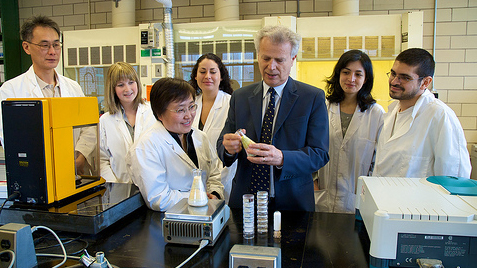
Professor Emeritus Levente Diosady (ChemE) has been named as one of 23 new Fellows of the International Academy of Food Science and Technology (IAFoST). Professor Diosady is the first chemical engineer to be inducted and one of only four Fellows from Canada.
Fellows of the academy exemplify the best minds of food science and technology internationally. It is composed of elected Fellows from all parts of the world and serves to promote high standards of ethics and scientific endeavours among food scientists and technologists.
It is also a source of information to support international activities related to food science and technology. The Academy acts in an advisory capacity to the International Union of Food Science and Technology (IUFoST), a global scientific organization representing more than 200,000 food scientists and technologists from more than 70 countries.
Professor Diosady makes what little food exists count for more by fortifying food with micro-encapsulated nutrients. One of his successes was double-fortifying salt with iodine and iron, which cured a million children in India of anemia. Currently, he plans to develop a protein-enriched soft drink called LiveADE to be used in developing countries as a source of protein, micronutrients and safe drinking water.

Already celebrated as a trailblazer for women in engineering, U of T Engineering Dean Cristina Amon has been named one of Canada’s 25 most influential women by Women of Influence Magazine.
The recognition is designed to honour and celebrate women who have demonstrated, over the last year, strong and unyielding leadership in one of five distinct sectors. Dean Amon was recognized in the public sector category, where she joins Carol Stephenson, Dean of the Richard Ivey School of Business at Western University, and Karen Stintz, Toronto City Councillor and Chair of the Toronto Transit Commission, among others.
“I am honoured to be recognized as a woman of influence and be associated with these 24 remarkable and visionary women,” said Dean Amon. “For me, through this opportunity, I hope to serve as an example to young women who might be considering a career in engineering.”
The ranking was based solely on quantitative criteria. Nominees were ranked by a uniform system dependent on measurable factors, including how many boards they currently sit on, recent promotions and awards.
“Creating access to role models is the most compelling reason why these achievers must be celebrated,” explained Carolyn Lawrence, President and CEO of Women of Influence. “The women we profile have made an important impact in their chosen fields, and they are all using their influence to change the world, for the better. It is important that they are recognized because they serve as role models for Canadian women and girls.”
At U of T, Dean Amon has worked actively to promote Engineering to young women. This has been accomplished through a variety of outreach initiatives, including Skule™ Sisters, Go Eng Girl, and Women Empowered in Engineering.
“Few professions foster the spirit of innovation as engineering does, translating so many ideas into devices and technologies that improve people’s lives in meaningful ways. Today, perhaps more than at any time before, we can see how engineering has the power to influence every part of our world and aspect of our lives: engineering is driving economic development, engineering is driving biomedical innovation and engineering is the key to solutions for environmental sustainability,” said Dean Amon.
“These are exciting times for the engineering profession and we need many more engineers. However, to become an engineering student, a strong foundation in high school math and science is needed. Young women often have to overcome societal pressures to give up on math and science. Women can excel in both areas and young girls often have a blazing curiosity about how things work and a boundless creativity – both key characteristics of successful engineers. But, as they become teenagers, cultural pressures can encourage them to pretend not to be interested in math and science,” said Dean Amon.
For Dean Amon, a career in engineering was born out of an interest in how devices work at an early age.
“When I was a girl, I loved trying to discover how things worked. I took gadgets and gizmos apart. I remember once when I was five my parents had what I recall as a giant radio. It was as big as a 15-inch television. Once when they were out, I took it apart. I was convinced there were little people in there acting out the dramas, singing the songs and reading the commercials,” she said.
Prior to joining U of T in 2006 as Dean and Alumni Chair Professor in Mechanical & Industrial Engineering, Dean Amon was the Raymond J. Lane Distinguished Professor of Mechanical & Biomedical Engineering and Director of the Institute for Complex Engineered Systems at Carnegie Mellon University. Her research has advanced the engineering foundation of heat transfer enhancement by flow destabilization, nano-scale thermal transport in semi-conductors, and hemodynamics mass transport in biological systems. She has made pioneering contributions to concurrent thermal designs, innovation in electronics cooling and transient thermal management of wearable computers.
Dean Amon has delivered keynote lectures worldwide and contributed 12 book chapters, one textbook and more than 280 refereed articles in the education and research literature. She has served the engineering profession with exceptional dedication; her many roles have included Founding Chair of the Global Engineering Dean’s Council and Chair of AAAS Engineering. She was inducted into the U.S. National Academy of Engineering, Canadian Academy of Engineering, Spanish Royal Academy of Engineering, and Royal Society of Canada, and is a Fellow of several technical societies including AAAS, ASEE, ASME and IEEE.
Among her many awards and honours, Dean Amon has been recognized by the Society of Women Engineers (SWE) with the 2011 SWE Achievement Award, the highest award given by the Society, for her outstanding contributions to the field of engineering over more than 20 years. She was also the recipient of the 2010 Award for the Support of Women by Engineers Canada, the 2011 YWCA Toronto Woman of Distinction award and the 2009 ASME Heat Transfer Memorial Award.
You can vote for who will be on the cover of the special issue of Women of Influence Magazine, which will profile the top 25, starting today and ending on September 24. Visit the Women of Influence website for more information and to vote.
On September 6 at Convocation Hall, first-year engineering students kickstarted their academic career with a plenary lecture filled with inspiring words from Faculty leaders, and one of U of T Engineering’s successful graduates, Canadian entrepreneur and telecommunications executive Anthony Lacavera (CompE 9T7).
Before Lacavera became the Chairman and CEO of Globalive Communications Inc. and WIND Mobile, he was a computer engineering student hoping to make an impact on Canada and the world. The 1,400 first-year students, listening intently to the business leader’s words, have joined U of T Engineering hoping to leave a similar, positive impact on the world around them.
“Like you here today, Anthony is the best among the best,” said Dean Cristina Amon. This year’s incoming U of T Engineering students make up the strongest class in the Faculty’s history, with a collective entering average of 91.3 per cent.
Dean Amon, along with Professor Kim Pressnail (CivE), First Year Chair, began the inaugural lecture by reminding students that they are starting out at the very best engineering school in Canada, “… and I believe soon to be, the best in the world,” said Dean Amon.
“Students, today you begin a journey – a journey not without its challenges, but you didn’t decide to study Engineering because you thought it might be easy. You came here seeking a challenge,” she added.
Overcoming challenges was one of the messages of Lacavera’s lecture. As head of two of the leading, fastest-growing companies in Canada, he’d seen his share of setbacks before turning WIND Mobile into Canada’s first independent wireless carrier in over a decade, and a powerful industry competitor.
Humility, persistence and hard work got him there, said Lacavera. At the lecture, he also urged students to value their time at U of T Engineering, build relationships – even asking students to introduce themselves to the person beside them – and nurture their entrepreneurial spirit.
“You need an entrepreneurial spirit to turn an idea that will change the world, into reality,” he said.
Lacavera was able to turn his vision, of a more globally competitive telecommunications market, into reality in 1998. A year after graduating, he launched Globalive Communications. Then, he initiated a groundbreaking public engagement campaign that asked Canadians what they wanted in wireless service. Built on feedback from thousands of Canadians, Lacavera launched WIND Mobile in 2009, a wireless provider used by more than half a million Canadians.
He’s been named CEO of the Year for 2010 by Globe and Mail’s Report on Business Magazine and one of Canada’s Top 40 Under 40, to name a few achievements. Lacavera is also the founder of the Shamba Foundation, a charity that provides event space and staff at no-cost for charitable fundraisers.
He hopes to hear the same stories of triumph and philanthropy from the students sitting before him. “When I look out, I see future leaders of our country,” he said. “You have a wonderful journey ahead.”

It is my great pleasure to welcome you to the 2012 – 2013 academic year at the Faculty of Applied Science & Engineering. As we start this academic year, we look forward to the next few months with a renewed and energized vision that is focused on the boundless opportunities ahead.
The Faculty, the engineering profession and the world are at a pivotal time. You could not be better situated to make a difference in the world with the choice of profession you have made.
We welcome all 1,405 undergraduate and 619 graduate students who are joining U of T Engineering. Only one out of thirteen undergraduate applicants got a place in our Faculty. Together, this first-year cohort has an Ontario Secondary School (OSS) System grade average of 91.3% – the highest in U of T Engineering’s history.
You come from 52 countries, representing all continents and from eight Canadian provinces, and 26% of you join us from countries around the world. This diversity of our students – within Canada, and from nations around the world – contributes to our remarkable multiculturalism and global outlook.
Diversity is also reflected through our new female students, who make up 25.7% of our incoming undergraduate class – a result of our ongoing effort to improve gender balance.
It is evident through the calibre of our incoming students that we have attracted the best to be among us and that we continue to offer the finest engineering education in Canada and among the best in the world.
We live in a world that is looking to engineers to overcome challenges of sustainability, energy, health and the environment. And, we can meet those challenges through the innovation, entrepreneurship and collaboration that has become a signature of Engineering at the University of Toronto.
As members of our thriving community, new and returning students, faculty and staff will work together in this new academic year to enhance our reputation by pushing our education, research and innovation to new heights. As we step into this new term, let us move boldly towards our boundless future and achieve our potential as one of the finest engineering schools in the world.
Best wishes and welcome
Cristina Amon, Dean
Faculty of Applied Science & Engineering
Chunks of concrete tumble from the Gardiner Expressway, the Algo Centre Mall collapses in Elliot Lake, shards of glass fall from Toronto condos, and a Radiohead stage gives way at Downsview Park.
Just how safe are the structures that we build?
“Nature always looks for ways to use energy in a favourable state – gravity always pushing things downwards is an example,” said Professor Doug Perovic (MSE).
“Any built structure naturally goes against nature. Therefore, all structures will eventually be broken or destroyed – given the right amount of time, they will break down or fail.”
In mid-July, pieces of concrete fell off the Gardiner Expressway onto Bathurst Street in Toronto. And in late June, a car was struck by a falling piece of concrete.
The Gardiner was designed in the 1950s and built in the 60s; at the time road salt was not used to prevent sliding and crashes during winters, said Professor Doug Hooton(CivE).
“They didn’t design [the Gardiner] to resist salt – they didn’t realize it would be exposed to salt,” said Professor Hooton, an NSERC/Cement Association of Canada Industrial Research Chair in Concrete Durability & Sustainability. “And so, they only put a small amount of concrete over the steel structure.”
As the road salt seeps into the concrete over the years it will eventually rust the steel structure of the elevated expressway.
“The rust causes the steel to become larger and puts the surrounding concrete in tension,” explains Hooton. “Then the outer layer of concrete gets cracked and pushed off.”
He believes Toronto’s recently unveiled 10-year plan to replace the concrete on the Gardiner is the best approach to the situation. The plan calls for the installation of concrete that is an appropriate thickness and a waterproofing membrane to prevent rust.
Hooton and Perovic point to parallels between the troubles of the expressway and the collapsed mall in Elliot Lake. Because the mall’s roof had acted as a parking garage, road salt had the opportunity to seep into the concrete, causing the steel to deteriorate.
“Again, it’s basically rusty steel – salt gone through the roof because they didn’t waterproof it,” explained Professor Hooton. “However, what collapsed was the actual steel frame, not just the concrete like on the Gardiner.”
“The scene has been completely sealed off by the police,” said Professor Perovic, who was part of a team that travelled to Elliot Lake to investigate the collapse, only to have the work called off by authorities after the structure was deemed too unstable.
Falling condominium glass has been another concern in the minds of Torontonians. However, Perovic believes pedestrians need not walk in fear.
The type of glass which has been shattering is tempered glass, which is about five times sturdier than regular glass and has been efficiently used for 50 years, he said.
“The reason we’re seeing all these failures at one time basically comes down to bad batches of glass with too much impurity,” said Professor Perovic. “A number of those buildings built last summer were from the same developer, so they’re probably getting the glass from the same manufacturer.”
Professor Perovic, who has analyzed pieces of the shattered glass, believes nickel sulphide particles in the glass (emanating from raw material of low quality) are to blame for the incidents. Nickel sulphide particles expand rapidly with heat, as the particles expand they shatter the glass from within.
“It only takes a small amount of nickel sulphide to ruin a lot of glass,” he said.
The incidents aren’t attributed to how the windows were installed or how they may have been damaged – it’s a built-in stress in the glass.
Both professors agree that Toronto remains a structurally sound and safe city. However, the collapse of the Downsview Park stage remains an unsolved mystery.
Perovic has spent a lot of time analyzing the Radiohead stage, which collapsed in mid-June. He is currently working with teams examining the material to determine the quality of the structure.
To read the full article, visit U of T News.

By Ahil Ganesh (EngSci 1T3), Co-Chair of UnERD 2012
On August 15, undergraduates gathered to showcase their diverse summer research at the 7th annual Undergraduate Engineering Research Day (UnERD).
Engineering students across all departments enthusiastically prepared podium and poster presentations to display their hard work. This year, we saw 48 podium presenters and 50 poster presenters.
There was a great diversity in the research being presented, ranging from hydrogels for studying cancer cell fate, to advances in atmospheric telescopy, to online game development for learning teamwork skills. It was also wonderful to see students interested in presentations from not only their own research field, but others as well.
This year’s event featured a keynote address from Professor Bryan Karney (CivE), Associate Dean of Cross-Disciplinary Programs. His address emphasized that being successful in research has a lot to do with responsibility and integrity. I know that everyone took away some valuable points.
The event continues to be greatly supported by U of T Engineering; we received valuable support from Professor Susan McCahan, Vice-Dean Undergraduate, as well as Leaders of Tomorrow (LOT). Our professors played a key role in the day’s events, with 38 faculty members acting as judges for the presentations, giving appreciated feedback to the presenters. The students really enjoyed presenting to them and were certainly challenged.
UnERD provides numerous opportunities for aspiring researchers. The poster session is based on conference sessions, so the event is a very important opportunity for engineering undergraduates to present in a very similar kind of setting. Another key aspect of UnERD is presenting to your peers – and once again, we saw students actively questioning each other about their work. As Co-Chair of this year’s UnERD, I have to say it was really inspiring to see future researchers already talking about collaborations.