
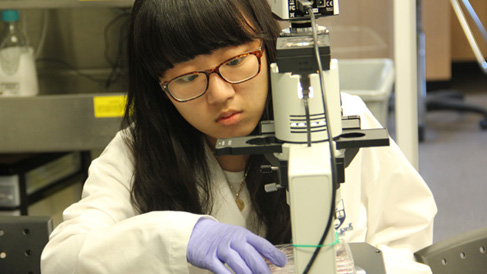
It’s the Da Vinci Engineering Enrichment Program Summer Academy but everyone calls it DEEP – and for the 10th straight year, it’s welcoming ambitious high school students from across Canada and around the world to U of T.
Running for four weeks in July, the camp offers teens the chance to go deeper into their high school curriculum – giving them the opportunity to learn fundamental math and science skills typically mastered by first- and second-year university students.
The past decade has seen the Academy undergo tremendous transformation.
“We’ve gone from being just a day program where we saw a couple hundred students to being a residence program where we’re seeing over a thousand students from around the world,” said Dawn Britton, Associate Director of the Faculty of Applied Science & Engineering’s Outreach Office.
The Academy’s sessions, targeting everything from design to enzyme digestion to fluorescent imaging, are designed and led by U of T Engineering students. Graduate students take areas of their research and pare the subject down to foundational skills that help prepare students for future studies, while undergraduate students gain invaluable experience as camp counsellors who assist the running of the courses.
“We have really incredible instructors, phenomenal students,” said Britton.
Esther Lau, a co-instructor on a course on stem cells, obtained her MASc from IBBME in Biomedical Engineering and is now in her second year of medical school. She has seen DEEP’s impact on students ripple out over the years.
“The first year they started running the program I remember being a student of DEEP, and what I was able to get out of it. As a grad student I’m able to come full circle and be in a teaching role.”
It’s an opportunity worth leaving home for – even if it means travelling across the world.
“It takes 12 hours to get from Korea to here,” said Chae Kyung Lim, a grade 11 student who made that journey to be a part of the DEEP experience. “But I love the very high level [of teaching].”
The hands-on laboratory experience and cool equipment is a major draw for many of the camp’s participants, as well. Getting to manipulate the state-of-the-art microscopes is exciting, as are exercises such as how to change the “food” for cell cultures inside a massive bio-safety cabinet that continuously circulates air in the newly renovated, top-of-the-line IBBME undergraduate teaching lab.
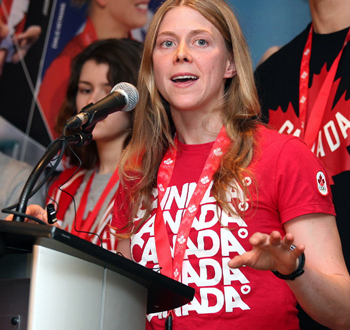
It’s an understatement to say that incoming Civil Engineering PhD student Donna Vakalis has a busy few weeks ahead of her before she joins the Faculty of Applied Science & Engineering. Just days before starting the program, the Toronto native who received her Master’s degree from U of T’s John H. Daniels Faculty of Architecture in 2009, will be competing in the pentathlon at the London Olympic Games.
As one of just 36 people from around the world who qualified for the event, Vakalis will be shooting, riding, fencing, running and swimming her way towards the gold medal. She recently took some time out of her hectic training schedule to answer a few questions for U of T Engineering about her Olympic and professional goals.
How did you start your career as a pentathlete?
I started out as a competitive swimmer and horseback rider, then learned about pentathlon from a fellow member of the Pony Club. At age 15 I retired from pentathlon and all sports. I made my way back to sports when I was doing my Master of Architecture at the University of Toronto. At the time, I found I was missing fencing and running and swimming. I felt the urge go workout to escape the studio. It built momentum to the point where I think I was probably training more hours than I was sleeping, which is only about five hours a night for the typical architecture student!
I’ve come a long way since then. I’ve been trying out different arrangements with working and schooling and training to find the right balance. I’ve also been working for a flexible employer, Janet Rosenberg and Associates, which has allowed me to make money to pay for training.
Where were you when you found out you would be competing in the pentathlon at the London Games? How did you feel when you got the news?
I was in China and felt a strong mix of emotions — including being tired from competing that day. But I felt overwhelmingly joyful.
Since then, what have your preparations and Olympics training been like?
There isn’t one typical day because we rotate between three and five training sessions per day between five disciplines. We also have supportive activities like weights and physiotherapy. I can say that there is often one morning workout like swimming, followed by a break. During the break I would normally go to work, but leading up to the Olympics I’m taking the time to concentrate purely on training. Now my breaks are more likely to be used for weights or a nap! After the break we have another training session such as running or shooting. Another break follows, then we have an evening session like fencing for few hours. Mix and repeat.
What are you looking forward to the most about competing in the London Games?
The experience leading up to the Olympics has already been incredible, and it’s only going to ramp up. It’s hard to guess what will top how great it is being part of the Olympic team. One momentous occasion will be wearing my Canadian uniform and meeting my friends and family just after crossing the finish line on competition day (August 12th, 2012) – potentially in medal form!
A few weeks after competing at the Olympics, you will be joining U of T Engineering’s PhD program in Civil Engineering. How did you feel when you found out you were accepted into the program?
I got the two pieces of news within days of each other: the official acceptance into U of T Engineering and the official news of being on the Olympic team. My excitement for each was multiplied exponentially. For that reason, I think the two experiences will always be intertwined in my mind. I know it’s kind of nerdy, but I get really giddy thinking about beginning my PhD. After finishing my Master’s in 2009, I knew that I’d want to return to school so I’ve been looking forward to this for a few years now.
What would you say are the skills that you’ve developed as an athlete that would be most helpful to you as a PhD candidate at U of T Engineering?
Since I’ve visited so many cities in the last four years, I’ve observed the different ideas expressed in buildings and infrastructure from all over the world. If you pay attention during travel, it can provide you with a wealth of innovative ways to design the extra small-, medium- and large-scale details of a city. I think I’ve also gotten the knack of fitting in 20-plus hours of output into 16 waking hours!
What will be the focus of your PhD work? Why did you choose that area of Engineering and what impact do you hope your research will make?
My focus will be on sustainability metrics for large-scale built projects with Professor Heather MacLean. I understand “sustainability” to capture the health, ecological and economic consequences of our activities and I hope that I can first educate myself. I want to use what I learn as a platform to help direct the radical changes we need to make to improve the world we live in. If we understand the consequences of the decisions we make in engineering and architecture activities, we’ll be better poised to make smarter decisions and imagine alternatives that haven’t been tried yet.
How do you plan to spend your time after the 2012 Games and before your start at U of T Engineering?
After competing in London, I’ll spend one week cycling around the Netherlands with my boyfriend. Then I’ll return to Canada and fly immediately to Vancouver for the 2012 Canadian National Championships. Classes will begin one week after that. Between moving into a new place and setting up timetables, I can only hope to spend a few days with friends to savour the prelude to the next big adventure that will be my PhD.
For more information about Donna Vakalis and to make a contribution to her training fund, visit her website thisisdonna.com, or follow her on Twitter at twitter.com/SportIsAllOver. You can also read our earlier article on her here.
It’s an increasingly familiar story for Torontonians: road closures due to pieces of concrete falling from the city’s elevated highway, the Gardiner Expressway. The cause, explain professors from the Department of Civil Engineering, is a combination of porous concrete, road salt and a lack of maintenance.
“Back in those days, they used a lot of water to mix concrete,” explained Professor Paul Gauvreau to CBC reporter Charlsie Agro.
The porous concrete allows salt, used in winter to guard against ice, to seep into the concrete and corrode the metal that supports it. The result is a weakened roadway.
To stave off the crumbling concrete, regular maintenance is needed. However, as Professor Shamim Sheikh recently told Toronto Star reporter Liam Casey, “we tend to only pay attention when it becomes critical.”
To learn more, you can read The Toronto Star article or view CBC News’ report.
The Natural Sciences & Engineering Research Council of Canada (NSERC) has awarded a $1.876 million Collaborative Research and Development (CRD) Grant to Chemical Engineering Professor Honghi Tran and his team. The announcement was made June 19.
The funds from the grant will be directed towards a four-year research program entitled, “Fundamental studies of drying, combustion and ash properties of biomass and impacts of pulp and paper mill operations.”
Requirements for efficient energy generation and usage, stringent environmental regulations, improved waste management and clean mill operations are growing concerns for pulp and paper mills. New approaches are required to address these important issues. The new CRD project led by Professor Tran aims at increasing the efficiency of biomass boilers in Canadian pulp and paper mills by preventing surface fouling of combustion ash, diversifying boiler fuel feedstocks, and increasing the utilization and value of ash that results from biomass combustion.
In addition to the NSERC-CRD Grant, 10 industrial partners consisting of pulp and paper producers, boiler manufacturers and chemical suppliers have agreed to sponsor the research program with approximately $1.4 million cash and $660,000 of in kind support.
“We are grateful that NSERC recognizes the relevance of the work that Professor Tran and his team are conducting. Not only will it bring many benefits to Canada but it will also help us train 26 graduate students, four postdoctoral fellows and 22 undergraduate students – creating highly qualified personnel,” said Professor Grant Allen, Chair of the Department of Chemical Engineering & Applied Chemistry.
Professor Tran is an internationally respected expert in the field of pulp and paper research. He holds the Frank Dottori Chair in Pulp and Paper Engineering and is Director of the University of Toronto Pulp & Paper Centre. Professor Tran is also a technical consultant to kraft pulp mills on problems related to kraft recovery boilers, lime kilns and borate autocausticizing. His research interests are in fouling and corrosion in recovery boilers and chemical recovery processes. Professor Tran has co-authored over 120 referred papers, holds eight patents and is a Fellow of the Technical Association of the Pulp and Paper Industry.
Donna Vakalis, who will begin her PhD in Civil Engineering this September, will be competing for Canada in the pentathlon competition at the 2012 Summer Olympic Games in London.
The pentathlon – which originated in the ancient Olympics as a test of military skills – is now a test of both mental and physical agility.
Speaking to The Toronto Star, Vakalis said that the five sport competition is “… very much a mental game, but it’s also a physical game now.”
Competitors are required to swim 200 metres, run three kilometres, fence, ride a horse through a show jumping circuit and fire a laser gun at a stationary target 10 metres away.
Vakalis is one of 36 athletes who qualified for the event, which will be held on August 11 and 12.
She has been seeking donations to cover the cost of the equipment required for the event, which includes a Kevlar vest for fencing and the laser gun. So far, she has raised $12,000 towards her ultimate goal of $36,000.
You can follow Vakalis as she prepares for the Olympic Games on Twitter. You can also see recent profiles of Vakalis in The Toronto Star andThe Globe and Mail or read our interview with her here.
University of Toronto Engineering Professor Peter Zandstra has been named to the scientific advisory committee of Stem Cells Australia, which is a network of Australia’s top researchers tackling the big questions in stem cell science.
Professor Zandstra is one of six internationally renowned researchers to join the committee. They were drawn from Australia, Canada, Japan and The Netherlands..
In announcing the appointments, Stem Cell Australia hailed the six as “scientific luminaries” who will provide strategic advice and independent evaluation of the research undertaken, which is supported by the Australian Research Council
“With impressive scientific expertise spanning developmental biology, bioengineering and genetics, as well as extensive knowledge of the international stem cell field, the members of the Scientific Advisory Committee will make a substantial contribution to Stem Cells Australia’s research program,” the organization said in a statement.
Professor Zandstra is a recognized leader in the integration of engineering and biological approaches to develop new ways to grow and differentiate adult and embryonic stem cells in clinically and industrially relevant numbers. His work impacts tissue and cellular engineering, gene therapy, and organ transplantation. He is a core faculty member in the Institute of Biomaterials & Biomedical Engineering and cross-appointed to the Department of Chemical Engineering & Applied Chemistry. He is also a member of the McEwen Centre for Regenerative Medicine, the Heart and Stroke/Richard Lewar Centre of Excellence and currently acts as Chief Scientific Officer for the Centre for the Commercialization of Regenerative Medicine.
“Peter Zandstra is an internationally-celebrated leader in stem cell research. His wise counsel will be of tremendous value to our colleagues in Australia,” said Professor Ted Sargent, Vice-Dean (Research) of the Faculty of Applied Science & Engineering. “This is yet another example of the global impact and international reach of U of T Engineering researchers.”
Also appointed was Professor Andras Nagy, Senior Investigator at the Samuel Lunenfeld Research Institute at Toronto’s Mount Sinai Hospital and a Professor in U of T’s Department of Obstetrics and Gynaecology.
This month, Professor Zandstra will be in Australia to deliver a keynote address at the BioNano Innovation Conference in Brisbane and will also visit Stem Cells Australia’s researchers in Brisbane, Sydney and Melbourn.