
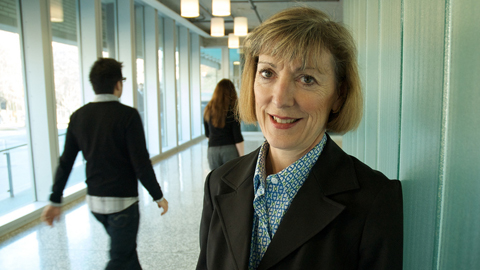
Faculty Registrar Barbara McCann is this year’s recipient of the Association of Registrars of the Universities and Colleges of Canada (ARUCC) Outstanding Achievement Award, which recognizes members who are making significant contributions to the registrarial profession, to their own institution, and/or to the improvement of service to students.
Since taking on the role of Faculty Registrar in 1985, McCann has ensured that the Office of the Registrar continually evolves to meet the changing needs of Engineering students. She has worked tirelessly to enhance registration services, advised and mentored countless students, introduced information technology initiatives to improve student services, and constantly demonstrated a commitment to student engagement and success. She has never forgotten that the primary mission of the Faculty is the education of our students.
McCann has long been a champion for underrepresented groups and those with special needs. She advocated accommodation for students with disabilities before such accommodations were legislated and has worked closely with LGBTOUT to deal with issues faced by the gay student community. She spearheaded the creation of the Women in Engineering Association and received the SAC Equity Commission Award for her work with the University of Toronto Muslim Student Association. McCann has also championed her colleagues; she created and implemented the Agnes Kaneko Award, one of the first staff recognition awards at U of T.
In 2009, McCann was recognized with the Chancellor’s Award in the Influential Leader Category, the University’s most prestigious award for outstanding contributions by an administrative staff member.
“I am delighted that Barbara McCann continues to be recognized for her exemplary contributions to the student experience,” said Cristina Amon, Dean, Faculty of Applied Science & Engineering. “Her tireless advocacy for our students and her passionate commitment to their success have made our Faculty a more inclusive and supportive place to learn.”
The ARUCC Outstanding Achievement Award was presented at a luncheon on June 27 at the Marriott Ottawa Hotel.
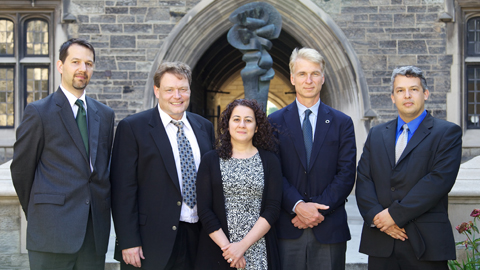
For generations now, people from around the world have accepted the invitation to fly the friendly skies. This has increased global travel and advanced cultural and commercial exchanges. However, it has also left an increasingly large carbon footprint, one that researchers at the University of Toronto Institute for Aerospace Studies (UTIAS) have been seeking to shrink.
The impacts of commercial aviation on the environment are substantial. The emissions created by burning jet fuel cause air pollution and, over decades, climate change. Currently, commercial aviation produces 4.9% of the total human contribution to global warming and that number is climbing. The International Air Transport Association (IATA) has targeted the stabilization of net CO2 emissions from the aviation industry by 2020, with a long-term goal to reduce net carbon emissions by 50% by 2050 compared to 2005 levels.
Now, thanks to a new Collaborative Research and Training Experience (CREATE) Program grant from the Natural Sciences & Engineering Research Council of Canada (NSERC), U of T Engineering professors can provide new training for the next generation of aerospace engineers. Today, NSERC announced $1.65-million in funding to establish the NSERC CREATE Program in Environmentally Sustainable Aviation. The grant will support students studying and conducting research in the field of sustainable aviation as well as establish a new certificate program. Over the six-year span of the grant, over 130 undergraduate and graduate students are expected to participate in the program.
“UTIAS has developed a strong international reputation for our research that reduces the aerospace industry’s carbon footprint,” explained UTIAS Director David Zingg. “This grant will allow us to capitalize on that expertise by offering new training to our students, which in turn will be taken into industry and put into practice.”
The program will train students to conduct research with world-class technical capabilities, develop their professional skills, and expose them to the highly interdisciplinary knowledge needed by sustainable aviation professionals. Students will learn about aerodynamics to reduce drag on airplanes, study lightweight options in aircraft construction, examine biofuel options and conduct life cycle assessments of aerospace technology. The result will be engineering graduates skilled in using the tools and techniques available to reduce carbon emissions.
“The NSERC CREATE Program in Environmentally Sustainable Aviation will prepare a new generation of engineers for the challenges associated with reducing the carbon-emissions of the aviation industry,” said U of T Engineering Dean Cristina Amon. “We congratulate UTIAS for receiving this research grant and thank NSERC for providing this important support.”
“Airline travel has made our lives better, but it has also contributed to the plight of our planet’s fragile environment,” said Professor Peter Lewis, U of T’s associate vice president (research). “This research and this important investment are addressing a real need in the quest to protect the planet’s environment while also enabling the airline industry to grow.”
The new program will also build upon the biennial International Workshop on Aviation and Climate Change, which is hosted and organized by UTIAS. The workshop brings together representatives from academia, government, and industry to find technological solutions to reduce the greenhouse gas emissions from aviation. The third annual conference was held May 2 to 4 and covered aircraft design, engine design, alternative fuels and atmospheric science.
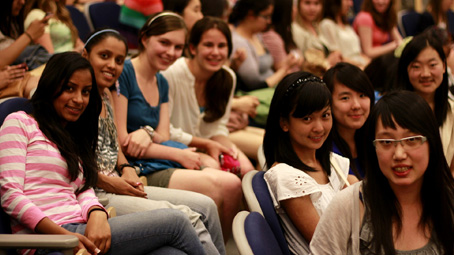
U of T Engineering welcomed more than 100 newly admitted female students to the first Girls Leadership in Engineering Experience (GLEE) weekend, held May 26 and 27.
The new initiative aims to empower female students who are about to join a community where women are at the forefront of engineering leadership and innovation. Next fall, over one-quarter of first year students in U of T Engineering will be women.
Yoley Li (ElecE 1T4), who participated in GLEE as a Residence Assistant, remembers going into her first year in electrical engineering feeling isolated and wishing she had the opportunity to better connect with fellow female students.
“I wanted to take this opportunity to inspire them … I told all the participants that, although engineering may be male-dominated, we still stand out,” she said.
Participants had the chance to gain knowledge and seek guidance from current students, faculty and alumni. Events included a semi-formal dinner with members of the U of T Engineering community, a career panel discussion, a hands-on workshop led by graduate students and a lunch hosted by the U of T chapter of Women in Science and Engineering (WISE).
U of T Engineering has a long and proud history of women mentors and leaders. From the early years of the Faculty to now, female professors, graduates and students have left an indelible mark on the profession.
One such example is Professor Brenda McCabe, the Chair of Civil Engineering, who spoke with students about the career paths of other women who’ve come through the program, all the way from the Faculty’s first female civil engineering graduate, Marcia Scott in 1947.
“My experience with this initiative was very positive,” said Professor McCabe. “I had the opportunity to meet bright, young women who want to become engineers. It was wonderful to share with them our very successful history of women in engineering.”
GLEE follows in the steps of many other initiatives that seek to cultivate the next generation of women engineers. Currently, more than a fifth of the Faculty’s undergraduates are women, while they make up a quarter of graduate students.

In an effort to rebuild Haiti after its devastating 2010 earthquake, Cast ConneX Corporation, a start-up out of the Department of Civil Engineering, is taking part in an industry-wide coalition aimed at preparing the island nation in the event of another major tremor.
The Toronto-based company’s earthquake-resistant connectors are playing a leading role in the establishment of a seismic-resistant school in the capital city of Port-au-Prince. Led by the Canadian Construction Association (CAA) and Builders without Borders, the project will reconstruct a vocational centre called École Lakay that will serve as a training facility for young Haitian tradespeople.
Project partner Fast + Epp of Vancouver sought out Cast ConneX’s cutting-edge connectors for the school’s structural ‘lateral-force resisting system’ because of their proven performance when subjected to earthquake-induced loading. Cast ConneX was then approached by the Canadian Institute of Steel Construction (CISC) – another project partner– to donate their products for the construction of the school.
While recent distribution agreements with global industry leaders are taking Cast ConneX technology worldwide, this project is particularly meaningful for the innovative company.
“Having our technology implemented in a reconstruction project in Haiti has been our goal for some time,” explained President and CEO, Carlos de Oliveira (CivE MASc 0T6). “We have long realized its potential to enable the construction of state-of-the-art, seismic-resistant buildings in nations that are lacking a fully developed steel construction industry, such as structural-qualified field welders.”
That potential will be being realized in Haiti since Cast ConneX connectors are fabricated in Canada and their structural steel elements do not need to be welded together in the field. “École Lakay can be entirely constructed using field-bolting, the same way one would put together a meccano set,” said de Oliveira. “As a result, our connectors will enable the school’s structural frame to be erected predominately by locals.”
Thanks to Cast ConneX’s seismic-resistant system, the school will also have the capacity to serve as a safe zone, providing food, shelter and medical attention in the event of a natural disaster.
“We hope that more of these structures can be established in Haiti,” said de Oliveira. “This will be a lasting legacy for the people of Port-au-Prince.”
The technology behind Cast ConneX’s connectors was developed at U of T Engineering in 2006, based on de Oliveira’s graduate thesis work and the doctoral work of Michael Gray (CivE PhD 1T1). Both research projects were supervised by CivE professors Jeffrey Packer and Constantin Christopoulos. In 2007, the four founded Cast ConneX as a start-up company to commercialize life-saving connectors. The impact of its technology on the well-being of society has earned Cast ConneX the Canadian Society for Civil Engineering’s 2009 Award for Excellence in Innovation in Civil Engineering.
For more information about Cast ConneX, please visit: http://www.castconnex.com.
Standing in front of Convocation Hall, surrounded by friends and family, with a bachelor’s degree in chemical engineering under her arm, Kelly Bryck described the graduation experience with these simple words: “It’s all about community.”
Bryck is one of the Faculty of Applied Science & Engineering’s newest alumni. She joined 950 undergraduates and 189 graduate students who graduated from the Faculty during two convocation ceremonies held today.
“We’re so proud of each other. And it was so nice to have all of the faculty out because I saw them while I was waiting to go up [on stage] … and it was nice that they all recognized us and tried to make it special for us,” Bryck said.
Today’s celebrations marked the culmination of a lot of hard work and high expectations.
“Graduates, I want you to think back to the first lecture that you attended here four or five years ago in this magnificent Convocation Hall. Back then, the road that led you here today must have seemed quite long,” said Engineering Dean Cristina Amon. “Now you can celebrate, with your family and friends, the achievement of graduating from an Engineering school that is not only the best in Canada but is among the finest in the world.”
The pride felt by the family and friends present was evident.
“I’m very proud. I understand he graduated with honours and was at the top of his class, which is a bonus,” said a beaming Sandra Sarwan, whose son Derrick graduated with a bachelor’s degree in industrial engineering.
The convocation ceremonies were also an opportunity to recognize two distinguished alumni from U of T Engineering. Dr. Pierre Rivard (MEng MechE 9T4) and Dr.Phillip (Rocky) Simmons (ChemE 6T4, MASc 6T5, PhD 6T9) were presented with Honorary Doctorates.
Dr. Rivard is a pioneer of Canada’s clean energy industry. Following a 20-year career in the Canadian Armed Forces as an Aerospace Engineer, Dr. Rivard co-founded Hydrogenics Corporation, which is one of the world’s leading fuel cell companies. He is now CEO of MAGENN Power Incorporated, a Canadian company focused on delivering next-generation wind turbines.
Speaking at the morning ceremony, Dr. Rivard implored graduates to be flexible and embrace the challenges before them today.
“Keep in mind that your calling or your career will change two or three times in your lifetime, so it is more important to get going on serving some cause than it is to keep searching indefinitely for the perfect start. Then work on better defining the social utility and higher purpose of the particular chapter that you are writing, as it is one of the foundations of a life well lived,” said Dr. Rivard.
Dr. Simmons was recognized for developing the groundbreaking ion exchange technology that spawned Eco-Tec, a world leader in purifying, recovering and recycling industrial wastewater. That technology was developed during Dr. Simmon’s graduate studies in the Department of Chemical Engineering & Applied Chemistry. To date, Eco-Tec has installed more than 2,000 units in 58 countries, including Canada, the UK, India and China.
“You are now about to embark on the most exciting, scary, rollercoaster of life that you can imagine. You will have many ups and downs but it will allow you to reap the benefits beyond your wildest dreams,” Dr. Simmons told graduates. “As you proceed on this rollercoaster, doors of opportunity will be opened to you often. In fact, you have opened the first door: gaining a superior engineering education at the best engineering faculty in the best university in the world.”
For Dr. Jon McKechnie, who earned a doctorate in civil engineering, his door of opportunity will open across the Atlantic. He has accepted a faculty position at the University of Nottingham in England. Reflecting on his experience at U of T Engineering, the research opportunities stand out most for him.
“It was a good fit [for me] and there are a lot of great opportunities for collaboration here,” said Dr. McKechnie, whose doctoral thesis focused on forest resource utilization and greenhouse gas mitigation under the supervision of Civil Engineering Professor Heather MacLean.
“I am excited to hit the world and leave the classroom,” said Amir Allana, who earned a Bachelor of Applied Science in Engineering Science degree. Allana will be working with Engineers Without Borders (EWB) in Uganda. He has served as President of U of T’s EWB chapter prior to his graduation.
“I had a strong desire to create change in this profession and create change in the world. And I didn’t really see how this profession was doing that on its own,” said Allana. “I definitely don’t believe that now,” he added, noting that his experiences at U of T introduced him to a lot of people and ideas that demonstrated the impact engineers can have.
Read Dean Cristina Amon’s message to graduates of spring 2012, view the archived webcast of the ceremonies, as well as our photo essay below:
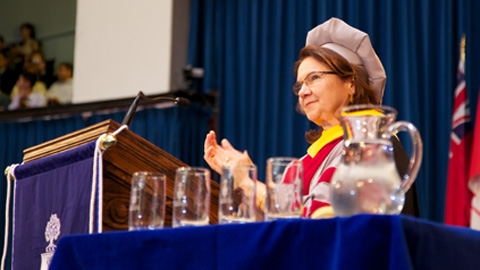
To the engineering graduates of Spring 2012: we congratulate you. This has been a tremendous year for our community, and it culminates with your remarkable achievement as our graduating class.
All members of our faculty, staff and alumni take enormous pride in this day. We stand with your loved ones when we say that we are incredibly proud of you. For your parents, families, friends, spouses and partners, this day is a fulfillment of their anticipation and immeasurable support. I join you in thanking them for their encouragement and belief in you over the last few years.
This spring, 950 undergraduates and 189 graduate students earn degrees (77 receive MEng degrees, 57 obtain MASc degrees and 55 earn PhD degrees). Each of you will leave Convocation Hall and enter a world that is ready for you to make a difference. A world that will look to you for the same dedication, determination and enthusiasm that you displayed during your time here. A world that is also eager for your boundless ideas, imagination and expertise.
As U of T Engineers, you are well prepared to meet and exceed these expectations. You will be at the forefront of solving some of the most pressing global problems. Your innovations will have a profound impact on industry, government and society, as you embrace diversity and work collaboratively with others. Through collaboration, we have so much to teach and learn as we work together to keep our society healthy, sustainable and prosperous.
In keeping with this spirit of excellence in engineering, our convocation ceremonies will be honouring two highly respected leaders from industry. Like you, they were once U of T Engineering students.
At the 10 am ceremony, our Honorary Graduand will be Mr. Pierre Rivard (MEng MechE 9T4), an international trailblazer in energy technologies and CEO of Magenn Power.
At the 2:30 pm ceremony , we will honour Dr. Phillip (Rocky) Simmons (ChemE 6T4, MASc 6T5, PhD 6T9), a world-renowned expert in water treatment and chemical recovery systems and President and CEO of Eco-Tec Limited.
Following each ceremony, the celebration will continue with a reception in the Great Hall at Hart House.
You will soon be members of the engineering profession, and the opportunities ahead of you are boundless. Along with your engineering degrees, you will carry forward the knowledge and experience you gathered at U of T to drive innovation and serve our global community.
So, on behalf of all of our faculty, staff and alumni, please accept our warm wishes for a rewarding career. I encourage you to look back at your years here with great pride and assurance that U of T Engineering will always be with you as you step into your future.
Cristina Amon, Dean
Faculty of Applied Science & Engineering
University of Toronto
Watch the archived webcasts here and view our convocation photo essay here.
Honorary Graduand Biographies:
Mr. Pierre Rivard (MEng MechE 9T4), CEO of Magenn Power
Dr. Phillip (Rocky) Simmons (ChemE 6T4, MASc 6T5, PhD 6T9), President and CEO of Eco-Tec Limited
For more information about Convocation 2012, please visit the Office of Convocation.