

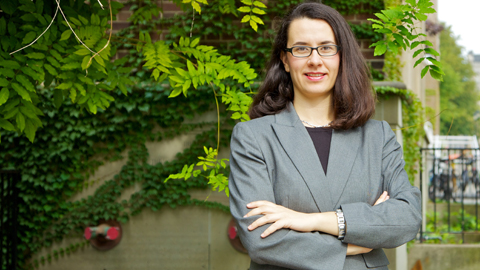
Kitty Kumar, a Materials Science & Engineering PhD Candidate, recently beat out more than 900 competitors to receive the Best Poster Award at the 38th annual IEEE Photovoltaic Specialists Conference (PVSC).
The IEEE-PVSC, which was held on June 3–8 in Austin, Texas, is one of the top technical events for photovoltaic scientists and engineers around the world.
Supervised by Professor and MSE Chair Jun Nogami, Associate Professor Nazir P. Kherani (ECE, MSE), and Professor Peter R. Herman (ECE), Kumar’s work addresses the capability to maximize light absorption in crystalline silicon (c-Si) – the primary material found in commercial photovoltaics.
Her award-winning research demonstrates a novel method of using high-resolution laser writing on thin wafers of c-Si to enable a unique chemical etching process. This process results in a nano-scale surface structure that drastically reduces light deflection over an unprecedented range.
“I’m particularly excited about these results as they are directly relevant to energy and sustainability, which are two major themes for the Department of Materials Science & Engineering,” says Professor Nogami. “It has been very rewarding to pursue this collaboration with both professors Kherani and Herman. This project shows how interdisciplinary collaboration within the Faculty of Applied Science & Engineering enables us to expand our expertise beyond what might have been achieved by each of our groups individually.”
Kumar also came in third place in the research talk competition at the NSERC Photovoltaic Innovation Network’s Next Generation Solar conference, held on May 14 and 15.
A leading designer of next-generation computer chips and a respected developer of engineering design curriculum were celebrated on June 8 as U of T Engineering’s two newest recipients of Natural Sciences and Engineering Research Council of Canada (NSERC) chairs.
Professor Kamran Behdinan (MIE) has been named the NSERC Chair in Multidisciplinary Engineering Design, while Professor Vaughn Betz (ECE) has been named the NSERC/Altera Industrial Research Chair in Programmable Silicon. Both appointments were announced on May 3.
“I want to congratulate our two new chairholders, both distinguished scholars and both great credits to this Faculty,” said U of T President David Naylor.
“These chairs not only recognize the outstanding contributions of Professors Behdinan and Betz, but they also provide much-needed resources to support their work,” said Professor Yu-Ling Cheng, Acting Dean, Faculty of Applied Science & Engineering.
In his role, Professor Behdinan – who is also the Director of the newly established Institute for Multidisciplinary Design & Innovation in the Department of Mechanical & Industrial Engineering – will establish real-world multidisciplinary senior design projects, which will utilize industrial collaboration and support. The projects will span all nine undergraduate programs in U of T Engineering.
The establishment of multidisciplinary design projects will further unite design initiatives across the Faculty and encourage collaboration, design and innovation. The projects will encourage students to approach design on a national and international scale, addressing pressing issues such as sustainability.
Professor Betz is one of the world’s leading developers of the software that powers programmable computer chips, field-programmable gate arrays (FPGAs), which can become any type of chip you might need. Unlike standard chips that are produced to serve one function, FPGAs can be reprogrammed based on the needs of the user at any time.
The research chair will further enable collaboration between Professor Betz and Altera, which is one of the two leading FPGA companies and has a major research and development centre located in downtown Toronto. The research results will enable both better FPGA chips and computer-assisted design software, benefiting not only FPGA companies but also the extremely wide variety of hardware designers who use FPGAs in their systems.
“Over the last decade, the University of Toronto’s Faculty of Applied Science & Engineering has developed an international reputation for its leadership in engineering research and education. With today’s announcement, the Faculty is set to enhance the training it provides to students,” said Dr. Suzanne Fortier, President of NSERC.
Both chairholders were presented with plaques to commemorate their appointments at a reception held in the Michael E. Charles Council Chamber.
Read the original announcements of Professor Behdinan and Professor Betz’s appointments.
Six U of T engineers are among those recognized by the University’s second annual Inventors of the Year Awards competition, which honoured the work of 15 inventors at a ceremony on June 7. The awards were presented in the Banting and Best Innovation Hub on College Street.
The awards recognize U of T inventors who make significant contributions in three areas:
- Biomedical and Life Sciences
- Engineering and Physical Sciences
- Information and Communication, Technology, Social Sciences and Humanities
“We decided to launch the Inventors of the Year program in 2011 to recognize the superb contributions U of T researchers make to global society through their inventions,” said Professor Paul Young, U of T’s vice president (research). “These awards give us an excellent opportunity to reinforce that university research – and, especially, U of T research — makes a difference to progress and to the quality of our lives.”
Young also noted the importance of students to the invention process. “Each award-winning project is directed by a U of T faculty member, but it is important to note that students are vital to the process. And, remember, these students will go on to apply their experiences here at U of T in their future careers, in academia, the public and private sectors, and as citizens. Once again, we see the connection between U of T research and society.”
The 2012 awards recognized a variety of inventions, ranging from the identification of a gene that, when manipulated, dramatically improves drought resistance in crops to devices that assist children with severe physical and cognitive challenges to communicate and learn.
The 2012 Inventors of the Year are:
Biomedical and Life Sciences
- J. Stewart Aitchison, The Edward S. Rogers Sr. Department of Electrical & Computing Engineering; co-inventor James Dou
- Sachdev Sidhu, Banting and Best Department of Medical Research
- Peter Zandstra, Institute for Biomaterials & Biomedical Engineering, Department of Chemical Engineering & Applied Chemistry
- Peter McCourt, Cell and Systems Biology
Engineering and Physical Sciences
- Eugenia Kumacheva, Department of Chemistry
- Aleksandar Prodic, The Edward S. Rogers Sr. Department of Electrical & Computer Engineering
- Aaron Wheeler, Department of Chemistry
Information and Communication, Technology, Social Sciences and Humanities
- Tom Chau, Institute of Biomaterials & Biomedical Engineering; Bloorview Research Institute
- Eyal de Lara & Michael Brudno, Department of Computer Sciences; co-inventors Andres Lagar-Cavilla, Adin Scannell, Joseph Whitney
- Dimitrios Hatzinakos, The Edward S. Rogers Sr. Department of Electrical & Computer Engineering
More detailed information about the winners and their inventions is available online.

As Chemical Engineering Professor Greg Evans explained, quantity hasn’t led to quality when it comes to developing effective team skills among engineering students.
“We provide our students with a lot of group experiences during their four years of study, but we haven’t always been intentional in teaching students how to be effective in teams,” he said.
Lectures and workshops are helpful, but the most valuable learning comes from fellow students. The challenge has been finding the right way to deliver honest and effective feedback.
Working with PhD Candidate Patricia Sheridan and Professor Doug Reeve (ChemE), Professor Evans is developing a new online learning tool to help students refine their group leadership skills in large classes.
Through a website, students can provide anonymous feedback to fellow teammates and use self-assessment tools to identify skills that could use further development. The assessment is based on 27 behavioural competencies that Sheridan and Professor Evans identified from earlier research on team dynamics. Depending on the responses provided, a student will be presented with web-based resources to develop their weaker skills. Over the course of a student’s studies, the website can develop a portfolio of their leadership experiences in group settings.
This project is one of two that recently attracted the financial support of the Higher Education Quality Council of Ontario (HECQO). The arms-length provincial agency provided research grants to allow investigators in U of T Engineering to study and thereby improve the quality of learning for students in the Faculty.
Dr. Micah Stickel, a Lecturer in The Edward S. Rogers Sr. Department of Electrical & Computer Engineering, will use his grant to invert the classroom experience.
As Dr. Stickel explained, the traditional learning dynamic involves students passively listening to lectures in the classroom while individual assignments are completed away from the supervision and support of instructors. Instead, he hopes to move more of his lectures online for students to watch prior to class. That will free class time for Dr. Stickel to work with students on problem sets and conceptual elements that have previously left learners struggling.
The new format will be used in ECE221, a mandatory second-year course for electrical and computer engineering students that focuses on electric and magnetic fields.
“The course is fairly difficult, both conceptually and mathematically. We use vector calculus to solve somewhat abstract problems, a combination which many students struggle with,” said Dr. Stickel, who explained it was those challenges that make the course perfect for testing the inverted classroom model. “It will support students in developing their conceptual understanding.”
Dr. Stickel will use a pair of conceptual tests at the beginning and end of the course, as well as another test in the following term to measure the breadth and depth of students’ learning.
The two projects are just a few of a broad range of research being conducted to improve and advance engineering education within the Faculty of Applied Science & Engineering.
Once disparate and individual efforts, new collaborations are being forged as a result of the newly-established Practitioners in Engineering Education Research (PEER) group. Initiated by Mechanical Engineering Professor Susan McCahan, U of T Engineering’s Vice-Dean, Undergraduate, PEER was a response to a growing interest within the Faculty to conduct research related to engineering education.
“About a year and a half ago, I started getting a lot of calls from people all across the Faculty asking questions about engineering education research. The type of questions, and the rate, made it clear that it was time to get everyone together for regular discussions,” said Professor McCahan.
The group is modeled on the Wilson Centre in the Faculty of Medicine, which seeks to advance healthcare education and practice by sharing and conducting research on learning in the field. PEER meets monthly and features presentations on research that will soon be shared at a conference or published in a journal.
“The people around the table are there to provide ideas and to ask questions,” she said.
The PEER group includes faculty members, administrative staff and graduate students with an interest in the topics discussed. Recent presentations have included research on teaching math within engineering curriculum and identifying the individual qualities that support student success in engineering programs.
Canada’s leadership in the global mining industry was the focus of discussion at the May 23 Biz Skule™ Networking Lecture Series event. Alumni, faculty and students gathered to learn more about this important industry, which in 2011 alone saw Canada produce more than $50-billion worth of minerals.
The newly transformed Lassonde Mining Building served as the backdrop for a panel discussion among alumni Ammar Al-Joundi (MechE 8T6) of Agnico-Eagle Mines Ltd., Peter Eunson (MinE 0T0) of Kinross Gold Corporation, Moderator David Harquail, (GeoE 7T9) of Franco-Nevada Corporation and Donovan Pollitt (MinE 0T4) of Gold Mines Ltd.
“It is a testament to the significance of this industry that this evening, the engineering disciplines of our attendees are nearly split equally,” said Claire Kennedy (ChemE 8T9), event organizer and Biz Skule™ Chair, who noted the breadth of interest.
As the panel discussed, Canada’s leadership in the industry extends beyond the material level, but impacts upon the social as well.
“Mining doesn’t have the best legacy,” said Pollitt. The environmental effects of mining are well known, but Canadian companies are taking the lead when it comes to making sustainability a priority.
“We see ourselves as temporary users of the land,” said Eunson.
“That’s why Canada is so successful,” Al-Joundi chimed in. “… we are able to deal with these social issues better, doing the right thing for the environment and for the people.”
The panelists also discussed the changing culture of the business. In April, Postmedia reported on the mining industry boom and the growing demand for qualified professionals.
“You had a lack of people going into mining in the ’90s,” said Harquail. “Now you’ve got a lot of people who are coming into the industry, all ready to go.”
An estimated 100,000 new workers are needed by the mining industry over the next decade.
U of T Engineering is at the forefront of addressing that need, graduating students through the Lassonde Institute of Mining and Lassonde Mineral Engineering Program. Next September will see the launch of a new undergraduate Mineral Resources certificate for students.
“Today, no matter how many students graduate [from mining programs], there will be a job waiting for you,” said Pollitt.
With another successful season of Biz Skule™ events now concluded, planning for the fall has already begun. On September 27, guests will have the chance to hear from Dr.Dan Rosen (ChemE MASc 9T1, PhD 9T3), CEO of R2 Financial Technologies.
Three members of the U of T Engineering community were recently recognized with Engineers Canada awards for their contributions and achievements in engineering. Professor Milica Radisic (IBBME/ChemE) received the Young Engineer Achievement Award, Engineering Science student Saksham Uppal (1T2) garnered the Student Gold Medal Award and alumna Anna Dunets-Wills (CivE 7T6) received the Meritorious Service Award for Community Service. Established in 1972, the Engineers Canada Awards are national awards which honour the contributions of Canadian engineers to their profession, their community, and to the safety and well-being of Canadians.
A leader in the field of tissue engineering and regenerative medicine, Professor Radisic has achieved international recognition for developing patches of engineered tissue that mimic a beating heart. She was the first to use electrical stimulation during cellular growth, with the result that the developing tissue behaves in the same manner as normal heart tissue. Professor Radisic was also co-inventor of a completely novel cell-protective peptide known as QHREDGS. This peptide may be capable of enhancing cardiac regeneration, bone regeneration or wound healing, by directing cell response. Professor Radisic was named one of the world’s Top 35 Innovators Under 35 by MIT’s Technology Review in 2008 and received the 2011 Ontario Professional Engineers Young Engineer Award.
A committed volunteer and a natural leader, Uppal has created several avenues for his peers to engage in leadership and volunteerism, both within the university community and beyond. His interest in innovation and entrepreneurship, plus his passion for creating positive change, led him to develop the Nspire Innovation Network and its flagship event, the National Business and Technology Conference. He also created the Take Action! Organization which works to contribute to the community while developing socially aware youth leaders. This organization now hosts two university chapters (at Queens and U of T) and has more than 400 members. In 2011, Uppal was selected to participate in The Next 36 – a national entrepreneurship program – where he tied for the highest marks in the program.
For more than 30 years, Dunets-Wills has been using her expertise in water and sanitation systems to help remote communities. Dunets-Wills has worked with urban planning and design firm planningAlliance and its sister practice, rePlan, to create best practices for international organizations operating in developing nations. She is credited with pioneering strategies for the effective long-term local management of both public and private infrastructure systems. Over the past five years, Dunets-Wills has been involved with a local NGO called RAMBIA, in western Uganda, concentrating on water, sanitation and other infrastructure projects in the region. In 2011, she received the Ontario Professional Engineers Citizenship Award.
“I am extremely proud that Engineers Canada has chosen to honour three such deserving members of our community,” said Yu-Ling Cheng, Acting Dean, Faculty of Applied Science & Engineering. “These prestigious awards are representative of the many ways in which our faculty, students and alumni contribute to the profession and to society.”
The award recipients were honoured at the Engineers Canada Awards Gala in Niagara Falls on June 2, 2012.