

The ambitions of a University of Toronto-based design team are about to take flight … again!
The team, led by U of T Engineering alumni Todd Reichert (EngSci 0T5, UTIAS PhD 1T1) and Cameron Robertson (EngSci 0T8, UTIAS MASc 0T9), is seeking to build a human-powered helicopter and be the first to win the Igor I. Sikorsky Human-Powered Helicopter Competition.
The American Helicopter Society International established the Sikorsky Prize in 1980. To win the $250,000 reward – the third largest monetary prize in aviation history – a human-powered helicopter has to maintain a flight duration of 60 seconds and reach an altitude of three metres (9.8 ft) while remaining in a 10 metre (32.8 ft) square. In the over 25-year history of the prize, no one has been able to claim the prize.
The team, known as AeroVelo, has good reason to believe they will be the first.
The core members of the team have been working together since 2006 when they founded U of T’s Human-Powered Vehicle Design Team. In August 2010, the team’s first project – the construction of the world’s first successful human-powered ornithopter – made aviation history by achieving the age-old dream of human-powered bird-like flight. Called Snowbird, the ornithopter sustained both altitude and airspeed for 19.3 seconds, and covered a distance of 145 metres at an average speed of 25.6 kilometres per hour.
The team is also responsible for U of T’s Human-Powered Vehicle, which reached 117 km/h at the 2011 World Human-Powered Speed Challenge, held in Battle Mountain, Nevada. That represents the ninth fastest time ever achieved and less than 17 km/h behind the current world record.
Now the team’s attention has turned to a human-powered helicopter, which has been named Atlas.
“An attempt at the Sikorsky Prize was the next obvious step for our team. The helicopter is where many of our contemporaries in human-powered flight are focusing, and it’s becoming a very exciting and competitive atmosphere. We’ve been driven to push the limits of engineering further than ever before,” said Robertson.
The AeroVelo team, which includes engineering students and professionals – many of whom are U of T graduates – has assembled in Tottenham, Ontario. They aim to have the helicopter built and flying by the end of August 2012.
To finance the project, the team has turned to an increasingly popular way to attract financial support: crowd funding. The notion is that a large number of people provide a relatively small contribution. In return, supporters receive perks and products. To be successful however, a goal has to be reached before the deadline for the team to receive the funds committed by supporters.
AeroVelo is hoping to raise $30,000 by June 16 through KickStarter, a well-known crowd funding website. That is less than 18% of the total budget of $170,000. To contribute to the project, visit the team’s KickStarter page.
Reichert, who also flew the Snowbird, will fly the helicopter. With an output of 772 watts per minute, he will be the most powerful athlete to ever fly a human-powered helicopter. Reichert explained that, “the Sikorsky Challenge provides an inspirational narrative: the project pushes the boundaries of possibility, showing that with creative solutions and innovative design we can do far more with far less.”

When you turn on your tap, you probably don’t give a second thought to the quality of the water that comes out.
North Americans can generally take for granted that the water provided from municipal supplies is clean and clear. However most are probably not aware of the engineering deployed to keep it that way.
Among those developing the research and techniques for water purification is Civil Engineering Professor Ron Hofmann, who has recently been named NSERC Associate Industrial Research Chair in Drinking Water. He explains that while confidence in our water supply is understandable, complacency can be deadly.
“Drinking water in North America is very safe, but given that there are over 300 million people drinking it every day, there are still occasional illnesses,” said Professor Hofmann, who added “… we are still trying to make drinking water safer.”
The public not only expects tap water to be safe to drink, but also to be clear and odourless, which is the challenge Professor Hofmann will tackle during the term of his research chair.
“From time to time there are algae blooms in Lake Ontario that make Toronto’s tap water unpalatable. The water is still perfectly safe to drink, but the earthy-musty smell erodes public confidence. I’m trying to improve the cost-effectiveness of removing these offensive tastes and odours,” he said.
He is exploring new ways to make the use of granular activated carbon (GAC) more cost-effective. GAC is currently used to remove taste and odour-causing compounds from drinking water and is familiar to anyone who uses black charcoal to purify their aquarium.
“GAC adsorbs organic molecules that create tastes and smells, removing them from the water. The GAC has a limited capacity for adsorbing the molecules, so eventually you need to remove the exhausted GAC and replace it with fresh material,” Professor Hofman said.
The challenge is that GAC is very expensive, so Professor Hofmann is working to better detect when it becomes exhausted and needs to be replaced. The aim is to use the material for a longer period, thereby reducing the overall cost. He is also exploring the benefits and challenges associated with using ultraviolet light and chlorine to destroy offensive taste and odour-causing chemicals.
The awarding of Professor Hofmann’s Associate Chair follows the recent re-appointment of fellow Civil Engineering Professor Robert Andrews as the Senior NSERC Industrial Research Chair in Drinking Water Research.
The funds associated with the research chair will support funding for five to six graduate students per year as well as additional research activities. The Industrial Research Chair is supported by the Natural Sciences and Engineering Research Council of Canada (NSERC) with corporate support from General Electric, Peterborough Utilities Corporation, Lake Huron and Elgin Area Water Supply System, as well as the regional municipalities of Durham, Halton, Peel and York, and the cities of Toronto and Barrie.
Professor Hofmann explained that the industrial partners not only provide financial support, but intellectual support as well.
“The industrial partners contribute intellectually to the research, first by identifying research needs from their perspective, and then working with me to translate those needs into appropriate research projects,” he said, noting, “there’s a very active channel of communication between the University and the partners.”
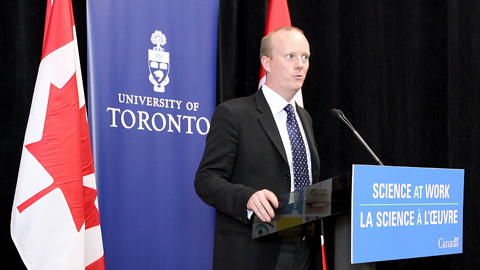
U of T Engineering are among the many who will benefit from today’s announcement by the Government of Canada and the Natural Sciences and Engineering Council of Canada (NSERC) of $43 million in research and scholarship investment at the University of Toronto.
The funding will support 176 research projects and 186 students at U of T.
“Our government’s top priority is jobs, growth and long-term prosperity. To remain at the forefront of the global economy, our government is investing in the people and ideas that will produce tomorrow’s breatkthroughs,” said Gary Goodyear, federal minister of state for science and technology. “Through these investments, we are creating the best-educated and most skilled workforce in the world.”
Goodyear made the announcement at an event held in U of T Engineering’s Galbraith Building.
Universities across the country will receive more than $410 million in grants and scholarships over terms ranging from one to five years. These awards comprise the 2012 competition results for NSERC’s Discovery Grants, Discovery Accelerator Supplements, Alexander Graham Bell Canada Graduate Scholarships, NSERC Postgraduate Scholarships and Postdoctoral Fellowships.
“We are grateful to the Government of Canada and NSERC for this magnificent investment in our research community and our students,” said Professor Peter Lewis, associate vice president, research at U of T. “This funding will go directly to work that will have a tangible impact on areas that are of vital importance to global society.”
Among the recipients are nine U of T Engineering professors who received Discovery Accelerator Supplements, which are awarded to accelerate progress and maximize the impact of superior research programs. The award is valued at $120,000 over three years ($40,000 annually) and provides recipients with additional resources to compete with the best in the world. These resources may be used to expand the recipient’s research group (i.e., students, postdoctoral fellows, technicians), to purchase, or to have access to, specialized equipment, or for other initiatives/resources that would accelerate the progress of their research program.
One of the recipients is Professor Ted Sargent of The Edward S. Rogers Sr. Department of Electrical & Computer Engineering (ECE). Sargent received a Discovery Grant and a Discovery Accelerator Supplement to explore ways of harvesting solar energy. While solar power is abundant, clean and free, it is not easy to harvest inexpensively and efficiently. Sargent’s research will build low-cost, high-efficiency novel devices to help advance solar cell performance.
The other U of T Engineering recipients of the Discovery Accelerator Supplements are:
- Miriam Diamond (Geography/ChemE) who is researching emissions, fate, exposure and management of chemical contaminants indoors, outdoors and globally;
- Ashvin Goel (ECE) who is researching end-to-end data reliability with runtime verification;
- Giovanni Grasselli (CivE) who is researching the influence of rock micro-scale properties and material heterogeneity on rock engineering modelling;
- Axel Guenther (MIE) who is researching fluidic microprocessors for material assembly;
- Andreas Moshovos (ECE) who is researching next generation heterogeneous computer device architectures;
- Adam Steinberg (UTIAS) who is researching high-repetition-rate laser diagnostics experiments for prediction and control of thermo-acoustic instabilities in low-emission gas turbine engines;
- Ning Yan (Forestry/ChemE) who is researching value-added chemicals and other bio-based products from bark; and,
- Wei Yu (ECE) who is researching interference mitigation and network topology optimization for cooperative wireless cellular systems.
“Through these programs, NSERC provides direct support to an exceptionally strong base of scientific and creative talent in every field of the natural sciences and engineering,” said NSERC President Dr. Suzanne Fortier. “Our scholarships and fellowships programs help us recruit and retain the bright young minds that will lead the next generation of Canadian discoverers and innovators. The flexibility and broad base of research supported by our internationally recognized Discovery Grants Program maintains our capacity to promote important breakthroughs.”
An integral component of Canada’s support for research and training excellence at Canadian universities, the Discovery Grants Program funds ongoing programs of research in every scientific and engineering discipline. Of the 2,161 recipients across the country, 125 have been identified to receive a Discovery Accelerator Supplement, in addition to their Discovery Grant. Valued at $120,000 over three years, Discovery Accelerator Supplements are awarded to researchers whose research proposals suggest and explore high-risk, novel or potentially transformative concepts and lines of inquiry, and are likely to have impact by contributing to groundbreaking advances in the proposed areas of research.
Overall, 1,599 new NSERC scholarships and fellowships have been offered this year—consisting of the Alexander Graham Bell Canada Graduate Scholarships, NSERC Postgraduate Scholarships and Postdoctoral Fellowships. The funding announced today offers support at the master’s, doctoral and postdoctoral levels.
For the lists of recipients and descriptions of projects, visit NSERC’s website.
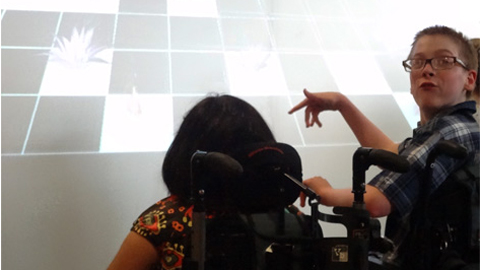
As a regular outpatient with cerebral palsy, 12-year-old Caleb spends a lot of time in waiting rooms. It hasn’t always been as fun as it is now.
Caleb was just one of the children from a focus group who helped launch ScreenPlay, an interactive waiting room installation, on May 18 at the Holland Bloorview Kids Rehabilitation Hospital.
Designed by Professor Elaine Biddiss, a scientist at the Bloorview Research Institute and a faculty member at the Institute of Biomaterials & Biomedical Engineering (IBBME), the installation boasts a pressure-sensitive floor comprised of 100 sensors. Calibrated from the microcontroller switches in the tiles, information is fed to a computer that then applies corresponding images to a glass wall from a ceiling-mounted projector. Anyone standing or sitting on the tiles can create elaborate, moving landscapes from the three rotating design motifs: flowers and bubbles, a forest blooming from a geometric grid, and abstract vines and patterns.
“We have a very vulnerable population here,” Professor Biddiss explained, and traditional waiting room toys have contact surfaces that easily spread infections. As many of the patients face mobility challenges, games requiring hand dexterity – including traditional and video games – are not practical. ScreenPlay allows anyone to interact without ever having to touch a contact surface or anyone else.
The longer a patient remains in one spot, the bigger the projection becomes, which allows those with the least amount of mobility to create the largest images. The floor likewise promotes collaborative fun: multiple children of all abilities can play together on the floor to create wall-sized forests, for instance.
“The only thing that all these kids have in common is that if you’re standing or sitting, you have gravity on your side. You have presence, and that presence is something we can always detect,” Professor Biddiss stated.
She noted that ScreenPlay was a “very collaborative effort” between engineers, the Holland Bloorview Kids Rehabilitation Hospital Foundation, as well as students from OCAD University who created the projector images for an interactive communications class.
Supported by a foundation established to honour the late Dr. Tammy Kagan-Kusher, the installation isn’t all just fun and games. The project was awarded a Canadian Institutes of Health Research grant that Professor Biddiss will use to study the effects of this type of interactive play on patient stress-levels and overall experience.
If Caleb’s grin is anything to go by, ScreenPlay is already a resounding success.
The Faculties of Applied Science & Engineering, Dentistry and Medicine recently gave the Institute of Biomaterials and Biomedical Engineering (IBBME) the perfect golden anniversary gift. IBBME Director Paul Santerre, along with Dean Cristina Amon of the Faculty of Applied Science & Engineering, Dean David Mock of the Faculty of Dentistry, and Dean Catharine Whiteside of the Faculty of Medicine, signed a historic document that re-affirms IBBME’s unique position as a tri-faculty Extra Departmental Unit (EDU) at U of T—and a world-renowned research institute.
The document, a “Memorandum of Understanding” (MOU), outlines the role and share of responsibility that IBBME and its partner Faculties will take on in the years to come. Engineering’s Acting Dean Yu-Ling Cheng said that the MOU “codifies the relationship between IBBME and its partner Faculties.” Engineering, which historically and contemporarily contributes the greatest amount of faculty members and associated resources to IBBME, will continue to take the lead role for faculty promotion and stewardship.
“We now know what everyone is contributing,” Dean Mock said. “In this document [the role of these parties] is much more clarified.”
The origins of the Institute can be traced back to 1962 when the Institute was established as a joint research endeavor between the Faculty of Medicine and two departments from the Faculty of Applied Science & Engineering. The Institute expanded and eventually merged in 1999 with the Center for Biomaterials, which was a partnership between Dentistry and Engineering, to create what we now know as IBBME. As an Institute, IBBME is an “extra-departmental unit A,” a designation that allows a remarkable degree of integration and collaboration across Faculties and disciplines to create some of the most ground-breaking research developments in the world, such as Professor Milica Radisic‘s research on generating heart tissue or Professor Jan Andrysek‘s work on developing low-cost artificial legs.
According to Professor Santerre, IBBME’s cross-disciplinary nature is the very reason for its longevity and success—a vision shared by its Faculty partners. “The very essence of IBBME is its interdisciplinary nature,” remarked Acting Dean Cheng. “Engineering concepts are in a constant dialogue with those derived from the fields of medicine and dentistry.”
For Dean Mock, IBBME’s interdisciplinary nature “goes beyond the word collaborative”: “[IBBME] is not just different disciplines collaborating, but rather is people coming together to create a single discipline.”
“Part of that collaboration,” explained Medicine’s Dean Whiteside, “has been with the hospitals as much as with the Faculties.” She highlighted the vitality and importance of IBBME’s close associations with the medical community, such as the Sunnybrook Health Sciences Centre, Mount Sinai Hospital, The Hospital for Sick Children, Holland Bloorview Kids Rehabilitation Hospital, St. Michael’s Hospital, and the University Health Network (UHN). In addition, IBBME has developed new collaborations with health research partners such as the Centre for the Commercialization of Regenerative Medicine (CCRM), the Centre for Research in Advanced Neural Implant Applications (CRANIA) and UHN’s Techna, to name a few.
Signed during a year when IBBME celebrates not only its 50th year but a year that positions its students and faculty as ranking among the top five biomedical and biomaterials programs in North America, the memorandum is a testament to IBBME and its partner Faculties’ commitment to relentlessly move forward towards a future of innovation in the field.
“We live in a world that is becoming evermore integrated. And we’re competing with the world,” Professor Santerre added.

It’s become second nature for Drew Taylor (IBBME PhD candidate) to begin his day at the lab and end it atop a pitching mound.
Since 2008, he’s been juggling a full-fledged baseball career as a pitcher for the Toronto Maple Leafs baseball team, while researching tissue engineering at U of T.
Taylor – who was also a minor league pitcher for the Toronto Blue Jays and Philadelphia Phillies – isn’t the first to combine high-level athletics and academics. Taylor’s father, Ronald Taylor (ElecE 6T1), graduated from U of T Engineering before pitching for teams such as the Cleveland Indians and St. Louis Cardinals. After two World Series wins, he went on to pursue medicine and is now the Toronto Blue Jays’ team physician.

“Because of him, it feels like a natural progression. If I didn’t have [baseball and research], I wouldn’t know what to do with all my time,” said Taylor.
As an athlete, Taylor’s experience with sports injuries has inspired and motivated his research in cartilage tissue engineering.
“I went through an injury when I was playing for the University of Michigan and ended up missing the entire season,” he said. “I battled back through rehabilitation and got to a point where I was throwing close to where I was before, but my arm never recovered 100%.”
Since cartilage lacks natural delivery of blood or nutrients, it is very difficult to repair when it gets damaged. Working under Professor Rita Kandel (IBBME), who is Chief of Pathology and Laboratory Medicine at Mount Sinai Hospital, Taylor is focused on growing the connective tissue in a patient. The challenge is doing so without losing collagens that make cartilage functional.
“We’re trying to expand it while maintaining those properties so that it’s capable of withstanding force,” he said. “Ultimately, I’d like to take the research from the lab to a level where there are direct applications, and it starts helping people.”
Taylor is now in his final year of his PhD program. After he graduates, he sees himself pursuing medicine at U of T and continuing his research. That means finally putting aside his baseball career.
“My focus has shifted to the research,” he said. “I’ve seen way too many people struggling to walk or to even get out of bed because of the pain from lack of cartilage. If we have the ability to re-coat that surface with tissue that is functional and can repair itself, that would be an amazing contribution.”