
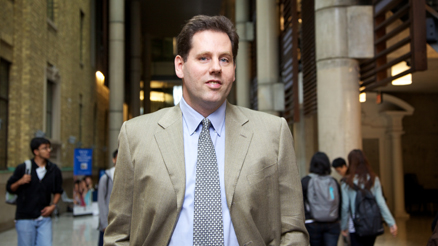
Professor Vaughn Betz (ECE) has been named the NSERC/Altera Industrial Research Chair in Programmable Silicon. The five-year renewable chair provides support for Professor Betz’s research on programmable computer chips, known as field-programmable gate arrays (FPGAs).
Professor Betz is one of the world’s leading developers of the software that powers FPGAs. The programmable computer chips have the unique ability to become any type of chip you might need. Unlike standard chips that are produced to serve one function, FPGAs can be reprogrammed based on the needs of the user at any time.
“FPGAs are an integral part of developing the next generation of computer technology. Canada is well positioned to be a leader in the field. The new Chair provides additional support to ensure that we leverage new developments in computer manufacturing with the versatility of FPGAs,” said Professor Betz.
Professor Betz recently returned to the University of Toronto, where he has completed his PhD, following 11 years as the Senior Director of Software Engineering at Altera Corporation, a programmable semiconductor manufacturer. He also co-founded a successful FPGA software start-up, and has an extensive publication record and holds 68 U.S. patents. He is an architect of one of the leading industrial FPGA device families, and of one of the leading industrial computer-assisted design (CAD) systems used to map designs into FPGAs.
The Chair will further enable collaboration between Professor Betz and Altera, which is one of the two leading FPGA companies and has a major research and development centre located in downtown Toronto. The research results will enable both better FPGA chips and CAD software, benefiting not only FPGA companies but also the extremely wide variety of hardware designers who use FPGAs in their systems.
“On behalf of the Faculty of Applied Science & Engineering, I congratulate Vaughn Betz on receiving the NSERC/Altera Industrial Research Chair in Programmable Silicon. He brings extraordinary expertise, entrepreneurial and industrial experience that will benefit our students and inspire their research,” said Engineering Dean Cristina Amon. “We are also deeply grateful for the support provided by NSERC and Altera Corporation,” she added.
“Vaughn Betz has made exceptional contributions to the development of reprogrammable computer chips,” said Suzanne Fortier, President of the Natural Sciences and Engineering Research Council of Canada (NSERC). “This is expected to become a crucial technology as its capabilities are further enhanced. As an Industrial Research Chairholder, Dr. Betz is addressing significant long-term problems. His research positions Canada on the leading edge of developments in this field, and the students who are trained under this program will be in high demand by many Canadian industries.”

What the heroes of Moneyball did for baseball, Industrial Engineering Professor Timothy Chan and undergraduate engineering student David Novati are doing for hockey.
As retold in the Oscar-nominated movie, Billy Beane and Paul DePodesta used statistical analysis and nuanced metrics such as on-base percentage and slugging percentage to assemble the Oakland A’s roster beginning in the late 1990s.
Chan and Novati are bringing the same evidence-based sensibility to hockey.
In a paper soon to be published in the journal Interfaces along with a follow-up paper presented at the 2012 MIT Sloan Sports Analytics Conference, Chan and Novati propose a new methodology for quantifying the value of a hockey player.
“Take Sidney Crosby as an example,” Chan said. “Our model considers him a top-tier player because he gets a lot of goals and assists, and generally has a good plus-minus. He adds a lot of value to his team. Now you have other players who are more physical, deliver hits and who get into a lot of fights. Our model says they don’t provide a lot of value to the team, contrary to what some people think.”
A player’s value can determine not only his or her salary, but also influence trades and playing time.
The development of the model began in 2009, not long after Chan arrived at the University of Toronto as an Assistant Professor in the Department of Mechanical & Industrial Engineering. Collaborating with Novati, who had a keen interest in sports statistics, the industrial engineers started to contemplate how they could apply their knowledge to the Vancouver Winter Olympic Games.
“We started thinking about how we could develop a model that would help predict what the ideal Team Canada hockey team would look like,” said Chan. In the process, they realized a need for a better method to value different player types, the focus of their current research.
Chan and Novati monitor a variety of player performance stats, including goals, assists, hits, blocks, time in the penalty box as well as time on ice. Their model considers a large number of statistics in concert to get an overall picture of a player.
In all, the model established four types of forwards (Top Line, Second Line, Defensive, Physical), four types of defensemen (Offensive, Defensive, Average, Physical), and three types of goalies (Elite, Average, Bottom).
The U of T team is continuing to test and refine their model. Statistics for hockey, unlike baseball, are less plentiful. Eventually they hope to make their statistical model available to the NHL and develop an online tool to help the average hockey fan create their fantasy team.
Novati, who will graduate in June, hopes this research could mean a career in the NHL’s backrooms.
“There are only a few teams that are really harnessing the insights that statistics offer,” said Novati. “I hope to have the chance to make the League realize the impact that stats and people like me can offer.”
For those teams watching this year’s NHL finals from the stands, Chan and Novati’s new valuation model could be the tool needed to walk home with the Stanley Cup next year.
Inspired by the notion of ‘giftivism,’ a Skule™ alumnus has established a new graduate student scholarship in U of T Engineering’s Centre for Global Engineering.
It you’re not familiar with the notion of ‘giftivism,’ you’re not alone. The donor, who wishes to remain anonymous, defines the term as the practice of radically generous acts to change the world. “Service is the ideal gift, but due to my current circumstances, this was not possible. So I decided to give a financial gift,” he states.
The new scholarship, to be known as the Wisdom Fellowship, will be presented to a graduate student conducting research affiliated with the Centre for Global Engineering. The criteria call for the award to be given to a student who is not only excelling academically, but also based on how she or he “… develops and applies generosity, compassion, and community service in their graduate research.”
As a graduate student, the alumnus benefited from financial support provided from government agencies and a fellowship that was established by Skule™ alumni. “These gifts allowed me to focus on my research and education without having to worry about financial stability. This convinced me that all students should have such an opportunity to pursue knowledge,” he says.
The benefactor says that establishing the scholarship was a “joyful experience” and one that will ultimately provide a return on his investment. “In the present case, giving others the opportunity to pursue knowledge will yield greater knowledge to me,” he states.
If you were to picture someone working in the mining industry, would she or he be wearing a hard hat and carrying a pickaxe or a business suit and carrying a briefcase?
Mining in Canada has come a long way. Far from the early days of the Yukon Gold Rush, today Canada is the global centre for mining business. Consider that in 2011, 90% of all mining equity financings were completed on the Toronto Stock Exchange (TSX) and its sister Venture Exchange (TSX-V). That represents 40% of all mining equity capital raised worldwide. Of the world’s public mining companies, 58% are listed in Toronto.
Canada’s leadership in the global mining industry will be the focus of discussion at the next Biz Skule™ Networking Lecture Series on May 23. Leading that discussion will by Skule™ alumnus David Harquail (GeoE 7T9), the President & CEO of Franco-Nevada Corporation. Joining him will be Ammar Al-Joundi (MechE 8T6), Senior Vice President, Finance and CFO of Agnico-Eagle Mines Limited, Donovan Pollitt(MinE 0T4), President & CEO of Wesdome Gold Mines Limited, and Martin Tunney (MinE 0T6), Director at CIBC Investment Banking, Global Mines Group.
As event organizer and Biz Skule™ Chair Claire Kennedy (ChemE 8T9) explains, the discussion comes at a ripe time for both the industry and the University of Toronto.
“There is no denying Canada’s important role in this global industry, but also its impact on Canada’s financial sector,” states Kennedy. “At the same time U of T, with the leadership and support of [Franco-Nevada Chairman] Dr. Pierre Lassonde, has been renewing its mineral engineering programs. This makes for an interesting nexus of business opportunities and academic innovation that will fuel a very rich discussion.”
This is the second panel discussion held by Biz Skule™. As Kennedy states, the panel format gives guests a greater opportunity to network and hear a broad variety of perspectives on a topic.
The event will be held on May 23, appropriately enough, in the new Goldcorp Mining Innovation Suite in the recently renamed Lassonde Mining Building (170 College Street, 4th Floor). The cost is $25 and the reception will begin at 5:30 p.m., with the panel discussion starting at 6 p.m. To register, please visit the online registration website or for more information, contact Sonia De Buglio at 416-946-8143 or by email at sonia@ecf.utoronto.ca.
Planning for the next Biz Skule™ event has already begun. On September 27, guests will have the chance to hear from Dr. Dan Rosen (ChemE MASc 9T1, PhD 9T3), CEO of R2 Financial Technologies. Stay tuned for additional details and registration information.
By Angela Tran-Kingyens (EngSci 0T5)
In February, two Skule™ alumni receptions were held in San Francisco (on February 21; coinciding with the IEEE International Solid State Circuits Conference) and Mountain View, California (on February 22).
Over 100 alumni living in the Bay Area enjoyed these evenings, which were an opportunity to network, establish new friendships, and catch up with Faculty leaders, including Dean Cristina Amon; the Chairs of The Edward S. Rogers Sr. Department of Electrical & Computer Engineering and Division of Engineering Science, Professors Farid Najm and Mark Kortschot; the Executive Director of Advancement, Jim Dawson; and the Director of Alumni Relations and Annual Giving, Sonia De Buglio.
In response to the enthusiasm of these alumni in the Bay Area, a new Skule™ chapter has recently been formed to unite the U of T Engineering graduates in Northern California.
The next event is scheduled for Thursday, May 17 at Tied House Brewery, in Mountain View, California, at 7:00pm. For more information, to RSVP, to get involved with the organizing committee, and to receive updates on future events and programs, please join the San Francisco / Bay Area Skule Alumni Chapter Facebook group. Details will also be posted on the University of Toronto Bay Area Alumni Group page on LinkedIn.
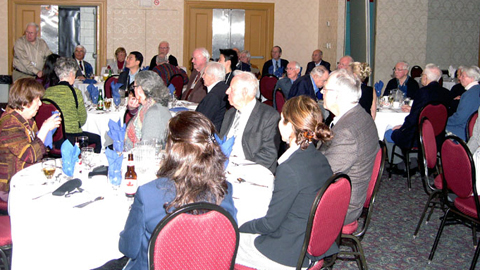
It began as a modest affair in the depths of the Great Depression. For the graduates of the Class of 3T5, their monthly lunches were an opportunity to share ideas and each other’s company. About 10 years ago, with the leadership of the Class of 5T3, the reins were passed to 5T3 in order to carry on the tradition.
Now known as the Skule™ Lunch and Learn, the monthly luncheons are an opportunity to discover more about U of T Engineering and the broader world.
“The topics are intentionally broad,” explains Dave Fenwick (EngBus 5T3), one of the alumni organizing the series, and who for the past ten years has been involved in booking speakers for the lunch. “We want to make sure that the topics are accessible and of general interest,” he adds.
Previous speakers have addressed topics ranging from activities of entrepreneurial businesses, space exploration, construction, military history, as well as examples of the cutting-edge research conducted within U of T Engineering.
“The objective is to be informative without being too heavy on the technical details,” Fenwick says. “We’re not teaching calculus here.”
The lunch attracts many retired alumni, who welcome the chance to connect with classmates and expand their horizons. Graduates from the late-1930s to the late 1960s regularly attend, with grads from the 1970s attending with increasing frequency. Alumni are also encouraged to bring their spouses or guests.
The annual March lunch is dedicated to the presentation of the 3T5 Second Mile Award, which is awarded to a fourth-year student, and the Class of 5T3 Engineering Award, which is given to a student in third year. Both awards recognize students for her or his high academic achievement and leadership as demonstrated through involvement in extra-curricular activities both within the University and the community at large.
“The lunch is an opportunity for us to come together, enjoy good comradeship as well as exchange memories and experiences, and learn a bit along the way,” says Fenwick.
Guests also enjoy a two- or three- course lunch with bar service available.
The gathering of Skule™ alumni occurs on the second Wednesday of each month from October to May at the Toronto Plaza Hotel near highways 400 and 401. If you’re interested in learning more about the Skule™ Lunch and Learn series, contact Sonia De Buglio, Director of Alumni Relations sonia@ecf.utoronto.ca and we will send you monthly announcements of dates, times and speakers for the series starting this fall.