
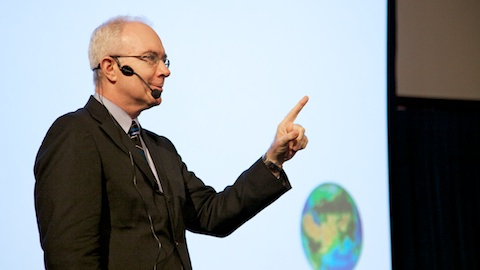
This year, the Faculty of Applied Science & Engineering was proud to present Paul Cadario (CivE 7T3), Senior Manager at the World Bank, as guest speaker of U of T Engineering’s annual plenary speech.
On September 8, first-year students ushered in their first week of classes with inspiring words from both Cadario and Dean Cristina Amon.
“More than ever, this world needs your dreams, your innovation and your hopes,” said Dean Amon, before introducing Cadario.
“Engineers have a great responsibility to improve the world. Paul Cadario has taken that to heart. He is not only a great friend to U of T Engineering, but is an engineer who has dedicated his career to fighting poverty and improving the living standards of people in the developing world,” said Dean Amon.
Following his Oxford studies as a Rhodes Scholar, the self-described “global engineer” went to work for the World Bank in 1975. As a young Transport Economist in West Africa, he helped the Bank use its funds to reduce poverty.
His career then took him around the world – to China, where he worked to integrate the country into the world economy, and to the countries of the former Soviet Union, as they joined the World Bank in the 1990s.
In late 2001, Cadario was appointed to his present post, where he oversees the Bank’s trusteeship of donor countries’ contributions to development activities outside the Bank’s normal lending business.
In his presentation, he gave the students a glimpse of his career, which intersects engineering, business and global politics. He explained to the class of 1T5 the importance of understanding the context of problems from multiple perspectives before undertaking a solution.
There are two key aspects, he said, that will help them pioneer solutions. “Much of what you’re doing will include context and perspective: why are we doing this? How will this affect the outcome now and in the future? And that is just as important as the engineering.”
“Paul’s talk was inspirational. He was able to show through his experiences how engineering can have a huge impact on the world,” said Professor Susan McCahan (MIE), the Vice-Dean, Undergraduate, beginning September 15.
Taking into consideration the political, social and environmental issues, is vital to successful design, said Cadario. “You can’t use the scientific approach for every approach.”
The challenges the World Bank encountered, financing the highly publicized Tarbela dam in Pakistan (upstream from India, on the Indian and Pakistani borders), involved more than just technical knowledge, he said. And creating ground water development initiatives, on Greece’s border with Turkey during politically sensitive times in the mid 1970s, meant thinking about present and future implications for people living on both sides.
“Today, being willing is not enough,” he said. “You must ask yourself what type of world you live in, what type of world do you want to live in and what are you going to do about it?”
Dean Cristina Amon (MIE) and Professors Michael Collins (CivE), Chul Park (MIE) and Peter Stangeby (UTIAS) have been elected Fellows of the Royal Society of Canada (RSC), one of Canada’s most prestigious academic honours. The RSC is the senior national body of distinguished Canadian scholars, artists and scientists. It consists of nearly 2,000 Fellows, who are selected by their peers for outstanding contributions to the natural and social sciences, the arts and the humanities.
This year’s new Fellows will be inducted into the RSC during the Induction and Awards Ceremony on Saturday, November 26, 2011 at the Ottawa Convention Centre in Ottawa.
Cristina Amon’s research pioneered the development of Computational Fluid Dynamics algorithms for formulating and solving thermal design problems subject to multidisciplinary competing constraints. This led to her creation of a multi-stage concurrent thermal design methodology based on hierarchical model refinement. Dean Amon’s research laid the scientific foundation by elucidating mechanisms of flow destabilization to induce heat transfer enhancement in self-sustained oscillatory flows and hemodynamics transport in biological systems. She has made pioneering contributions to concurrent thermal designs, innovation in electronics cooling and transient thermal management of wearable computers.
Michael Collins is internationally renowned for his contributions to the understanding of the nonlinear behaviour of reinforced and prestressed concrete structures and its application to the design of buildings, bridges, concrete offshore oil platforms, nuclear containment structures, and other heavy industrial facilities. His Modified Compression Field Theory, based on novel experimental techniques, has transformed the shear design of concrete structures from restrictive empirical procedures to rigorous, general, easy-to-follow models and has been used as the basis for widely-used computer programs such as Response-2000. His theories have been incorporated into design specifications all over the world.
A world leader in the field of plastic foaming, Chul Park holds a Canada Research Chair in Microcellular Plastics and is Founder and Director of the Microcellular Plastics Manufacturing Laboratory and the Centre for Industrial Application of Microcellular Plastics. Professor Park’s microcellular research has produced pivotal breakthroughs that have reshaped scientists’ knowledge of plastics engineering. He has identified the fundamental mechanisms that govern cell nucleation and foam expansion, enabling him to invent numerous novel technologies for polymer processing. His research has generated 20 patents, and hundreds of companies throughout the world have licensed his microcellular systems.
Peter Stangeby is internationally recognized as the world’s leading authority on the boundary physics of fusion energy research devices, particularly tokamaks. Fusion powers the sun and stars; the aim of nuclear fusion research is to create a potentially limitless terrestrial energy source. Professor Stangeby’s standing is due to his numerous foundational discoveries, his impressive record of publications in top-ranked journals, and his highly accomplished graduate students, many of whom now occupy key positions in the two largest international fusion research projects. His book The Plasma Boundary of Magnetic Fusion Devices has become the standard reference in tokamak boundary physics research.
“The unprecedented election of four of our faculty members to the Royal Society of Canada is a testament to the world-leading research taking place in the Faculty,” says Cristina Amon, Dean, Faculty of Applied Science & Engineering. “On behalf of the Faculty and all the newly inducted Fellows, I extend our deep gratitude to the Academy for this honour.”

Hundreds of first-year students gathered at the Bahen Building (40 St. George St.) on Tuesday, September 7 to discover their new campus and meet professors and staff at the annual Fun With Faculty event.
Under an overcast grey sky, students participated in a range of programs from funny improv classes to informative research talks and campus tours.
Professor Jonathan Rose (EngSci 8T0, ElecE MASc 8T2, PhD 8T6) offered one of the first lectures of the day. He spoke to students about the engineering science behind smartphones and delved into how apps are developed. Organizing and speaking at the lecture was just as much fun for him as it was the students, Professor Rose admits.
“It’s exciting to touch the energy of first-year engineering students as they embark on their career,” he says. “I was also excited that the talk attracted students from across the engineering disciplines — chemical, mechanical, civil, etc.. — who all came out,” he adds.
The day organized by the Faculty is a meet-and-greet event special to U of T Engineering. “Fun With Faculty is a unique program because it really gives students the chance to meet the professors, staff and people who work behind the scenes,” states Lesley Mak, Student Success Specialist and TrackOne Liaison. “It really encourages new students to get to know our Faculty in a way that not many other programs and Faculties do.”
Fun With Faculty is one of several frosh events taking place this week that began with matriculation and ends with an overnight trip to Hart House on Sunday September 11.
During the event, current undergraduates helped orient first-years. They hosted improv classes, flipped pancakes for hungry students and answered questions of every kind from 8:30 am to noon.
While the allure of free food and playing games for many was tempting, meeting their peers and professors was the main goal at the frosh event.
“It’s great to be able to meet your profs and the other people in your year in a really fun way,” says Kate Kazlovich (CivE 1T5). “You learn so much about your peers and what to expect this year.”
The cheering that emanated from the lobby of Bahen Building where most of the day’s events took place was deafening at certain points. Students covered in purple dye sang Skule™ songs, while others schmoozed with staff and leaders.
For Marko Spudice (CivE 1T3) the day was a reminder of how much fun he had in his first year. The need to create a memorable experience for others was behind his decision to flip pancakes starting at 6 am on an outdoor grill.
“My time [at orientation] was the best, and I wanted to help with entertainment and help other people have a good time,” he says. “And besides I love working with barbecues so it was a no-brainer for me.”
Along with Spudice, engineering students from each department helped hundreds learn about their departments and find their way around the St. George campus. Hourly tours introduced students to common room hangouts, lectures, department space and labs.
Another one of the many students to chip in was Ishan Gupta (ChemE 1T4). Along with his cousin Kunal Taneja (MechE 1T4), Gupta spent most of their day helping their groups of students get settled into life in the Faculty.
“Engineering is really a community,” Gupta explains. “We’re all united, and I want new students to feel that way, too. We want them to feel as welcome and comfortable as we do,” Kunal adds.
He, a first-year Engineering Science student, participated in a similar class, the Learning to Lead class, and found it fun and educational.
“I met a lot of people and like how they put the emphasis for leadership on connections, not just about what you know,” He states. “I think [the class] and just everything here today helped people open up, at least for me it did.”

It is my great pleasure to welcome you all back to a new academic year in the Faculty of Applied Science & Engineering. We step into the next few months strong, refreshed and energized. Certainly the excitement and zeal of our new students is contagious, and we welcome all 1,354 undergraduates and more than 650 graduate students. They are a remarkable group.
They join us from 57 countries and from all continents. Collectively, our incoming first-year undergraduate students have an Ontario Secondary School average of 90.6% — the highest in the history of the Faculty. What a glowing tribute to our reputation and their dedication.
I am also pleased that 23% of the new students are female, a rewarding outcome of our ongoing effort to improve gender balance. Many of our new students come from nine provinces and one territory, and 30% join us from countries around the world. It is this diversity — in Canada, and from nations around the world, that will contribute to our multiculturalism and global outlook.
We have attracted the best to be among us. And we will continue to offer the finest Engineering education in Canada.
U of T Engineering prides itself on being ahead of the curve in the education we offer our students. We want to make certain that upon graduation, they are ready, not just to take up careers in the most exciting, in-demand and promising fields, but to become leaders in them. That is why we have launched new minors in Engineering Business, and Robotics and Mechatronics, as well as certificates in Global Engineering and Engineering Business. These innovative offerings will future-proof our students in a competitive marketplace looking to hire the most qualified candidates.
Together, new and established students, faculty and staff, we will work in the coming year to enhance our reputation and to continue our pursuit of excellence. We will celebrate our diversity, listen well to new ideas and help each of us become the best we can be. Most of all, we will contribute globally and locally by offering our best ideas to a world in need. Let us step into the new term with that ideal, the ideal of all engineers, fuelling our progress.
Best wishes and welcome,
Dean Cristina Amon
Faculty of Applied Science & Engineering

The University of Toronto Formula SAE Racing Team placed 15th overall at the Formula Student Germany competition in Hockenheim, Germany.
The competition occurred August 2 to 7 and included 78 teams from 25 nations.
“The German competition is one of the most challenging in the world,” explains Michael Bakaic (Mech 1T1 + PEY), who is the team captain. “It is a genuine test of our skills, which makes our strong showing so much more meaningful to us.”
The competition evaluates the student built and designed vehicles on a series of criteria, including static factors such as cost, design, marketing, as well as dynamic criteria like performance on the skidpad, endurance and fuel efficiency.
“The skidpad was definitely the highlight of the competition,” says Bakaic, who notes the team placed first in that category.
“This was the first competition where the organizers had run this category in full wet conditions,” says Bakaic, explaining that the judges ensured a wet surface by using sprinklers to keep the track covered with water.
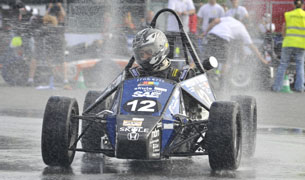
That surprised all of the teams, who were only notified one month prior to the competition. For the U of T team, that news arrived too late to practise; the racing vehicle had already been shipped to Germany.
“It was a real testament to the talent of our driver and our design that we were able to do so well,” says Bakaic.
The team’s next competition will be the University of Toronto Shootout on October 1 at the Mosport International Raceway. Hosted by the U of T Formula SAE Team, the “shootout” attracts 21 Formula SAE design teams from around North America for a full day of autocross racing.
However, the team’s attention is now turning towards the design of their 2012 vehicle.
Bakaic has high hopes for the team’s performance in 2012 based on their success this year.
“We had a very young team this year,” he states, noting the departure of many senior team members who graduated this past year, “but we were able to organize ourselves well and it obviously paid off with our success in Germany.”
To keep apprised of the team’s performance throughout the year, visit their website.
Three assistant professors from U of T Engineering are among 17 researchers at the University of Toronto who are benefiting from new funding announced today by the Canada Foundation for Innovation (CFI).
The grants will provide support to:
- Professor Cathy Chin (ChemE) for the Multidisciplinary Laboratory for Innovative Catalytic Science;
- Professor Daman Panesar (CivE) for Characterization of Cement-Based Materials Using a MicroXRF for Durable Concrete Infrastructure; and,
- Professor Arun Ramchandran (ChemE) for the Laboratory of Complex Fluids.
The new funding from CFI’s Leaders Opportunity Fund will allow researchers to purchase new equipment that wouldn’t have been possible before.
“The equipment necessary to complete my research needs to be highly customized,” explains Professor Chin. “It’s not something that I can purchase off the shelf.”
Professor Chin’s research seeks to generate new fuel sources from biomass, which is generated from waste products. Utilizing catalytic conversion technology, Professor Chin hopes to provide new fuel sources that will eliminate the need for carbon fuels like coal and petroleum.
The grant arrives at an important time for Professor Chin, who is still establishing her lab after beginning at U of T just this past May.
“We are delighted to see some of our newest faculty members benefit from today’s announcement,” states Professor Cristina Amon, Dean of the Faculty of Applied Science & Engineering. “Obtaining the required equipment is critical to achieving research excellence, and we are grateful to CFI for the support provided to Professors Chin, Panesar and Ramchandran.”
The CFI Leaders Opportunity Fund grant will support Professor Panesar’s efforts to address a critical challenge facing Canada today: deteriorating infrastructure.
“A survey revealed that 88% and 83% of roads and bridges in Canada require repair or replacement and rehabilitation needs for bridges alone is $700 million dollars annually,” states Professor Panesar.
Professor Panesar’s research focuses on developing methods to assess and improve the durability of concrete. The grant will provide important equipment to support this research.
“Advancement of the lab facilities will enable transformative research in the area of durable cement-based materials, leading to significant contributions and insight into the mechanisms that cause age-related degradation,” says Professor Panesar.
The grants will also benefit Professor Ramchandran’s research in fluid mechanics. His focus is on understanding the suspensions of rigid particles in fluids and deformable particles, such as drops, elastic particles and vesicles.
Created by the Government of Canada in 1997, CFI strives to build our nation’s capacity to undertake world-class research and technology development through investments in state-of-the-art facilities and equipment in universities, colleges, research hospitals and non-profit research institutions. Its Leaders Opportunity Fund helps universities attract and retain top research talent.
“CFI investments provide vital infrastructure in communities across the country and create opportunities for leveraging the work being undertaken by our enterprising researchers,” says Dr. Gilles G. Patry, CFI President and CEO. “Cutting-edge research facilities are magnets that attract the best talent from around the world, allowing them to work with business and train a new generation of Canadian researchers and innovators.”
Seventeen U of T researchers won a total of $3,892,005, representing 13.7% of the total funding awarded nationally.
“On behalf of the University of Toronto, I extend heartfelt thanks to the Canada Foundation for Innovation and to the Government of Canada for this investment in our researchers,” states Professor Paul Young, U of T’s Vice President (Research). “Support like this is crucial to the success of our research endeavour — both here at U of T and across the country.