

Throughout the summer, U of T Engineering showcased the best the Faculty has to offer the next generation of engineers.
Through innovative programs offered by senior graduate students, supported by undergraduate students, a wide variety of youth enriched their understanding of engineering. Organized by the Engineering Student Outreach Office, more than 1,200 youth from 20 countries around the world took part in cutting-edge projects such as building solar cars, model lungs and miniature wind turbines.
The budding engineers also used skills they learned to tackle hands-on teamwork activities, like building and programming robots during in-class labs.
July: DEEP Summer Academy
The Da Vinci Engineering Enrichment Program (DEEP) offered more than 40 courses inspired by graduate student research to 900 highly motivated students between grades nine and 12. Among the courses offered by the summer academy were two unique sessions: in the first, youth had the opportunity to analyze the embryonic stem cells of mice, while in another course, participants delved into the science behind space robotics taught by alumnus Jian-Feng Shi (AeroE MASc 0T4).
The students involved in the program also applied the skills they developed to tackle hands-on teamwork activities in U of T’s leading-edge research facilities.
August: Jr. DEEP, Girls’ Jr. DEEP & ENGage
In August, the Faculty also played host to Jr. DEEP and Girls’ Jr. DEEP. The programs, modeled on DEEP, encourage interest in science by exploring popular themes like aeronautics, environmental sustainability solutions and earth systems.
Jr. DEEP was geared towards students in grade seven and eight. Participants had the opportunity to explore everything from engineering’s most extreme jobs to biomedical science and engineering. They learned all about designing amusement parks and underwater exploration. Students also conducted mini-experiments to diagnose clinical conditions like hyperthyroidism.
Along with Jr. DEEP, the Engineering Student Outreach Office also ran Girls’ Jr. DEEP, a program meant to develop the engineering interests of female students in grade seven and eight. The unique initiative is part of the Faculty’s ongoing response to the under-representation of women in the engineering profession.
Throughout the program, undergraduate and graduate female instructors taught participants about a range of disciplines in science, engineering and mathematics. In one class, students learned about cells, how they function and even created their own models with help from instructors.
The girls learned about the science behind rocket mechanics and later launched their very own devices on campus. Participants also built hydraulic mazes and mini-labyrinths using hydraulic pumps (syringes) to navigate them.
Also taking place in August was ENGage, a program meant to inspire black youth to explore the exciting world of engineering. U of T’s chapter of the National Society of Black Engineers (NSBE) and the Engineering Student Outreach Office organized the second year of the program.
The program was conceived by Mikhail Burke (MSE 1T2) and Ayokanmi Falade (MechE 1T1 + PEY) in 2009–10 when they were President and Vice President, respectively, of U of T’s NSBE chapter. While the 2010 camp lasted only one week, this year’s edition of ENGage offered two, one-week sessions. Plans are underway to offer a similar program that will run on Saturdays during the academic year.
Participants in the program were recruited through community partners based in Regent Park and Parkdale. However, word of mouth also spread news of the initiative far and wide.
For more information about other interactive programs offered to pre-University students throughout the year or to get involved, please visit the Engineering Outreach’s official website.
A group of engineering students from the University of Toronto have created a device that could revolutionize how malaria is diagnosed in developing countries.
Joshua Dian (ElecE PhD candidate), Shyra Khosla (MechE 1T0), Martin Labrecque (ElecE 1T1, PhD candidate), Shervin Mehryar (ElecE 1T2) and Aaron Persad (MechE PhD candidate) received the 2010 James Dyson Award and praise from peers for their out-of-the-box thinking that could save lives around the world.
The group’s Automated Parasite Detection System (APDS) has the ability to replicate the work that would normally be done by highly qualified personnel. It prepares a monolayer of cells, and fixates and stains the cells in a repeatable, operator-independent manner. The device also includes a machine vision system capable of repeatable differentiation of infected from uninfected cells resulting in low false-positive and false-negative rates. In lay terms, it can diagnose malaria using clean blood work in as little as 60 minutes.
The project originally started out as an extra-curricular project, but soon turned into so much more, confessed Persad. It was the group’s desire to do something for others in Africa, where the majority of deaths occur that first spurred the work. “I was watching TV, and it really struck me how expensive medication is, and how there’s no guarantee it will work,” Persad said. “There’s still so much that needs to be done.”
The complexities that surround diagnosing malaria (especially in remote areas) can be difficult to understand. The painstaking process for identifying the parasite can take weeks in rural communities. Meanwhile, access to tools, resources, health specialists who can diagnose the parasite, and most importantly, funding to carry out the task, are serious handicaps that threaten to derail effective treatment.
“We wanted to create a more convenient, more accessible diagnosis process,” said Dian. “Something that would help others not just in places like Africa that people often think of when they hear malaria, but all over the world.”
The journey for the students from unlikely competitors to national winners was extremely difficult said Martin. The project went through several revisions to create the finished project — a portable device that is easy to transport and inexpensive to build. “We spent days inside Josh’s house going over everything again and again to make sure it was perfect. It was a challenge, but the fact this is one of the most pressing issues of our time keeps you motivated.”
Although winning an award of this magnitude is impressive to the U of T Engineering students, they’re more excited about what the future of the device may hold. They hope APDD can be adapted to other blood-borne parasites, if more funding were to become available, and to diagnose other diseases. “This could be the beginning of so much more,” said Khosla.
The team was funded in part by the University of Toronto and the local chapter of the Engineering World Health (EWH). Both groups provided tools, resources, labs and financial assistance to help with the project.

When Oti Agbeyegbe (MIE 1T2) signed up for Impact Apprentice – a business competition based on Donald Trump’s famed Apprentice – he was excited.
It wasn’t competing against peers from across Canada or possibly being named the best in the country that filled his stomach with butterflies, but the opportunity to prove that engineers posses just as much business savvy as they do practical knowledge.
“Sometimes people assume that engineers are only capable of building things, but that’s not the case,” he said. “I like the idea of problem solving, which is what we do here and what I’ll do in the competition.”
The third-year engineering student spent the week of August 23 putting his skills to the test, while competing in a series of business challenges in downtown Toronto.
In the competition, 32 university students at post-secondary institutions from coast to coast were selected to participate after undergoing a series of tasks to narrow down the competition. One of the unusual tasks included pitching themselves to judges in a short one-minute video.
For Oti, creating the video was a big departure from normal tasks he’s been assigned while at school, but it worked out great in the end. “I worked hard on that video, and it ended up paying off because I was chosen to compete.”
Although he didn’t end up winning, the experience was invaluable and helped him build on the entrepreneurial skills he learned at U of T. For instance, he used the know-how he learned in business U of T Engineering classes to package and market products to strangers during tasks and improve upon business processes, alongside seven other teammates.
He wouldn’t trade his time in the competition for anything else and cherished the moments where he was able to showcase his skills. “Being in this competition let me apply other skills like communication and entrepreneurship in a different environment and really show more of what I can do,” he said.
For some, the summer is a chance to catch up on sleep or travel. However, for hundreds of undergraduates in the Faculty of Applied Science & Engineering, this summer was a chance to experience life in the lab.
Under the supervision of faculty members and senior graduate students, students undertook a broad range of research that can improve life in many ways. From less turbulent flights, improved air quality, new biomedical devices or computers that don’t crash, students were devising new solutions for society.
Many of the results were presented at the Undergraduate Engineering Research Day (UnERD) on August 17. However, if you missed those presentations, fear not! Learn more about the research conducted by six students this summer at U of T Engineering.
The days of the blood sample routine – arm out, tie tube, make a fist, find a vein, and tap in – may soon be over, thanks to a new analysis method developed at U of T by Institute of Biomaterials & Biomedical Engineering (IBBME) Professor Aaron Wheeler in which only a pinprick of blood necessary.
Traditional methods of blood sampling requires intravenous extraction of several millilitres of blood. A phlebotomist then separates serum, which is frozen for transport or storage, and later thawed and analyzed. A relatively new alternative to the traditional method uses blood samples stored as dried blood spots (DBSs). The DBS method requires only a pinprick to extract a few microlitres of blood, which is blotted onto filter paper, where the sample, it has been found, remains stable. While DBSs have been gaining increasing popularity for the ease of sampling and storage for some time, they are still not a standard laboratory technique, and the process for using them remained laborious – until now.
In a study published in Lab on a Chip on August 25, Professor Wheeler and colleagues demonstrated the proof-of-principle that digital microfluidics could be used to automate the process of dried blood spot analysis in the case of testing for specific genetic diseases at Newborn Screening Ontario (NSO) in Ottawa. This paper is the result of a collaboration between Professor Wheeler and NSO rsearchers.
NSO regularly screens every baby born in Ontario for genetic diseases – some 140,000 babies a year – and collects DBS samples via heelprick. Each DBS must be manually collected. Technicians must prepare the sample for testing, put it into a centrifugal tube, pipette solvent onto the sample, extract the necessary material by centrifuge, and then use robotics to conduct the chemical analysis.
Professor Wheeler’s digital microfluidic platform automates this process. Droplets are manipulated onto the sample using electrical signals, and the material needed for analysis is extracted – all on a “lab-on-a-chip” with little manual intervention. He created the prototype for this process in the Bahen Cleanroom, a facility of the Emerging Communications Technology Institute at U of T.
Professor Wheeler’s study quantified particular amino acids that are markers of three metabolic disorders: phenylketonuria, homocystinuria, and tyrosinemia. His next steps will be to evaluate the rest of the 28 diseases that NSO screens for.
Professor Wheeler’s innovation is indicative of the innovative tools for biomedical engineering that IBBME researchers create. “The applications for this process go far beyond newborn screening,” Professor Wheeler stated. “Pharmaceutical companies are moving towards dried blood spot analysis, but they’re still lacking the tools to make widespread use feasible. We’ve demonstrated that digital microfluidics could be that tool. Our system is fast, robust, precise, and compatible with automation.”
While it might be a while before the days of the dreaded blood sample needle are behind us, Professor Wheeler’s digital microfluidics method is the next step in moving to a DBS-based sampling system, says Dr. Pranesh Chakraborty, Director of NSO. “This approach could save considerable costs as a result of the lower volumes of reagent required,” he affirmed. “An automated system based on this approach would also process samples faster, with higher accuracy, less risk of errors, all while freeing up time for technologists to perform other work.” Dr. Charaborty’s team provided the screening and medical perspective in this research.
A patent has been filed, and Professor Wheeler is currently exploring commercialization options.
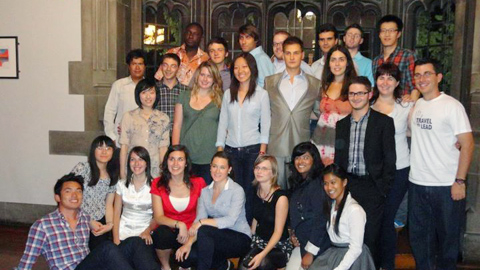
Ray Chen (CompE 1T3 +PEY) has a lofty goal: he wants engineering students to enter the workforce with more than just technical knowledge, but the communication and leadership skills necessary for them to succeed.
In order to do that, he and a team of dedicated volunteers have created the Leadership Summer School that he hopes will help students, like him, become true leaders in their field.
From Aug. 21 to 27, U of T Engineering hosted the elite Canadian Federation of Engineering Students (CFES) program, which included 21 participants from 14 countries around the world.
Engineering students from as far away as Mexico and Belgium took part in the new professional development program, which will give youth a head start in the working world.
The CFES summer initiative, the first of its kind in Canada, selected only a couple dozen engineering students to take part in the sessions. It brought students and others from professionally related organizations together on the University’s St. George Campus to share lessons and tips in an interactive environment. Five experienced international trainers also helped the future leaders learn more about best practices and leadership opportunities.
“People really brought international experiences with them when they came,” he said, “and when you have so many people sharing their strengths and advice in one place, it creates stronger engineers.”
Classes ranging from Life Planning (how students can prepare for their careers and achieve personal goals) to Emotional Intelligence (which lays out how engineers can approach stressful situations and understand emotional behaviors in a team) were covered.
Besides the obvious benefits of hosting an event of this nature it also served as a meet-and-greet for participants and strengthened relations between different institutions.
“These days engineers travel all over the world and it makes sense that we create essential dialogue with our peers wherever they live,” said Chen, who is currently studying political sciences and economics at Sciences Po Paris overseas.
Although capacity at the conference was limited, the knowledge students gained was still shared with fellow students, student groups in their home institutions.
“Physically only 24 people can attend, but [the participants] go back and develop the skills the learned and share them with their student groups and peers,” he said. “Students can still be a part of the program even if they’re not in room with us, that is why it’s so interesting.”
During the seven-day event, youth also had the opportunity to open up about ways students are falling short communication-wise and what can be done at their respective universities to expand upon their leadership knowledge –- a skill Chen confesses many students lack.
“We’ve heard from employers that students have the technical knowledge but not necessarily the communication skills so I decided to create this event where people can learn.”
He realizes that in order for U of T and international engineering students to make their mark in the world they need to learn how to better communicate their ideas.
“You have the technical knowledge, but what are you going to do with it? We want to help others prepare for the world outside of university where they’ll need communication skills, too. Knowing what you’re doing is only half the battle,” he said, ” the other half is helping others understand it.”