
Four graduate students from the Faculty of Applied Science & Engineering are among the 167 individuals named recipients of Canada’s prestigious Vanier Graduate Scholarship this year.
The scholarships, which have been likened to the Rhodes Scholarship, are part of an effort by the federal government to attract and retain top graduate students in Canada.
To receive a Vanier, students not only require a strong academic record, but also demonstrate research potential and leadership.
The application is long and the chances of success are slim, but the rewards are great. The scholarship provides $50,000 a year for three years. In addition, the growing number of fellow Vanier Scholars can also offer outstanding networking opportunities.
Get to know the 2011 Vanier Scholars from U of T Engineering:
- Jan Niklas Caspers (PhD Candidate, ECE)
- Michael Galle (PhD Candidate, ECE)
- Julie-Anne Gandier (PhD Candidate, ChemE)
- Malgosia Pakulska (PhD Candidate, ChemE)
Jan Niklas Caspers

PhD Candidate, The Edward S. Rogers Sr. Department of Electrical & Computer Engineering
Optical silicon waveguides will be essential for the next generation of servers, by bringing optical communication onto the chip. However, they are susceptible to temperature fluctuations and will require large amounts of energy for cooling. The challenge for Jan Niklas Caspers (PhD Candidate, ECE), who was recently named a Vanier Scholar, is to find new ways to reduce the temperature dependence.
“We need to bring the light onto the chip, but the current concepts are inherently sensitive and will further increase the energy consumptions of servers, the backbones of today’s Internet. I am hoping to find better methods that can reduce the amount of energy needed, and lower the carbon footprint we currently create,” explains Caspers.
Caspers’ background for this project was in physics, which he studied at the Karlsruhe Institute of Technology in Germany. During his undergraduate studies, he participated in a student exchange with the University of Toronto.
“I knew that I wanted to study outside of Germany for my graduate studies. I looked at institutions in Canada and the U.S., but U of T stood out because I knew it and because of the engaged and motivated people here,” Caspers says.
Caspers wanted to focus more on applications during his PhD research. This led him to the lab of Professor Joyce Poon in The Edward S. Rogers Sr. Department of Computer & Electrical Engineering. Professor Poon’s lab focuses on developing optoelectronic devices for high-performance communication and computing systems.
In addition to his research, Caspers is an active volunteer in the community. He is an energetic member of Let’s Talk Science, which inspires interest and understanding of science and technology among youth. Caspers was also recently elected as a student representative on the University’s Graduate Education Council.
Caspers doesn’t see his future in academia, but is instead focused on developing an industrial career.
“If my research pans out, I wouldn’t mind starting my own company that can further develop and market the technology,” Caspers says.
As an international student, the Vanier Scholarship is particularly welcome by Caspers.
“There are very few scholarships for international students, so I feel especially honoured,” he says.
The Vanier Scholarship is one of a small number of scholarships available to international students studying in Canada.
Michael Galle

PhD Candidate, The Edward S. Rogers Sr. Department of Electrical & Computer Engineering
In many ways, Michael Galle (PhD Candidate, ECE) had achieved the dream many graduate students harbour.
He had successfully transferred his master’s research into a growing company, Inometrix Incorporated, which manufactures photonic test and measurement solutions based on its patent pending Virtual Reference™ Interferometer Technology.
However, Galle still felt he lacked the background and knowledge that could best serve his clients or company.
“When I talked with clients, I was talking to PhDs. They all assumed I was a PhD, but I had to explain I only had a master’s degree. I just didn’t feel as prepared as I had wanted,” Galle explains.
So despite the demands of his company, not to mention his young daughter and wife, Galle decided to head back to graduate school and earn his doctorate.
His aim wasn’t simply to earn the credential, but to benefit from the creative environment that graduate education offers and that is especially encouraged by his supervisor, Professor Li Qian (ECE).
“We usually start with a crazy idea, but we then try to determine how we can make it less crazy. The aim is to think in a really creative way to solve problems or develop new approaches,” says Galle.
Returning to school also offers Galle the time and space to think more critically about how he can improve and advance Inometrix’s products and services.
“Returning to school has forced me to clarify what my role is in the company. I use to do everything myself, but now I am getting help for the things that others can do. I don’t need to do the accounting, but I am really the only one who can focus on the value-generating ideas and intellectual property,” Galle states.
Galle’s research is in the field of photonics, which uses light to convey information. The field relies on highly precise measurements of light diffraction, refraction and interference. Many of those measurements have traditionally come from interferometry equipment that was large, expensive and required regular calibration. Galle’s innovation, which launched Inometrix, replaces the hardware with low-cost electronics and software that could simultaneously increase accuracy, speed and portability while dramatically reducing cost. His PhD work will continue to advance his research in this area.
While Galle welcomes the money attached to the Vanier Scholarship, he believes its true value will be in the networking opportunities it affords. At a lunch held in honour of the Vanier Scholars, Galle reveled in the opportunity to talk with other graduate students who were conducting research in many diverse areas.
“I really believe that the next great innovations are not going to come from deeper research in one very specific field. It’s going to come from collaborations across disciplines that build on great ideas in different areas,” Galle asserts.
It’s a message he has been delivering to Niagara College as a member of is advisory board, and that he hopes to share with more people through the network that is being facilitated through the Vanier Scholarship.
Julie-Anne Gandier

PhD Candidate, Department of Chemical Engineering & Applied Chemistry
Julie-Anne Gandier (PhD Candidate, ChemE) was struck silent upon learning she would receive one of Canada’s prestigious Vanier Scholarships.
“I literally couldn’t speak. I slid down the wall and started to see little black spots,” Gandier recalls. “It took almost four days before I could start to think about it without shaking.”
To say that the Vanier news was a surprise to Gandier is a profound understatement.
“I had a lot of people tell me early in my undergraduate studies that research wasn’t for me. That I should consider something else,” says Gandier.
However, she has a message for those people now: perseverance pays off.
The initial discouragement did little to dissuade Gandier’s passion for research. There was no doubt in her mind that research would be part of her future. So she decided to put in the hard work and dedication needed to achieve her dream.
“After my less than extraordinary first two years of study, I decided this was what I actually wanted to do. During the summer of my second year, I decided I would get a 10.0 in the fall semester, and actually pulled it off,” Gandier explains.
Gandier’s research focuses on hydrophobins, which is a class of small fungal proteins that could be used to create water-resistant surfaces. Her interest is in creating new products from forest products. This may include using wood fibres to create a material that could replace plastic, which is derived from fossil fuels. The result would be an option that is more sustainable and environmentally friendly.
“There is a lot of fundamental science that is part of my research, and I am asking a lot of a fundamental question,” says Gandier, who describes herself as a scientist and an engineer. “I am interested not only in applying knowledge but asking questions. I was trained to do both due to my interdisciplinary undergraduate degree,” she adds.
What drew Gandier to the University of Toronto was BioZone, a new collaborative research centre focused on applied bioengineering.
“I was drawn to the notion of professors pooling their resources and working together to harness novel fundamental discoveries to apply them in the real world,” Gandier explains. “We are encouraged as graduate students to share our knowledge and expertise with our colleagues rather than being secretive.”
Gandier will soon head to Finland for a four-month exchange at the University of Helsinki. The exchange is facilitated by the Gandier’s supervisor, Professor Emma Master (ChemE) who is a Finland Distinguished Professor Fellow, and supported by the Michael Smith Foreign Study Supplement. In Helsinki, Gandier will continue her research, while building a broader network for further collaboration.
Important to Gandier is the notion of giving back. As an undergraduate student, she was the Director of the Ottawa Heart of the City Piano Program, which offers piano lessons in elementary schools where students wouldn’t otherwise have the opportunity to receive music lessons. It was an opportunity for Gandier to return the lessons she enjoyed as a young music student. She hopes to find a similar opportunity related to research.
“I was given a chance to prove myself as a researcher. I think it’s a chance that more faculty members need to make available to more students,” says Gandier. “Marks alone don’t tell the tale.”
Malgosia Pakulska

PhD Candidate, Department of Chemical Engineering & Applied Chemistry
The promise of her research sits far on the horizon, but its impact could be profound for individuals suffering from spinal cord damage.
Newly-minted Vanier Scholar Malgosia Pakulska (PhD Candidate, ChemE) is striving to find a cure for spinal injuries that result in paralysis.
“We’re not going to find the solution any time soon, especially because the ultimate solution is probably going to involve a combination of therapies, including stem cells, growth factors and rehabilitation,” Pakulska explains.
There may not be a magic pill that will cure paralysis, but that does little to lessen her enthusiasm for the task. In fact, it was the challenge of the project itself that drew Pakulska to this field.
“I was always interested in tissue engineering. The idea that we could generate human tissue really fascinated me,” says Pakulska.
Tissue engineering can have many applications, so Pakulska sought out the one field that would have the most impact.
“I could work in generating bone tissue for example, but broken bones already heal themselves,” she says. Instead, the opportunity to work on restoring nerve endings that do not regenerate after severe trauma presented Pakulska with a meaty challenge to solve.
Pakulska’s specific project, which will be the focus of her PhD research, is on the delivery of enzymes that will degrade scar tissue that surrounds injured nerve endings. Pakulska identified the project in conversation with her supervisor, Professor Molly Shoichet (ChemE/IBBME). Many believe this is a critical step to restore proper nerve function.
Pakulska marvels at the range of equipment and collaborators available at the University of Toronto to support her research.
“Anything I want to try to do, its available to me … usually in this building,” says Pakulska, gesturing to the Terrence Donnelly Centre for Cellular and Biomolecular Research, in which she sits.
She also appreciates the opportunity to collaborate with researchers in other fields who are nearby.
“Early in my research, I was focusing on protein expression and was able to find all of the equipment and expertise I needed in the lab next door,” states Pakulska.
Like other Vanier Scholars, Pakulska’s contributions are not limited to the lab. She also works as a dedicated volunteer of Let’s Talk Science, which educates and inspires children and youth from kindergarten to high school about science and technology.
The years ahead provide Pakulska with the opportunity to not only conduct her research, but uncover future opportunities. “I am not sure if I will work in universities or in industries, but I have no doubt that research will be a big part of my future career,” she says.
Professor Michael Stumm (ECE), a self-described “techie,” sat down with Future Magazine to talk about technology, innovation, regulation, traders’ rights and the future of the company he now heads called Oanda. Professor Strumm is a faculty member in The Edward S. Rogers Sr. Department of Electrical & Computer Engineering.
The engineer, who earned a doctorate in computer science from the University of Zurich and holds five patents, also goes into great detail about why teaching talented youngsters at U of T is so important. “I like interacting with bright, young minds. It keeps me young and energized, and a large part of my career is catapulting young people into their career path,” he said. “I do that at the University, but I also do that at the company. You hire young people and help them build their careers. That is very gratifying. There are advantages in both directions.”
Read more of Professor Stumm’s comments here.
Four students who will be joining U of T Engineering this fall are lauded in the Toronto Star and York Region for their academic and personal accomplishments.
Find out more about the stellar students below:
Shums Kassam, 18
The Markham student, who is currently volunteering at an orphanage in Tanzania, was the president of his school’s social justice club and a member of the dragon boat team that travelled to Macau last year for an international sport competition.
The Roberts High School student, who spends his free time tutoring youth, graduated with 100% in calculus, functions, two chemistry courses and physics.
Harris Chan, 18
The high school graduate, who is colourblind, has experienced increased attention in past years for his ability to solve the Rubik’s Cube in less than 10 seconds.
Mr. Chan graduated with 100% in functions, calculus, two chemistry courses, and 99% in physics and economics.
Tommy Pearson, 20
The soon-to-be engineering student spends his free time volunteering as a math tutor and part-time hockey coach in his local community.
As a continuing education student Pearson has worked hard to accomplish his enviable grade point average of 100% in calculus, physics, functions, economics; 98% in chemistry and 96% in English.
Ashley Deonarain, 17
In addition, Ashley Deonarain, who was valedictorian of her graduating class, will also join U of T Engineering this fall.
The youth currently spends her free time volunteering for a variety of causes. In the past, she was an athletic council executive, swim instructor and LINK crew leader (helping Grade 9 students to adjust to high school).
Ms. Deonarain graduated with 100% in two biology classes, two math courses, chemistry and economics.
They are four of the many outstanding students attending U of T Engineering after an unprecedented 2010-11 admission cycle.

Engineering students at the University of Toronto have won the Special Judges’ Award for Shock and Awe at the 2011 Toronto Pride Parade, the city’s annual celebration of the lesbian, gay, bisexual and transgendered communities.
The contingent was organized by the Engineering Society, the student government for undergraduate students in the Faculty of Applied Science & Engineering. The Engineering Society has participated in the Pride Parade for a number of years, with the Cannon Guard, which fires and protects the Skule™ Cannon, and the Lady Godiva Memorial Band both on hand.
Deciding to one-up themselves, students constructed a float for this year’s parade that featured a large silver horse. The float was constructed by the Blue and Gold Committee, the Engineering Society’s spirit committee, and was the brainchild of co-chairs Luis Ramirez (ECE 1T2+PEY) and Sandra Sousa (ECE 1T3).
“Because Pride is such a huge event in Toronto, we felt that U of T Engineering should have more of a presence. Plus, we like to show off our skills,” explains Sousa.
The Blue and Gold Committee already constructed two floats each year; one for the annual orientation parade and the other for homecoming. Ramirez explains that part of the reason the Pride Parade became the focus for a third float was to combat the impression that engineering is not an inclusive profession.
“Engineering is typecast …” Ramirez says, adding, “we want to show that engineering is accepting and supporting of everyone.”
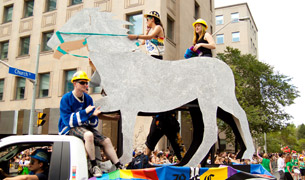
Ramirez explains that the horse was in honour of Lady Godiva, who is famed for her nude ride through the streets of Coventry, England.
“Our patron saint is Lady Godiva, so it was meant to represent Godiva’s horse,” he says.
Despite careful planning and diligent construction, the U of T group did face one big challenge prior to the start of the parade: the horse broke into four different pieces en route to the marshalling area.
“We had to call in all sorts of reinforcements, but we ended up putting it back together,” explains Sousa, noting that duct tape and some borrowed tools helped to ensure the float was roadworthy in time for the parade’s start. Plus, more than 50 students were on hand to help out.
“Pride Toronto would like to congratulate the University of Toronto Engineering students for their inspiring collective efforts and colourful spirit in this year’s Pride parade,” states Peter McHugh, Communications Director for Pride Toronto.
When asked to explain what they did to earn an award called “shock and awe,” Ramirez suggests the Skule™ Cannon may have played a role.
“We fired the cannon right in front of the judges, which I think was the shock part,” he says.
“I guess the coveralls and the hard hats were pretty shocking. You don’t normally see that sort of thing at the Pride Parade,” offers Sousa.
While the judges were shocked and awed by the cannon, they have been invited to return next year.
“Pride Toronto welcomes the participation of University of Toronto Engineering students and other engineering groups in future Pride Toronto celebrations,” says McHugh.
Sousa and Ramirez think the award will help ensure that Pride Parade float becomes an annual tradition.
“The reason we built a float this year is because we want this to be the start of a new tradition,” Ramirez explains.
The focus now for the Blue and Gold Committee is on constructing this year’s orientation float.
“As engineers, we always try to outdo ourselves,” says Ramirez. “We want to make sure that not just the Engineering frosh know about us, but the campus knows about us.”
The orientation parade will take place on September 9 beginning at 2 pm on Front Campus.
University of Toronto researchers will benefit from a $19.58 million investment in water technologies announced today by FedDev Ontario, an agency created in 2009 as part of Canada’s Economic Action Plan.
Peter Kent, Canada’s minister of environment, was on campus to announce funding to the Southern Ontario Water Consortium, an alliance of universities, companies, municipalities and non-profit organizations working to develop, test and pilot water technologies.
U of T researchers participating in the Southern Ontario Water Consortium include:
- Robert Andrews, Susan Andrews and Ron Hofmann of civil engineering, who comprise the Drinking Water Research Group;
- Vanessa Allen of laboratory medicine and pathobiology;
- Miriam Diamond of geography and chemical engineering and applied chemistry;
- Eric Miller of civil engineering; and,
- Brent Sleep of civil engineering.
The funding will allow the Southern Ontario Water Consortium to build an integrated system for the development, testing and demonstration of new market-driven water technologies and services, primarily along the Grand River and adjacent watersheds.
“Our government is committed to supporting innovative projects, to ensure that businesses and communities in Southern Ontario can continue to grow now and in the future,” said Gary Goodyear, Canada’s Minister of State for the Federal Economic Development Agency of Southern Ontario, who made a simultaneous announcement of the project at the 2011 Association of Municipalities of Ontario annual conference. He noted that the project was also expected to create jobs throughout the region.
“The quality, safety and viability of water is one of the vital issues facing global society today,” said Professor Peter Lewis, U of T’s Associate Vice-President (Research). “U of T is proud to be collaborating with so many other organizations to ensure that people in Southern Ontario and around the world continue to enjoy access to safe, clean water. Thank you to the Government of Canada for their investment in this important work.”
The Engineering Student Outreach Office (ESOO) in the Faculty of Applied Science & Engineering will benefit from two new grants announced by governments in Canada.
On August 17, the Federal Economic Development Agency for Southern Ontario announced a grant of $1.25-million to support Actua, a national science, engineering and technology youth outreach network. These funds will support outreach programs at nine universities in Southern Ontario, including ESOO, that target Aboriginal youth, girls and at-risk youth.
“This additional funding will allow us to continue to increase our innovative programming,” explains Dawn Britton, ESOO’s Associate Director.
In addition, ESOO’s Da Vinci Engineering Enrichment Program (DEEP) has been selected as one of three possible destinations for students in Newfoundland and Labrador who receive a new award.
The Newfoundland government, through the Research & Development Corporation, established the Research Inspired Student Enrichment (RISE) Awards on August 23. The award provides top high school students with the chance to attend internationally recognized science and technology enrichment programs for youth.
DEEP provides high school students who have a keen interest in engineering with the chance to gain hands-on experience in a number of specialized fields. The program is offered each year in July. More than 4,000 students have participated in the program since it was established in 2003. Courses are taught by some of the Faculty’s top graduate students.
The other two destinations are Shad International, which hosts programs at ten different universities in Canada, and the Research Science Institution, which is based at the Massachusetts Institute of Technology (MIT).
“These new awards will support our effort to recruit students to DEEP from coast to coast,” says Britton, noting that only one student from Newfoundland previously attended DEEP.
The first RISE Awards will be presented in 2012.