
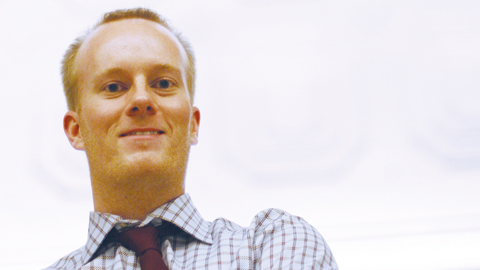
In a paper published in Nature Photonics, U of T Engineering researchers report a new solar cell that may pave the way to inexpensive coatings that efficiently convert the sun’s rays to electricity.
The U of T Engineers, led by Professor Ted Sargent (ECE PhD 9T8), report the first efficient tandem solar cell based on colloidal quantum dots (CQD). “The U of T device is a stack of two light-absorbing layers – one tuned to capture the sun’s visible rays, the other engineered to harvest the half of the sun’s power that lies in the infrared,” said lead coauthor Dr. Xihua Wang.
“We needed a breakthrough in architecting the interface between the visible and infrared junction,” said Sargent, a Professor of Electrical and Computer Engineering at the University of Toronto, who is also the Canada Research Chair in Nanotechnology. “The team engineered a cascade – really a waterfall – of nanometers-thick materials to shuttle electrons between the visible and infrared layers.”
According to doctoral student and lead coauthor Ghada Koleilat, (ECE MEng 2T8, PhD Candidate) “We needed a new strategy – which we call the Graded Recombination Layer – so that our visible and infrared light-harvesters could be linked together efficiently, without any compromise to either layer.”
The team pioneered solar cells made using CQDs, nanoscale materials that can readily be tuned to respond to specific wavelengths of the visible and invisible spectrum. By capturing such a broad range of light waves – wider than normal solar cells – tandem CQD solar cells can in principle reach up to 42% efficiencies. The best single-junction solar cells are constrained to a maximum of 31% efficiency. In reality, solar cells that are on the roofs of houses and in consumer products have 14 to 18% efficiency. The work expands the Toronto team’s world-leading 5.6 % efficient colloidal quantum dot solar cells.
“Building efficient, cost-effective solar cells is a grand global challenge. The University of Toronto is extremely proud of its world-class leadership in the field,” said Professor Farid Najm, Chair of The Edward S. Rogers Sr. Department of Electrical & Computer Engineering.
Sargent is hopeful that in five years solar cells using the graded recombination layer published in Nature Photonics paper will be integrated into building materials, automobiles and mobile devices.
“The solar community – and the world – needs a solar cell that is over 10 per cent efficient, and that dramatically improves on today’s photovoltaic module price points,” said Sargent. “This advance lights up a practical path to engineering high-efficiency solar cells that make the best use of the diverse photons making up the sun’s broad palette.”
The publication was based in part on work supported by an award made by the King Abdullah University of Science and Technology (KAUST), by the Ontario Research Fund Research Excellence Program, and by the Natural Sciences and Engineering Research Council (NSERC) of Canada. Equipment from Angstrom Engineering and Innovative Technology enabled the research.
Watch Professor Ted Sargent describe the first efficient tandem solar cell based on colloidal quantum dots (CQD):
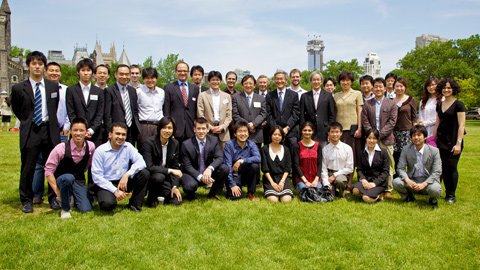
On June 9 and 10, 2011, the Faculty of Applied Science & Engineering hosted the 10th anniversary of UT², a graduate student conference held annually between the University of Tokyo and the University of Toronto.
The event provides graduate students and faculty members with opportunities to meet and discuss ideas with experts within their field and promotes international research collaboration and exchange.
The conference, which both participating universities alternate hosting, initially began in 2001 as a workshop for Materials Science & Engineering (MSE) students at both institutions but soon evolved into a Faculty-wide initiative. Graduate students and faculty members from the Department of Chemical Engineering & Applied Chemistry (ChemE) and the Department of Mechanical & Industrial Engineering (MIE) joined the conference in later years, with participants able to also independently organize exchanges throughout the year.
Eric Morris (ChemE PhD Candidate), a UT² Planning Committee Member, sees the annual event as invaluable experience for U of T Engineering. “This conference is a great way for graduate students to see how things are done at a different institution in a different country,” said Morris. “Not only does this help to broaden our horizons, but it also opens the door for new ideas and new collaborative research opportunities.” This year’s UT² Planning Committee Members also included Yuki Kuwauchi (MSE MASc Candidate), Leili Tafaghodikhajavi (MSE PhD Candidate) and Reza Rizvi (MechE PhD Candidate).
Professor Jun Nogami, Chair of the Department of Materials Science & Engineering, agrees. “Our relationship with Tokyo is a great opportunity to further our goals in internationalizing our research, our programs for graduate students, and eventually, our undergraduate students,” he said.
Cristina Amon, Dean of the Faculty of Applied Science & Engineering offered her thanks to the staff and faculty who organized this year’s and past UT² events. “Our engineers are often at the forefront of research and collaborations within, and outside, U of T. Congratulations to the faculty, staff and students who have made 10 years of excellent exchanges possible.”
City crews will be examining sections of the Gardiner Expressway after a 4.5-kilogram chunk of concrete fell onto Lake Shore Blvd. W. on Monday, hitting a guardrail and ricocheting into the road.
Aside from the dangers inherent in a chunk of concrete weighing almost as much as a bowling ball falling from the sky, the expressway itself is sound. This is according to Professor R. Doug Hooton (CivE), who provides expert comment.
To read the full story, visit the Toronto Star.
U of T proves that it’s once again ahead of the curve by hosting the launch of two major stem cell and regenerative medicine initiatives: the Ontario Stem Cell Initiative (OSCI) and the Centre for Commercialization of Regenerative Medicine (CCRM).
More than 400 attendees packed U of T’s MacLeod Auditorium for the announcements on June 14. The creation of the CCRM was made possible by the awarding of $15 million from the Government of Canada in December 2010, as part of its Centres of Excellence for Commercialization and Research (CECR) competition. OSCI received infrastructure grants of $25 million from the Canadian Foundation for Innovation (CFI) and the Ontario Research Fund (ORF).
Both organizations aim to enhance and support work in stem cell and regenerative medicine research within Ontario.
Professor Peter Zandstra (IBBME), the CCRM Chief Scientific Officer and OSCI Organizing Committee member, is proud and honoured by the role U of T – and U of T Engineering – played in creating both projects. “CCRM is built on the fundamental strengths in bioengineering and stem cell biology, [which has been] long supported by IBBME and the University of Toronto and its teaching hospitals. We are very excited to work with interested regenerative medicine researchers in Ontario to help them develop and commercialize their innovative discoveries.”
Stem cells and regenerative medicine-based therapies have the potential to alleviate suffering caused by some of the most debilitating diseases in the world, by bridging the gap between researchers and industry to ensure that innovations get from the labs to the hospitals.
The partnership between OSCI researchers and CCRM will be key in building towards breakthroughs in regenerative medicine, and translating these innovations into viable therapies.
The OSCI is a “virtual” network of 65 stem cell scientists in Ontario and represents an expansion of the Toronto Stem Cell Initiative.
For more information, visit the IBBME website.
Professor Barry Adams (CivE) has received the 2011 Camille Dagenais Award from the Canadian Society for Civil Engineering (CSCE), in recognition of his outstanding contributions to the development and practice of hydrotechnical engineering in Canada.
Barry Adams has served the Faculty with distinction as Chair of the Environmental Engineering program and Chair of the Department of Civil Engineering. He has supervised over 50 graduate students and published more than 100 papers and 50 technical reports in the field of water resources and urban infrastructure. Professor Adams is internationally recognized for his innovative research in the development of analytical probabilistic models for urban water resource infrastructure system planning and design. He wrote the first major textbook on this subject, published in 2000. Professor Adams is a Fellow of CSCE, the Engineering Institute of Canada, and the Canadian Academy of Engineering.
“I am delighted that Professor Adams has been recognized by the CSCE for his remarkable contributions to the profession” said Cristina Amon, Dean, Faculty of Applied Science & Engineering. “He is a world leader in his field and has served the professional community and the Faculty with genuine dedication.”
Professor Adams received this award at a ceremony on June 16, 2011 during the CSCE’s annual conference in Ottawa.
U of T Engineering received a record number of applications this year for the Class of 1T5. The Office of the Registrar counted 8,761 in all*, up from 7,881 in 2010, for the 1,150 spots available. The high number of applications reflects the Faculty’s commitment to an unparalleled undergraduate engineering education. It also reinforces its standing as a first-rank Faculty nationally and places it among the world’s leading research and teaching institutions.
Not only did more students apply to U of T Engineering this year, but the academic strength of the admitted group increased as well. The Faculty was able to select only the most promising students based on academic performance, student profile and extra-curricular involvement.
Meanwhile, U of T Engineering has continued to attract a diverse undergraduate class. The Class of 1T5 will have 313 women and 392 students from 56 countries around the world including Canadians living abroad.
“This year’s volume and strength of applicants prove U of T’s preeminence in engineering education,” said Cristina Amon, Dean of the Faculty of Applied Science & Engineering. “We are humbled by the extraordinary pool of applicants from all over the world and look forward to welcoming an exceptional first-year class this fall.”
*Figures as of June 17, 2011 — please note, these statistics are subject to change as the year progresses.