
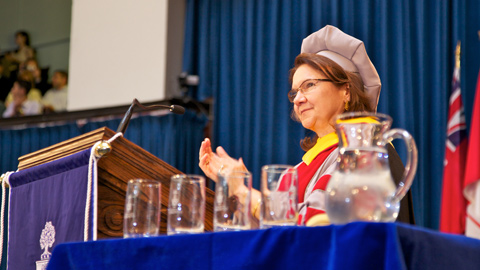
Graduates, we congratulate you — the innovative and dedicated Engineering students of Spring 2011. As you officially move on from the University of Toronto on Wednesday, June 15, we take pride in knowing that you, along with more than 41,000 Skule™ alumni before you, will now have the ability and imaginations that can make a difference in the world. We see you as future engineers who will forever be on the cutting edge — innovating, influencing and being always at the forefront. You will be leaders and champions of great change and profound ideas. We salute you. For parents, families, friends, spouses and partners, this day marks the fulfillment of years of anticipation, as your endless support has led you to here, now, together. Savour this upcoming moment, all of you. This spring, 866 undergraduates and 176 graduate students will be receiving degrees. Among you, 467 undergraduates completed the PEY program and 23 were in the ELITE graduate program. All faculty, staff and alumni take great pride in your remarkable collective achievement. At the 10 am ceremony, our Honorary Graduand will be Anne Sado (IndE 7T7), the President of George Brown College. At the 2:30 pm ceremony, we will similarly honour Dr. Bert Wasmund (ChemE PhD 6T6), a world-renowned metallurgist, Vice-President at Hatch. Following the ceremony, the celebration continues, as we look forward to joining you at the reception being held in the Great Hall in Hart House. On behalf of U of T Engineering faculty and staff, I congratulate you on your success; it is remarkable. Welcome to the Engineering profession. Cristina Amon, Dean Faculty of Applied Science & Engineering University of Toronto Convocation Stories Simon Kuany (MinE 1T0 + PEY) Great Global Contributors Anne Sado (IndE 7T7), President of George Brown College, June 15, 2011 at 10 am Bert Wasmund (ChemE PhD 6T6), Engineer and Inventor, June 15 at 2:30 pm Koh Yong Guan (MechE 7T0 MASc 7T2), High Commissioner of Singapore to Canada, June 6 at 2 pm
The University of Toronto Institute for Aerospace Studies (UTIAS) was featured in the latest issue of University Affairs Magazine for its contributions to the field of space exploration.
Forty-one years ago, four professors from (UTIAS) were contacted to help do the impossible: an explosion had crippled an Apollo 13 spacecraft and their expertise was needed to help bring the three astronauts stuck on board back to Earth.
Former professors, Phil Sullivan, Rod Tennyson, Irvine Glass, Barry French and Ben Etkin pooled their knowledge together and came up with a solution that allowed the Apollo 13 astronauts to safely return home. It’s moments like this that helped cement the Department’s reputation as one of the leaders in the space industry.
Since then, UTIAS has continued to play a pivotal role in the ever-changing space industry. One of the Canadarm pioneers was U of T Professor Peter Hughes, while Gabriele D’Eleuterio (UTIAS), worked with professor Hughes to develop some of the robotics for the International Space Station, work that professor D’Eleuterio and others continue to this day.
Today, UTIAS still remains a leader in space technology. The Autonomous Space Robotics Lab that tests space robotics technology which is used for NASA voyages to Mars and the moon, and a flight simulator which recreates situations in a helicopter or fixed-wing aircrafts are just a few of the technologies offered on campus.
Read more about the UTIAS and the exceptional work being done there in University Affairs’ latest issue.
Dr. Graeme Norval, Associate Chair and Undergraduate Coordinator in the Department of Chemical Engineering & Applied Chemistry, has received the Minerva Canada Education Award of Honour.
The award recognizes Dr. Norval’s contributions to advancing safety and health education in Canadian universities. He is the first engineering educator to receive the award. Minerva Canada is a not for profit corporation that seeks to advance safety management education in universities and colleges.
Dr. Norval has made numerous contributions to health and safety education in the Faculty, with the goal of instilling an appreciation for the importance of safety in young engineers. These include organizing and leading Minerva Summer Institutes, developing new health and safety teaching modules, involving other professors in safety education and highlighting health and safety in classes and student projects.
“I am delighted that Dr. Norval has been recognized by Minerva Canada for his contributions to health and safety education,” said Cristina Amon, Dean, Faculty of Applied Science & Engineering. “This award demonstrates another of the many ways our faculty members contribute to the profession and the community.”
Dr. Norval was presented with his award at Minerva’s 2011 Summer Institute dinner, held May 30th at the U of T Faculty Club. He will be inducted into the Minerva Canada Education Hall of Fame, which is being established this year.
In a recent article in The Globe and Mail, Professor Kim Pressnail (CivE) discusses his team’s latest study that shows affordable ways Canadians can reduce energy consumption and save money on their energy bills.
Some of his tips, which include insulating attics, sealing air leaks around baseboards and raising the thermostat on air conditioners to 24 degrees, could save households hundreds of dollars.

The Engineering Student Societies’ Council of Ontario (ESSCO) has elected its new President – U of T Engineering student Mauricio Curbelo (CivE 1T3).
The announcement was made at the organization’s Annual General Meeting, which took place at the University of Ontario Institute of Technology, from May 26-29.
“As President, I’ll be responsible for facilitating constructive dialogue between engineering-student governments in Ontario and working with member schools to establish the strategic direction of the organization.
I’ll also be representing 20,000 engineering students in Ontario to several student and professional organizations,” said Curbelo.
In addition to leading ESSCO, Curbelo has been an active member of the U of T Engineering community, as he is also the VP, External, of the Engineering Society.
“On behalf of the Faculty, I congratulate Mauricio on his new leadership role,” said Dean Cristina Amon, “We are very proud that one of our exceptional U of T Engineering students will be leading such a large and essential organization.”
ESSCO brings together 17 engineering student societies across Ontario, including U of T’s Engineering Society, to share best practices. It represents the province’s engineering students to the Council of Ontario Deans of Engineering and the Ontario Society of Professional Engineers, just to name a few.
Professor John Hadjigeorgiou (CivE), Director of the Lassonde Institute for Mining and Claudette MacKay Lassonde Chair in Mineral Engineering, was recently elected to the Council of the Canadian Institute of Mining, Metallurgy and Petroleum (CIM).
Professor Hadjigeorgiou was also elected as Chair of the Rock Engineering Society (RES) at its Annual General Meeting in Montreal on May 22, 2011.
Founded in 1898, CIM is the leading technical society of professionals in the Canadian minerals, metals, materials and energy industries. Its Rock Engineering Society, a constituent society of CIM since 1984, promotes the development and application of mining industry geomechanics to support safe and economically viable extraction.